
Your Compass to Care: Specialized Treatment Centers for Autism and Depression in Adults

Top Co-occurring Autism & Depression Centers: Hope 2025
The Overlooked Link Between Autism and Depression
Treatment centers for co-occurring autism and depression in adults are essential because autistic adults face depression at rates four times higher than the general population. Yet, finding care that truly understands this intersection remains frustratingly difficult.
Quick Answer: What to Look for in Treatment Centers:
- Neurodiversity-affirming approach: Staff who respect autism as an identity, not a disorder to fix.
- Dual expertise: Clinicians trained in both autism and mental health conditions.
- Modified therapies: Adapted CBT, DBT, and other evidence-based treatments for autistic communication and thinking patterns.
- Flexible formats: Virtual IOP, in-person PHP, or hybrid models to fit your life.
- Integrated treatment: Programs that address autism and depression simultaneously, not separately.
The challenge isn’t just the frequency of depression; it’s that depression looks different in autistic individuals. A therapist might miss it if they’re only looking for textbook sadness.
For many autistic adults, depression manifests as increased stimming, more frequent shutdowns, losing interest in special interests, or heightened sensory sensitivities. The constant exhaustion of masking autistic traits to fit in creates a recipe for severe, often unrecognized mental health struggles.
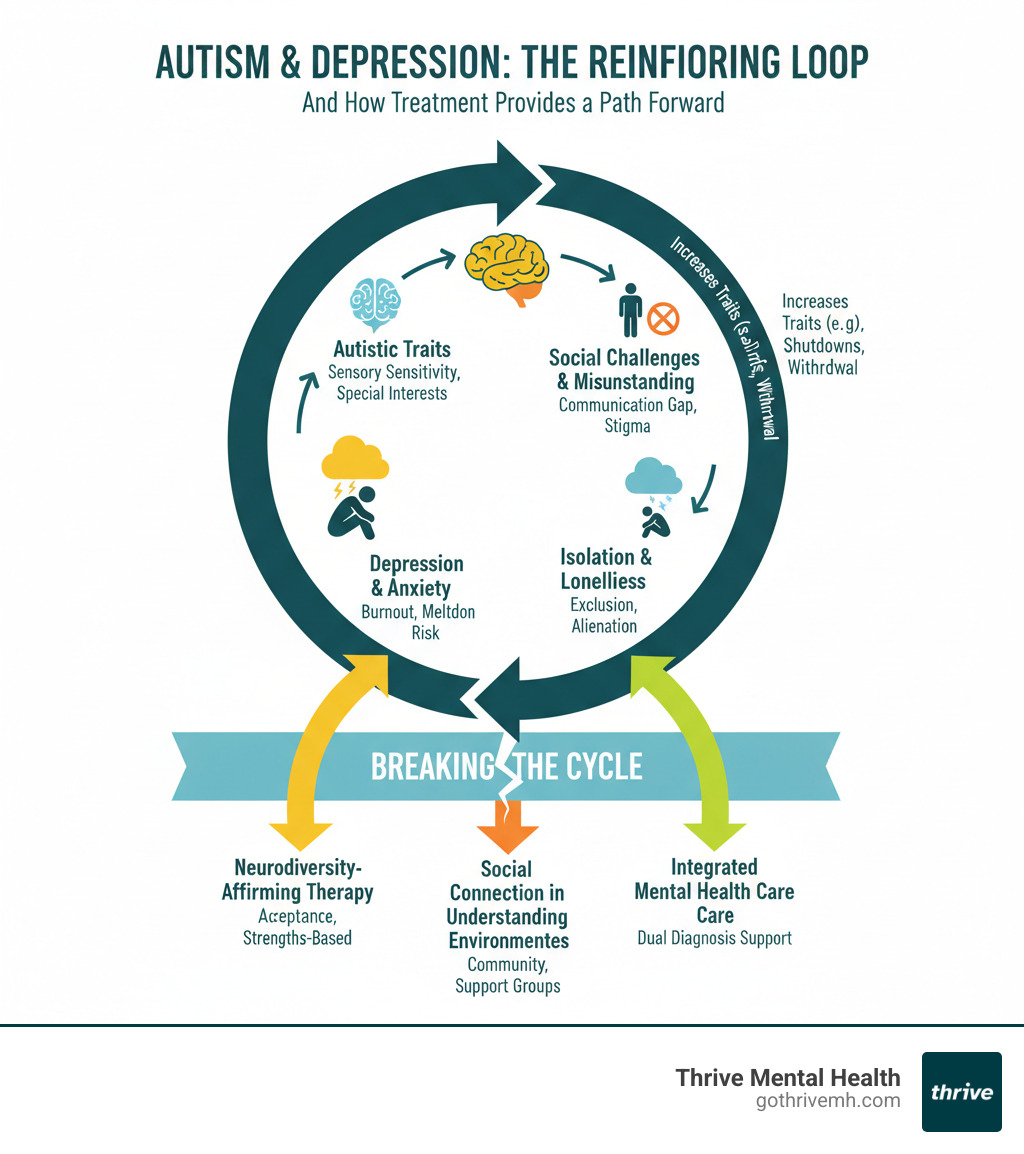
This leads to a painful cycle: social challenges cause isolation, which deepens depression, making connection even harder. Many providers lack autism training, leading to misdiagnosis or dismissing symptoms as “just part of autism”—a phenomenon called diagnostic overshadowing.
You deserve care that sees all of you. This guide, informed by my experience as Chief Clinical Officer at Thrive Mental Health, will walk you through what makes treatment effective, how to evaluate programs, and what questions to ask before committing to care.
Understanding the Unique Intersection: Why Depression in Autistic Adults is Different
When you’re autistic and depressed, you’re facing something most mental health providers don’t fully grasp. Research shows autistic people are four times more likely to develop depression, but the numbers don’t capture the lived reality of how these conditions intertwine.
This isn’t just about sadness. It’s about navigating a world not designed for your neurology. The exhausting process of masking—suppressing natural autistic traits like stimming or avoiding eye contact to fit neurotypical expectations—takes a significant toll. This can lead to autistic burnout, a state of profound exhaustion that is a major risk factor for depression.
Many autistic adults also experience alexithymia, or difficulty identifying and describing emotions. This creates a cruel paradox: you may be deeply depressed but unable to name the feeling, making it hard to seek help. Understanding Autistic People: Insights and Perspectives explores these unique challenges further.
Sensory overload makes everything worse. When you’re depressed, the sensory world can become unbearable. The hum of fluorescent lights or the texture of clothing can feel like an assault, deepening isolation and despair.
How Depression Manifests Differently in Autistic Adults
Depression in autistic adults often doesn’t fit the textbook description. Instead of classic sadness, you might notice:
- Intensified stimming: Repetitive movements like rocking or hand-flapping may increase as your brain seeks regulation.
- More frequent meltdowns and shutdowns: These nervous system responses to unbearable stress can become a daily occurrence as your coping threshold drops.
- Loss of interest in special interests: When the activities that once brought joy and comfort become meaningless, it’s a serious red flag.
- Heightened sensory sensitivities: Previously manageable sounds, lights, or textures become excruciating.
- Increased social withdrawal: A complete retreat from connection because everything feels like too much.
- Irritability: Depression can manifest as frustration, anger, or a short temper rather than sadness.
The Challenge of Diagnosis and “Diagnostic Overshadowing”
Getting an accurate diagnosis is difficult due to “diagnostic overshadowing,” where clinicians mistakenly attribute depressive symptoms to autism itself. The symptom overlap is a major issue—social withdrawal, flat affect, and communication differences can be features of both conditions. A clinician without deep autism expertise might see these signs and think, “that’s just how autistic people are,” missing the depression entirely.
This diagnostic failure has severe consequences. Unaddressed depression can be life-threatening, as research shows autistic adults face significantly higher rates of suicidal ideation—up to nine times higher than non-autistic populations. This is why finding treatment centers for co-occurring autism and depression in adults with genuine dual expertise is not just important; it’s potentially lifesaving.
Crisis Support: If you are having thoughts of suicide or self-harm, you are not alone. Please call or text the 988 Suicide and Crisis Lifeline at 988 or visit 988Lifeline.org to connect with a trained counselor.
You need clinicians who understand that autism and depression are distinct but interacting conditions. Choosing the Right Neurologist for Autism Diagnosis: A Comprehensive Guide discusses the importance of working with experienced professionals who won’t miss critical diagnoses.
Evidence-Based Treatments: What Actually Works for Co-Occurring Conditions
Effective treatment centers for co-occurring autism and depression in adults use an integrated approach. They address both conditions simultaneously, understanding that your autistic traits affect your depression and vice versa. This isn’t about “fixing” autism; it’s about treating depression while honoring and accommodating your autistic identity through personalized care.
The Role of Neurodiversity-Affirming Therapy
This approach views autism as a natural variation, not a disorder. The goal is to help you thrive as your authentic autistic self by managing depression.
-
Modified Cognitive Behavioral Therapy (CBT): Standard CBT is adapted for autistic adults. Research shows these adaptations are key. Modifications include using concrete language, visual aids, predictable session structures, and explicit instructions. At Thrive, we build these into our Cognitive Behavioral Therapy for Depression programs.
-
Dialectical Behavior Therapy (DBT): DBT offers powerful, structured tools for emotion regulation and distress tolerance. Its clear modules and specific techniques often resonate with autistic thinking styles, teaching concrete strategies for managing overwhelming emotions.
-
Social Skills Training: In a neurodiversity-affirming context, this isn’t about acting neurotypical. It’s about providing tools to steer social situations more comfortably, if you choose. The goal is to reduce anxiety and isolation, not change who you are. Our Autism and Depression Treatment integrates these elements thoughtfully.
Medication and Pharmacological Interventions
Medication like Selective Serotonin Reuptake Inhibitors (SSRIs) can be a valuable tool for managing severe depression. However, autistic individuals may metabolize medications differently and be more sensitive to side effects. A psychiatrist experienced with neurodivergent populations will start with low doses, increase slowly, and monitor you closely. Medication should support therapy, not replace it, and your prescriber should always take your concerns seriously.
Creating a Supportive Treatment Environment
Beyond therapy, the environment is crucial. A well-designed space reduces overwhelm and promotes healing.
- Low-sensory spaces: Soft lighting, quiet rooms, and minimal clutter reduce sensory drain.
- Clear, direct communication: Clinicians say what they mean, eliminating guesswork.
- Predictable routines: Knowing what to expect in each session reduces anxiety.
- Respect for autonomy: You are the expert on your experience. Decisions are made with you.
- Strength-based approaches: Treatment builds on your assets—like pattern recognition and authenticity—rather than focusing on deficits.
What to Look for in Treatment Centers for Co-occurring Autism and Depression in Adults
Choosing the right treatment center is a critical decision. Most general mental health services aren’t equipped to handle the intersection of autism and depression. You need a place that understands your neurodivergent identity while addressing your mental health struggles.

Key Qualities of an Effective Program
When evaluating centers, look for these non-negotiable qualities:
- Neurodiversity-Affirming Philosophy: The center must view autism as a valid human variation, not a disorder to be “fixed.” Their goal should be helping you thrive as an autistic person.
- Dual-Trained Staff: Clinicians must have specialized training and experience with autistic adults and co-occurring mental health conditions.
- Individualized Treatment Planning: Care plans should be developed collaboratively with you, custom to your specific goals, strengths, and challenges.
- Integrated Care Model: The program must treat autism and depression as interconnected. Therapy, medication management, and other services should be coordinated to address both simultaneously, as explored in our Autism and Depression Treatment approach.
- Expertise in Other Co-occurring Conditions: The center should be equipped to handle common co-occurring conditions like anxiety, ADHD, and OCD.
Finding In-Person vs. Virtual Treatment
Telehealth has transformed access to specialized care. You have options:
- In-Person Care (PHP/IOP): Offers a structured, dedicated healing space separate from home. It can be beneficial for those who thrive on physical routine and controlled social interaction. However, the travel and new sensory environment can be overwhelming for some.
- Virtual Care (PHP/IOP): Allows you to receive intensive, structured care from the comfort of your own home. Our Virtual IOP for neurodivergent individuals eliminates commutes and lets you control your sensory environment, which can make treatment more effective by reducing environmental stress.
Partial Hospitalization Programs (PHP) are full-day programs for maximum support, while Intensive Outpatient Programs (IOP) are half-day, offering more flexibility.
Key Questions to Ask Potential Treatment Centers
Before committing, ask these essential questions to see if a center truly understands your needs:
- What is your specific experience and training with autistic adults who have co-occurring depression?
- How do you adapt therapies like CBT or DBT for neurodivergent clients?
- Can you describe your neurodiversity-affirming philosophy and how it’s applied in treatment?
- How is family involved in the treatment process?
- What does a typical day or week in the program look like?
- How do you help foster authentic social connection among participants?
- What measures are in place to address sensory challenges in the treatment environment?
- What are your strategies for long-term recovery and relapse prevention?
- How will I have input on my treatment plan and goals?
- What is your approach to medication management for neurodivergent adults?
The right center will welcome these questions. A defensive or dismissive response is a major red flag.
Navigating Insurance and Care Options in Florida
Navigating the financial side of mental health care can be daunting, but understanding your insurance options makes it manageable. Specialized treatment centers for co-occurring autism and depression in adults are often covered by insurance.

Insurance Coverage for Specialized Treatment
Most private insurance plans, and some state Medicaid programs, cover a substantial portion of intensive outpatient (IOP) and partial hospitalization (PHP) programs. At Thrive Mental Health, we work with many major providers, including Cigna, Aetna, Optum (UnitedHealthcare), and Florida Blue, as well as other Blue Cross Blue Shield plans.
The key is to verify your benefits before starting. You’ll want to know if your plan covers IOP/PHP services, if pre-authorization is needed, and what your deductible or co-pay will be. At Thrive, we can verify your insurance in about 2 minutes with no obligation, so you know exactly what to expect.
Finding Local and Virtual Care in Florida
For residents across Florida, accessing expert care is more convenient than ever. Thrive Mental Health is dedicated to serving the Florida community with both virtual and in-person IOP and PHP programs.
We serve communities throughout the state, with dedicated services for areas including Tampa Bay, St. Petersburg, Miami, and Orlando.
Our Virtual IOP program allows you to participate in structured treatment from home, which is ideal for managing sensory sensitivities or transportation challenges. You no longer have to settle for care that doesn’t understand the intersection of autism and depression, whether you’re near one of our physical locations or elsewhere in Florida.
Frequently Asked Questions about Autism and Depression Treatment
How is depression different in autistic adults?
Depression in autistic adults often presents atypically. Instead of just sadness, look for signs like an increase in repetitive behaviors (stimming), more frequent meltdowns or shutdowns, losing interest in special interests, heightened sensory sensitivities, and increased irritability or social withdrawal. Many also have alexithymia, making it hard to identify and name their emotions.
Can you treat autism and depression at the same time?
Yes, and it is the most effective approach. Integrated treatment addresses the depression while understanding and accommodating the needs of an autistic person. The goal is not to “treat” autism, but to manage depression in a way that respects your neurotype. Our Autism and Depression Treatment program is built on this holistic model.
What is the best therapy for co-occurring autism and depression?
Modified Cognitive Behavioral Therapy (CBT) and Dialectical Behavior Therapy (DBT) are two of the most effective, evidence-based options. The key is that these therapies must be “modified” for autistic individuals—using concrete language, visual aids, and predictable structures. The most important factor is a neurodiversity-affirming stance, where the therapist respects your autistic identity as a valid difference, not a deficit.
Your Path Forward: Finding Hope and Healing in Florida
Living with co-occurring autism and depression can feel incredibly isolating, but you are not alone. Effective, specialized treatment exists, and finding it is a courageous act of self-advocacy.
Effective treatment centers for co-occurring autism and depression in adults use a neurodiversity-affirming approach. They offer modified therapies that work with your brain, not against it, in environments designed to reduce overwhelm. You deserve clinicians who won’t dismiss your struggles as “just part of autism” and who see your strengths as clearly as your challenges.
At Thrive Mental Health, this integrated, individualized approach is the foundation of our care for adults across Florida. Healing doesn’t mean becoming less autistic; it means thriving as your authentic self, free from the weight of untreated depression.
If you are in Florida and ready for support, Thrive offers virtual and in-person IOP/PHP with evening options. Verify your insurance in 2 minutes (no obligation) or call 561-203-6085. If you’re in crisis, call/text 988.