
Therapist Hunting Made Easy with United Healthcare’s Directory

Why Finding the Right Therapist Through United Healthcare Can Transform Your Mental Health Journey
Finding mental health support shouldn’t be a maze. The United Healthcare therapist directory connects you with qualified professionals who accept your insurance, and knowing how to use it effectively makes all the difference.
Quick Answer for United Healthcare Members:
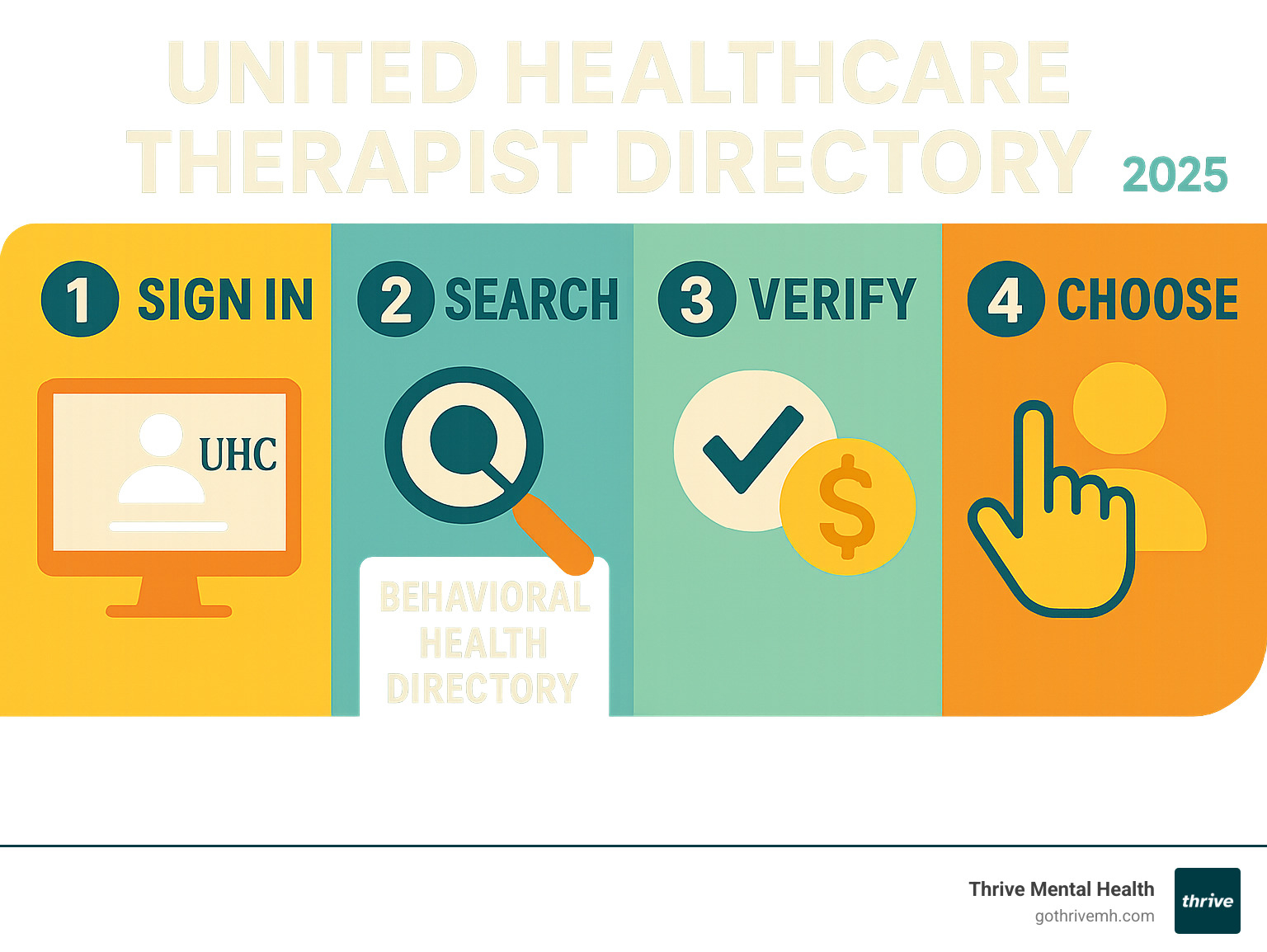
- Sign in to your member account at myuhc.com for personalized results
- Search the Behavioral Health Directory with filters for specialty and location
- Verify your specific benefits and coverage details
- Choose a provider and schedule your first appointment
The process is straightforward. UHC’s network includes over 1.7 million professionals, giving you access to extensive mental health resources, from individual therapy to intensive outpatient programs.
For those seeking immediate access: Most UHC plans offer $0-$50 copays for in-network therapy sessions, and many cover telehealth options for added convenience.
As Nate Raine, CEO of Thrive Mental Health, I’ve helped countless individuals steer insurance to access quality care. My experience shows that the right tools, like the United Healthcare therapist directory, can eliminate barriers to the mental health support you need.
Navigating the United Healthcare Therapist Directory: A Step-by-Step Guide
Finding a mental health provider through UnitedHealthcare doesn’t have to be overwhelming. The United Healthcare therapist directory is designed to simplify your search. Whether you’re dealing with anxiety, depression, or other challenges, UHC’s online tools make finding support straightforward.

Your journey starts at the main provider search page: Find a doctor, dentist or provider | UnitedHealthcare. From here, you’ll find that UnitedHealthcare has built their directory to work for everyone – whether you’re already a member or still exploring your options.
Member vs. Guest Search: What’s the Difference?
When you visit the provider search page, you’ll see two options: a member search and a guest search.
Member Provider Search is the recommended path. When you’re a current UnitedHealthcare member, we strongly recommend you sign in to your member account for the most accurate, plan-specific provider list. Your UHC plan has specific plan details determining which providers are in-network. Signing in tailors the directory to show only therapists who accept your specific plan, helping you avoid coverage issues.
Guest Provider Search is for those shopping for plans or who can’t access their member account. This option lets you browse the general network by choosing a plan type. It’s perfect for general browsing, but for starting therapy, the personalized member list is essential.
Using the Online United Healthcare Therapist Directory as a Member
Once signed in, use the United Healthcare therapist directory effectively with these steps:
Start with the Behavioral Health Directory. UHC has a dedicated space for mental health providers. Look for the “Behavioral Health” or “Mental Health” section, or go directly to Find mental health/behavioral health providers.
Use the search filters. The directory offers several ways to narrow your search. Location filters help you find therapists nearby. Provider specialties are crucial; you can search for therapists who specialize in anxiety, depression, trauma, or other issues. Provider credentials let you specify whether you’re looking for a psychiatrist, psychologist, or counselor. Use practical filters like gender and language preferences to find a provider you’ll be comfortable with.
Review provider profiles. Each provider’s profile includes their contact information, specialties, credentials, and whether they’re accepting new patients. Pay close attention to their availability to avoid finding a perfect match with a long waiting list.
Before your first appointment, call the provider’s office to confirm they accept your specific UnitedHealthcare plan. This quick step prevents future billing issues.
Finding a Therapist on the Go with the UHC App
UnitedHealthcare makes its provider directory mobile-friendly through a dedicated app, understanding that many people manage their lives on their phones.
The UHC app brings the same powerful search tools to your smartphone with added convenience. You can Get the app from your phone’s app store and have the entire United Healthcare therapist directory in your pocket.
The app’s integration with your member ID cards and plan details is particularly useful. You can search for therapists, save profiles, and have your digital insurance card ready when you call to schedule an appointment. This mobile access means you can plan your mental health care whenever and wherever it’s convenient for you.
Understanding Your UHC Mental Health Coverage
Understanding insurance can feel like solving a puzzle, but UnitedHealthcare’s mental health coverage is comprehensive. Once you know the basics, you can confidently get the care you need.

For more detailed information about how insurance can support your mental health journey, check out our resources on Insurance Coverage for Mental Health Services.
Does UnitedHealthcare Cover Mental Health Services?
Yes, absolutely. Thanks to the Mental Health Parity and Addiction Equity Act (MHPAEA), insurers must cover mental health care at the same level as physical health care. This means your benefits for anxiety treatment should be equivalent to those for a broken arm.
UnitedHealthcare’s behavioral health benefits cover a wide range of services, from individual therapy sessions to substance use treatment. They have dedicated resources and programs designed to support your mental health journey. You can explore their full range of offerings at Mental health programs | Member resources | UnitedHealthcare.
Decoding the Costs: Copays, Coinsurance, and Deductibles
When using your UHC benefits for therapy, you’ll encounter three main cost terms:
- Copays: A fixed amount you pay for each session with an in-network therapist. With UHC, this typically ranges from $0 to $50 per session, making costs predictable.
- Coinsurance: Your share of the cost, expressed as a percentage (e.g., 20% of the total bill), which you pay after meeting your deductible.
- Deductibles: The amount you must pay out-of-pocket for care before your insurance begins to pay. For example, with a $1,000 deductible, you pay the first $1,000 of costs.
Many UHC plans allow you to pay your copay for therapy even before meeting your deductible, but plans vary. Always check your specific benefits. For a deeper dive, our guide Aetna or UnitedHealthcare: Which is Better for You? offers helpful insights.
Are Specific Types of Therapy Covered?
UnitedHealthcare covers a wide range of mental health services:
- Individual therapy is the standard one-on-one session and is covered by nearly all plans when medically necessary.
- Online therapy is widely accepted by UHC, with virtual sessions typically covered just like in-person visits. At Thrive Mental Health, we’ve seen how effective Online Mental Health Care can be.
- Group therapy is often covered and can be a powerful, cost-effective way to connect with others.
- Couples counseling coverage is often complex. It’s typically not covered unless one partner has a mental health diagnosis that the therapy aims to treat.
- Intensive Outpatient Programs (IOP) and Partial Hospitalization Programs (PHP) are often covered for those needing more support than weekly therapy. At Thrive Mental Health, we work with UHC to ensure our programs are accessible. Learn more at Virtual IOP Insurance Coverage.
How to Verify Your Specific UHC Benefits
The most important advice is to always verify your specific benefits before starting therapy. The easiest way is to sign in to your member account and review your Summary of Benefits and Coverage. This document outlines exactly what’s covered and what you’ll pay.
Alternatively, call the member services number on the back of your UHC ID card. A representative can answer specific questions about your coverage and costs.
Choosing the Right Mental Health Professional for You
After understanding your UHC benefits, the next step is selecting a mental health professional. This is a personal choice, and finding a provider who makes you feel comfortable is paramount.

For a deeper dive into making this crucial decision, we’ve prepared a comprehensive Guide to Finding Your Ideal Behavioral Health Therapist.
Do I Need a Referral to See a Therapist?
Whether you need a referral from your primary care physician (PCP) depends on your plan type.
- HMO (Health Maintenance Organization) plans generally require a referral from your PCP to see a mental health specialist. Without it, services may not be covered.
- PPO (Preferred Provider Organization) plans offer more flexibility, typically not requiring a referral to see an in-network specialist.
The golden rule is to always check your specific plan’s requirements by reviewing your benefits summary or calling member services. You can learn more about referrals in this UHC user guide.
Types of Mental Health Professionals in the UHC Network
Understanding the different types of mental health professionals can help you choose the best fit for your needs.
- Psychiatrists (MD): Medical doctors who diagnose conditions, prescribe medication, and provide therapy. See a psychiatrist if you think you may need medication.
- Psychologists (PhD/PsyD): Hold doctoral degrees and specialize in psychotherapy and psychological testing. They typically do not prescribe medication.
- Licensed Clinical Social Workers (LCSW): Hold a master’s degree and provide therapy, often focusing on the connection between mental health and social environments.
- Licensed Professional Counselors (LPC/LMHC): Hold a master’s degree and use various counseling tools to help with emotional, mental, and behavioral issues.
- Licensed Marriage and Family Therapists (LMFT): Specialize in relationship and family dynamics, helping individuals and families steer complex interpersonal issues.
For a deeper dive into the types of therapy they offer, explore our article on Understanding the Different Types of Mental Health Therapy.
Key Considerations When Selecting a Provider
Beyond credentials, several key factors can impact your therapeutic experience.
- Therapeutic approach: Research approaches like CBT, DBT, or EMDR to find one that resonates with your goals.
- Provider specialties: Look for a therapist with expertise in the specific issues you’re facing, such as anxiety, trauma, or addiction.
- Personal comfort: A good therapeutic relationship, built on trust, is vital for effective treatment. Schedule initial consultations to gauge your comfort level.
- Telehealth options: If convenience is a priority, confirm if the therapist offers online therapy sessions.
- Location: For in-person therapy, consider the office’s location and accessibility to make getting there stress-free.
Choosing a mental health professional is a significant decision. For more guidance, read our article on Key Considerations in Choosing a Mental Healthcare Provider.
Recognizing the Need for Support and Finding Immediate Help
Recognizing when you need support for challenges like persistent sadness, anxiety, or relationship struggles is a sign of strength. Mental health challenges can affect anyone, and what matters is recognizing when they interfere with your daily life and taking the step to get help.

Professional support can be transformative, helping you develop coping skills and improve your well-being. To learn more, explore The Benefits of Utilizing Mental Health Services.
Signs It Might Be Time to Seek Mental Health Support
Your mind and body send signals when something isn’t right. Pay attention to these signs:
- Persistent sadness or anxiety that lasts for weeks.
- Changes in sleep or appetite, including significant weight changes.
- Loss of interest in activities you once enjoyed.
- Excessive worry or fear that interferes with daily life.
- Difficulty concentrating or making decisions.
- Social withdrawal from friends and family.
- Irritability or unexplained anger.
- Increased use of substances to cope with emotions.
- Unexplained physical aches and pains.
- Thoughts of self-harm or harming others, which require immediate attention.
If you experience these signs, reaching out for help is a brave and necessary step. You can check out mentalhealth.gov to view a longer list of mental health concerns and get additional guidance.
Crisis and Emergency Care: Where to Turn for Immediate Help
If you or someone you know is in crisis or immediate danger, knowing where to turn is critical.
- If you’re experiencing suicidal thoughts or a mental health crisis, call or text 988 anytime. The 988 Suicide & Crisis Lifeline connects you with trained crisis counselors 24/7 for free, confidential support. Learn about the 988 Lifeline to understand how this vital resource works.
- For immediate, life-threatening situations, call 911 for emergency medical services.
- For domestic violence support, call the National Domestic Violence Hotline at 1-800-799-SAFE (7233) or text ‘START’ to 88788.
- For mental health or substance use referrals, call the SAMHSA National Helpline at 1-800-662-HELP (4357) for 24/7, free, and confidential information.
Reaching out for help during a crisis takes courage. You are not alone, and there are people trained to support you.
Frequently Asked Questions about Finding a UHC Therapist
As you steer finding mental health support through UnitedHealthcare, it’s natural to have questions. Here are answers to common concerns.
How much does therapy typically cost with an in-network United Healthcare therapist?
The cost of therapy with UHC varies by plan, but in-network care is often affordable. After meeting your annual deductible, you typically pay a copay for each session, which can range from $0 to $50. If your deductible isn’t met, you may pay the full session fee until it is. Always verify costs with your specific plan by calling the number on your member ID card to avoid surprises.
What’s the best way to confirm a therapist is in my UHC network?
Confirming a therapist is in your UHC network is crucial to avoid unexpected costs. The most reliable method is to use the myuhc.com portal, which is customized to your specific plan’s network. This eliminates the guesswork of general searches.
You can also call the member services number on your ID card to provide the therapist’s name and confirm their status. We recommend confirming coverage with both your insurance and the therapist’s office before your first appointment.
Does United Healthcare cover online therapy?
Yes, most UnitedHealthcare plans cover online therapy, offering a convenient and effective way to receive care. Online therapy (telehealth) typically has the same cost structure as in-person sessions, with the same copay or coinsurance. This makes it a convenient and cost-effective option.
You can sign in to your member account to learn about the specific telehealth benefits available with your plan. The quality of online therapy has been proven to be just as effective as in-person sessions for many mental health conditions.
Conclusion: Take the Next Step on Your Mental Health Journey
Finding the right mental health support doesn’t have to be overwhelming. This guide has shown you how to use the United Healthcare therapist directory, understand your coverage, and choose a provider. Your mental health journey is personal, and you deserve to feel empowered. With UHC’s network and the tools in this guide, you can find quality, in-network care.
Remember the key steps: Sign into your member portal, use the behavioral health directory with filters, verify your benefits, and choose a provider who makes you feel understood.
For those needing more than weekly therapy, structured programs like virtual Intensive Outpatient Programs (IOP) and Partial Hospitalization Programs (PHP) offer comprehensive care. Thrive Mental Health specializes in these flexible, evidence-based programs. Our team works directly with UnitedHealthcare to make our programs accessible and affordable. We handle the insurance verification process to maximize your benefits.
Your mental health matters. Taking the step to seek support shows incredible strength. Whether you’re dealing with anxiety, depression, or other life challenges, the right professional support can help you develop coping skills and improve your well-being.
The path forward is clearer. You have the tools and resources to find the support you deserve through your UHC plan.
Ready to explore your options further? Learn more about Navigating Mental Health Support with Aetna and UnitedHealthcare to find additional insights that can support your mental health journey.