
Virtual CBT Explained: Changing Thoughts, Not Your Schedule

If Youre in Crisis, Call/Text 988 Now
If youre in crisis, call/text 988 right now. You are not alone.
Virtual Cognitive Behavioral Therapy [2025]: 8 12 Sessions, No Commute, Often $0 CopayStart Now or Stay Stuck
Get Effective Mental Health Support—Without Leaving Home
Life is busy. Between work, family, and just keeping it together, adding therapy appointments can feel impossible. What if you could get proven mental health support without the commute, waiting room, or schedule gymnastics?
That’s what virtual cognitive behavioral therapy offers. It’s not a watered-down version of “real” therapy; it’s the same evidence-based treatment that has helped millions, delivered in a way that fits your life.
With virtual cognitive behavioral therapy, you’ll work with a licensed therapist via secure video, phone, or messaging to spot and change unhelpful thought patterns that fuel anxiety, depression, and stress. The approach is structured and goal-focused—you’re not just talking about problems, you’re building skills to solve them.
CBT helps people with anxiety, depression, PTSD, OCD, insomnia, and more. Research shows that 60–80% of people see significant improvement, and multiple studies confirm virtual CBT is just as effective as in-person therapy. Most people benefit from 8–12 weekly sessions, and many insurance plans (including Cigna, Optum, and Florida Blue) cover it. Sessions typically start at $69/week, making quality care accessible.
Whether you’re in Indiana, California, Florida, or beyond, you can connect with a therapist who gets it—without leaving your couch. No more rushing through traffic or scrambling for childcare. Just you, your therapist, and a real path forward.
I’m Anna Green, LMHC, LPC, and Chief Clinical Officer at Thrive Mental Health. I founded Thrive because I’ve seen too many people put off getting help because traditional therapy didn’t fit their reality. My goal is to make high-quality care easier to start, stick with, and afford—so you can show up for yourself without rearranging your life.
If you’ve been putting off therapy because you’re too busy or tired to add one more thing to your plate, virtual CBT might be the solution. Ready to see how it works? Let’s walk through it together.
If you need more intensive support, Thrive also offers virtual IOP and behavioral health IOP programs, including specialized care for conditions like eating disorders through our eating disorder virtual IOP.
What Is Cognitive Behavioral Therapy (CBT) and How Does It Work?
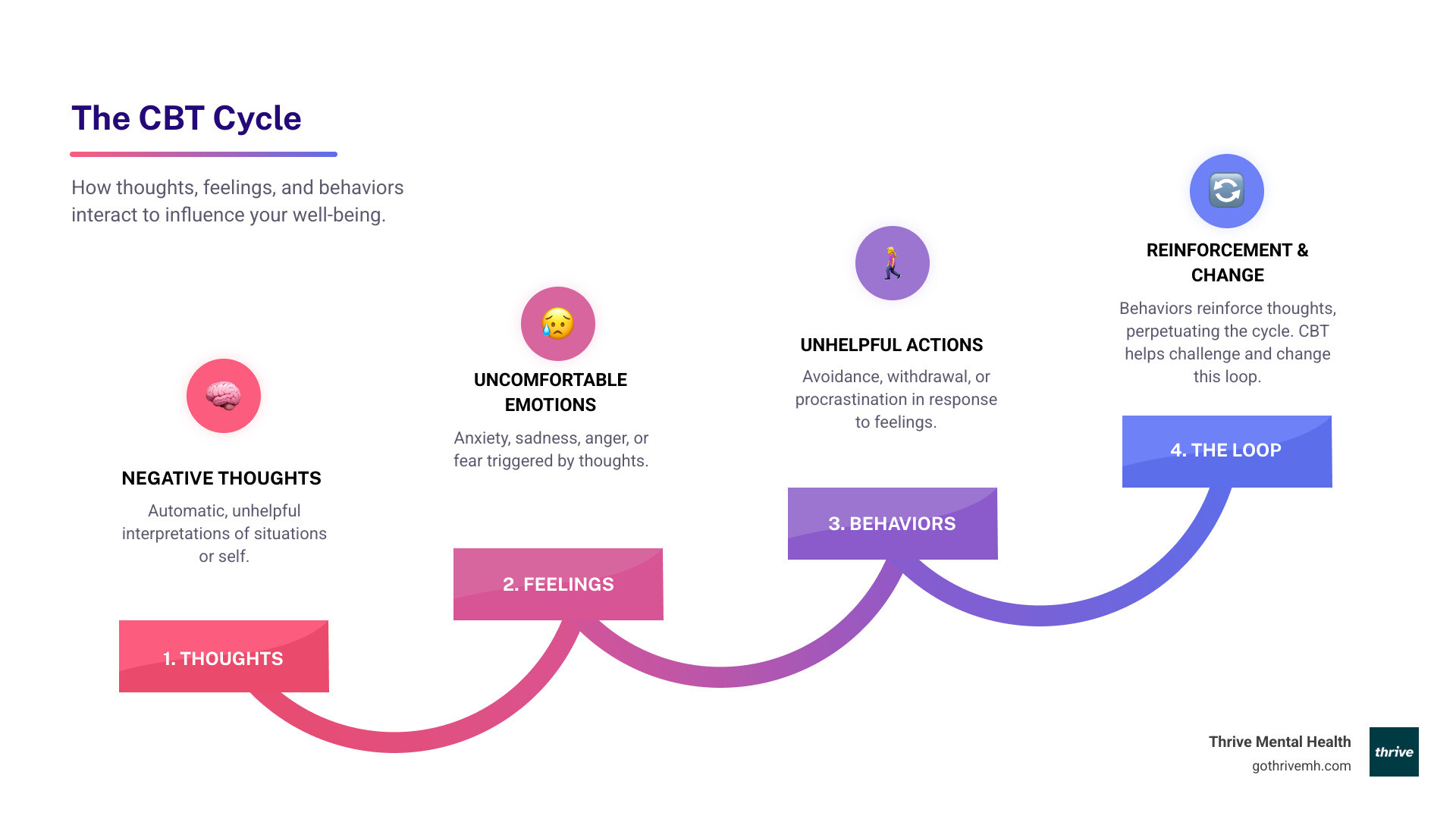
Cognitive Behavioral Therapy (CBT) is built on a straightforward but powerful idea: change your thoughts, and you change your life. Developed by psychiatrist Aaron T. Beck, CBT focuses on the connection between what you think, how you feel, and what you do. It’s not about dwelling on the past—it’s about giving you practical tools to manage what’s happening right now.
The core principle is that your thoughts shape your emotions and behaviors. When you think “I’m going to mess this up,” you feel anxious, which might make you avoid the situation, reinforcing the original thought. CBT helps you spot these patterns and break free.
CBT is goal-focused and short-term, typically lasting 8 to 12 sessions. You’re not committing to years of therapy. Instead, you and your therapist work together to set clear goals and build strategies that fit your daily routine.
If you’re new to this approach, A Beginner’s Guide to CBT walks through the fundamentals in more detail.
Core CBT Techniques You’ll Use
In virtual cognitive behavioral therapy, you’ll learn practical skills you can use right away to become your own best therapist.
- Cognitive restructuring (or reframing) teaches you to catch, challenge, and replace negative thoughts with more balanced perspectives.
- Behavioral activation gets you moving again by scheduling and engaging in positive activities, even when you lack motivation.
- Exposure therapy helps you gradually face feared situations in a safe, controlled way, which is particularly helpful for anxiety and phobias.
- Journaling helps you track patterns in your thoughts and feelings, providing a space to practice new skills between sessions.
- Problem-solving skills teach you to break overwhelming challenges into smaller, manageable steps.
- Mindfulness and relaxation techniques like deep breathing help you manage stress and stay grounded in the present.
You’ll practice these skills between sessions—that’s where the real change happens. We provide resources like CBT Worksheets & Exercises to support your work outside of therapy. The more you practice, the more natural these tools become.
How Virtual CBT Works: Therapy That Fits Your Life
Virtual cognitive behavioral therapy brings expert mental health care directly to you. It’s the same evidence-based CBT, just delivered remotely through secure digital platforms—no driving across town or rearranging your day.
How are sessions delivered? You have options. Most people connect through secure video calls, but phone sessions and messaging or chat therapy are also available. Every platform we use is HIPAA-compliant, meaning your health information is protected with the same strict privacy standards as a doctor’s office.

Virtual vs. In-Person CBT: What’s the Difference?
The therapy itself is identical. What changes is how you access it, which makes all the difference for many people.
| Feature | Virtual CBT | In-Person CBT |
|---|---|---|
| Accessibility | From anywhere with an internet connection (e.g., Indiana, California, Florida, Arizona) | Limited by therapist location and transportation |
| Convenience | Flexible scheduling, no commute, fits into busy daily life | Requires travel time, fixed appointments |
| Comfort/Privacy | From your own home or preferred private space | Office setting, potential for waiting room encounters |
| Cost | Often more affordable due to lower overhead | Generally higher cost, potential for travel expenses |
| Scheduling | Easier to fit around work/family; messaging options | Typically weekly, fixed time slots |
| Non-Verbal Cues | May be reduced in video/phone calls (though still present) | Full range of non-verbal communication |
| Geographic Reach | Access to specialists nationwide (or worldwide, depending on licensing) | Limited to local therapists |
| Adherence | Research suggests higher adherence rates for some | Can be impacted by logistical barriers |
The key benefits of virtual CBT are accessibility, convenience, and cost-effectiveness. It removes geographic barriers, especially for those in rural areas of Indiana or California, and fits into busy schedules. Many people find they are more open and consistent with therapy when they can do it from the comfort of home. Our therapists are trained to build strong connections virtually, so you don’t sacrifice quality for convenience.
What to Watch Out For with Virtual CBT
Virtual cognitive behavioral therapy is highly effective, but it’s good to be aware of a few things.
- Tech Issues: Your internet might drop or your device could freeze. Test your setup beforehand and have a backup plan, like switching to your phone.
- Fewer Non-Verbal Cues: While some cues can be missed on calls, skilled therapists are trained to pick up on tone and ask clarifying questions. Video sessions capture most of what in-person therapy offers.
- Not for Crisis Situations: This is critical. Virtual CBT is not for acute crises. If you are in immediate danger or having suicidal thoughts, call or text 988 immediately.
- Self-Discipline: The flexibility of virtual therapy means you need to be accountable for showing up to sessions and doing the work in between.
- Find a Private Space: You’ll need a quiet, confidential spot where you can speak freely without interruptions.
Does Virtual CBT Really Work? What the Research Shows
If you’re considering virtual cognitive behavioral therapy, you probably want to know if it actually works. The good news: the research is overwhelmingly positive.
Multiple studies and meta-analyses confirm that virtual CBT is just as effective as in-person therapy for most conditions, including anxiety and depression. A 2017 systematic review found it to be both effective and cost-efficient. Encouragingly, some research also shows higher adherence to treatment with virtual CBT. When therapy is easier to attend, people stick with it more consistently, which drives results.
The numbers speak for themselves: about 60% to 80% of people with anxiety and depression benefit from CBT. Many start feeling better in as little as 6 sessions, with a typical course of treatment being 8 to 12 weekly sessions. Your engagement in the process—practicing skills between sessions—is key to success.
This isn’t second-rate care. It’s the same evidence-based treatment, delivered in a format that removes barriers. For a comprehensive look, explore How CBT Can Transform Your Mental Health.
What Conditions Can Virtual CBT Treat?
Virtual cognitive behavioral therapy is remarkably versatile, effective for a wide range of mental health challenges.

- Anxiety Disorders: Excellent for GAD, social anxiety, and panic disorder by helping you challenge irrational fears.
- Depression: Lifts symptoms by addressing negative thought patterns and increasing engagement in positive activities.
- Post-Traumatic Stress Disorder (PTSD): Helps you process traumatic memories and develop healthier coping strategies from a safe space.
- Obsessive-Compulsive Disorder (OCD): Uses a specialized technique (ERP) to help you manage intrusive thoughts and resist compulsions.
- Stress Management: Provides practical tools to identify stressors and develop healthier coping mechanisms. Dive deeper into CBT for Stress Management.
- Insomnia: CBT for Insomnia (CBT-I) is the gold standard treatment, changing sleep-related thoughts and behaviors without medication.
- Phobias: Helps you gradually face fears like flying or public speaking in a controlled way, sometimes using virtual reality (VR).
Virtual CBT is also beneficial for body image issues, chronic worry, low self-esteem, and professional burnout. If something is holding you back from the life you want, there’s a good chance it can help.
How to Start Virtual CBT: Step-by-Step
Starting your journey with virtual cognitive behavioral therapy is a simple, streamlined process designed to get you support quickly.
The most important steps are choosing a licensed provider, ensuring the platform is HIPAA-compliant and secure, and committing to therapist-guided care. While self-help resources exist, working with a trained therapist provides the personalized support and accountability needed for the best results. At Thrive, our therapists are fully licensed and use secure platforms to guide you. For a deeper look, visit our Virtual Therapy Services page.
Cost, Insurance, and Local Access
We strive to make virtual cognitive behavioral therapy affordable and accessible.
- Cost: Virtual CBT is often more affordable, with plans at Thrive starting from $69/week.
- Insurance: We are in-network with many major plans, including Cigna, Optum, and Florida Blue. Many insured members have a $0 copay.
- Locations: We serve residents across Indiana, California, Florida, Arizona, and South Carolina.
To understand your specific coverage, you can Verify Your Insurance in just a few minutes. For our Florida residents, learn more at Telehealth Counseling Florida.
How to Prepare for Your First Virtual CBT Session
A little preparation can help you make the most of your first session.

- Set Clear Goals: Before your session, think about what you hope to achieve.
- Find a Private Space: Choose a quiet, confidential spot where you won’t be interrupted.
- Test Your Tech: Check your internet connection, camera, and microphone beforehand to avoid stress.
- Be Open and Honest: Therapy is a team effort. Your honesty helps your therapist tailor the treatment to your needs.
- What to Expect: Your first session will focus on your goals and background. It’s a collaborative, practical approach designed to empower you with lasting skills.
Frequently Asked Questions About Virtual CBT
Is virtual cognitive behavioral therapy as effective as in-person?
Yes. Studies show virtual CBT delivers outcomes comparable to in-person for anxiety, depression, OCD, PTSD, and more.
How much does virtual CBT cost, and is it covered by insurance?
Plans can start around $69/week. Many insurersincluding Cigna, Optum, and Florida Bluecover virtual CBT similar to in-person. Copays can be as low as $0 depending on your plan.
How many sessions do I need to see results?
Many people feel improvement by 6 sessions. A typical course runs 8 12 weekly sessions.
Is virtual CBT available in Indiana and California?
Yes. Thrive offers licensed virtual care in Indiana and California (and select other states). You can attend from anywhere within those states.
What if Im in crisis or having suicidal thoughts?
Virtual CBT isnt for emergencies. Call or text 988 now. You are not alone.
Suggested FAQPage JSON-LD (add to your page head or body):
Summary: Virtual CBT—Change Your Thoughts, Change Your Life (No Commute Required)
Virtual cognitive behavioral therapy brings the proven power of CBT directly to you, wherever you are. It helps you change the unhelpful thought patterns that fuel anxiety, depression, and stress—without the commute or waiting room.
Research confirms virtual CBT is just as effective as in-person therapy for conditions like anxiety, depression, PTSD, and OCD, with 60–80% of people seeing significant improvement. Its effectiveness comes from a combination of accessibility, flexibility, and affordability. You can schedule sessions around your life, attend from home, and often pay less than traditional therapy. Many insurance plans, including Cigna, Optum, and Florida Blue, provide coverage.
While it requires a private space and self-discipline, the payoff is expert-led, evidence-based care custom to your needs. Whether you’re in Indiana, California, Florida, or beyond, Thrive Mental Health’s licensed therapists are ready to help you build the skills to change your life. It’s therapy that works, on your terms.
Ready for Support? Take the First Step Now
You’ve learned how virtual cognitive behavioral therapy works, what it treats, and why it’s just as effective as in-person care. Now comes the most important part: actually starting.
At Thrive Mental Health, we offer virtual and hybrid Intensive Outpatient Programs (IOP) and Partial Hospitalization Programs (PHP) designed for adults and young professionals who need more than weekly therapy but don’t require inpatient care. Our programs include evening options, so you can get the support you need without putting your job or responsibilities on hold.
Whether you’re struggling with anxiety, depression, trauma, or another mental health challenge, our evidence-based programsincluding virtual cognitive behavioral therapyare built around your life, not the other way around.
Here’s how to get started:
We can verify your insurance benefits in about 2 minutes, with no obligation. Many of our clients find they’re covered with little to no out-of-pocket cost. Start your benefits check at gothrivemh.com/virtual-intensive-outpatient-programs. Our team is here to answer your questions and help you understand your options.
You don’t have to figure this out alone. Taking the first step is often the hardest part, but it’s also the most important. You deserve support that actually fits your lifeand we’re here to provide it.
If you’re in crisis right now, please call or text 988 immediately. Help is available 24/7, and you are not alone.
Ready for support? Thrive offers virtual and hybrid IOP/PHP with evening options. Verify your insurance in 2 minutes (no obligation) Start benefits check or call 561-203-6085. If youre in crisis, call/text 988.