
5 Smart Strategies for Finding Mental Health Services for Tech Innovators

What Are the Best Mental Health Services for Technology Innovators? [Burnout Fixes That Actually Work]
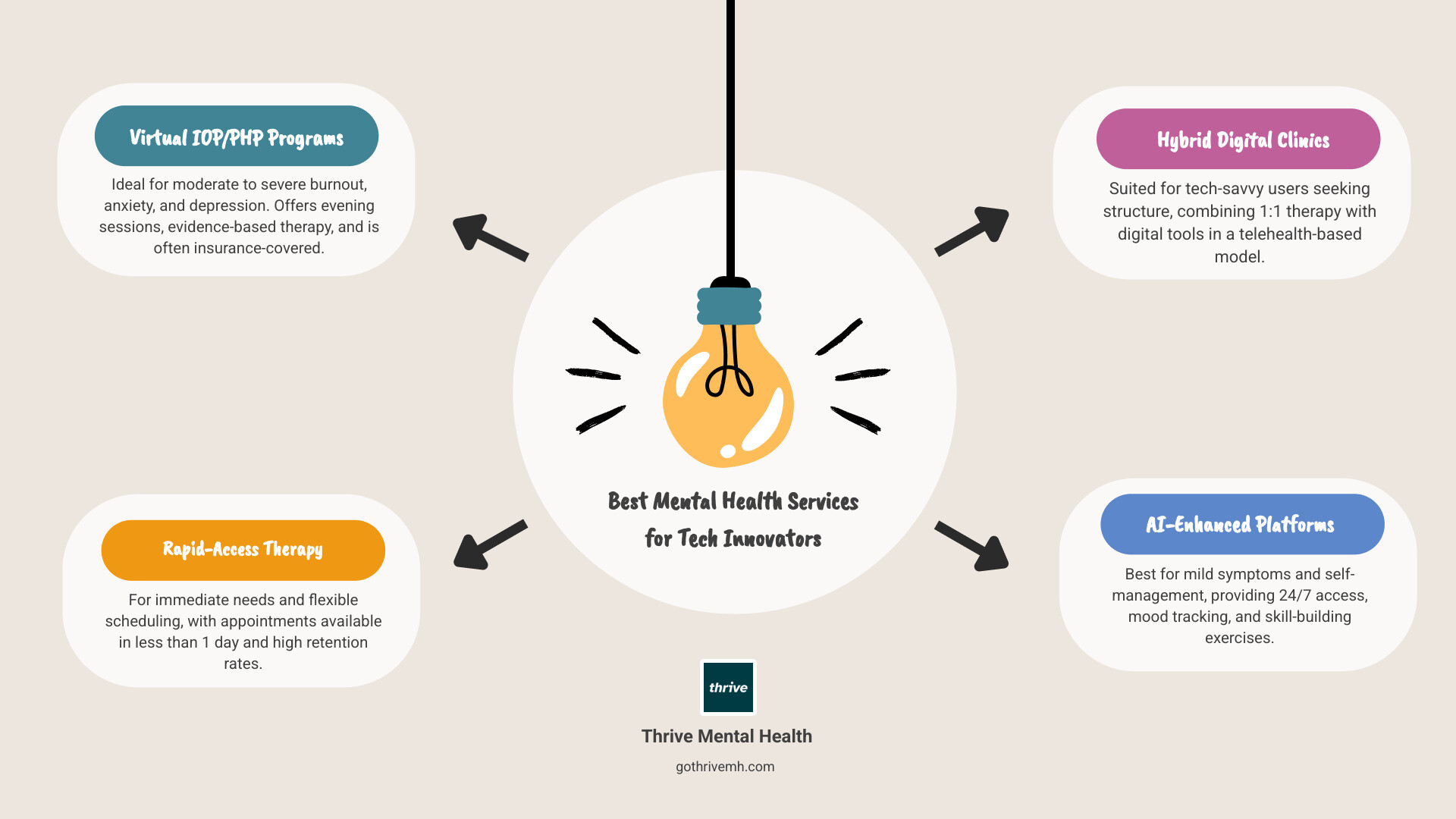
What are the best mental health services for technology innovators? The strongest options give you fast access, evening hours, and intensive support when you’re crashing—not just a weekly 50-minute Zoom. For most tech leaders and builders, the best mix is: flexible virtual therapy for ongoing support, plus higher-level care like Intensive Outpatient Programs (IOP) and Partial Hospitalization Programs (PHP) you can attend remotely without stepping away from your career.
The best mental health services for technology innovators do three things:
- Protect your time (evenings, virtual, minimal disruption to work)
- Match your level of burnout (from mild stress to “I can’t do this anymore”)
- Are built by clinicians who understand high-pressure tech culture
Top options that check all three boxes include comprehensive virtual programs like Thrive’s Virtual IOP and Virtual PHP, alongside flexible individual therapy and hybrid models that blend virtual and in-person care.
Quick Answer: Best Mental Health Services for Tech Innovators
| Service Type | Best For | Key Benefits |
|---|---|---|
| Virtual IOP/PHP | Moderate to severe burnout, anxiety, depression | Faster stabilization, evening sessions, insurance-friendly (Cigna, Optum, Florida Blue, Aetna, more) |
| Flexible Virtual Therapy | Early burnout, ongoing support | Same-week access, no commute, fits sprint cycles |
| Hybrid Programs | Need structure + some in-person contact | 1:1 therapy + groups, mix of virtual and onsite care |
| AI-Improved Tools | Mild symptoms, skill practice between sessions | 24/7 coping tools, mood tracking, habit building |
Tech never sleeps—and your brain is paying the price. About 2 in 5 tech workers are burned out. Another 42% are thinking about quitting within six months because of it. Over half—52%—report depression or anxiety.
If you ignore this, you don’t just lose productivity—you risk your health, reputation, and long-term earning power. With the right care, you can often feel noticeably better in weeks, not years.
I’m Nate Raine, CEO of Thrive Mental Health. I’ve spent over a decade helping high-performers in tech and other pressure-cooker industries recover faster with data-backed care. This guide breaks down what are the best mental health services for technology innovators, how to choose the right level of support, and how to use your insurance to pay for it—especially if you’re in Florida.
If you’re ready to see your options now, you can verify your insurance in 2 minutes (no obligation) and see if you qualify for virtual IOP, PHP, or hybrid care with Thrive.
Strategy 1: Identify Your Unique Tech Stressors—And Attack Them Directly
The tech industry is a double-edged sword. It’s exhilarating, innovative, and pushes the boundaries of what’s possible. But it also presents a unique set of mental health challenges that can leave even the most resilient innovators feeling overwhelmed and exhausted. To find what are the best mental health services for technology innovators, we first need to understand what makes your experience distinct.
Think about it:
- High-pressure launches and relentless deadlines: The constant need to deliver innovation and results at speeds that exacerbate stress levels is a defining characteristic of tech. One out of every two people in the world will develop a mental health disorder in their lifetime, and this pressure cooker environment certainly doesn’t help.
- Imposter syndrome: Many innovators, despite their achievements, secretly fear they’re not good enough or that their success is a fluke. This internal struggle can be incredibly isolating and anxiety-inducing.
- Performance anxiety: In an industry built on finding the next big breakthrough, the pressure to stay ahead of the curve and the competition is immense. This can lead to a constant state of anxiety, fearing failure or falling behind.
- Rapid pace of change and continuous learning demands: Technology evolves at lightning speed. You’re expected to constantly learn new languages, frameworks, and methodologies. This continuous demand for upskilling can feel like an endless treadmill, contributing to chronic stress.
- Blurred work-life boundaries: The “always-on” culture, especially with remote work, means your laptop is often just a few steps away, making it difficult to truly disconnect. This leads to poor work-life balance, which results in chronic stress, fatigue, and an inability to recharge—a direct path to burnout.
These aren’t just minor annoyances; they are real threats to your mental well-being. The “always-on” culture means your brain never truly gets a break. Your nervous system is perpetually in overdrive, making it impossible to recharge effectively.
Knowing the warning signs is your first line of defense. Look out for:
- Chronic fatigue and physical exhaustion: You’re tired even after a full night’s sleep.
- Irritability and cynicism: You find yourself snapping at colleagues or feeling detached from your work and once-loved projects.
- Deteriorating performance and productivity: You’re missing deadlines, making mistakes, or producing subpar results, even if you’re a high achiever.
- Loss of motivation and interest: The spark that once drove your innovation has dimmed, replaced by apathy.
- Increased physical ailments: Headaches, stomach issues, or frequent illnesses can be your body’s way of signaling distress.
These signs indicate that stress is turning into burnout, an occupational phenomenon that can lead to feelings of depression and anxiety. More than half (52%) of people who work in tech experience depression or anxiety, underscoring the severity of this issue. Recognizing these symptoms in yourself or your team is crucial for taking effective action.

Strategy 2: Use Virtual Mental Health Services Built for Tech Pros—Not Generic Apps
In tech, time is your most limited resource. You can’t disappear for weeks, but you also can’t keep pushing through burnout without consequences. That’s why virtual care tailored to tech professionals is often what are the best mental health services for technology innovators.
Why Virtual Services Work for Tech Innovators
Virtual mental health services give you:
- Speed: Same-week or near-immediate access instead of waiting months.
- Flexibility: Evening sessions that fit around standups, deploys, and investor calls.
- Privacy: Discreet care from home or the office—no waiting rooms.
What this can mean for you:
- Faster symptom relief (often within weeks of structured care)
- Fewer missed workdays
- Less risk of hitting a full breakdown that forces you to step away
Here’s how different virtual options stack up:
- Virtual therapy: 1:1 video sessions with licensed clinicians using evidence-based approaches like CBT. Great for mild to moderate anxiety, depression, or early burnout.
- Secure telehealth platforms: HIPAA-compliant, encrypted tools built for healthcare—not random video apps—so your data stays locked down.
- Thrive’s Virtual IOP and Virtual PHP: For when weekly therapy isn’t enough, but you don’t need inpatient. These programs offer multiple sessions per week, group and individual therapy, and psychiatric support. They’re designed to work around your job with evening options and are available across Florida. Many clients use insurance like Cigna, Optum, Florida Blue, and Aetna to keep costs manageable.
- Rapid access to care: Instead of waiting until you’re in crisis, you can often start a structured program within days. That timing can be the difference between staying functional and completely crashing.
Virtual care is not just “convenient tech.” For many innovators, it’s the only realistic way to get high-quality, intensive help without sacrificing momentum in their career.
Why Generic Mental Health Apps Aren’t Enough
Wellness apps have their place—but they often fail people in real burnout or depression.
Problems with relying on apps alone:
- Too shallow: Most are built for mild stress, not serious burnout, panic attacks, or suicidal thoughts.
- No real relationship: A chatbot can’t replace an experienced therapist who understands your history and context.
- No customization to tech life: Generic content doesn’t speak to late-night deploys, failed raises, or founder stress.
Use apps as supplements, not your main treatment. To actually recover—and stay better—you need real humans using proven methods, ideally in programs designed for high-pressure industries like tech.
If you’re already beyond “a little stressed,” explore whether virtual IOP or virtual PHP is a better fit than trying yet another meditation app.
Strategy 3: Know When to Level Up—When Self-Help Isn’t Enough
If you’re in immediate danger or thinking about suicide, call or text the 988 Suicide and Crisis Lifeline right now. You are not alone.
If you’re in crisis, call/text 988 right now. You are not alone.
There’s a point where “pushing through” stops working. Sleep, weekends off, and meditation apps help—until they don’t. If you’re secretly wondering whether you’re close to a full crash, it’s time to look at higher-level care.
Signs You Need More Than Weekly Therapy or Self-Help
Consider Intensive Outpatient (IOP) or Partial Hospitalization (PHP) if you notice:
- You wake up exhausted and dreading work most days
- You’ve thought, “If I disappear, at least the pressure would stop”
- Panic, numbness, or hopelessness are becoming your default
- Weekly therapy helps for a day or two, then you spiral again
- You’re missing deadlines, withdrawing from friends, or making uncharacteristic mistakes
These are red flags that your current tools aren’t enough. At this stage, doing nothing often leads to bigger fallout: job loss, relationship damage, or a medical leave you didn’t plan for.
How IOP and PHP Help Tech Innovators Recover Faster
This is where programs like Thrive’s Virtual IOP and Virtual PHP come in.
They’re built for people who need:
- More support than weekly therapy
- Less restriction than inpatient hospitalization
- Real structure, without quitting their job
What you can expect inside Thrive’s IOP/PHP (available in Florida):
- Structured, evidence-based therapy: CBT, DBT, and other proven approaches targeted to burnout, anxiety, depression, and trauma.
- Group + individual sessions: 1:1 time to go deep on your story, plus groups where you hear, “Oh, it’s not just me” from other high performers.
- Evening and virtual options: So you can attend treatment and still keep your role, your team, and your income.
- Psychiatric support when needed: Medication evaluation and management integrated into your care, not tacked on.
- Insurance-friendly: Many clients use Cigna, Optum, Florida Blue, Aetna, and other major plans to significantly reduce out-of-pocket costs.
Think of this as calling in a senior incident-response team for your brain. You’re not “failing”—you’re escalating to the right level of support so you can stabilize faster and protect everything you’ve worked for.
If you’re unsure whether you need IOP, PHP, or something lighter, you can start a quick benefits check and talk with our team about what level of care fits your symptoms, schedule, and coverage.
What Makes the Best Mental Health Services for Tech Innovators? [Vetting Checklist]
When you’re searching for what are the best mental health services for technology innovators, you need a checklist—just like you’d vet a new platform or a potential hire. Not all mental health services are created equal, especially when it comes to understanding the unique demands of the tech industry.
Must-Have Features:
- Flexible scheduling (evenings, virtual options): This is non-negotiable. Your work doesn’t stop at 5 PM, and neither should your access to care. Look for services that offer evening options, like Thrive’s virtual IOP/PHP programs, and rapid access to appointments.
- Deep understanding of tech culture and stressors: Look for clinicians who “get it.” They should understand concepts like imposter syndrome, the pressure of a Series A funding round, the agony of a bug in production, or the “always-on” mentality. This cultural competency ensures therapy is relevant and effective.
- Data privacy and HIPAA compliance: In an industry built on data security, you should expect nothing less from your mental health provider. Ensure all digital platforms and communication methods are fully encrypted and compliant with HIPAA regulations.
- Evidence-based therapies (CBT, DBT, trauma-informed care): These aren’t buzzwords; they are clinically proven approaches that yield results. Cognitive Behavioral Therapy (CBT) helps you reframe negative thought patterns, and Dialectical Behavior Therapy (DBT) provides skills for emotional regulation and distress tolerance—essential for navigating high-stress environments.
- Support for founders, leaders, and high-performers: These groups face unique pressures, including immense responsibility, isolation, and the constant need to innovate. The best services offer specialized coaching or therapy that addresses these leadership-specific challenges.
How Tech Companies Can Step Up:
The responsibility for mental well-being isn’t solely on the individual. Tech companies have a crucial role to play in fostering a supportive environment.
- Offer robust mental health benefits (IOP, PHP, virtual therapy): Beyond basic EAPs, companies should provide comprehensive coverage for higher levels of care like IOP and PHP programs and ensure easy access to virtual therapy. Investing in comprehensive benefits has been shown to deliver a positive return on investment and significantly increase employee use of mental health resources.
- Train leaders to spot burnout and support well-being: Managers are often the first to notice signs of distress. Training them to recognize burnout, have empathetic conversations, and direct employees to resources is vital.
- Destigmatize mental health—make it part of the culture: Open conversations about mental health, led by leadership, can break down barriers. Make it clear that seeking help is a strength, not a weakness.
- Flexible work policies and strong Employee Assistance Programs (EAPs): Promoting healthy work-life boundaries, offering flexible hours, and providing robust EAPs that go beyond basic counseling can significantly reduce employee stress.
- Related: How to Build a Mental Health-First Tech Culture
Ethical Musts for Tech-Driven Care:
As innovators ourselves, we understand the allure of technology. However, when it comes to mental health, ethical considerations are paramount.
- Data security and privacy: Innovators often work with sensitive information, and they expect the same level of protection for their personal health data. Any digital mental health service must have ironclad security protocols.
- Transparency and informed consent: Users must fully understand how their data is collected, used, and protected, especially with AI tools. The ethical implications of AI in mental health, from potential bias to the limits of its diagnostic capabilities, must be openly addressed.
- Human connection is irreplaceable—AI can help, but not replace: While AI can improve accessibility, personalize care, and assist providers (e.g., with “smart notes” that save therapists 10 minutes per session), it cannot replicate the empathy, intuition, and therapeutic relationship that a human clinician provides. For example, effective hybrid models combine 1:1 therapy with digital tools, recognizing the need for both human connection and technological support.
Strategy 5: How to Find and Choose the Right Mental Health Service—Step by Step
You wouldn’t ship production code without due diligence. Treat your mental health provider the same way. Here’s a fast process to find what are the best mental health services for technology innovators—without getting lost in tabs.
1. Check Insurance First (Save Time and Money)
Know what’s covered before you fall in love with a program.
- Look for providers that work with Cigna, Optum, Florida Blue, Aetna, and other major plans.
- For Thrive, you can verify your insurance in 2 minutes (no obligation) to see coverage for virtual IOP, PHP, and hybrid care in Florida.
2. Confirm Provider Credentials + Experience With Tech Pros
Non-negotiables:
- Licensed therapists, psychologists, and psychiatrists
- Real experience with startup founders, engineers, and tech leaders
Ask directly how often they work with tech clients—and what they see most (burnout, anxiety, panic, depression, ADHD, trauma).
3. Make Sure They “Get” Tech Culture
You shouldn’t have to spend half your session explaining what a sprint, on-call rotation, or funding round is.
Look for:
- Awareness of founder stress, scaling pressures, layoffs, and remote isolation
- Comfort talking about performance, high stakes, and identity tied to output
4. Decide If You Need Therapy, IOP, or PHP
Match the level of care to the level of pain:
- Virtual therapy: You’re stressed, but still functioning. You want tools and support.
- IOP: Your symptoms are disrupting work and relationships. You need several sessions per week but can stay at home and keep working.
- PHP: You’re close to a full crash. You need intense daily structure but don’t need 24/7 hospital care.
Thrive offers all three layers: Virtual IOP, Virtual PHP, and hybrid options, so you can step up or down as you improve.
5. Ask These 6 Questions Before You Commit
Treat it like hiring a key team member:
- “What’s your experience with high-pressure tech clients?”
- “Do you offer evening or virtual sessions?”
- “What evidence-based therapies do you use for burnout, anxiety, and depression?”
- “How do you protect my privacy and data for virtual sessions?”
- “How quickly could I start if I’m really struggling?”
- “How do you measure progress?”
Want to go deeper on building a sustainable, mentally healthy org? Check out Thrive’s related guide: How to Build a Mental Health-First Tech Culture (search our blog for the latest version).
Frequently Asked Questions: Best Mental Health Services for Tech Innovators
How do I know if I have tech burnout or just normal stress?
If a weekend off and good sleep don’t touch it, it’s probably more than normal stress. Burnout shows up as chronic exhaustion, cynicism, and feeling ineffective—often for weeks or months. Normal stress usually eases once the deadline or project ends.
Are virtual IOP and PHP programs effective for tech professionals?
Yes. For many innovators, virtual IOP and PHP are the fastest realistic way to get intensive help without stepping away from work. Thrive’s virtual IOP/PHP use proven therapies, group and individual sessions, and evening options to reduce anxiety, depression, and burnout while you stay at home and keep your role.
Does insurance cover Thrive’s virtual IOP/PHP programs?
Often, yes. Thrive works with Cigna, Optum, Florida Blue, Aetna, and other major insurers. Coverage varies by plan, so the simplest move is to verify your insurance online in about 2 minutes.
Can I get help if I’m in Florida?
Yes. Thrive offers virtual and hybrid IOP/PHP programs across Florida. That means you can access higher-level care from home in major tech hubs like Miami, Tampa, Orlando, and Jacksonville, and throughout the state.
What’s the best first step if I feel close to burning out or breaking down?
Don’t wait for a crisis. Start by checking your insurance and options for structured care. You can start a benefits check, then talk with our team about whether virtual therapy, IOP, or PHP is the right level of support for what you’re going through.
Summary: The Best Mental Health Services for Technology Innovators—Before Burnout Blows Up Your Life
If you’re in tech, chronic stress is almost a given. But full burnout, panic, or depression are not the cost of success. The best mental health services for technology innovators are:
- Flexible: Evening and virtual options that don’t wreck your calendar
- Intensive when needed: Virtual IOP/PHP that step in before a total breakdown
- Built for tech culture: Clinicians who understand launches, layoffs, and hypergrowth
- Insurance-friendly and local: Covered by plans like Cigna, Optum, Florida Blue, Aetna, and available across Florida
If you ignore this, the costs are real: lost roles, damaged relationships, medical leave, or worse. If you act now, you can protect your health, your income, and the work that matters to you—and often feel significantly better within weeks of structured, evidence-based care.
Ready for support? Thrive offers virtual and hybrid IOP/PHP programs with evening options. Verify your insurance in 2 minutes (no obligation) → Start benefits check or call 561-203-6085. If you’re in crisis, call/text 988.