
5 Things Every Entrepreneur Needs: Best Mental Health Support

Why Entrepreneurs Can’t Afford to Ignore Mental Health
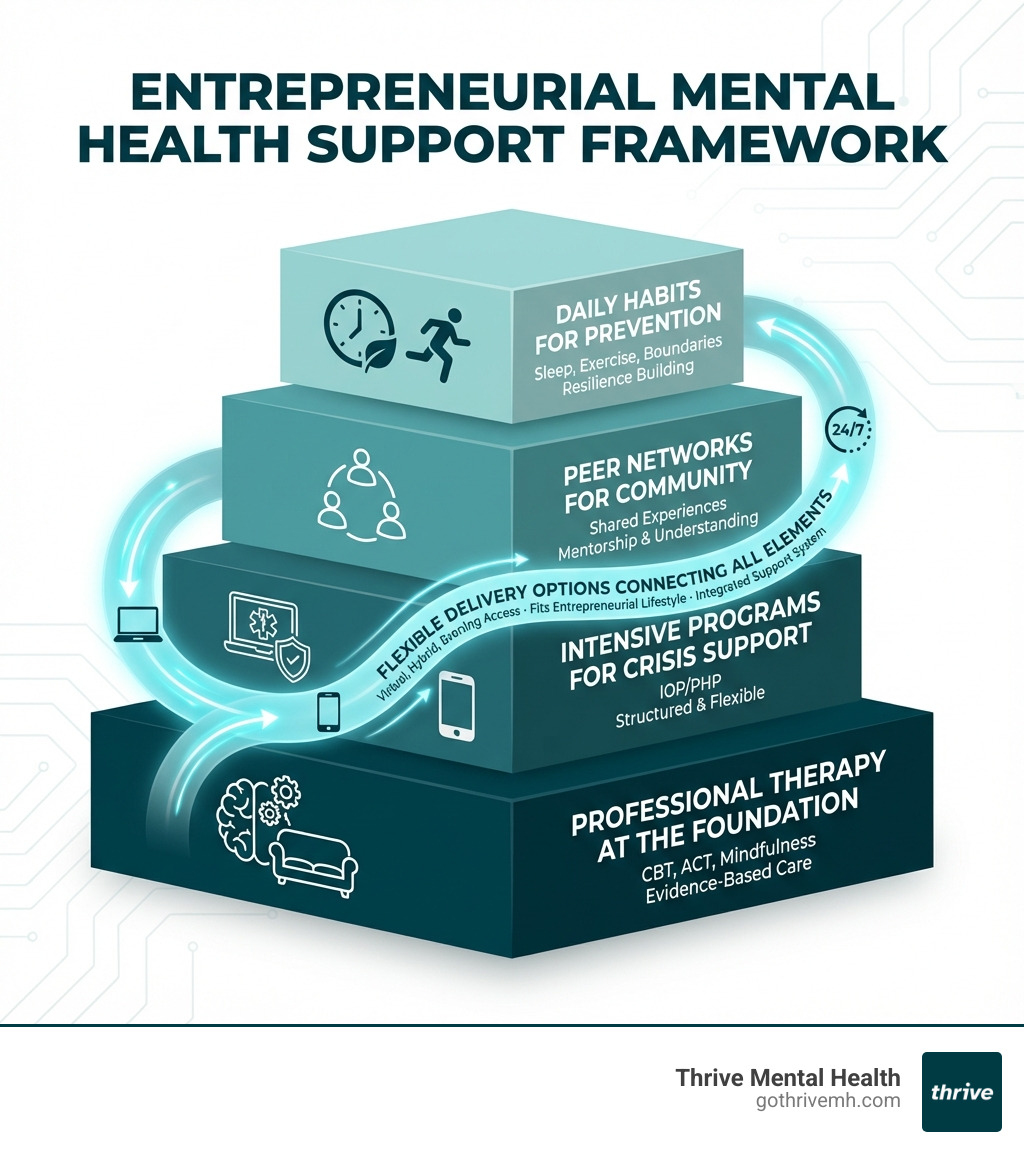
What mental health support works best for entrepreneurs managing high-stress environments? The most effective support combines professional therapy (like Cognitive Behavioral Therapy), intensive programs (IOP/PHP), peer support networks, and daily resilience habits—all custom to fit the demanding entrepreneurial lifestyle.
Quick Answer: Best Mental Health Support for Entrepreneurs
- Professional Therapy – CBT, ACT, and mindfulness-based approaches reduce anxiety and stress
- Intensive Outpatient Programs (IOP/PHP) – Flexible, evidence-based care that fits around your business
- Peer Support & Mentorship – Connect with other founders who understand the pressure
- Daily Resilience Habits – Sleep, exercise, boundaries, and gratitude practices
- Virtual/Hybrid Options – Evening sessions, remote access, insurance-covered
Here’s the reality: 72% of entrepreneurs report mental health concerns—significantly higher than the general population. Nearly half say mental health issues interfere with their ability to work at least once a week. For entrepreneurs under 40, that number jumps to 60%.
Your mental health isn’t a luxury. It’s your most valuable business asset.
When you’re burned out, your decisions suffer. Your team feels it. Your revenue takes a hit. The data is clear: mental health directly impacts business performance, innovation, and growth.
But here’s the good news: 47% of entrepreneurs who sought professional help reported reduced anxiety, and 40% improved their stress management. The right support works—if you know what to look for and actually use it.
At Thrive Mental Health, we’ve spent over a decade at the intersection of mental health, digital change, and leadership—helping entrepreneurs and high-performers access evidence-based care that actually fits their lives. Understanding what mental health support works best for entrepreneurs managing high-stress environments has been central to building our virtual and hybrid IOP/PHP programs across Florida, with additional virtual services available in California, Indiana, Arizona, and South Carolina.
The Hidden Cost of Stress: Why Your Business Bleeds When You Burn Out

Your mental health isn’t just a personal matter; it’s intricately linked to the success and sustainability of your entrepreneurial venture. The relentless demands of managing a business, especially in high-stress environments, can exact a heavy toll. When entrepreneurs struggle with their mental well-being, the consequences ripple through every aspect of their operation, leading to a tangible decline in productivity and profitability.
A staggering 72% of entrepreneurs report mental health concerns, a figure significantly higher than their non-entrepreneurial counterparts. This isn’t just a statistic; it’s a crisis impacting the engine of our economy. Nearly three-quarters (72%) of entrepreneurs have mental health concerns, with 49% having experienced one or more mental health conditions. This pervasive issue means that for many, their ability to lead, innovate, and grow their businesses is constantly under threat. More than one-third (36%) of business owners report that mental health challenges interfere with their ability to work at least once a week. This interference skyrockets to 60% for entrepreneurs under 40, highlighting a critical vulnerability in the next generation of business leaders.
When an entrepreneur is overwhelmed, their capacity for sound decision-making, creative problem-solving, and effective team leadership diminishes. This can lead to increased team friction, missed opportunities, and ultimately, lost revenue. Our mental well-being is not just beneficial—it’s essential for coping with life’s stresses, realizing our abilities, learning well, working well, and contributing to our community, as defined by the World Health Organization. For an entrepreneur, this state of mental well-being is the very foundation upon which their business thrives.
What Are the Top Mental Health Challenges for Entrepreneurs?
Entrepreneurs steer a unique landscape filled with pressures that can significantly impact their mental health. These are not just typical workplace stressors but amplified versions, often experienced in isolation.
- High-stakes Pressure: Every decision, every investment, every pivot carries immense weight. The constant pressure to succeed, innovate, and stay ahead of the curve can be mentally exhausting. The possibility of tax breaks for startup small businesses and growing markets might incentivize new ventures, but they also bring increased competition and pressure.
- Financial Risk: Many entrepreneurs invest their personal savings, take on loans, and bear the financial burden of their ventures. Concerns about maintaining cash flow are paramount, with 50% of entrepreneurs citing it as a primary stressor. This financial insecurity can fuel chronic anxiety and sleep disturbances.
- Isolation: Despite potentially having a team, the ultimate responsibility often rests solely on the entrepreneur’s shoulders. This can lead to profound feelings of loneliness and isolation, making it difficult to share vulnerabilities or seek support. The intense focus and time investment required to grow a business can strain even the strongest relationships, further contributing to this isolation.
- Imposter Syndrome: Even highly successful entrepreneurs often battle feelings of inadequacy, constantly questioning their capabilities despite evidence of their achievements. This self-doubt can be debilitating and prevent them from celebrating successes or seeking help.
- Uncertainty: The entrepreneurial journey is inherently unpredictable. Market shifts, economic downturns, global events, and political uncertainties can create a constant state of flux. 47% of entrepreneurs are concerned about economic and political uncertainty, and 37% are worried about global events or crises. This pervasive uncertainty is a major contributor to psychological distress.
- Burnout: The relentless combination of these factors often culminates in burnout. We see that nearly half (46%) of entrepreneurs experienced low mood or felt mentally tired at least once a week, and three of five (62%) felt depressed at least once a week. This chronic exhaustion can manifest as emotional, cognitive, and physical health problems.
A comprehensive study in the Journal of Business Venturing Insights by Reid, Patel, and Wolfe (2018) found that while entrepreneurship offers immense rewards like autonomy and the pursuit of passion, it is also positively associated with short-term psychological distress due to intense demands and occasional feelings of helplessness and lack of control.
Study: Entrepreneurial distress and its impact
How Does the Entrepreneurial Lifestyle Cause Burnout?
The very nature of entrepreneurship, often glorified as “hustle culture,” inherently contributes to increased stress and mental health concerns. This lifestyle often blurs the lines between work and personal life, leading to a chronic state of activation that can quickly lead to burnout.
- No Work-Life Boundaries: The “hustle culture” mindset, often perpetuated by social media, encourages constant work and discourages rest. This can make it incredibly difficult for entrepreneurs to establish and maintain clear boundaries between work and personal life. Without these boundaries, work infiltrates every hour, every space, and every relationship, preventing true mental and emotional recovery.
- 24/7 Responsibility: The buck stops with the entrepreneur. From securing funding to managing operations, making critical decisions, and dealing with unexpected crises, the responsibility is ceaseless. This “always on” mentality means the entrepreneurial mind rarely gets a break, leading to mental fatigue and exhaustion.
- Sleep Loss: A direct consequence of 24/7 responsibility and blurred boundaries is inadequate sleep. Entrepreneurs often sacrifice sleep to meet deadlines or work on new ideas. However, consistent, quality sleep is foundational for cognitive function and emotional regulation. Chronic sleep deprivation severely impairs judgment, creativity, and resilience.
- Ignoring Health: In the relentless pursuit of business goals, personal health often takes a backseat. Regular exercise, healthy eating, and even basic self-care practices are neglected. This can lead to physical ailments that further exacerbate mental health issues. The World Health Organization defines mental health as “a state of mental well-being that enables people to cope with the stresses of life, realize their abilities, learn well and work well, and contribute to their community.” Ignoring fundamental health needs directly undermines this state.
- High Self-Expectations and Perfectionism: Entrepreneurs often set impossibly high standards for themselves and their ventures. While this drive can be a motivator, it can also become a source of immense stress, leading to feelings of inadequacy and self-criticism when things inevitably don’t go perfectly.
- Economic and Political Uncertainty: External factors beyond an entrepreneur’s control, such as economic downturns, inflation, and global crises, can significantly exacerbate mental health challenges. These uncertainties add layers of stress, making it even harder to manage existing pressures. Most of us are feeling anxious and depressed right now, and that’s not just because of an ongoing global pandemic. The economy is dwindling, layoffs are rampant, wars continue, and the health of our planet doesn’t seem to be improving. These external stressors compound the internal pressures entrepreneurs already face.
This combination of intense demands, lack of boundaries, and neglect of personal well-being creates a fertile ground for burnout, leading to a cycle where the entrepreneur’s mental health suffers, which in turn negatively impacts the business.
7 Non-Negotiable Habits to Build Mental Resilience

Building mental resilience isn’t about avoiding stress; it’s about developing the capacity to steer it effectively, bounce back stronger, and even thrive amidst adversity. For entrepreneurs, these aren’t optional extras but essential strategies for long-term success and well-being. Don’t wait for a crisis to implement these; small, consistent daily habits compound into powerful resilience.
Master Your Mind: Rewire Self-Talk and Practice Gratitude
Our inner dialogue profoundly shapes our reality. For entrepreneurs, who often face criticism and setbacks, managing self-talk is crucial.
- Challenge Negative Thoughts: Notice your self-talk. Test and challenge unhelpful thoughts. Are you constantly telling yourself you’re not good enough, or that failure is inevitable? These negative patterns can be identified and reframed. Practicing self-compassion, treating yourself with the same kindness and understanding you would offer a friend, is a powerful antidote.
Checklist for helpful self-talk - Cultivate Gratitude: Daily gratitude practices can significantly improve mental well-being by shifting focus from challenges to appreciations, thus enhancing overall life satisfaction and resilience. This simple act can rewire your brain to see opportunities instead of obstacles.
Gratitude exercises from Calm
Here are 5 daily gratitude prompts for founders:
- What business challenge did I overcome today, and what did I learn?
- What one interaction with a team member or client made me feel valued?
- What aspect of my work brings me joy or fulfillment, no matter how small?
- What personal strength did I use today that contributed to my success?
- What opportunity am I grateful for, even amidst uncertainty?
The Physical Foundation: Sleep, Nutrition, and Exercise
Often neglected, these three pillars are non-negotiable for entrepreneurial mental health and peak performance.
- Prioritize Sleep: Consistent, quality sleep (7-8 hours per night) is foundational for cognitive function and emotional regulation. It’s often neglected when life becomes busy or stressful, but it’s when your brain consolidates memories, processes emotions, and recharges.
- Fuel Your Body with Nutrition: A healthy, balanced diet directly impacts mood, energy levels, and cognitive clarity. Eating a variety of healthy foods can prevent energy crashes and mood swings that often accompany high-stress periods.
- Move Your Body: Regular exercise vigorously for 150 minutes each week is a powerful stress reliever and mood booster. Physical activity releases endorphins, reduces stress hormones, and improves sleep quality. Short movement breaks throughout the day can also significantly reduce stress and improve mental health.
Canada’s guide to healthy eating and physical activity
Reclaim Your Time: Boundaries and Smart Systems
Entrepreneurs thrive on autonomy, but without structure, that freedom can quickly become a cage of endless work.
- Define and Maintain Clear Boundaries: Establishing and maintaining clear boundaries between work and personal life is critical to prevent burnout. This includes setting realistic work hours, taking regular breaks, and being intentional about disconnecting. For instance, try not to check emails after a certain time or dedicate specific days to non-work activities.
- Delegate Tasks Effectively: You can’t do everything yourself. Prioritizing your workload and delegating tasks allows you to focus on high-impact activities while empowering your team. This isn’t just about offloading work; it’s about strategic resource allocation.
BDC’s guide to effective delegation - Create and Maintain Organizational Systems: Efficient organizational systems can mitigate feelings of overwhelm. Leverage tools and techniques to streamline your workflows, set achievable goals, and prioritize to reduce the cognitive load of multitasking. This frees up mental energy for creative thinking and strategic planning.
- Practice Mindfulness: Integrating mindfulness practices into your daily routine can improve focus, reduce stress, and build resilience. Mindfulness can be as simple as a walk outside without your phone to intentionally pay attention to the sensory details of the environment, or a few minutes of guided meditation. These practices help you stay present and manage the constant influx of entrepreneurial demands.
Practice mindfulness to build mental resilience
What Mental Health Support Works Best for Entrepreneurs Managing High-Stress Environments? [Expert Solutions]
While self-care and resilience-building habits are foundational, for many entrepreneurs operating in high-stress environments, self-help simply isn’t enough. The unique pressures, isolation, and high stakes of running a business demand specialized, expert intervention. This is where professional mental health support becomes not just an option, but a critical investment with significant ROI.
The data speaks volumes: 35% of entrepreneurs indicated they sought professional help to address a mental health concern in the last year. Younger entrepreneurs are especially proactive, with 57% of those under 45 seeking professional support. The benefits are clear: 47% said professional help helped reduce anxiety, and 40% reported improved stress management. These aren’t just minor improvements; they translate directly into better decision-making, improved focus, and sustainable business growth.
So, what mental health support works best for entrepreneurs managing high-stress environments? It’s a multi-faceted approach, often involving therapeutic modalities proven to address the specific challenges entrepreneurs face. Cognitive Behavioral Therapy (CBT) is highly effective for entrepreneurial anxiety, helping to identify and reframe negative thought patterns that can hinder performance. Acceptance and Commitment Therapy (ACT) fosters psychological flexibility, allowing entrepreneurs to steer uncertainty and commit to value-driven actions. Mindfulness-Based Stress Reduction (MBSR) and Solution-Focused Brief Therapy (SFBT) also offer practical tools for managing stress and leveraging strengths. For many, a blended approach that includes professional coaching or therapy with these therapeutic components can be profoundly impactful.
Why Virtual IOP & PHP Programs Are a Game-Changer for Entrepreneurs
Traditional therapy models often don’t fit the demanding, unpredictable schedules of entrepreneurs. This is precisely where Intensive Outpatient Programs (IOP) and Partial Hospitalization Programs (PHP), especially those offered virtually or in hybrid formats, become a game-changer. Thrive Mental Health offers these programs for entrepreneurs throughout Florida, with virtual options also available in California, Indiana, Arizona, and South Carolina, all specifically designed with the high-achieving professional in mind.
- Flexible Scheduling (Evenings, Remote Options): Our programs are structured to accommodate your busy life, with evening sessions and remote access. This means you can get intensive, evidence-based care without having to put your business on hold.
- Intensive Support Without Pausing Your Business: IOP and PHP offer a higher level of care than weekly therapy, providing multiple hours of group and individual therapy sessions per week. This intensity leads to faster progress and more robust coping skills, all while allowing you to maintain your essential business operations.
- Fast-Track Recovery—Get Back to Peak Performance: When you’re struggling, time is money. Intensive programs accelerate your recovery, equipping you with practical tools and strategies to manage stress, anxiety, burnout, and other mental health challenges more effectively. The goal is not just to cope, but to thrive and return to peak performance, both personally and professionally.
- Covered by Major Insurance: We believe access to care shouldn’t be a barrier. Our programs are often covered by major insurance providers, including Cigna, Optum, Florida Blue, and Aetna. This makes high-quality, intensive mental health support a financially viable option for many entrepreneurs.
Learn more about Thrive’s IOP and PHP programs
Explore Thrive’s Virtual Therapy options
How to Find the Right Mental Health Support in Florida
Finding the right mental health support is a crucial step towards sustainable success. Here’s what to look for:
- Choose a Provider Who Gets Entrepreneurs: Seek out therapists, coaches, or programs that understand the unique pressures of the entrepreneurial journey. A provider who recognizes the intense demands, financial risks, and isolation you face can offer more relevant and effective strategies. Look for those specializing in therapy for professionals or executives.
- Check Insurance Coverage: Don’t let perceived cost be a barrier. Many professional mental health services, including IOP and PHP, are covered by insurance. Verify your benefits with providers like Cigna, Optum, Florida Blue, and Aetna.
- Ask About Virtual and Hybrid Options: Flexibility is key for entrepreneurs. Virtual therapy and hybrid programs (combining in-person and remote sessions) offer convenience and accessibility, allowing you to integrate treatment into your schedule without significant disruption. Thrive Mental Health offers these flexible options for entrepreneurs across Florida.
Verify your insurance in 2 minutes
When Is Intensive Support Needed?
It can be challenging to recognize when your mental health struggles require more than just weekly therapy or self-care. Here are clear indicators that intensive support, such as an IOP or PHP, might be the best path forward:
- Burnout Won’t Budge: If chronic fatigue, cynicism, and feelings of ineffectiveness persist despite your best efforts at self-care, it’s a sign that you need a higher level of intervention.
- Work and Life Are Falling Apart: When your mental health issues are significantly impacting your ability to function at work (e.g., missed deadlines, poor decisions, strained team relationships) and in your personal life (e.g., neglecting family, social withdrawal), it’s time for more comprehensive support.
- Weekly Therapy Isn’t Enough: If you’ve been in traditional weekly therapy but aren’t seeing the progress you need, an IOP or PHP can provide the concentrated, multi-modal treatment necessary to break through plateaus.
- IOP/PHP = More Sessions, Faster Results, Still Flexible: These programs offer several hours of therapy per day, multiple days a week, providing a structured, supportive environment to develop robust coping mechanisms and achieve stability more quickly. Despite their intensity, virtual and hybrid formats maintain the flexibility entrepreneurs need.
More on Thrive’s remote IOP/PHP programs
FAQs: Entrepreneurial Mental Health Support
How does an entrepreneur’s mental health impact business success?
Your mental health directly drives your leadership, decision-making, innovation, and team dynamics. Poor mental health leads to burnout, impaired judgment, increased team turnover, and ultimately, lost revenue and reduced business growth. Investing in your mental well-being is investing in your business’s bottom line.
What’s the first step if I’m burning out?
Admit it. Acknowledge that you’re struggling. Then, prioritize rest and identify the single biggest stressor you can address immediately. Make one small change, like delegating a task, taking an afternoon off, or getting an extra hour of sleep. If these small steps aren’t enough to shift your state, it’s crucial to seek professional help. You don’t have to steer this alone.
Is therapy for entrepreneurs covered by insurance?
Yes, many professional mental health services, including individual therapy and intensive outpatient programs (IOP/PHP), are covered by major insurance providers. At Thrive Mental Health, we work with plans from Cigna, Optum, Aetna, Florida Blue, and others. We recommend verifying your specific benefits to understand your coverage.
What’s the difference between IOP and PHP?
IOP stands for Intensive Outpatient Program, typically involving 3-5 days per week of structured therapy, allowing for more flexibility to manage work and personal responsibilities. PHP, or Partial Hospitalization Program, offers a higher level of care with more hours of therapy per day, providing even more intensive support. Both can be delivered virtually or in hybrid formats at Thrive, custom to fit your needs.
Can I get help if I’m in crisis?
If you’re in crisis, call/text 988 right now. You are not alone.
Your Mental Health Is Your #1 Business Asset
Prioritizing your mental health is the smartest business move you’ll ever make. It’s not a weakness; it’s a strategic advantage that fuels resilience, sharpens decision-making, and sustains innovation. Understanding what mental health support works best for entrepreneurs managing high-stress environments means recognizing the need for both robust self-care and expert professional intervention.
Thrive Mental Health delivers expert, flexible care for high-achieving entrepreneurs in Florida, with virtual support also available in California, Indiana, Arizona, and South Carolina. Our virtual and hybrid Intensive Outpatient (IOP) and Partial Hospitalization (PHP) programs are designed to provide the intensive support you need to overcome mental health challenges, regain your focus, and lead your business with renewed strength and clarity. Don’t let stress and burnout compromise your vision.
Related: How Virtual IOPs Cut Recovery Time by 50%
Ready for support? Thrive offers virtual and hybrid IOP/PHP programs with evening options. Verify your insurance in 2 minutes (no obligation) → Start benefits check or call 561-203-6085. If you’re in crisis, call/text 988.