
The Ultimate Guide to Treatment-Resistant Depression Strategies
What is Treatment-Resistant Depression (And Why Haven’t Antidepressants Worked)?
What treatment strategies work best for adults with treatment-resistant depression? The most effective plans combine advanced interventions with personalized, high-touch care, often delivered through structured programs like intensive outpatient (IOP) and partial hospitalization (PHP).
Here is how the leading options compare:
| Treatment Type | Key Options | Response Rate |
|---|---|---|
| Brain Stimulation | rTMS, Accelerated TMS (SAINT-iTBS), ECT | 50-85% response |
| Rapid-Acting Medications | Ketamine (IV), Esketamine (Spravato nasal spray) | 60-70% response |
| Medication Strategies | Switch antidepressants, augment with aripiprazole/quetiapine, add lithium or T3 | 25-48% response |
| Psychotherapy | CBT, IPT, Mindfulness-Based Therapy (especially combined with meds) | 60-87% response |
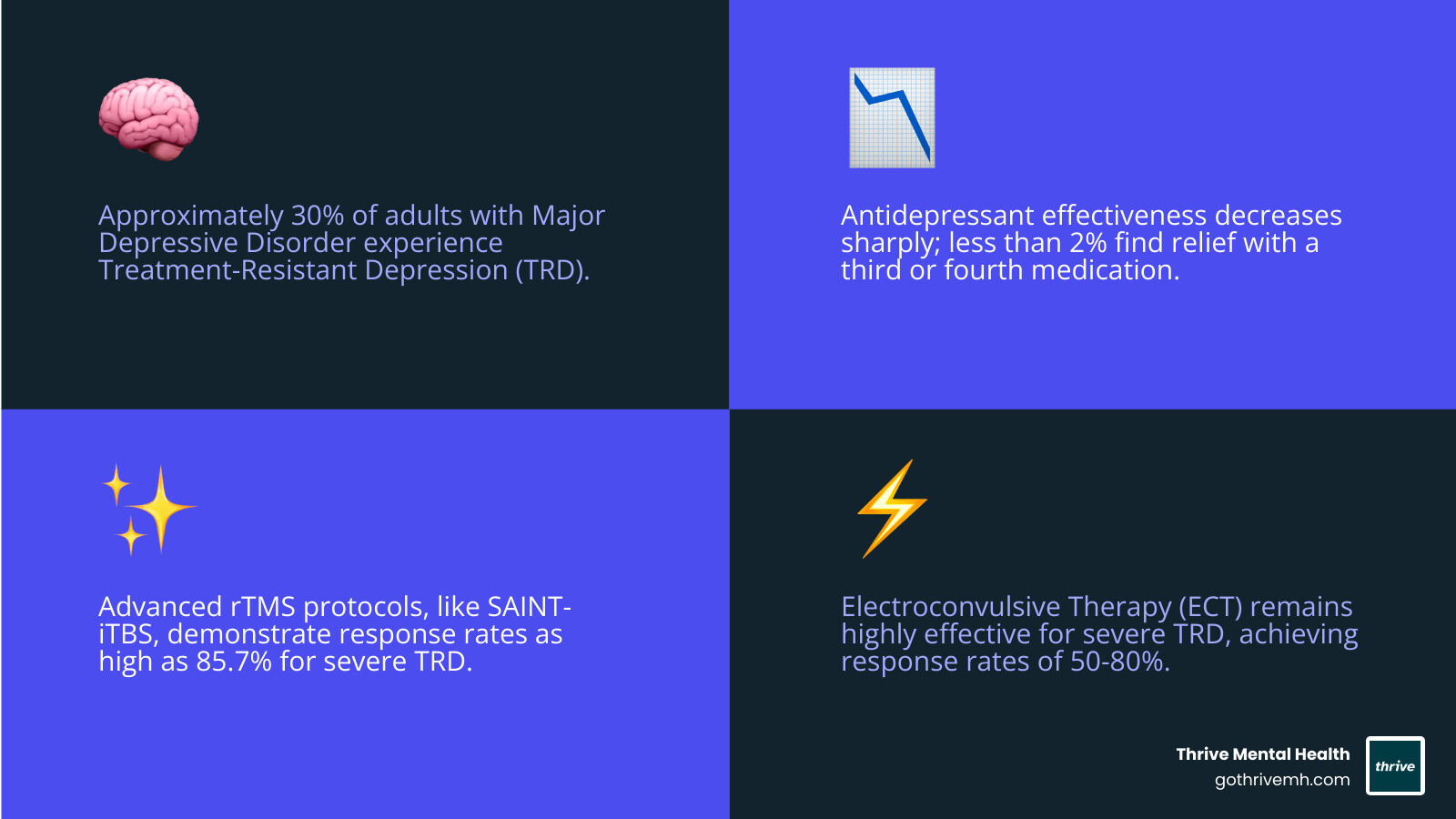
Treatment-resistant depression (TRD) affects about 30% of people with major depressive disorder. That means roughly one in three adults who start an antidepressant will not find significant relief, even after trying multiple medications. If you’ve taken your medication as prescribed, tried more than one option, and still feel stuck, it is not a personal failure. It is likely TRD.
Traditional antidepressants meaningfully relieve symptoms for only about one-third of patients. After two failed trials at a proper dose and duration, your depression is considered “treatment-resistant,” and the smartest move is to change the playbook—not to keep repeating the same approach.
But TRD is not a dead end. Breakthrough treatments like repetitive transcranial magnetic stimulation (rTMS), rapid-acting therapies like ketamine and esketamine, and intensive, evidence-based psychotherapy have transformed outcomes. Electroconvulsive therapy (ECT) remains highly effective for severe TRD, and newer accelerated TMS protocols show response rates as high as 85.7%.
This guide breaks down what treatment strategies work best for adults with treatment-resistant depression in 2025—from optimizing medications and exploring brain stimulation to integrating psychotherapy, lifestyle changes, and higher-level care like Intensive Outpatient Programs (IOP) and Partial Hospitalization Programs (PHP).
I’m Nate Raine, CEO of Thrive Mental Health. We specialize in helping adults steer complex, hard-to-treat conditions through our IOP and PHP programs across Florida, with flexible virtual and in-person options. Our care teams know that the most effective strategy for TRD blends advanced interventions, structured daily support, and a dedicated clinical team that refuses to give up on you.
In short: if standard antidepressants have failed you, there are still powerful, research-backed options—and you do not have to figure them out alone.
Why Standard Antidepressants Fail: Understanding TRD
If you’re in crisis, call or text 988 right now. You are not alone.
Understanding treatment-resistant depression (TRD) is the first step toward finding effective relief. TRD is diagnosed when major depressive disorder (MDD) does not improve after trying at least two different antidepressants at an adequate dose for a sufficient duration (typically 6-8 weeks each). It is not about “quitting too early”; it is about recognizing when standard approaches are not working and it is time for a more advanced plan.
Several factors can contribute to why someone might not respond to initial treatments:
- Common risk factors: Research points to contributors like lower socioeconomic status, childhood trauma, and high baseline severity of depression. Anhedonia (inability to feel pleasure), anxiety, and cognitive deficits also play a significant role.
- Comorbid conditions: Other mental health conditions, such as anxiety disorders, personality disorders, ADHD, or substance use disorders, can complicate treatment by masking or worsening depressive symptoms.
- Chronic physical illness: Unaddressed physical health problems, like hypothyroidism, chronic pain, autoimmune disorders, or sleep apnea, can mimic or worsen depression, making it feel treatment-resistant.
- Misdiagnosis: An inaccurate initial diagnosis can lead to ineffective treatment. For instance, if bipolar disorder is mistaken for unipolar depression, antidepressants alone may destabilize mood or make cycling worse.
- Suboptimal treatment (pseudo-resistance): Pseudo-resistance can occur if medications are not taken at the right dose, for a long enough period, or if there is poor adherence to the treatment plan because of side effects, cost, or lack of support.
A psychiatrist is essential for diagnosing and treating TRD. They can review your full treatment history, assess for co-occurring conditions, order labs when needed, and map out all potential contributing factors to create a comprehensive, individualized approach. Often, the most effective next step is a higher level of structured care—such as a virtual or in-person IOP or PHP day program—where medication management, therapy, and lifestyle support are coordinated in one place.
Effective treatment means moving beyond a one-size-fits-all mentality. For more on the complex nature of depression, you can refer to scientific research on the complexity of depression.
Advanced Medication Strategies for TRD [That Actually Work]
When initial antidepressant trials fall short, it is time to explore more sophisticated medication strategies. The goal is to find what treatment strategies work best for adults with treatment-resistant depression by carefully re-evaluating pharmacological approaches inside a structured, data-driven care plan.
Key strategies include:
- Switching: If a medication is not working, switching to a different class of antidepressant (for example, from an SSRI to an SNRI, atypical antidepressant, or TCA) can be more effective than switching within the same class.
- Augmentation: This involves adding a non-antidepressant medication to boost your current one’s effects. Common, FDA-approved agents include atypical antipsychotics like aripiprazole and quetiapine, which have shown response rates up to 48%. Other options include lithium or thyroid hormone (T3).
- Combination: This strategy uses two antidepressants from different classes simultaneously (for example, an SSRI with bupropion) to target multiple neurotransmitter systems for a synergistic effect.
These strategies require careful management of potential side effects, always balancing efficacy with tolerability. In Thrive’s IOP and PHP programs across Florida, psychiatrists and prescribing providers adjust medications while therapists track day-to-day changes in mood, sleep, and functioning—so you are not navigating the trial-and-error process alone.
How can pharmacogenetic testing aid in the treatment of treatment-resistant depression?
Pharmacogenetic testing is a powerful tool in personalized medicine for TRD. This approach analyzes your genes to predict how your body might process and respond to certain medications, particularly by examining CYP450 enzymes that metabolize many psychiatric drugs.
This testing can:
- Guide medication choice: Help select medications that are more likely to be effective and less likely to cause side effects based on your genetic profile.
- Reduce trial-and-error: Shorten the path to finding the right treatment, avoiding months or years of cycling through ineffective medications.
- Improve outcomes: By tailoring treatment to your genetic makeup, clinicians can improve the chances of achieving remission and reduce the burden of side effects.
While not a magic bullet, pharmacogenetic testing offers valuable clues, especially for those who have struggled with side effects or poor results from multiple medications. At Thrive, test results are integrated into a broader treatment plan that also includes therapy, skills training, and lifestyle support.
What are the different medication strategies for treatment-resistant depression?
In practice, psychiatrists often use a stepwise approach:
- Confirm basics: Verify diagnosis, check doses and duration, address adherence, and screen for medical contributors.
- Switching strategies:
- SSRI → SNRI (for example, sertraline → venlafaxine)
- SSRI → atypical antidepressant (for example, escitalopram → bupropion or mirtazapine)
- Augmentation strategies:
- Add aripiprazole or quetiapine to an SSRI or SNRI
- Add lithium for mood stabilization and antidepressant augmentation
- Add low-dose T3 (liothyronine) in carefully selected patients
- Combination strategies:
- SSRI + bupropion
- SNRI + mirtazapine (sometimes called “California rocket fuel”)
These strategies are based on extensive research into the management strategies for TRD and are carefully considered by our clinical team. Many patients in our virtual programs use commercial insurance such as Cigna, Optum, or Florida Blue to help cover both medication management and intensive therapy.
Breakthrough Interventional Therapies for TRD [2025 Guide]
For many adults with TRD, traditional medications and once-a-week psychotherapy are not enough. Interventional therapies, also known as brain stimulation or neuromodulation, offer powerful, evidence-based alternatives that directly modulate brain activity and can be integrated into an IOP or PHP schedule.
| Treatment | Effectiveness | Treatment Duration | Side Effects | Invasiveness |
|---|---|---|---|---|
| rTMS | ~50% response, ~30% remission (standard); ~85.7% response, ~78.6% remission (SAINT-iTBS) | 4-6 weeks (standard); 1 week (accelerated) | Mild (headaches, scalp discomfort) | Non-invasive |
| Esketamine (Spravato) | Rapid relief, ~60-70% response | Weeks to months (initial phase), ongoing maintenance | Dissociation, nausea, dizziness, BP changes, cognitive impairment | Minimally invasive (nasal spray under supervision) |
| ECT | ~80% response, ~65% remission | 6-18 sessions over 2-6 weeks | Memory loss, cognitive issues, headaches, nausea | Invasive (requires general anesthesia) |
Repetitive Transcranial Magnetic Stimulation (rTMS): A Non-Invasive Breakthrough
rTMS is a non-invasive treatment that has reshaped the approach to TRD. It uses magnetic fields to stimulate nerve cells in the dorsolateral prefrontal cortex (DLPFC), an area of the brain affected by depression, helping restore more normal activity.
- Success rates: Standard rTMS improves symptoms in about 50% of patients, with over 30% achieving remission.
- SAINT-iTBS protocol: A groundbreaking advance, the Stanford Accelerated Intelligent Neuromodulation Therapy (SAINT-iTBS) protocol, showed an 85.7% response rate and a 78.6% remission rate in a key trial. You can read more about the SAINT-iTBS trial results.
- Combining rTMS with psychotherapy: When combined with structured psychotherapy—such as CBT delivered in an intensive outpatient program—rTMS success rates can climb to a ~66% response and ~55% remission rate.
We offer rTMS in many of our Thrive Mental Health locations across Florida, often integrating it with our IOP and PHP programs so patients can receive brain stimulation, therapy, and psychiatry in a single coordinated plan.
Ketamine and Esketamine (Spravato): Rapid Relief with Critical Safeguards
Ketamine and its derivative esketamine (Spravato) are rapid-acting antidepressants that work on the brain’s glutamate system. They can provide relief within hours or days, which is crucial for patients with severe depression and suicidal ideation.
- Forms and FDA approval: Intravenous (IV) ketamine is administered in a clinic, while intranasal esketamine (Spravato) is FDA-approved for TRD but requires close medical supervision due to potential risks. You can read more in the FDA approval of Spravato.
- Potential risks and safeguards: Ketamine can cause dissociative effects, changes in blood pressure, and potential cognitive impairments. Treatment must be administered in a certified medical facility by a healthcare professional to ensure patient safety.
Our clinicians carefully assess each patient to determine if ketamine or esketamine is a suitable option within their treatment plan. For many adults in Florida, these treatments are paired with IOP/PHP-level therapy to build coping skills while mood improves.
Electroconvulsive Therapy (ECT): The Gold Standard for Severe Cases
Electroconvulsive therapy (ECT) is one of the most effective interventions for severe TRD, especially in life-threatening situations (such as psychotic depression, catatonia, or severe suicidality). It is often considered the “gold standard” when other treatments fail.
- ECT procedure: The procedure involves passing a brief, controlled electric current through the brain under general anesthesia, inducing a seizure that is thought to reset brain chemistry.
- High efficacy: Studies show that almost 80% of patients respond to ECT, with 65% reaching remission. You can find more details on ECT response rates.
- Significant side effects: Despite its effectiveness, ECT has significant side effects, including memory loss, cognitive issues, headaches, and nausea. Patients are fully informed of these risks before proceeding.
ECT is typically delivered in a hospital setting. After a course of ECT, many people benefit from stepping down to a PHP or IOP level of care to maintain gains, optimize medications, and prevent relapse.
Why Psychotherapy is Critical for Overcoming TRD
While medications and interventional therapies are crucial, lasting recovery from TRD almost always requires more. Psychotherapy, or “talk therapy,” works in synergy with other treatments to build resilience, develop coping skills, and prevent relapse.
Psychotherapy helps individuals address the underlying thoughts, emotions, and behaviors contributing to their depression. It provides a safe space to process difficult experiences, improve relationships, and learn strategies for managing stress. In a structured setting—like Thrive’s IOP and PHP programs—therapy is not just once a week; it is several days per week with measurable goals and skills practice.
Cognitive Behavioral Therapy (CBT): Rewiring Depressive Thought Patterns
Cognitive Behavioral Therapy (CBT) is a highly effective psychotherapy for depression and TRD. It operates on the principle that our thoughts, feelings, and behaviors are interconnected.
- Core principles: CBT helps individuals identify and challenge negative thought patterns and encourages behavioral activation—engaging in rewarding activities to counteract low motivation.
- Long-term effectiveness: Research shows CBT is highly effective for depression, with a notable advantage in long-term outcomes and relapse prevention. Its effectiveness is well-documented in studies like this one on CBT’s effectiveness for depression.
- Improving TMS outcomes: Combining CBT with treatments like rTMS can further improve response and remission rates, making it a key part of comprehensive TRD care.
Our IOP and PHP programs at Thrive Mental Health, available virtually and in person across Florida, heavily integrate CBT to equip patients with lifelong tools for managing their mental health.
Interpersonal and Mindfulness-Based Therapies
Other psychotherapies offer unique benefits for adults with TRD:
- Interpersonal Therapy (IPT): This therapy focuses on improving interpersonal relationships and addressing social roles that may contribute to depression. Studies show that IPT can be effective in treating depression, particularly when used in combination with antidepressant medication.
- Mindfulness-Based Cognitive Therapy (MBCT): MBCT combines CBT with mindfulness to help individuals become aware of their thoughts without judgment, breaking the cycle of negative rumination. Mindfulness helps patients focus on the present, reducing the stress and anxiety that often accompany depression.
To see how these approaches look in real life, explore our related blog on how virtual group therapy supports recovery: How Virtual Group Therapy Helps Adults Stay on Track.
Lifestyle & Supplement Strategies to Support TRD Recovery
Addressing TRD requires a holistic approach that supports overall brain health and empowers patients. Integrating lifestyle and complementary strategies can reinforce therapeutic gains and build lasting resilience—especially when combined with structured care like IOP or PHP.
What lifestyle changes can individuals with treatment-resistant depression implement?
Simple, repeatable lifestyle changes can have a profound impact on mood and well-being:
- Regular exercise: Physical activity is a powerful mood booster that stimulates the release of endorphins and neurochemicals like BDNF. Even short walks can make a difference, as shown in compelling research on exercise for depression.
- Balanced nutrition: No single diet cures depression, but a balanced eating pattern like the Mediterranean diet—rich in whole foods—can support mental health. Diets high in processed foods and sugar may worsen mood.
- Sleep hygiene: Poor sleep and depression are closely linked. Establishing a consistent sleep schedule and creating a restful environment are crucial for mood regulation.
- Mindfulness practices: Engaging in mindfulness through meditation, deep breathing, or guided exercises can help reduce the stress, anxiety, and rumination that accompany TRD.
- Social connection: Isolation exacerbates depression. Actively maintaining connections with friends, family, or support groups provides a vital network of encouragement.
These strategies are built into the day-to-day work of Thrive Mental Health’s IOP and PHP programs, helping adults in Florida build a foundation for sustained well-being.
What are the latest research findings on supplements for TRD?
The world of supplements for depression is mixed. Always consult a doctor before starting any supplement, as they can interact with prescription medications, including antidepressants, mood stabilizers, and antipsychotics.
- Omega-3 fatty acids: Essential for nervous system function, though studies on their mood benefits are contradictory. They may help some patients as an adjunct, particularly those with low dietary intake.
- St. John’s Wort: An herbal remedy that may be as effective as SSRIs for mild depression. However, it must not be taken with antidepressants due to severe drug interactions and risk of serotonin syndrome.
- Vitamin D: May benefit patients with depression, but primarily if they have a pre-existing deficiency. Many clinicians now routinely check vitamin D levels.
- Iron: Supplementation can be beneficial for patients with diagnosed iron deficiency, as low levels can affect dopamine and serotonin.
- Probiotics and prebiotics: Emerging research suggests a link between gut health and mental health, with some studies showing probiotics can help patients with depression.
For unbiased research on complementary medicine, review the National Institutes of Health website, specifically its section on unbiased research on complementary medicine. In our programs, supplements are always considered in the context of your full medication list and lab work, not as stand-alone fixes.
Frequently Asked Questions about Treatment-Resistant Depression
How do I know if I have treatment-resistant depression?
You may have TRD if you’ve tried at least two different antidepressant medications for an adequate dose and duration (typically 6-8 weeks each) without significant improvement in your symptoms. A formal diagnosis must be made by a psychiatrist or qualified mental health professional, who will also rule out medical causes and misdiagnosis.
Is TMS more effective than ECT for treatment-resistant depression?
ECT is generally considered more effective, with higher response and remission rates, especially for severe, psychotic, or catatonic depression. However, TMS is non-invasive, has fewer and milder side effects (like no generalized anesthesia or typical memory loss), and does not require hospital-level care, making it a preferred option for many patients with moderate to severe TRD.
Can treatment-resistant depression be cured?
“Cure” can be a complex term in mental health, but achieving and maintaining remission (the absence or near-absence of symptoms) is a realistic goal for many people with TRD. It often requires a combination of advanced treatments, ongoing therapy, lifestyle adjustments, and a long-term maintenance plan—often supported through structured care like IOP or PHP—to prevent relapse.
What treatment strategies work best for adults with treatment-resistant depression?
The strongest results usually come from combining strategies rather than relying on one tool. That might include optimized medications, rTMS or ketamine/esketamine, plus intensive psychotherapy (CBT, IPT, or MBCT) delivered through an Intensive Outpatient Program or Partial Hospitalization Program. For the most severe or life-threatening cases, ECT may be recommended.
Does insurance cover advanced TRD treatment like IOP or PHP?
Many commercial insurance plans—including Cigna, Optum, and in Florida, Florida Blue—offer coverage for higher levels of care such as IOP and PHP when medically necessary. Coverage for rTMS and esketamine varies by plan. You can verify your benefits in a few minutes through Thrive’s online tool: Start benefits check.
Your Path to TRD Recovery Starts Here
Treatment-resistant depression is a serious challenge, but it is not a life sentence. As we have explored, advanced strategies like rTMS, ketamine, esketamine, and specialized psychotherapy—combined with lifestyle support and smart medication management—offer real hope when standard treatments fail.
The key is working with a specialist to create a personalized, multi-layered plan instead of trying one more pill on your own. Thrive Mental Health offers intensive outpatient (IOP) and partial hospitalization (PHP) programs that integrate these evidence-based therapies to help adults in Florida find lasting relief. Many patients use insurance such as Cigna, Optum, and Florida Blue to reduce out-of-pocket costs.
If once-a-week therapy has not been enough and medications have not fully worked, stepping into an IOP or PHP level of care can be the turning point—the place where psychiatry, therapy, skills training, and support finally come together.
Ready for support? Thrive offers virtual and hybrid IOP/PHP programs with evening options. Verify your insurance in 2 minutes (no obligation) → Start benefits check or call 561-203-6085. If you’re in crisis, call/text 988.