
How Flexible Mental Health Programs Help You Manage Schedules

Which Comprehensive Mental Health Programs Accommodate Challenging Schedules?
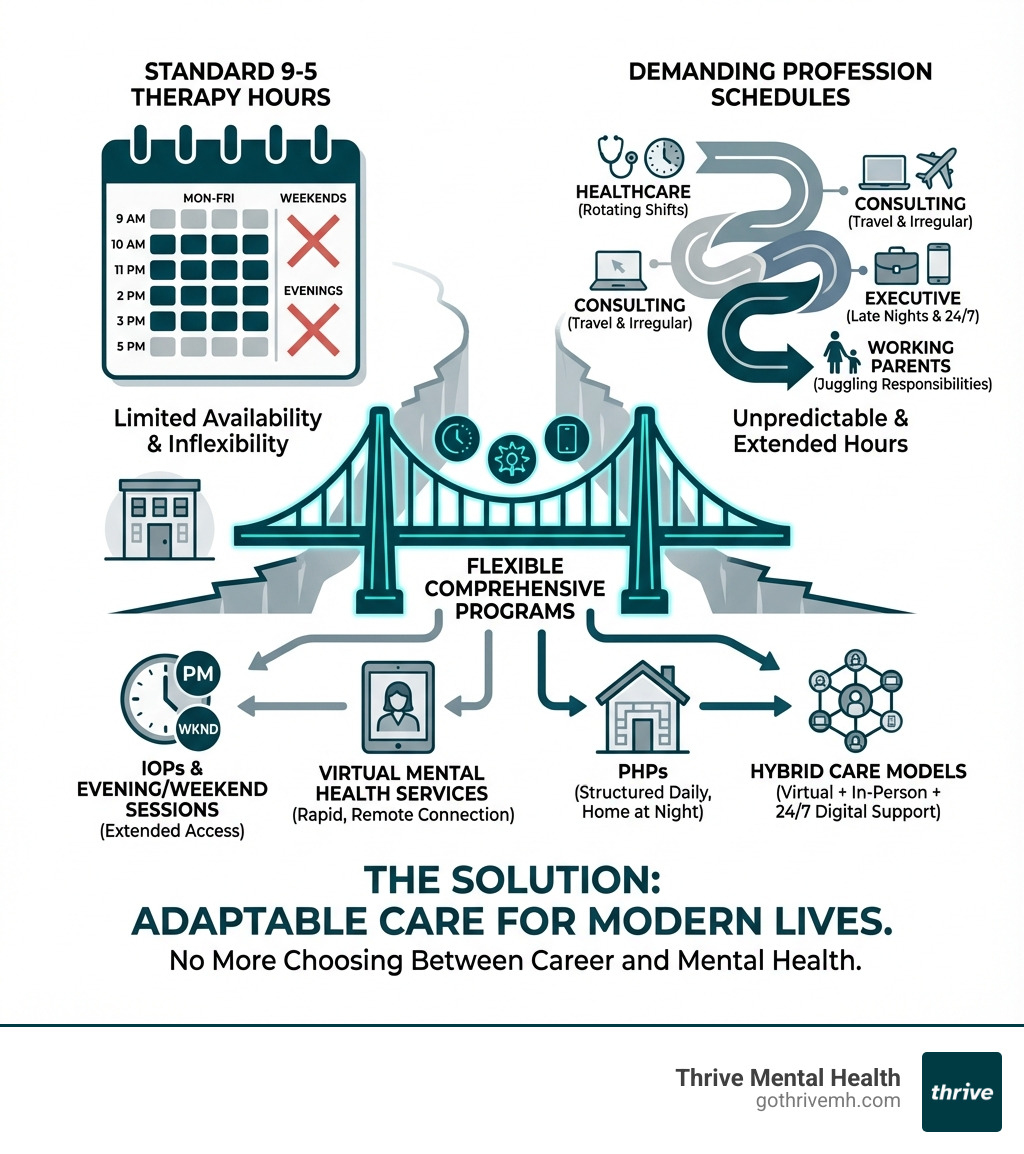
When your career demands everything, finding time for mental health feels impossible. But you don’t have to choose. Modern, flexible programs are designed to fit challenging schedules. The most effective options include:
- Intensive Outpatient Programs (IOPs): 9-19 hours weekly, spread across 3-5 days, with evening and weekend sessions available
- Virtual Mental Health Services: Connect with therapists in as little as 2 days for virtual sessions, 3 days for in-person care
- Partial Hospitalization Programs (PHPs): Structured daily treatment (20-30 hours/week) that still allows you to sleep at home
- Hybrid Care Models: Combine virtual therapy, in-person sessions, and 24/7 digital support
The key difference? These programs offer flexible scheduling options like evening appointments, weekend availability, and virtual sessions—so you don’t have to choose between your career and your mental health.
The numbers tell a clear story. Over 332 million people worldwide struggle with depression, yet traditional therapy operates on a 9-to-5 schedule that makes it nearly impossible for busy professionals to get help. You’re expected to take time off work, commute to appointments, and somehow fit recovery into business hours—all while managing the exact stress that brought you to therapy in the first place.
It doesn’t have to be this way.
Modern mental health programs are built differently. They recognize that flexibility isn’t a luxury—it’s a requirement for effective care. Whether you’re a working parent juggling daycare pickups in Tampa, a healthcare professional on rotating shifts in Miami, or a consultant traveling between Orlando and Jacksonville three weeks out of four, comprehensive programs now exist that meet you where you are.
I’m Nate Raine, CEO of Thrive Mental Health, and over the past decade I’ve led initiatives focused on making evidence-based behavioral health accessible through tech-enabled solutions. I’ve seen how the right program structure can answer the question which comprehensive mental health programs accommodate challenging schedules by delivering measurable outcomes without derailing your life.
Quick Which comprehensive mental health programs accommodate challenging schedules? definitions and resources from Thrive:
- I need mental health treatment that’s more intensive than weekly therapy but less than inpatient care. What are my options in Miami, FL?
- Mental health treatment centers in Tampa Bay, Florida.
- Remote mental health support that fits your life
The Core Challenges: Why Traditional Therapy Fails Busy Professionals
Let’s be honest: traditional therapy often feels like it was designed for a bygone era. The standard 9-to-5 appointment slots clash head-on with the demanding realities of modern work schedules. For professionals, particularly those in high-pressure fields or with irregular hours, the idea of squeezing in a weekly therapy session can feel like just another impossible task on an already overflowing plate.
We’ve heard countless stories from individuals across Florida who desperately need support but simply can’t make it work. The logistical problems are immense:
- Time Constraints: Taking time off work, even for an hour, can mean falling behind, missing crucial meetings, or feeling the pressure of deadlines. This isn’t just about the hour in session; it’s about the ripple effect on your entire workday.
- Logistical Problems: Commuting to appointments, navigating traffic, or finding parking adds significant time and stress. Imagine trying to get to an in-person appointment in Miami or Orlando during rush hour—it’s a nightmare.
- Lack of Evening or Weekend Options: Many traditional practices close their doors when the workday ends, leaving no room for those who work late or need weekend flexibility.
- Stigma in the Workplace: The fear of colleagues or superiors finding out you’re seeking mental health support can prevent many from even trying, especially in cultures where mental health is still misunderstood.
- Fear of Falling Behind: The idea that addressing your mental health means sacrificing your career progress is a powerful, debilitating barrier.
- High Cost Without Good Insurance Coverage: Even if you find a program, the financial burden can be overwhelming if your insurance (like Cigna, Optum, or Florida Blue) doesn’t cover it adequately. This financial stress can ironically exacerbate the very mental health issues you’re trying to address.
These barriers don’t just make seeking help difficult; they make it feel impossible, pushing many into a cycle of untreated stress and burnout. We believe your well-being should never be a sacrifice for your profession.
What Makes a Mental Health Program Truly Flexible? [Key Components]
So, what does a truly flexible mental health program look like? It’s one that doesn’t ask you to overhaul your life to fit its schedule but instead adapts to yours. We’ve identified several key components that make a comprehensive mental health program genuinely adaptable:

- Teletherapy and Virtual Care: This is a game-changer. Virtual sessions eliminate commute times and allow you to receive care from the privacy and comfort of your home or office. Our research shows that participants can connect with virtual sessions in an average of two days, significantly faster than the average of three days for in-person counseling. This rapid access is crucial when you’re navigating a challenging schedule.
- Asynchronous Communication Options: While not a replacement for live sessions, the ability to communicate with your care team through secure messaging can provide ongoing support and address urgent questions without needing a scheduled appointment.
- 24/7 Clinical Support: Knowing that professional help is available around the clock for urgent concerns provides an invaluable safety net. This ensures that you always get the right care, at the right time, and in the right way, even outside of traditional hours.
- Rapid Access to Care: Long waitlists are a non-starter for busy professionals. Programs designed for flexibility prioritize quick onboarding and immediate access to providers.
- Technology’s Role: Digital platforms aren’t just for scheduling. They facilitate secure teletherapy, provide access to digital tools and resources, and enable measurement-based care to track your progress effectively.
- Measurement-Based Care: This ensures that your treatment is continually adjusted based on your progress and needs, making every session count and optimizing your time investment.
How do flexible options benefit individuals with demanding jobs?
The benefits of these flexible options for individuals with demanding jobs are profound and far-reaching:
- Reduced Travel Time: This is perhaps the most obvious benefit. Eliminating the need to commute frees up hours each week, allowing you to allocate that time to work, family, or personal well-being.
- Increased Privacy: Virtual sessions, especially when conducted from home, offer a level of discretion that in-person appointments often cannot. This can be vital for professionals concerned about privacy or workplace stigma.
- Consistent Care: When care is easy to access, it’s easier to maintain consistency. Regular engagement with therapy, even amidst a chaotic schedule, is key to sustained mental health improvement.
- Evening Appointments and Weekend Sessions: These options directly address the core scheduling conflict. Many comprehensive programs now offer sessions outside the traditional 9-to-5, recognizing that your life doesn’t stop at 5 PM.
- Rapid Onboarding: As we mentioned, virtual sessions can be accommodated in an average of two days, and even in-person care can be arranged in an average of three days. This speed means less time waiting and more time healing.
For more on how virtual options can transform your mental health journey, explore our dedicated page on More info about virtual therapy.
Which comprehensive mental health programs accommodate challenging schedules? [A Breakdown]
Understanding the different levels of mental health care is crucial when deciding which comprehensive mental health programs accommodate challenging schedules. The spectrum ranges from highly intensive, round-the-clock care to more flexible, outpatient models.

- Inpatient Programs: These are the highest level of care, requiring you to live at a facility 24/7. While essential for acute crises, they are incompatible with maintaining work or school responsibilities.
- Partial Hospitalization Programs (PHP): PHPs offer intensive daily treatment, typically 20-30 hours per week, but allow you to return home in the evenings. They provide a structured environment and comprehensive psychiatric oversight, serving as a step-down from inpatient care or an alternative to hospitalization for those needing significant support.
- Intensive Outpatient Programs (IOP): These programs strike a balance, offering structured therapy for 9-19 hours per week, usually spread over 3-5 days. IOPs allow you to live at home and continue with some daily responsibilities, making them a popular choice for busy professionals.
- Traditional Outpatient Therapy: This involves weekly or bi-weekly sessions with a therapist or psychiatrist. While highly flexible in terms of time commitment, it offers the least intensity and structure, suitable for less severe conditions or ongoing maintenance.
How do programs like IOPs balance intensity with flexibility?
Intensive Outpatient Programs (IOPs) are specifically designed to bridge the gap between weekly therapy and inpatient care, making them ideal for professionals asking which comprehensive mental health programs accommodate challenging schedules. Here’s how they achieve that balance:
- Structured Treatment: IOPs provide a robust curriculum that includes individual therapy, group therapy, family sessions, psychoeducation, and skill-building workshops. This structure ensures you receive comprehensive care without the need for an overnight stay.
- Manageable Time Commitment: While IOPs require 9 to 19 hours of participation per week, this is typically spread over 3 to 5 days. This allows for significant therapeutic engagement without consuming your entire week.
- Evening and Weekend Sessions: Many IOPs, especially virtual ones, offer flexible scheduling with evening or weekend sessions. This means you can participate in treatment before or after your workday, or on non-working days, minimizing disruption to your professional life.
- Maintaining Daily Responsibilities: The core benefit of an IOP is the ability to maintain responsibilities at work, school, or home while receiving intensive treatment. You apply the skills learned in therapy directly to your daily life, then bring those real-world experiences back to your sessions for further processing.
- Group Therapy: A cornerstone of IOPs, group therapy fosters a sense of community and shared experience. It allows you to gain insights from peers facing similar challenges, building social connection and reducing feelings of isolation.
- Individual Counseling: Alongside group work, individual sessions ensure personalized attention, allowing you to dig into specific challenges and develop a custom treatment plan.
For a deeper dive into how these programs can fit into your life, explore our More info about virtual IOP programs.
Which comprehensive mental health programs accommodate challenging schedules best?
To help you decide which comprehensive mental health programs accommodate challenging schedules for your unique needs, here’s a comparison of different levels of care based on key flexibility factors:
| Feature | Inpatient (Residential) | Partial Hospitalization Program (PHP) | Intensive Outpatient Program (IOP) | Traditional Outpatient Therapy |
|---|---|---|---|---|
| Time Commitment | 24/7 stay | 20-30 hrs/wk, daytime | 9-19 hrs/wk, flexible sessions | 1 hr/wk or bi-weekly |
| Location | Residential facility | Commute daily to facility | Hybrid (Virtual/In-person options) | Hybrid (Virtual/In-person options) |
| Work/School | Not possible | Difficult, often requires leave | Possible, with flexible scheduling | Possible |
| Cost | Highest | High | Moderate | Low |
| Intensity | Highest | High | Moderate | Low |
As you can see, IOPs and Traditional Outpatient Therapy offer the most flexibility, with IOPs providing a higher level of care and structure for those who need more than weekly sessions but can’t commit to a PHP.
The Proof: How Flexible Care Drives Real-World Results
The true measure of any mental health program isn’t just its flexibility, but its ability to deliver tangible, measurable results. For busy professionals and their employers, the impact needs to extend beyond clinical outcomes to touch on workplace productivity and employee retention. We’ve seen this in the programs we offer across Florida.
A comprehensive digital mental health program, similar to the flexible models we champion, has been rigorously studied for its impact on frontline health service workers—a group accustomed to challenging schedules. The findings are compelling and underscore why flexible, comprehensive care is not just a benefit, but a strategic investment:
- Significant Symptom Reduction: Participants experienced an average 5.60 point reduction in depression and a 5.48 point reduction in anxiety over six months. This isn’t just feeling a little better; these are clinically significant improvements. In fact, 69.9% of participants reliably improved their symptoms, and 84.1% achieved reliable improvement or recovery.
- Improved Workplace Productivity: Mental health issues can significantly impact workdays, leading to both missed days and unproductive hours. The study found that participants recovered 0.70 workdays per week previously impacted by mental health issues. This translates to real-world impact for employees in demanding roles.
- Tangible Financial Savings: For an employee earning the federal median wage of $50,000, that recovery of 0.70 workdays per week corresponds to an estimated $3,491 in salary savings over six months. This demonstrates a clear return on investment for both the individual and their employer.
- Higher Employee Retention Rates: Companies thrive when their employees stay. Those who engaged with the mental health program were retained at 1.58 times the rate of those who did not, representing a 31.2% relative reduction in turnover. This is a powerful indicator of how flexible care supports long-term workforce stability.
These results are supported by scientific research on workplace mental health programs, proving that when mental health support is accessible and effective, everyone benefits.
What are the measurable benefits for employees and employers?
The benefits of accessible, flexible, and comprehensive mental health programs are clear:
- For Employees:
- 5.6 point depression reduction: A significant step towards regaining emotional balance.
- 5.5 point anxiety reduction: Less stress, more peace of mind.
- 0.70 fewer workdays impacted weekly: More productive time, less burnout.
- Increased sense of control: The ability to manage mental health without sacrificing career or personal life.
- For Employers:
- $3,491 in salary savings per employee (over 6 months): Direct financial benefits from improved productivity.
- 1.58x higher employee retention rate: A more stable, experienced, and loyal workforce.
- Reduced absenteeism and presenteeism: Employees are more engaged and effective when they are well.
- Improved company culture: Demonstrates a commitment to employee well-being, attracting and retaining top talent.
We are committed to delivering these kinds of measurable outcomes through our programs. To understand how we can support you with higher-intensity care, explore our Learn about our PHP options.
For Employers: How to Choose a Mental Health Program That Actually Works
For employers, offering robust mental health support isn’t just about ticking a box; it’s about fostering a resilient, productive, and loyal workforce. But with so many options, how do you choose which comprehensive mental health programs accommodate challenging schedules and genuinely work for your team?
First, let’s address what often falls short: traditional Employee Assistance Programs (EAPs) frequently suffer from low utilization rates, often due to limited offerings or a lack of proactive engagement. Your employees need more than just a helpline; they need a pathway to effective, accessible care.
Here’s how to design or select mental health programs that offer both comprehensive care and the flexibility needed for challenging schedules:
- Prioritize Accessibility: This means quick onboarding and minimal wait times. Our programs, for example, can connect participants with virtual sessions in an average of two days and in-person care in three days.
- Accept Technology and Virtual Care: Offering teletherapy and digital tools significantly expands access, especially for employees in diverse locations across Florida—from the Panhandle to the Keys—where in-person access might be limited.
- Offer Flexible Scheduling: Look for programs that provide evening, weekend, and hybrid (virtual and in-person) options. This ensures that care can fit around varying work shifts and personal commitments.
- Ensure Comprehensive, Evidence-Based Treatment: The program should offer a full spectrum of care, from individual and group therapy to medication management, all grounded in proven clinical approaches.
- Implement Proactive Screening and Care Navigation: Don’t wait for employees to be in crisis. Proactive screenings can identify needs early, and dedicated care navigators can guide employees to the right level of support, reducing the burden of finding help.
- Focus on Measurable Outcomes: A truly effective program tracks clinical improvements, productivity gains, and retention rates. This data allows you to see the real impact of your investment.
- Understand Legal Compliance and Reasonable Accommodations: Employers have obligations under the ADA to provide reasonable accommodations for employees with mental health conditions. Resources like the Resources from the Job Accommodation Network (JAN) can help you understand and implement these effectively. This includes flexible workplace arrangements, scheduling adjustments, and modified work environments.
- Ensure Broad Insurance Coverage: Partner with providers who accept a wide range of insurance plans, including major carriers like Cigna, Optum, and Florida Blue, to minimize financial barriers for your employees.
By focusing on these key features, employers can build a mental health benefit that truly supports their workforce, leading to healthier employees and a more productive organization.
Frequently Asked Questions about Flexible Mental Health Care
How much time do I need to commit to an IOP?
Most Intensive Outpatient Programs (IOPs) require 9 to 19 hours of participation per week, typically spread across 3 to 5 days. Many programs, especially virtual ones, offer evening or weekend sessions to fit around a standard workday, making them highly adaptable to challenging schedules.
Can I use my insurance for a flexible mental health program?
Yes, most major insurance plans, including Florida Blue, Cigna, Aetna, Optum, UnitedHealthcare, and others, often cover comprehensive programs like IOP and PHP. It’s crucial to verify your specific benefits, as coverage for in-network and out-of-network providers can vary. Our team can help you steer this process to ensure you understand your options and maximize your coverage.
Is virtual therapy as effective as in-person care?
Research shows that for many conditions like depression, anxiety, PTSD, and OCD, virtual therapy delivers outcomes comparable to in-person treatment. The key is finding a structured, evidence-based program with qualified clinicians, regardless of the format. Virtual care offers the added benefits of convenience, privacy, and reduced logistical problems, making it an excellent option for those with demanding schedules. You can learn more about Thrive’s virtual options here: More info about virtual therapy.
What if my schedule fluctuates significantly?
Programs designed for flexibility are often built to accommodate this. Virtual options allow you to access care from anywhere, reducing the impact of travel or changing shifts. Some programs offer asynchronous tools or flexible check-ins, and many IOPs provide multiple session times throughout the week, allowing you to choose what works best for your current schedule. Open communication with your care team is key to maintaining consistent support.
Do Thrive’s flexible programs serve my state?
Yes, Thrive offers virtual and in-person IOP and PHP options across Florida, with dedicated centers and providers in major areas like Tampa Bay, Miami, and Orlando. If you live in Florida, you can start with a virtual assessment and get matched to the right level of care within a few days.
Conclusion: Take Back Control of Your Schedule and Your Well-being
Busy schedules and demanding jobs often leave little room for self-care, let alone comprehensive mental health treatment. But the good news is, you no longer have to choose between your career and your well-being. Modern mental health programs are redefining access to care, proving that it is possible to receive high-quality, evidence-based support without derailing your life.
When considering which comprehensive mental health programs accommodate challenging schedules, look for those that prioritize flexibility through virtual options, evening and weekend sessions, and rapid access to care. Intensive Outpatient Programs (IOPs) and Partial Hospitalization Programs (PHPs) are leading the way, offering the structured, intensive care you need with the adaptability your life demands. These programs deliver measurable results, improving clinical outcomes, boosting workplace productivity, and enhancing employee retention.
If you live in Florida, Thrive’s virtual and in-person programs are designed specifically for busy adults and young professionals who need more than weekly therapy but less than inpatient care. Explore our services to see what fits your life:
- Intensive Outpatient Program (IOP)
- Partial Hospitalization Program (PHP)
- Virtual therapy and remote support
- Verify your insurance benefits in minutes
It’s time to take back control of your schedule and invest in your mental health. Your career and your well-being can, and should, thrive together.
Ready for support? Thrive offers virtual and hybrid IOP/PHP programs with evening options. Verify your insurance in 2 minutes (no obligation) → Start benefits check or call 561-203-6085. If you’re in crisis, call/text 988.