
A Practical Guide to Personalized Mental Health Care

A Practical Guide to Personalized Mental Health Care: Why Your Treatment Isn’t Working (And What to Do About It)
Which mental health treatment approach offers the most personalized care? Precision mental health care combining measurement-based care (MBC), individualized data analysis (genetics, brain imaging, lifestyle factors), and intensive programs like IOP/PHP offers the most personalized treatment today. Unlike traditional one-size-fits-all approaches, these methods tailor interventions to your unique biology, history, and real-time progress—not just your diagnosis.
Quick Answer: The Most Personalized Mental Health Approaches
| Approach | Why It’s Personalized | Best For |
|---|---|---|
| Measurement-Based Care (MBC) | Tracks your progress weekly and adjusts treatment in real time based on data | Anyone in therapy who wants to see if it’s actually working |
| Intensive Outpatient Programs (IOP) | Combines individual therapy, group support, and skills training custom to your specific challenges | Treatment-resistant depression, anxiety, trauma, or burnout |
| Precision Psychiatry | Uses genetics, brain scans, and AI to match you with the most effective medication or therapy | People who’ve tried multiple medications without success |
| Modular/Integrative Therapy | Blends techniques from CBT, DBT, EMDR, and other methods based on what you need right now | Complex or co-occurring conditions |
Here’s the uncomfortable truth: nearly one-third of adults with major depression don’t respond to at least two different antidepressants. Half of people treated for anxiety don’t improve with first-line treatments. If you’ve been in therapy for months—or years—without feeling significantly better, it’s not your fault. The problem is the one-size-fits-all system.
Traditional mental health care gives you a label (depression, anxiety, PTSD) and a standard protocol, ignoring your unique brain, history, and genetics. This cookie-cutter approach fails because it ignores everything that makes you you.
The good news? A new approach is here. Personalized (or “precision”) mental health care uses real data—your symptoms, your biology, your weekly progress—to build a treatment plan that actually fits. It’s faster, more effective, and proven to help people who’ve been stuck in the trial-and-error loop for years.
This guide shows you exactly how personalized care works and how to access it in Florida.
I’m Nate Raine, CEO of Thrive Mental Health. We built Thrive to fix a broken system. For over a decade, my work in precision medicine and large-scale healthcare research has focused on one question: which mental health treatment approach offers the most personalized care? This guide gives you the answer—and shows you how to get treatment that actually works for you.
What is Personalized Mental Health Care (And Why It’s the Future)
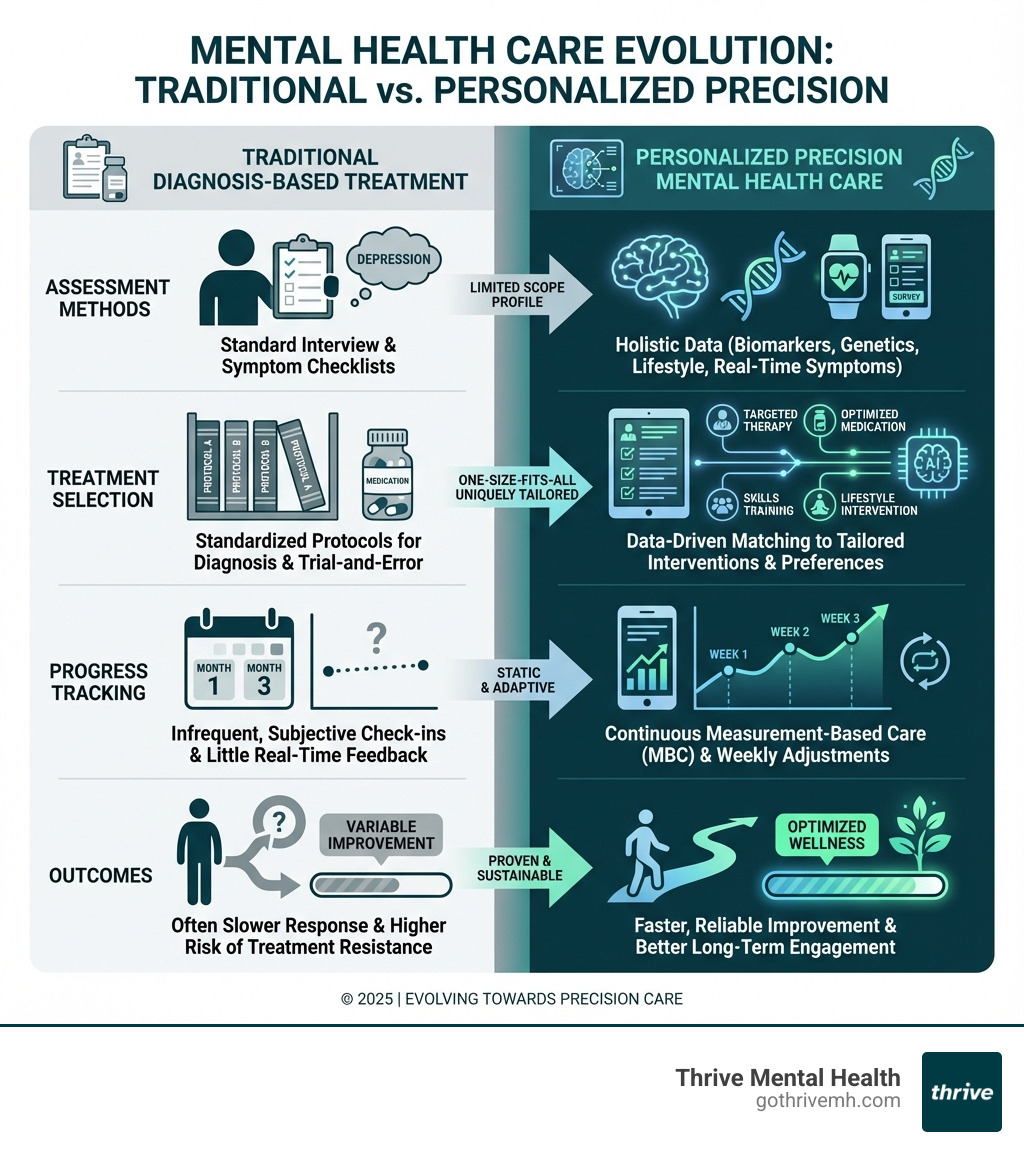
Personalized mental health care, often called precision mental health, is an approach that moves beyond generic treatment protocols. Instead of treating a diagnosis, we treat the individual. This means tailoring every aspect of care—from assessment to intervention—to your unique biological, psychological, and social profile. It is about recognizing that your journey is unlike anyone else’s, even if you share a similar diagnosis.
This approach acknowledges that your symptoms are influenced by a complex interplay of factors, including your genetics, brain chemistry, life experiences, cultural background, and personal preferences. By gathering and analyzing this individualized data, we can create a treatment plan that is not only more effective but also deeply resonates with you, leading to greater engagement and better outcomes.
The Failure of the “One-Size-Fits-All” Model
For too long, mental health care has relied on a “one-size-fits-all” model. This traditional approach typically involves assigning a diagnostic label based on the Diagnostic and Statistical Manual of Mental Disorders (DSM) and then applying a standardized treatment protocol. While these protocols have their place, they often overlook the nuances of individual experience.
The limitations of this model are stark. Research shows that nearly one-third of adults with major depressive disorder fail to respond to at least two different antidepressant medications, and half of those treated for generalized anxiety disorder do not respond to first-line treatments. These are not just statistics; they represent millions of people stuck in a frustrating cycle of trial-and-error treatment. This “one-size-fits-all” approach leads to burnout, hopelessness, and a feeling that the system itself has failed you. It is inefficient, disheartening, and it is why so many people struggle to find relief.
If you want to understand how therapy itself can help when it is done well, this overview of the benefits of therapy explains how different approaches can improve mood, relationships, and daily functioning.
The Real-World Benefits of a Custom Treatment Plan
The shift to personalized mental health care is not just a theoretical improvement; it delivers tangible, life-changing benefits for patients. When treatment is precisely matched to your needs, we see:
- Higher Success Rates: Instead of hoping a generic treatment works, personalized approaches target the root causes and specific manifestations of your condition, leading to more effective interventions.
- Faster Recovery: By eliminating much of the trial-and-error phase, you can get to the right treatment sooner, accelerating your path to feeling better.
- Reduced Side Effects: Especially in pharmacotherapy, genetic insights can help predict how you will metabolize medications, minimizing adverse reactions and optimizing dosage.
- Increased Client Engagement: When you feel heard, understood, and actively involved in your treatment plan, your motivation and participation increase. This is critical, as research shows that client engagement—”the process of creating deep connections with clients that drive decisions, interaction, and participation over time”—is a cornerstone of successful therapy. You can read more about the power of client engagement in therapy.
- Long-Term Wellness: Personalized care often equips you with bespoke coping strategies and a deeper understanding of your own mental landscape, fostering resilience and sustained well-being.
- Feeling Seen and Heard: Perhaps most importantly, personalized care validates your individual experience. It assures you that your unique struggles are being addressed, building trust and strengthening the therapeutic alliance.
The impact of this approach is significant. Studies show that when care is custom and responsive, patients see clinically significant improvements in their symptoms. People get better, faster. Our programs at Thrive Mental Health are built on this very principle: combining clinical expertise, flexible scheduling, and measurable results to deliver care that actually works for you.
If you are exploring options beyond once-a-week sessions, our Intensive Outpatient Program (IOP) and Partial Hospitalization Program (PHP) are designed around this personalized, data-driven model.
The Science of You: Data That Powers 21st-Century Treatment
Personalized mental health is not based on guesswork; it is powered by data. We are moving beyond subjective assessments to use objective, measurable factors that create a clear map of your mental health. This data-driven view allows us to answer which mental health treatment approach offers the most personalized care by identifying precisely what you need to get better.

From Your Genes to Your Brain: Opening Up Biological Clues
Your biology holds critical clues to your mental health. Thanks to major scientific advances, we can now look inside your body and brain to guide treatment:
- Genetic Testing (PGx): Pharmacogenomics (PGx) can analyze how your genes influence your response to certain medications. This is crucial because variations in specific genes can affect drug metabolism and response, meaning a medication that works for one person might be ineffective or cause severe side effects in another. While PGx currently helps narrow down treatment options rather than definitively identify the best one, it is a powerful tool to guide medication selection and reduce trial-and-error.
- Brain Imaging (fMRI): Functional Magnetic Resonance Imaging (fMRI) allows us to observe brain activity. Researchers like Leanne Williams have used fMRI to identify at least six “biotypes” of depression, each associated with specific patterns of dysfunction in brain circuits. This is not just academic; it directly informs treatment:
- CBT may be effective for those with hyperconnectivity in the default mode network.
- Pramipexole, a dopamine agonist, has shown promise for depression biotypes with reward circuit dysfunction.
- Transcranial Magnetic Stimulation (TMS) can benefit individuals with underactive cognitive control circuits.
- Problem-solving therapy (a form of CBT) proved effective for one-third of individuals with depression and obesity who had overactive cognitive control circuits.
- Neuroimaging for Precision Psychiatry: The ultimate goal is to use these insights to offer “the right treatment for each patient.” This includes optimizing brain-stimulation target sites and frequencies based on an individual’s unique brain structure and function. As we dig deeper into neuroimaging for precision psychiatry, we open up unprecedented opportunities for truly personalized interventions.
How AI and Technology Are Finally Fixing Mental Health Care
The sheer volume and complexity of biological and psychological data necessitate powerful tools for analysis. This is where Artificial Intelligence (AI) and machine learning (ML) step in, changing the landscape of mental health care.
- Predictive Analytics and Machine Learning Models: AI algorithms can analyze vast datasets, including patient history, family history, suicidality, inpatient treatment records, personality factors, anxiety and depression assessments, and comorbidities, to predict treatment outcomes and even suicide risk. For example, a team led by Dr. Bentley is using ML algorithms to improve the prediction of suicide risk within months of a patient seeing a healthcare provider, analyzing data from over 800,000 suicide risk assessments.
- Clinical Decision Support Systems (CDSS): These systems integrate AI and ML to provide clinicians with evidence-based recommendations, augmenting their decision-making capabilities. The Trier Treatment Navigator (TTN) is one such example, helping tailor individual psychological interventions. These tools do not replace human clinicians but empower them with data-driven insights, ensuring that treatment choices are as informed and precise as possible.
- Treatment Matching Algorithms: Imagine an algorithm that could predict which specific therapy or medication you are most likely to respond to. Researchers are building machine learning models that can give individualized treatment recommendations based on a multitude of variables. This moves us closer to a future where your treatment is not a guess, but a calculated, data-informed choice.
At Thrive Mental Health, we accept these advancements. Our tech-enabled approach leverages insights from data and research to inform our care, ensuring that our virtual and in-person programs deliver measurable results. If you want to see how this looks in real life, explore our virtual IOP and hybrid programs available across Florida.
Which mental health treatment approach offers the most personalized care?
So, which mental health treatment approach offers the most personalized care? It is not a single therapy type. It is a system designed to adapt to you. The most effective approach combines two powerful strategies: Measurement-Based Care (MBC) and intensive, structured programs like IOP and PHP.

Measurement-Based Care (MBC): Tracking What Actually Works for You
Measurement-Based Care (MBC) is a cornerstone of personalized mental health. It involves routine progress monitoring, where your symptoms and well-being are regularly assessed using standardized tools. This is not just paperwork; it is about collecting real-time data that provides objective feedback on your progress.
Here is how MBC ensures personalized care:
- Data-Informed Feedback: The data collected gives your clinician concrete information about how you are responding to treatment. This moves beyond subjective feelings to objective metrics.
- Adjusting Treatment in Real Time: If the data shows you are not progressing as expected, or if new challenges arise, your therapist can adjust your treatment plan immediately. This agile approach prevents prolonged periods of ineffective treatment.
- Patient-Reported Outcomes (PROs): Your input is central. MBC often relies on PROs, ensuring that your experience and perception of progress are central to the treatment decisions.
- Empowering Patients with Data: Seeing your own progress, or lack thereof, can be incredibly empowering. It fosters a collaborative spirit, making you an active participant in your recovery journey.
At Thrive Mental Health, our “measurable results” philosophy is deeply rooted in MBC. We continuously monitor your progress, ensuring that the care you receive is always optimized for your unique needs.
Intensive Programs (IOP/PHP): A Deep Dive into Personalized Healing
For many, standard weekly therapy simply is not enough. This is where Intensive Outpatient Programs (IOPs) and Partial Hospitalization Programs (PHPs) offer a profoundly personalized and effective solution. These programs provide a higher level of care than traditional outpatient therapy but are less restrictive than inpatient hospitalization, allowing you to maintain daily routines while receiving robust support.
- More Than Once-a-Week Therapy: IOPs typically involve several hours of therapy multiple days a week, while PHPs offer even more intensive daily sessions. This increased contact allows for deeper therapeutic work, faster skill acquisition, and more consistent support.
- Combining Group and Individual Therapy: Our programs skillfully blend individual therapy—where you receive one-on-one attention custom to your specific issues—with group therapy. Group sessions offer peer support, diverse perspectives, and a safe space to practice new skills, all while still allowing for personalized application of concepts.
- Skills-Based Learning (CBT, DBT): We integrate evidence-based modalities like Cognitive Behavioral Therapy (CBT) and Dialectical Behavior Therapy (DBT). While these are structured therapies, their application within an IOP/PHP setting is highly personalized, focusing on your specific negative thought patterns, your emotional regulation challenges, and your coping skills.
- Structured Support: The structured nature of IOP/PHP provides a consistent and supportive environment crucial for significant healing. Our programs are designed for people who need more than once-a-week therapy but less than inpatient care, offering the ideal balance of intensity and flexibility.
- Ideal for Treatment-Resistant Conditions: Because of their intensity and multi-faceted approach, IOPs and PHPs are particularly effective for individuals who have not responded to less intensive treatments. They provide the comprehensive support needed to break through persistent symptoms.
- Flexible Virtual and Hybrid Options: We understand the demands of modern life. That is why Thrive Mental Health offers flexible virtual and hybrid IOP/PHP options across Florida. This means you can access highly personalized, evidence-based care from the comfort of your home, fitting treatment around your work or family commitments. You can learn more about our Intensive Outpatient Programs (IOP) and our Partial Hospitalization Programs (PHP).
Which conditions benefit most from a personalized approach?
While almost anyone can benefit from personalized care, certain conditions particularly thrive under this custom model:
- Treatment-Resistant Depression (TRD): When standard antidepressants and therapies fail, a personalized approach using genetic testing, brain imaging to identify specific “biotypes” of depression, and intensive programs like PHP can pinpoint effective alternative treatments.
- Complex PTSD (CPTSD): CPTSD often stems from prolonged or repeated trauma, leading to intricate symptom presentations. Personalized care allows for a multi-modal approach, integrating trauma-informed therapies like EMDR, somatic therapy, and DBT skills custom to the individual’s unique trauma history and coping mechanisms.
- Bipolar Disorder: Managing bipolar disorder requires precise adjustments to medication, lifestyle, and therapy based on an individual’s specific mood cycling patterns, triggers, and family history. Personalized care ensures a dynamic treatment plan that evolves with the client.
- Severe Anxiety Disorders (e.g., OCD, Panic Disorder): For severe anxiety, highly personalized exposure and response prevention (ERP) protocols, combined with genetic insights into medication response and intensive skill-building in an IOP setting, can be transformative.
- Co-occurring Disorders: Many individuals experience mental health challenges alongside substance use disorders, eating disorders, or personality disorders. Personalized treatment is essential here, as it addresses the complex interplay of these conditions simultaneously, rather than in isolation.
Our Partial Hospitalization Programs (PHP) are specifically designed to address these complex needs with an intensive, personalized framework that delivers results.
How to Find and Access a Truly Personalized Mental Health Program
Finding a mental health program that truly prioritizes personalized care can feel daunting, but it is a critical step toward effective healing. It requires a proactive approach and knowing what questions to ask.
| Aspect | Traditional Therapist/Program | Personalized Care Provider (like Thrive) |
|---|---|---|
| Assessment | Focuses on diagnostic labels and general symptom checklists. | Deep dive into biology (genetics, brain patterns), personal history, lifestyle, and real-time symptoms. |
| Treatment Plan | Standardized protocols for a given diagnosis. | Dynamic plan custom to your unique profile, adapting as you progress. |
| Progress Tracking | Often subjective, relying on verbal reports. | Objective, data-driven (MBC), using validated tools and real-time feedback. |
| Flexibility | Limited ability to adjust core approach. | Highly adaptable, blending modalities (CBT, DBT, EMDR) based on your evolving needs. |
| Engagement | Patient passively receives treatment. | Patient actively collaborates in shaping their treatment journey. |
| Outcomes | Variable, often requires trial-and-error. | Higher success rates, faster recovery, sustained wellness due to precision. |
Critical Questions to Ask Any Potential Therapist
When you are looking for a mental health provider, especially if you are seeking personalized care, ask questions that go beyond their credentials. Here are some critical questions to help you find the right fit:
- “How do you measure progress?” A provider committed to personalized care will have a systematic way of tracking your symptoms and well-being, using tools like patient-reported outcomes (PROs) and measurement-based care (MBC). They should be able to articulate how this data informs your treatment.
- “How do you tailor treatment beyond the diagnosis?” Listen for answers that describe considering your unique history, preferences, lifestyle, cultural background, and even biological factors like genetics or brain function. They should explain how they move beyond generic protocols.
- “What happens if the initial approach isn’t working?” A personalized approach means actively monitoring and adjusting. They should describe a process for re-evaluating your plan, exploring different modalities, or intensifying care if you are not seeing the desired results, rather than just continuing with an ineffective strategy.
- “Do you use data to inform treatment decisions?” This is a key indicator. Providers utilizing data-informed approaches are more likely to offer truly personalized care, as they rely on objective information, not just intuition, to guide their interventions.
At Thrive Mental Health, we pride ourselves on our outcome-focused treatment, where these questions are central to our philosophy. Our clinicians are experts in tailoring evidence-based practices to your individual journey.
Navigating Insurance for Advanced Care (IOP & PHP)
Accessing high-quality, personalized mental health care, especially intensive programs like IOPs and PHPs, often involves navigating insurance. We understand this can be complex, but we are here to help.
- Understanding Your Plan: Familiarize yourself with your insurance plan’s specifics, particularly regarding mental health coverage. Know the difference between in-network and out-of-network benefits, and whether you have a PPO or HMO plan, as this impacts your options and costs.
- Verifying Benefits for IOP/PHP: Intensive programs are often covered, but coverage can vary significantly. It is crucial to verify your specific benefits for IOP or PHP services. Many major insurance providers, including Cigna, Optum, and Florida Blue, offer coverage for these levels of care.
- Local Access in Florida: Whether you are in Tampa Bay, Miami, Orlando, Jacksonville, Boca Raton, West Palm Beach, Fort Lauderdale, Sarasota, Naples, St. Petersburg, or anywhere else in the state, we provide virtual and hybrid programs designed to be accessible. Our virtual model helps overcome geographical barriers, ensuring you can receive personalized care regardless of your exact location within Florida.
We make it easy to understand your options. You can quickly and confidentially verify your insurance coverage in 2 minutes for our programs with no obligation.
Frequently Asked Questions about Personalized Mental Health Care
Is personalized mental health care more expensive?
It is often more cost-effective. While some advanced diagnostics have upfront costs, personalized care saves you money and time in the long run by avoiding ineffective treatments and speeding up recovery. Many insurance plans, including Cigna, Optum, and Florida Blue, cover advanced programs like IOP and PHP that use personalized methods, making them highly accessible.
Can I get personalized care through virtual therapy?
Absolutely. Modern virtual IOP and PHP programs like ours leverage technology to deliver highly personalized, data-driven care. This makes it incredibly accessible from anywhere in Florida. Our virtual platforms allow for continuous monitoring, real-time adjustments, and a blend of individual and group therapies, all custom to your needs. This can be a game-changer for people seeking effective care without geographical limitations.
How do I know if I need more than standard weekly therapy?
If you have been consistently attending therapy for several months and still feel stuck, your symptoms are not improving significantly, or you find yourself needing more support and structure than one hour a week can provide, it is a strong indicator that a more intensive and personalized program like an Intensive Outpatient Program (IOP) or Partial Hospitalization Program (PHP) might be your most effective next step. These programs offer a deeper dive into healing, providing the comprehensive support needed for breakthrough progress.
Which mental health treatment approach offers the most personalized care?
The most personalized approach combines Measurement-Based Care (MBC) with intensive, structured programs like IOP and PHP. MBC tracks your symptoms and functioning session by session, while IOP/PHP give you enough time, support, and skills practice each week to actually change patterns. At Thrive, we build this into all of our IOP and PHP tracks.
Do Thrive programs take my insurance?
Thrive Mental Health is in-network with many major insurers in Florida, including Cigna, Optum, and Florida Blue. Coverage can vary by plan, so the fastest way to know your exact out-of-pocket cost is to verify your insurance online. It takes about 2 minutes and does not obligate you to start treatment.
Your Path to Recovery Starts Here
The failure of a one-size-fits-all approach to mental health care is not your failure. It highlights a systemic gap that personalized, precision mental health care is finally closing. At Thrive Mental Health, we are dedicated to providing the most personalized and effective treatment available, helping you move past the frustration of ineffective care toward genuine, lasting recovery. Our approach integrates cutting-edge science with compassionate, individualized support, ensuring that your unique journey is honored and your specific needs are met.
Whether you are in Tampa Bay, Miami, Orlando, Jacksonville, or joining virtually from anywhere in Florida, you can access structured, measurement-based care without putting your life on hold. Our Intensive Outpatient (IOP) and Partial Hospitalization (PHP) programs give you more than once-a-week support, with evening options and hybrid formats to fit real schedules.
If you are exploring next steps and want to avoid another round of trial-and-error, you can check your benefits in minutes and see what your care would actually cost.
Ready for support? Thrive offers virtual and hybrid IOP/PHP programs with evening options. Verify your insurance in 2 minutes (no obligation) → Start benefits check or call 561-203-6085. If you’re in crisis, call/text 988.