
Buyer’s Guide: Best Flexible PHP Programs

You Don’t Have to Quit Your Job to Get Real Mental Health Help
Which partial hospitalization programs offer flexible scheduling for full-time employees? Virtual and hybrid PHP programs—like those offered by Thrive Mental Health across Florida—now provide evening, weekend, and telehealth options that let you maintain full-time employment while receiving intensive care. Traditional PHPs require 20-30 daytime hours per week, but flexible programs adapt to your work schedule instead of forcing you to choose between your paycheck and recovery.
Quick Answer: Work-Friendly PHP Options
- Virtual PHPs: Zero commute, attend from home before/after work
- Evening Programs: Sessions scheduled outside typical 9-5 hours
- Hybrid Models: Mix of telehealth and occasional in-person visits
- Weekend Tracks: Available at select facilities including Thrive locations
- Coverage Areas: Florida (statewide virtual and in-person), with virtual options also available in California, Indiana, Arizona, and South Carolina
- Insurance: Most major plans accepted (Cigna, Optum, Florida Blue, Aetna, Blue Cross)
You’re stuck. Weekly therapy isn’t cutting it anymore, but the intensive programs you need all seem to run Monday through Friday, 9 AM to 3 PM—right when you’re supposed to be working. The thought of telling your boss you need to disappear for weeks sounds impossible. Your anxiety spikes just thinking about it.
Here’s what nobody tells you: you don’t have to choose between keeping your job and getting serious help. The mental health industry is finally catching up. Flexible Partial Hospitalization Programs now exist specifically for people who can’t afford to pause their careers.
Traditional PHPs are based on an outdated model. But research shows structured outpatient programs work—94% of clients don’t need readmission to higher levels of care. You can get real results without quitting your job. The key is finding a program built around your schedule.
The difference is scheduling flexibility, virtual options, and staff who understand workplace accommodations. Some programs offer evening or telehealth sessions. The best, like what we’ve built at Thrive, combine both and add weekend options when needed.
I’m Nate Raine, CEO of Thrive Mental Health. We built our IOP and PHP programs for working adults who need more than weekly therapy but can’t disappear from their jobs. We help professionals find which partial hospitalization programs offer flexible scheduling for full-time employees without sacrificing their careers.
This is about getting the intensive support you need, structured around the life you’re trying to protect. Below, I’ll show you how flexible PHPs work, your legal rights, and how to find a program that fits—starting now.
Which partial hospitalization programs offer flexible scheduling for full-time employees? vocab explained:
What Does a Flexible PHP Schedule Look Like at Thrive?
Traditional Partial Hospitalization Programs (PHPs) require 20-30 hours of weekly therapy—excellent for progress, but nearly impossible to manage with a full-time job. This level of care is often a step-down from inpatient treatment or for symptoms too severe for standard therapy. At Thrive Mental Health, we’ve innovated our programs to make this intensive support accessible for people working 40+ hours a week across Florida.
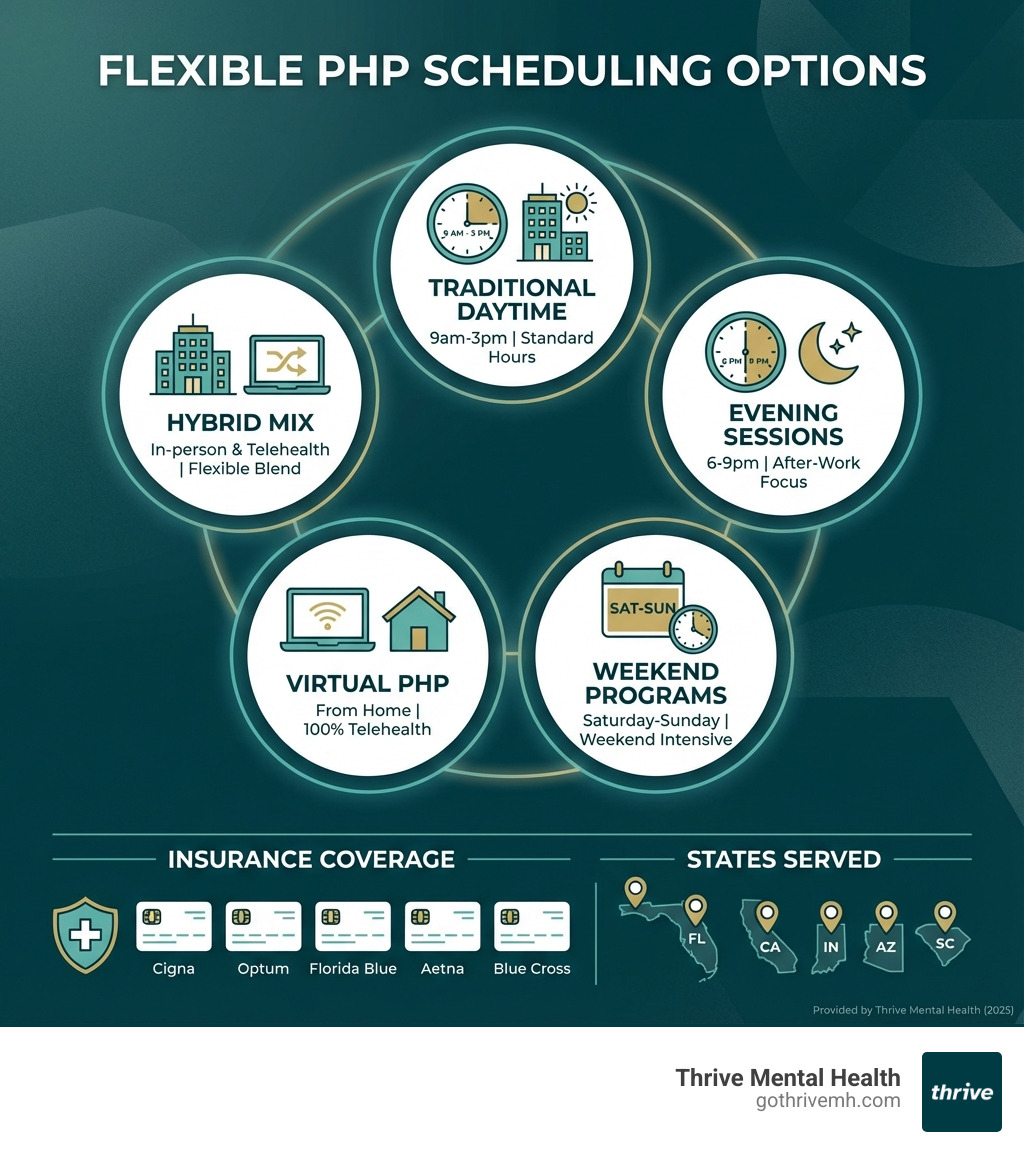
At Thrive, “flexible” means our programs integrate into your life, not dismantle it. We make intensive mental health care a reality for working professionals throughout Florida, with virtual programs also available in California, Indiana, Arizona, and South Carolina.
Here’s how we offer the flexibility you need:
-
Evening and Weekend PHP Tracks: Instead of requiring attendance during business hours, we offer comprehensive PHP sessions in the evenings and on weekends. This allows you to get therapy outside of your work schedule, maintain your job, and continue earning a living—all crucial for recovery.
-
Virtual PHPs (Telehealth) for Zero Commute: Our virtual PHP options let you attend sessions from home, eliminating travel time and saving energy. This is a huge benefit in our Florida service areas like Miami or Tampa, where commutes can be long. Telehealth also provides a layer of discretion many professionals value.
-
Hybrid Models (Mix of In-Person and Virtual): For those who want a mix of online convenience and in-person connection, our hybrid models offer the best of both. Attend some sessions virtually and others at our centers in Florida locations like Tampa Bay. This adapts your treatment to your clinical needs and lifestyle.
-
Insurance Accepted: Access to care shouldn’t be limited by cost. We work with most major insurance providers, including Cigna, Optum, Florida Blue, Aetna, and Blue Cross, and help you steer coverage to ensure your PHP is affordable.
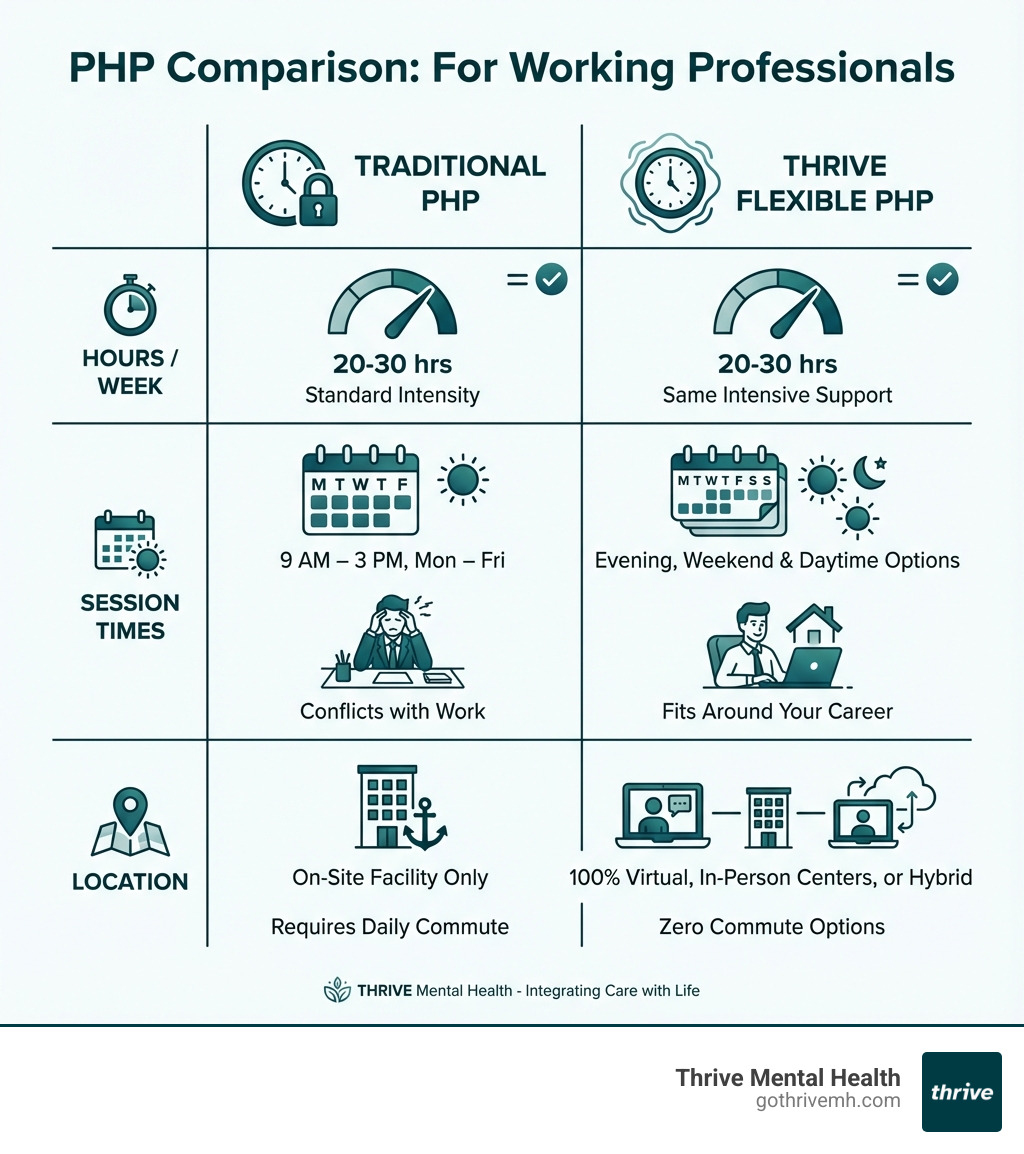
| Feature | Traditional PHP | Thrive Flexible PHP |
|---|---|---|
| Hours/Week | 20-30 hours | 20-30 hours |
| Session Times | Primarily 9 AM – 3 PM, Monday – Friday | Evening, Weekend, and Daytime Options |
| Location | On-site facility only | 100% Virtual, In-Person Centers, or Hybrid |
| Commute | Daily commute required | Zero commute (Virtual), Reduced commute (Hybrid) |
| Work Compatibility | Highly challenging for full-time employees | Designed for full-time employees |
| Privacy | May require disclosing absence from work | More discreet, less interruption to work schedule |
| Insurance | Varies by provider | Cigna, Optum, Florida Blue, Aetna, Blue Cross, and others |
| States Served | Local only | Florida (statewide virtual & in-person), with virtual options in CA, IN, AZ, SC |
How Do Thrive’s Flexible PHPs Let You Keep Your Job?
The core challenge for working individuals is getting help without jeopardizing their livelihood. Our flexible PHPs bridge this gap.
-
Structured Support Outside Work Hours: By offering evening and weekend sessions, we ensure you receive comprehensive therapy without taking extensive time off work. You can attend group therapy, individual counseling, and psychiatric consultations when your workday is done.
-
Real-World Skill Practice Between Sessions: Unlike inpatient programs, PHP allows you to practice new coping mechanisms in real-time. If you’re learning Dialectical Behavior Therapy (DBT) skills, you can immediately apply them at work. This integration of learning and living accelerates recovery.
-
No Wasted Time Commuting (Virtual): With our virtual PHP, the hours spent driving are reclaimed. You can log in from your home office in Orlando, your quiet space in Fort Lauderdale, or a private room at your workplace in Jacksonville. This efficiency means less stress and more time for personal responsibilities.
-
Maintain Employment and Benefits While Getting Care: A flexible PHP helps you avoid the financial strain and career disruption of traditional programs. You keep your income, health insurance, and professional momentum. This stability is a powerful factor in recovery.
Is an IOP Enough for Working Professionals?
Intensive Outpatient Programs (IOPs) are another excellent, often more flexible, option. IOPs typically require 9 to 15 hours per week, with sessions frequently scheduled in the evenings or on weekends, making them highly compatible with a full-time job.
-
When to Choose PHP vs. IOP (Clinical Need, Symptom Severity): The decision depends on your clinical needs.
- Choose PHP if you require a higher level of structure (20-30 hours/week), perhaps as a step-down from inpatient care or if symptoms make it hard to function independently.
- Choose IOP if you need more than weekly therapy but not the daily structure of a PHP. IOPs are ideal for moderate symptoms if you can maintain safety and manage daily responsibilities.
-
Step-Down Care for Ongoing Support: For many, an IOP is a crucial “step-down” from a PHP. It allows you to continue building skills and solidify your recovery with ongoing, structured support, which is vital for long-term success.
At Thrive, we offer both flexible PHP and IOP programs. We can help you determine the appropriate level of care based on a comprehensive assessment.
How to Find a Work-Friendly PHP That Actually Fits Your Life

Finding a PHP that accommodates a full-time work schedule is more achievable than ever, thanks to telehealth and specialized programs. Here’s what to look for to assess if a program is a true fit.
Must-Have Features in a Flexible PHP for Full-Time Employees
When evaluating which partial hospitalization programs offer flexible scheduling for full-time employees, dig deeper than just asking about “flexibility.” Here are the non-negotiables:
- Evening or Weekend Session Options: This is paramount. Verify that group therapy, individual sessions, and psychiatric check-ins are available when you’re not at work.
- 100% Virtual or Hybrid Delivery: Virtual programs eliminate commute time and offer privacy. Hybrid models balance remote convenience with in-person connection, which is useful in our Florida service areas from Miami to Tampa.
- Clear Attendance Policy for Working Adults: A flexible PHP understands work emergencies. Ask about their policy on missed sessions, make-up options, and how they handle occasional work conflicts.
- Staff Who Help with FMLA/ADA Paperwork: The best programs have staff knowledgeable about FMLA and ADA who can help you prepare documentation for your employer. This support reduces stress and helps you use your legal protections.
- Career-Focused Therapy Groups: Some programs offer groups or counseling addressing work-related stress, career transitions, or integrating recovery into your professional life.
How to Search for the Right Program
A targeted search yields the best results. Don’t just type “PHP near me.”
- Use Terms Like “Evening PHP” or “Virtual PHP for Professionals”: These keywords will filter out programs with only traditional daytime schedules.
- Check Your Insurance Network: Confirm coverage early. Most major plans, including Cigna, Optum, Florida Blue, Aetna, and Blue Cross, increasingly cover virtual and flexible PHP options.
- Ask for Referrals from Your Provider or HR: Your therapist, doctor, or HR department may have a list of recommended programs for working individuals.
- Localize Your Search: If you prefer a hybrid model, search for programs in your Florida city, such as Tampa Bay, Miami, Orlando, or Jacksonville.
- See Thrive’s Virtual PHP and IOP options
How to Know If a Flexible PHP Is Right for You
Choosing a PHP is a personal decision requiring self-awareness and practical considerations.
- Consider Your Job Type (Remote vs. In-Person): A virtual PHP is a natural fit for remote work. For in-person roles, evening or hybrid options might be better.
- Assess Your Work Environment and Supervisor Support: A supportive manager or HR department can make balancing treatment much easier.
- Know Your Energy Limits and Personal Needs: PHPs are intensive. Be honest about your capacity to manage both work and therapy. Prioritizing rest is crucial.
- Read: How Virtual Therapy Works for Busy Professionals
Know Your Legal Rights Before You Talk to HR
Disclosing your mental health needs to an employer is daunting, but crucial legal protections can safeguard your job. Understanding these rights is your first line of defense.
-
ADA: Right to Reasonable Accommodations: The Americans with Disabilities Act (ADA) prohibits discrimination and requires employers to provide “reasonable accommodations” unless it causes undue hardship. For mental health treatment, this can mean:
- Modified work schedules: Adjusting start/end times for evening PHP sessions.
- Remote work options: Working from home to facilitate virtual attendance.
- Modified duties: Temporarily adjusting responsibilities to reduce stress.
- Use of a private space: For virtual sessions if you’re working on-site.
-
FMLA: Up to 12 Weeks of Job-Protected Leave for Treatment: The Family and Medical Leave Act (FMLA) allows eligible employees to take up to 12 weeks of unpaid, job-protected leave for serious health conditions, including mental health treatment. This leave can be:
- Continuous: Taking a block of time off.
- Intermittent: Taking leave in separate blocks or reducing your work schedule for appointments (e.g., attending PHP sessions a few hours each day).
Your job (or an equivalent one) is protected upon your return.
-
Intermittent Leave for Appointments: FMLA’s intermittent leave is particularly useful for flexible PHPs. It lets you take time off in smaller increments—hours or days—to attend therapy without losing your job. Your employer can require medical certification.
-
The Value of Structured Outpatient Treatment
How to Talk to Your Employer About Treatment
This is often the most anxiety-provoking step, but preparation helps. You control what you disclose.
- Who to Tell (HR vs. Manager): Start with HR. They are trained in legal protections and confidentiality. If you have a strong, trusting relationship with your manager, you can inform them after speaking with HR, focusing on logistics, not clinical details.
- What to Disclose (Focus on Needs, Not Diagnosis): You are not required to disclose your diagnosis. Focus on your needs. State that you need accommodation for a “serious health condition” requiring a modified schedule or leave. Explain that treatment will ultimately improve your performance.
- Sample Script for Requesting Accommodations: “I am writing to request a reasonable accommodation under the ADA to manage a health condition. My medical provider has recommended a treatment program that requires me to adjust my work schedule to attend sessions [e.g., three evenings a week / a few hours on specific days]. I believe this will allow me to perform my job functions effectively while receiving necessary care. I am happy to discuss how we can implement this with minimal disruption.”
- Document Every Conversation: Keep a written record of all communications, including dates, times, and what was discussed. Follow up verbal conversations with a summary email.
5 Proven Strategies to Keep Your Job While in a PHP
Balancing a demanding PHP with a full-time job requires intentional strategies for managing your time, energy, and boundaries.
- Ruthless Time Management (Eisenhower Matrix): Master your schedule with tools like the Eisenhower Matrix to categorize tasks by urgency and importance. Prioritize, delegate, or eliminate tasks. Block out therapy and work commitments in a digital calendar.
- Protect Your Energy—Schedule Breaks and Recovery Time: PHPs are intensive and emotionally fatiguing. Schedule non-negotiable breaks and recovery time after sessions and on weekends. This is essential for sustained engagement in your treatment and job.
- Set Clear Boundaries with Coworkers: Communicate your availability clearly. If you’re attending virtual sessions, let colleagues know when you’re unavailable. If using intermittent leave, ensure your team understands your new schedule. You don’t need to overshare.
- Make Self-Care Non-Negotiable: Self-care is a critical component of your recovery. Incorporate activities that recharge you, such as exercise, mindfulness, healthy eating, and adequate sleep. These practices help manage stress and prevent burnout.
- Build a Support System (Family, Friends, Therapist): You don’t have to do this alone. Lean on family and friends for practical and emotional support. Your therapist and treatment team are also part of this system, offering guidance for balancing your responsibilities.
What Challenges Will You Face—and How to Beat Them?
Being prepared for challenges is half the battle.
- Burnout and Fatigue: The combination of your job and the emotional labor of therapy can be exhausting.
- Beat it: Proactively schedule rest. Don’t wait until you’re depleted. Learn to say “no” to extra commitments and monitor your well-being.
- Overwhelm: Juggling multiple priorities can lead to feeling swamped.
- Beat it: Prioritize tasks using techniques like the Eisenhower Matrix. Break down large tasks into smaller steps. Focus on one thing at a time.
- Privacy at Work: You might worry about privacy if attending virtual sessions on-site or requesting accommodations.
- Beat it: Use virtual options from home when possible. If at work, find a private space. Remember ADA/FMLA protect your privacy.
- Staying Connected with Your Treatment Team: Consistent engagement is key despite a busy schedule.
- Beat it: Use program communication channels effectively. Be proactive in communicating any challenges you’re facing with your team.
Frequently Asked Questions: Flexible PHPs for Working Professionals
If you’re in crisis, call/text 988 right now. You are not alone.
Can I really work full-time while in a PHP?
Yes—if you choose a virtual or evening PHP designed for working adults. Traditional daytime PHPs make it nearly impossible, requiring 20-30 hours during standard business hours. But Thrive’s flexible programs, offered across Florida, let you keep your job and get intensive mental health care by scheduling sessions outside your work hours, often virtually. We also offer virtual programs in California, Indiana, Arizona, and South Carolina.
Is an IOP better than a PHP for full-time employees?
Often, yes, an IOP can be more flexible for full-time employees because it requires fewer hours per week (typically 9–15 hours) compared to a PHP (20–30 hours). IOPs are frequently scheduled in evenings or on weekends. However, if your clinical needs or symptom severity warrant a higher level of daily support, a flexible PHP is the best choice. Thrive offers both flexible IOP and PHP options, and we can help you determine the most appropriate level of care.
Do I have to tell my boss I’m in a mental health program?
No. You are not legally obligated to disclose your specific diagnosis or the nature of your mental health treatment to your employer. You can request schedule changes or leave under the Americans with Disabilities Act (ADA) for reasonable accommodations or the Family and Medical Leave Act (FMLA) for job-protected leave, simply stating it’s for a “serious health condition” or “medical treatment.”
Does insurance cover flexible PHPs?
Most major insurance plans, including Cigna, Optum, Florida Blue, Aetna, and Blue Cross, recognize the medical necessity of PHPs and often cover virtual and evening options. Coverage can vary based on your specific plan and state (e.g., Florida vs. California). We recommend verifying your benefits directly with your provider or allowing us to assist you. Check your insurance in 2 minutes.
What if I’m in crisis?
If you’re in crisis, call/text 988 right now. You are not alone.
Summary: Flexible PHPs Let You Keep Your Job and Get Real Help
You don’t have to choose between your career and your mental health. The days of sacrificing your livelihood for intensive treatment are over. Modern, flexible Partial Hospitalization Programs, especially virtual and evening options like those offered by Thrive Mental Health across Florida, are specifically designed to accommodate the demands of full-time employment. By understanding your legal rights, selecting a program with genuine flexibility, and implementing smart strategies for managing your time and energy, you can get the intensive support you need without risking your income or career. Take action now—your well-being and your career both deserve it.
Ready for support? Thrive offers virtual and hybrid IOP/PHP programs with evening options. Verify your insurance in 2 minutes (no obligation) → Start benefits check. If you’re in crisis, call/text 988.