
10 Best PHPs for Personalized Care Plans

Which Partial Hospitalization Programs Offer Personalized Care Plans? [10 Signs to Avoid Cookie‑Cutter Treatment]
If you are experiencing a mental health crisis or thinking about self-harm, call or text 988 right now. You are not alone.
If you’re in crisis, call/text 988 right now. You are not alone.
Feeling like just another number in treatment is exhausting—and dangerous. A partial hospitalization program (PHP) that hands you the same plan as everyone else can waste months of your life, drain your savings, and still leave you in crisis.
So, which partial hospitalization programs offer personalized care plans that actually move the needle on your symptoms, relationships, and stability?
The best PHPs build treatment around you—your history, your triggers, your schedule, and your goals. They:
- Run deep, in-person or virtual assessments instead of quick intakes
- Adjust treatment weekly based on your progress and feedback
- Integrate mental health, substance use, and medical needs in one plan
Skip those, and you risk spinning through the system without real change.
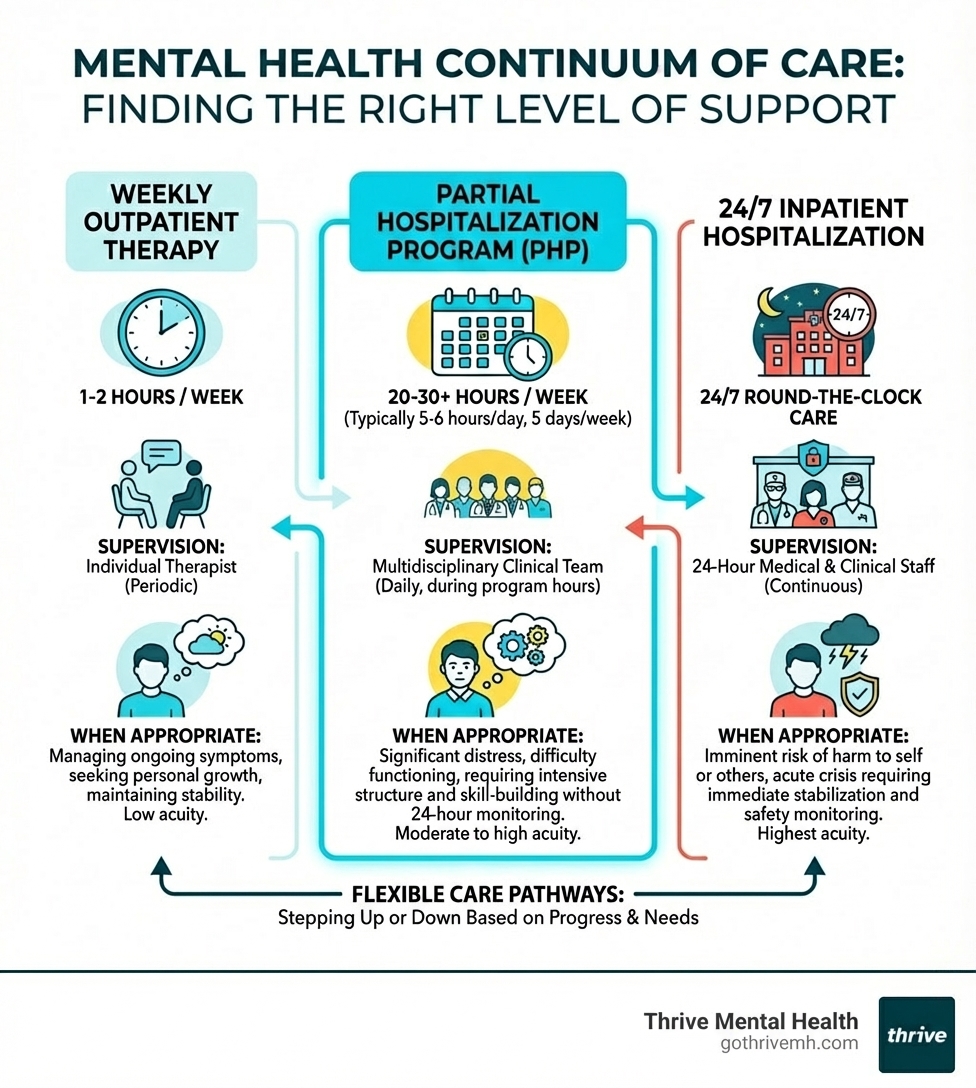
A Partial Hospitalization Program (PHP) is structured day treatment—more intensive than weekly therapy, less restrictive than inpatient. You typically attend 5 days per week, 4–6 hours a day, then sleep at home. At Thrive Mental Health, we offer PHP and IOP across Florida, including virtual and hybrid options that fit real-life schedules.
Personalized care means your plan is co-created with your clinical team, tied to measurable goals (like fewer panic attacks, reduced self-harm urges, better sleep), and adjusted as you improve. It’s not paperwork—it’s your roadmap out of crisis.
I’m Nate Raine, CEO of Thrive Mental Health. After more than a decade working at the intersection of mental health and data science, I’ve seen one pattern again and again: custom, data-driven care plans get people better faster—especially when insurance (Cigna, Optum, Aetna, Florida Blue, and others) is used strategically to support the right level of care.
This guide breaks down 10 signs a PHP truly offers personalized care plans, so you can avoid wasting time and money on programs that don’t fit.
Quick guides if you’re comparing options:
- How long is a partial hospitalization program?
- IOP vs PHP: Which level of care do you actually need?
- What’s an IOP and how does virtual IOP work?
- Verify your insurance in minutes
Summary: If you’re searching “which partial hospitalization programs offer personalized care plans,” look for deep assessment, flexible scheduling (including virtual options), integrated mental health and substance use care, and clear, measurable goals. The right PHP can shorten your recovery time, reduce relapse risk, and save you money by getting it right the first time.
What “Personalized Care” Actually Means in a PHP (and How It Shortens Recovery Time)
“Personalized care” isn’t a buzzword—it’s the difference between months of spinning your wheels and actually getting your life back.
In a true personalized PHP, your treatment plan is driven by your symptoms, your goals, and your reality (work, kids, transportation, finances)—not by whatever open group slot the program has.
A treatment plan should:
- Spell out what you want to change (fewer panic attacks, no self-harm, sober days, better sleep)
- Use methods that match your diagnosis and history
- Include a timeline and clear markers of progress
You’re not a passive patient—you’re part of the team.
Core Components of a Truly Custom Plan
A strong PHP in Florida should offer:
-
Clear personal goals
What does “better” mean to you in 30–90 days? Fewer ER trips? Back to work or school? Safer at home? Your plan should say this in plain language. -
Full clinical picture, not a checkbox intake
That means:- Mental health history and prior treatment
- Substance use, medications, and medical issues
- Trauma history and safety risks (including suicide/self-harm)
- Family, culture, work, school, and housing situation
-
Integrated support for co-occurring conditions
Anxiety + alcohol. Depression + chronic pain. PTSD + opioids. Ignoring one is how people end up back in the hospital. -
Living, adjustable plan
The plan should change based on weekly progress—not stay frozen because it looks neat in your chart.
Why Integrated Care for Co-Occurring Conditions Is Non‑Negotiable
If you have both a mental health disorder and substance use (dual diagnosis), treating only one is a setup for relapse.
Integrated care means:
- One team treats both conditions together
- Medication, therapy, and safety planning are coordinated
- You don’t have to bounce between programs that don’t talk to each other
As research on integrated care shows, coordinated treatment improves outcomes and cuts down on ER visits and hospitalizations.
At Thrive’s PHP and IOP programs across Florida, we:
- Combine psychiatric care, therapy, and substance use treatment in one plan
- Work with insurers like Cigna, Optum, Aetna, Florida Blue, and others to authorize the right level of care
- Offer virtual and hybrid options so missing work or childcare doesn’t blow up your recovery
Ignoring integrated care costs time, money, and sometimes safety. Choosing a PHP that truly personalizes and integrates can mean **stabilizing in weeks instead of repeatedly crashing over months.
The Blueprint: How Top PHPs Design Your Custom Plan (Step by Step)
How do the best answers to “which partial hospitalization programs offer personalized care plans?” actually build those plans? They follow a clear, disciplined process.

Your Voice Is the Most Important Part of the Plan
If you feel talked at instead of worked with, that’s a red flag.
In a solid PHP, you should see:
- Collaborative goal-setting: You help choose what gets better first—mood, safety, sobriety, sleep, work, or relationships.
- Shared decisions: Your team explains options (CBT, DBT, meds, trauma work, virtual vs in-person groups), and you decide together.
- Optional family involvement: With your permission, family or key supports can join sessions to learn how to actually help.
- Regular feedback loops: You’re asked what’s working, what isn’t, and your plan changes accordingly.
Which Partial Hospitalization Programs Offer Personalized Care Plans Based on a Thorough Assessment?
If your “assessment” was a 15‑minute phone screen, you’re not getting personalized care.
Top PHPs—including Thrive’s programs in Florida—start with:
- Comprehensive psychiatric evaluation by a licensed psychiatrist or psychiatric NP
- Screening for substance use, trauma, and medical issues
- Risk assessment for suicide, self-harm, and safety at home
- Psychological testing when needed to clarify diagnosis (ADHD, bipolar, PTSD, OCD, etc.)
Then a multidisciplinary team—psychiatrists, medical doctors, nurses, therapists, and social workers—meets to:
- Confirm your diagnoses
- Identify immediate risks
- Choose the most effective therapies and supports for you
From there, they build your initial plan with:
- Specific, measurable goals (ex: “Reduce panic attacks from daily to 1x/week in 6 weeks”)
- Targeted modalities (CBT, DBT, trauma therapy, medication management)
- Schedule and format (in-person, virtual PHP/IOP, or hybrid to match work/school)
If you’re unsure which level of care to choose, compare: IOP vs PHP. You can also verify your insurance in about 2 minutes to see what Cigna, Optum, Florida Blue, Aetna, and others may cover.
Which partial hospitalization programs offer personalized care plans? [Key Therapeutic Modalities]
Top PHPs don’t just offer a single type of therapy; they provide a rich mix of approaches to ensure a personalized fit. This includes a blend of evidence-based therapies, holistic approaches, and even innovative treatments. Think of it as building a “toolbox” for your recovery, rather than trying to fix every problem with a single hammer. The goal is to equip you with diverse skills and insights that empower you in your daily life.
Foundational Therapies for Lasting Change
The bedrock of personalized PHP treatment often lies in well-established, evidence-based therapies. These include:
- Cognitive-Behavioral Therapy (CBT): This therapy helps you identify and challenge negative thought patterns and behaviors that contribute to mental health struggles. Learn about evidence-based CBT and how it can help you restructure maladaptive thinking processes. Many leading PHPs, including our programs in Florida, widely incorporate CBT.
- Dialectical Behavior Therapy (DBT): Often used for intense emotional dysregulation, DBT focuses on building skills in mindfulness, distress tolerance, emotion regulation, and interpersonal effectiveness. It’s a cornerstone in many personalized PHPs, including our programs in Florida. Read more about DBT to understand its comprehensive approach.
- Acceptance and Commitment Therapy (ACT): This therapy encourages you to accept difficult thoughts and feelings rather than fighting them, while committing to actions aligned with your values. Top-tier PHPs often use ACT to help patients build powerful coping skills.
Specialized and Holistic Approaches
Beyond these foundational therapies, personalized PHPs integrate a variety of specialized and holistic methods:
- Trauma-informed care: This approach recognizes the widespread impact of trauma and integrates knowledge about trauma into all aspects of treatment. It creates a safe and supportive environment for healing.
- Group therapy sessions: These are vital for fostering connection and reducing feelings of isolation. Research shows group therapy provides a structured environment to understand that you are not alone, offering peer support and guidance from specialized psychologists.
- Medication management: A crucial component, especially for co-occurring conditions. Your medical team will work with you to understand your medications, discuss side effects, and ensure your regimen supports your overall well-being.
- Experiential therapies: Activities like art therapy, yoga, psychodrama, or even recreational therapies such as surfing or painting can provide alternative avenues for expression, stress reduction, and skill-building.
- Emerging treatments: Some PHPs, including those in Florida, are beginning to incorporate innovative treatments like Transcranial Magnetic Stimulation (TMS) and ketamine therapy, which can be game-changers for individuals who haven’t found relief through traditional methods.
Standardized vs. Personalized PHP: Why a Custom Fit Protects Your Time, Money, and Safety
Imagine trying to open a unique lock with a generic key. That’s what a standardized PHP does: same schedule, same curriculum, same goals—for everyone.
When you’re dealing with depression, anxiety, trauma, or addiction, that doesn’t just feel bad. It’s expensive, discouraging, and risky.

[TABLE] Standardized vs. Personalized PHP Plans
| Feature | Standardized PHP | Personalized PHP |
|---|---|---|
| Patient Role | Passive: “Show up and sit in group.” | Active: You help set goals and adjust the plan. |
| Co-occurring Disorders | Often split or ignored (mental health or substance use). | Treated together with one coordinated team. |
| Fit With Real Life | Fixed schedule, little flexibility for work/school/kids. | Options for virtual, hybrid, and evening care when available. |
| Skill Use in Daily Life | Generic skills that may not match your triggers. | Skills custom to your actual home, work, and relationship challenges. |
| Discharge & Aftercare | One-page, generic relapse plan. | Specific aftercare: therapy, psychiatry, IOP, support groups, crisis plan. |
| Long-Term Outcomes | Higher relapse and rehospitalization risk. | Better stability, faster progress, fewer crises. |
Bottom line: a personalized PHP may mean shorter time in high-level care, fewer hospital stays, and lower total cost—especially when insurance (Cigna, Optum, Florida Blue, Aetna, and others) is used to support the right intensity upfront.
FAQs: Which Partial Hospitalization Programs Offer Personalized Care Plans?
1. How do I know if a PHP really offers personalized care plans?
Look for: a full psychiatric assessment, weekly plan reviews, integrated mental health + substance use care, and options that fit your life (virtual/hybrid, evening sessions). If your goals aren’t written down, it’s not truly personalized.
2. Are personalized PHP plans covered by insurance?
Often yes. Many plans with Cigna, Optum, Aetna, Florida Blue, and others cover PHP when it’s medically necessary. The level of personalization doesn’t reduce coverage—it usually improves your case because it’s clearly documented. You can verify your insurance coverage in about 2 minutes.
3. What’s the difference between PHP and IOP if I want personalized treatment?
PHP is more intensive (4–6 hours a day, 5 days a week). IOP is fewer hours. Both can be personalized. PHP is better if you’re recently hospitalized, in frequent crisis, or struggling to stay safe. Compare options here: IOP vs PHP.
4. Can PHP be personalized if I need virtual or evening sessions?
Yes—many modern programs, including Thrive, offer virtual and hybrid PHP/IOP with evening options so you don’t have to choose between treatment and your job or kids.
5. What happens after I finish a personalized PHP?
You shouldn’t be dropped. A good program builds an aftercare plan: step-down to IOP, weekly therapy, psychiatry, support groups, and a clear crisis plan so you’re not left alone the day you graduate.
Ready for support? Thrive offers virtual and hybrid IOP/PHP programs with evening options. Verify your insurance in 2 minutes (no obligation) → Start benefits check or call 561-203-6085. If you’re in crisis, call/text 988.