
In Depth Guide to Gender Identity Therapy

Why Gender-Affirming Care Is Essential for Mental Health and Authentic Living
If you or someone you know is in crisis or struggling with thoughts of self-harm, please call or text 988 to reach the Suicide & Crisis Lifeline. You are not alone, and help is available 24/7.
Which therapy approaches help adults steer gender identity challenges? The most effective approaches include gender-affirmative therapy (which validates rather than pathologizes identity), Cognitive Behavioral Therapy (CBT) adapted for transgender and gender-diverse individuals, narrative therapy for reshaping personal stories, and group therapy for community support. Each approach addresses the unique stressors—including gender dysphoria, minority stress, and societal stigma—that impact mental health for adults exploring or affirming their gender identity.
Here’s a quick breakdown of the core approaches:
Primary Therapy Approaches for Gender Identity Challenges
- Gender-Affirmative Therapy: Creates a safe, non-judgmental space to explore identity without trying to change it; focuses on validation and empowerment
- Cognitive Behavioral Therapy (CBT): Challenges internalized transphobia and negative thought patterns; builds practical coping skills for dysphoria and anxiety
- Narrative Therapy: Helps you reshape your personal story and reclaim your narrative from societal expectations
- Group Therapy: Provides community connection and mutual support with others navigating similar experiences
- Mindfulness-Based Practices: Teaches grounding techniques to manage present-moment distress and foster self-acceptance
Gender identity exploration isn’t a mental illness that needs “fixing”—it’s a deeply personal journey that deserves professional support. Yet the challenges are real: around 50% of transgender individuals have attempted suicide in their lifetime, often due to lack of support and exposure to trauma. Gender dysphoria, minority stress from discrimination, and societal prejudice create significant mental health risks including depression, anxiety, and PTSD.
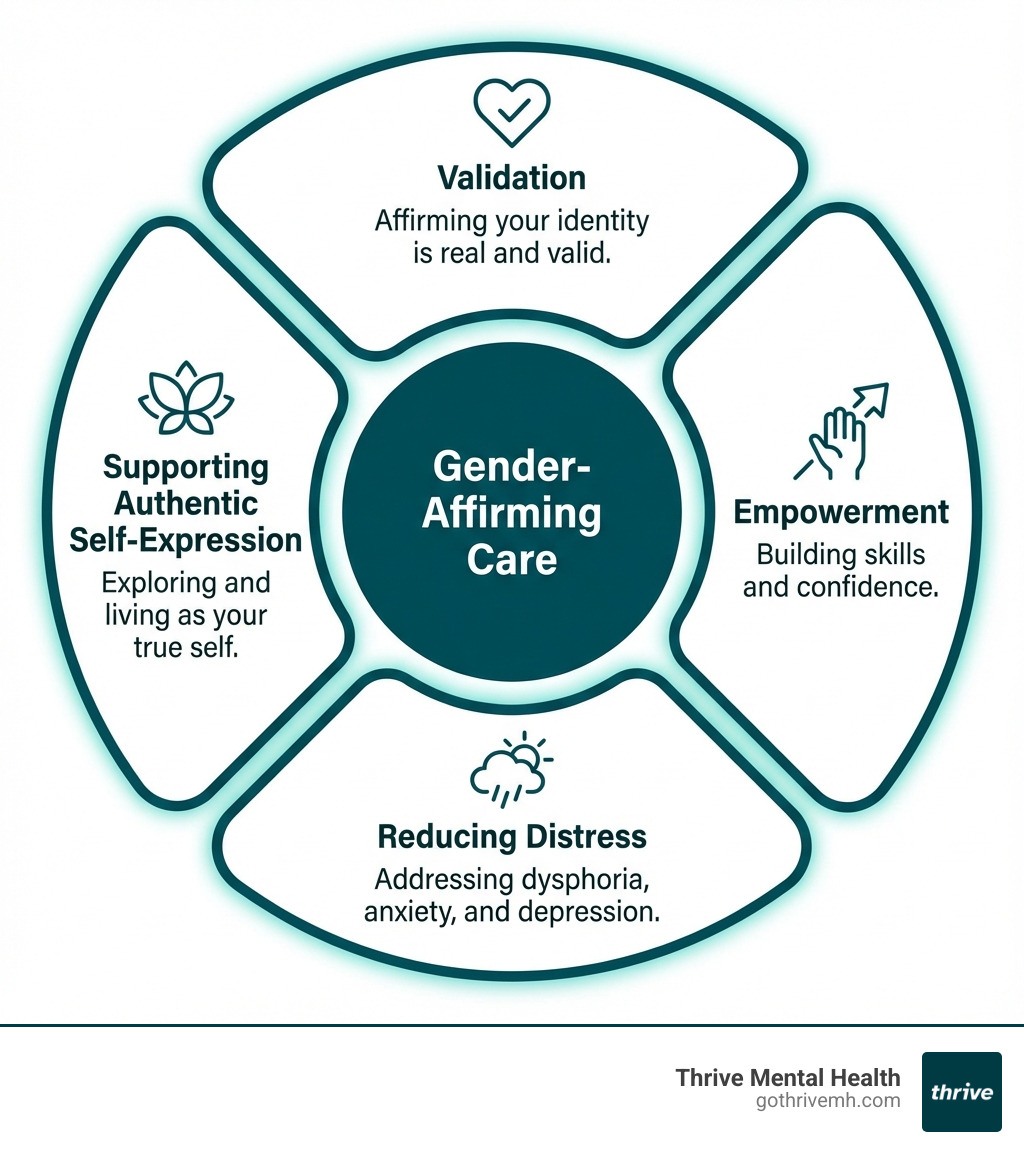
The goal of gender-affirming care is validation and empowerment, not change. Therapy helps you understand yourself, develop resilience against stigma, and make informed decisions about your path—whether that includes social transition, medical interventions, legal changes, or simply living more authentically in your current expression.
I’m Nate Raine, CEO of Thrive Mental Health, and I’ve spent over a decade leading behavioral health innovation across our programs in Florida. Understanding which therapy approaches help adults steer gender identity challenges has been central to developing our evidence-based, tech-enabled treatment programs that integrate compassionate care with measurable outcomes. Our clinical teams specialize in creating affirming environments where identity exploration is met with expertise, not judgment.
Why “Just Talking” Isn’t Enough: The Critical Need for Affirming Care
For many adults, navigating gender identity challenges involves more than just self-reflection; it often means confronting deeply ingrained societal norms, prejudice, and even discrimination. This is where the crucial role of mental health support, particularly gender-affirming care, comes into play. It’s not just about “talking through” feelings; it’s about providing a structured, validating environment to address complex psychological, social, and emotional problems.
Let’s start by understanding the core challenge: gender dysphoria. This isn’t a choice or a lifestyle. It’s the profound distress that arises when there’s a disconnect between an individual’s internal sense of gender identity and the sex they were assigned at birth. This distress can manifest in various ways, from intense discomfort with one’s physical characteristics to a deep sense that one’s gender identity doesn’t align with societal expectations. Symptoms can include a strong desire to be treated as a gender different from assigned sex, and feeling that one’s body doesn’t match their inner self.

The journey of gender identity exploration is often compounded by what is known as minority stress. This theory explains that individuals from marginalized groups experience unique stressors related to their stigmatized identities, such as prejudice, discrimination, and societal non-acceptance. For transgender and gender diverse individuals, this can lead to significantly higher rates of mental health issues like depression, anxiety, and substance use compared to cisgender and heterosexual individuals. The American Psychiatric Association notes that transgender and gender nonconforming (TGNC) people face a disproportionately high rate of mental illness and suicidal ideation, with as many as 50% attempting suicide in their lifetime, and at least 25% reporting physical attacks.
If you’re in crisis, call or text 988 right now. You are not alone. Confidential support is available 24/7 in the United States.
This pervasive societal prejudice creates a fertile ground for trauma and shame. Many individuals seeking gender-affirming care have experienced feelings of powerlessness, invalidation, and profound loneliness due to transphobia and societal rejection. This can lead to internalized stigma, where societal negativity is absorbed, causing self-doubt and self-criticism.
This makes the role of mental health support not just beneficial, but crucial. Gender-affirming therapy is designed to create a safe, non-judgmental space where clients can explore their gender identity, address any related issues, and develop coping strategies. Therapists actively work to validate feelings and reinforce strengths, helping clients find empowering outlets for expression. This inclusive care acknowledges and respects each person’s identity, providing support free from judgment or bias. It empowers individuals to reclaim their narratives, accept their authentic selves, and build resilience against external pressures. For adults who need more intensive support than once-a-week sessions, structured programs like Intensive Outpatient (IOP) and Partial Hospitalization (PHP) at Thrive can offer multiple weekly sessions, skills groups, and psychiatry support within a gender-affirming framework.
Which Therapy Approaches Help Adults Steer Gender Identity Challenges? [A Breakdown]
When considering which therapy approaches help adults steer gender identity challenges, it’s important to understand that the most effective care is rooted in an affirmative therapy framework. This means the therapist’s stance is one of unconditional acceptance and support for your gender identity. They do not try to “repair” or change who you are, but rather help you explore, understand, and live authentically as yourself. This non-pathologizing approach is foundational to all effective gender-affirming care.
Within this affirmative framework, several therapeutic modalities prove highly effective:
- Cognitive Behavioral Therapy (CBT): A goal-oriented therapy that focuses on identifying and challenging negative thought patterns and behaviors. When applied to gender identity challenges, CBT helps individuals manage anxiety, depression, or self-doubt related to their journey.
- Narrative Therapy: This approach centers around the stories we tell about ourselves and our experiences. For those exploring gender identity and transitions, narrative therapy can help individuals shape and reframe their personal narratives in ways that empower them, allowing them to externalize problems and highlight their unique strengths and preferred identities.
- Group Therapy: Involves individuals with similar experiences coming together to share their journeys and offer mutual support. Participating in a group focused on gender questioning and transitions can provide a sense of community, reduce feelings of isolation, and foster shared coping strategies.
Here’s a quick comparison of these core approaches:
| Therapy Approach | Primary Goal | Key Techniques | Best-Fit Scenarios |
|---|---|---|---|
| Affirmative Therapy | Validate identity, empower self-exploration | Unconditional positive regard, advocacy, psychoeducation | Foundational for all gender identity work, creating a safe space for any stage of exploration or transition. |
| Cognitive Behavioral Therapy (CBT) | Challenge negative thoughts, build coping skills | Thought records, behavioral experiments, exposure therapy | Managing anxiety, depression, or dysphoria-related distress; building resilience against internalized stigma. |
| Narrative Therapy | Reclaim personal story, empower identity | Externalizing problems, re-authoring conversations, identifying unique outcomes | Processing past experiences, building a coherent and positive self-narrative, finding meaning in one’s journey. |
| Group Therapy | Build community, reduce isolation, mutual support | Shared experiences, peer feedback, skill-building in a collective setting | Seeking connection, practicing social skills, gaining diverse perspectives, feeling less alone. |
We understand that choosing the right therapy can feel overwhelming. Our evidence-based IOP programs and PHP programs integrate many of these approaches, tailoring them to your unique needs in Florida.
How does Cognitive Behavioral Therapy (CBT) specifically help?
CBT is a powerhouse when it comes to addressing the practical mental health challenges that often accompany gender identity exploration. For transgender and gender diverse individuals, it’s not about “treating” gender identity, but rather about addressing the distress that can arise from societal pressures, internalized stigma, and the challenges of transition.
A key benefit of CBT is its ability to help in reframing negative thoughts. Many individuals internalize negative messages from society, leading to self-doubt, shame, or anxiety. CBT teaches us to identify these automatic negative thoughts and challenge their validity. For example, if you find yourself thinking, “I’m not valid because of how society sees me,” CBT helps you question that thought and replace it with a more balanced and affirming perspective, such as “My identity is valid, regardless of external perceptions.” This process is crucial for addressing internalized transphobia or other forms of internalized stigma. As the Australian Psychological Society notes, by addressing internalized stigma or societal pressures, individuals can develop a more positive self-image.
CBT also excels at building coping skills for managing the emotional weight of gender dysphoria and anxiety. These skills are practical, actionable tools that you can use in your daily life.
Here are some CBT-based coping strategies for managing daily dysphoria and anxiety:
- Thought Stopping: When negative or dysphoric thoughts arise, mentally or verbally say “stop” to interrupt the pattern, then redirect your focus.
- Cognitive Restructuring: Actively challenge distorted thoughts about your body or identity. Ask: Is this thought fact or feeling? What’s the evidence for/against it? What’s a more balanced perspective?
- Mindfulness & Grounding Techniques: Focus on the present moment to reduce overwhelming feelings. Deep breathing, engaging your five senses (e.g., naming 5 things you see, 4 you hear, 3 you feel), or body scans can help.
- Behavioral Activation: Engage in activities that align with your affirmed gender or bring you joy, even when you don’t feel like it. This can combat withdrawal and increase positive experiences.
- Exposure Therapy (modified): Gradually expose yourself to situations or expressions that cause anxiety (e.g., using new pronouns, trying new clothing), starting with less intense scenarios and building up. This helps desensitize anxiety responses.
- Self-Compassion Practices: Treat yourself with the same kindness and understanding you would a friend. Use affirming self-talk and gentle self-care routines.
- Goal Setting: Break down larger transition goals (social, medical, legal) into smaller, manageable steps. Achieving these smaller goals can boost confidence and reduce feelings of overwhelm.
Through these techniques, CBT helps you develop resilience, reframe negative thoughts, and improve confidence, empowering you to steer your journey with greater strength and self-acceptance.
What are other effective therapeutic techniques?
Beyond CBT, a range of other therapeutic approaches can significantly contribute to an adult’s journey in navigating gender identity challenges:
- Mindfulness-Based Practices: These techniques focus on bringing your attention to the present moment, observing thoughts and feelings without judgment. For individuals experiencing gender dysphoria, mindfulness can be profoundly helpful in managing intense discomfort or anxiety. Grounding techniques, a subset of mindfulness, can help you reconnect with your body and surroundings when feeling overwhelmed, fostering a sense of safety and presence. Mindfulness helps cultivate self-acceptance and reduce the intensity of distressing emotions.
- Attachment-Based Therapy: This approach explores how early relationships and attachment styles influence current patterns of relating to oneself and others. For many transgender and gender diverse individuals, experiences of rejection or non-affirmation can lead to relational trauma. Attachment-Based Therapy can help in healing relational trauma, building secure attachment with oneself, and fostering healthier relationships with supportive others.
- Emotion-Focused Therapy (EFT): EFT helps individuals understand, process, and regulate their emotions. For those struggling with gender identity, deep-seated feelings of shame and fear are common, often stemming from societal stigma or past experiences. EFT provides a safe space to explore these core emotions, allowing for their healthy expression and change. By processing these feelings, individuals can move towards greater emotional clarity and self-acceptance.
- Somatic Therapy: This approach focuses on the connection between the mind and body. Gender experiences often manifest physically, and somatic approaches can help process dysphoria or disconnection, fostering a more integrated sense of self.
- Art Therapy: For some, verbal expression can be challenging, especially when discussing complex or painful emotions related to gender identity. Art therapy offers a creative outlet for non-verbal expression, allowing individuals to explore their feelings, identities, and experiences through visual mediums.
- Trauma-Informed Therapy: Given the high rates of trauma experienced by transgender individuals due to discrimination and violence, integrating trauma-informed care is essential. Approaches like Eye Movement Desensitization and Reprocessing (EMDR) can be particularly effective in processing trauma related to gender identity and discrimination.
- Existential Therapy: This therapy explores fundamental questions about meaning, purpose, and identity. For individuals questioning their gender, existential therapy can provide a framework for deeper self-understanding and finding personal meaning in their unique journey.
- Solution-Focused Therapy: Rather than dwelling on problems, this approach helps individuals identify their strengths and resources to construct solutions. It’s empowering for setting goals and envisioning a positive future related to gender affirmation.
- Family Therapy: When navigating gender identity, the support of family can be critical. Family therapy can help improve communication, foster understanding, and build a more supportive home environment for the individual.
- Internal Family Systems Therapy (IFS): This model views the mind as comprised of various “parts” or sub-personalities. It can be very helpful for individuals experiencing internal conflicts or self-criticism related to their gender identity, helping them to heal and integrate these different aspects of self.
These diverse approaches, often used in combination, create a holistic and personalized therapeutic experience, ensuring that every aspect of an adult’s gender identity journey is met with compassionate and effective support. At Thrive, many of these techniques are woven into our virtual IOP and PHP programs, so adults in cities like Miami, Orlando, and across the state can access specialized, affirming care without relocating.
Your Roadmap to Authenticity: What to Expect from Gender Identity Therapy
Starting on gender identity therapy is a brave and empowering step towards living authentically. Knowing what to expect can help ease any anxieties you might have.

Finding the right therapist is paramount. We recommend seeking a licensed mental health professional who explicitly states their experience and commitment to gender-affirming care. They should be informed, inclusive, and capable of creating a safe, non-judgmental environment. Look for therapists in Florida who specialize in LGBTQIA+ issues. Many directories allow you to filter by specialization, and programs like Thrive’s virtual IOP and PHP give you access to affirming clinicians regardless of where you live in the state.
Your first session will typically involve your therapist gathering information about your experiences, challenges, and strengths. This includes asking for your preferred name, pronouns, and gender identity. This initial meeting is about establishing trust and rapport, and for the therapist to understand your unique goals. It’s a two-way street: you should also use this time to ask questions and determine if the therapist is a good fit for you.
It’s natural to have fears about therapy for gender questioning and transitions. Common concerns include:
- Fear of Judgment or Invalidation: Many worry a therapist might question their identity or try to dissuade them. A truly affirming therapist will never do this. Their role is to validate your feelings and support your self-findy.
- Fear of Being Rushed: The journey is yours, and a good therapist respects your pace, whether you’re exploring, questioning, or actively transitioning.
- Fear of (Mis)diagnosis: Gender identity itself is not a mental illness. While gender dysphoria is a diagnosis that can facilitate access to care, it’s not about pathologizing your identity.
- Fear of Invasive Questioning: An ethical therapist will respect your boundaries and only dig into areas you’re comfortable discussing, ensuring a safe space.
For gender-questioning individuals, therapy provides a unique space to explore without pressure. Being gender-questioning means you’re examining and uncertain about your gender identity. A therapist can help you explore questions like: “Am I trans, nonbinary, or something else?” “Is what I’m feeling valid?” or “Do I need to transition?” The goal is to help you listen to yourself more clearly and confidently, without any predetermined agenda.
Therapy also plays a vital role in planning for transition. This can involve discussing readiness for social changes, medical interventions, or legal steps. Your therapist can help you anticipate challenges, develop coping strategies, and connect you with other affirming resources.
Regarding access, we understand that insurance coverage is a significant concern. Many insurance plans, including major providers like Cigna and Optum, as well as state-specific options like Florida Blue, are increasingly covering gender-affirming care and higher levels of support such as IOP and PHP. We encourage you to find out if your insurance covers gender-affirming care through our quick verification process at Thrive Mental Health admissions. We aim to make quality care accessible across our locations in Florida, from Miami and Orlando to Tampa Bay and Jacksonville.
How does therapy prepare you for social and medical transitions?
Therapy is an invaluable guide throughout the intricate process of gender transition, offering support and strategies for every step.
For social transition planning, your therapist can help you develop effective coming out strategies. This includes exploring how and when to share your identity with family, friends, and colleagues, practicing conversations, and anticipating potential reactions. They can help you steer changing your name and pronouns, and experimenting with gender expression in ways that feel safe and authentic.
When it comes to medical transition support, such as hormone therapy or gender-affirming surgeries, a therapist can help you explore your readiness, understand the emotional and psychological impacts, and make informed decisions. They can also assist in writing letters of support, which are often required by medical providers. The American Psychological Association (APA) provides comprehensive APA guidelines for psychological practice with transgender people, emphasizing the importance of mental health support in these processes.
Lastly, your therapist can provide legal affirmation guidance. While they won’t act as your lawyer, they can help you understand the process of changing legal documents (like your name or gender marker) and connect you with legal resources in Florida that specialize in transgender rights. This holistic support ensures that your transition journey is as smooth and affirming as possible, addressing both your internal well-being and external realities. For adults who want this level of guidance wrapped into a structured program, Thrive’s hybrid IOP/PHP options can combine individual therapy, skills groups, psychiatry, and care coordination.
Frequently Asked Questions about Gender Identity Therapy
How do I know if I need gender-affirming therapy?
If you experience significant distress, confusion, or anxiety related to your gender identity, or if you simply want a safe space to explore it, therapy can be beneficial. It’s not just for those with a diagnosis of gender dysphoria; it’s for anyone seeking clarity, support, and empowerment in their gender journey.
Will a therapist try to change my gender identity?
No. A qualified gender-affirming therapist will never try to change who you are. Their role is to support and validate your identity, helping you explore it at your own pace and reduce any associated distress. The focus is on affirmation and helping you live authentically, not on conversion or changing your core self.
What if I’m not sure about transitioning?
That’s perfectly okay. Therapy is a space for exploration, not a one-way street to transition. A good therapist will support you whether you decide to transition, not to transition, or remain in a questioning phase. The process is entirely guided by your self-findy and what feels right for you.
How much does gender-affirming therapy cost?
Costs vary by provider and location. Many insurance plans, including Cigna, Optum, and state-specific plans like Florida Blue, now cover gender-affirming care. Programs like virtual Intensive Outpatient Programs (IOP) or Partial Hospitalization Programs (PHP) can be cost-effective options for intensive support, offering more structure than weekly therapy without the cost of inpatient care. You can quickly see what your plan covers using Thrive’s online insurance verification tool.
Can I access gender-affirming IOP or PHP if I live outside a major city?
Yes. Thrive offers virtual programs across Florida, so you can join from anywhere in the state, including places like Sarasota, without needing to relocate. All programs are designed to be accessible, LGBTQIA+ affirming, and compatible with work or school schedules.
Conclusion: Take the Next Step on Your Journey
Navigating your gender identity is a profoundly unique and personal journey. It can be filled with moments of profound self-findy, joy, and liberation, but also with challenges like dysphoria, societal stigma, and emotional distress. The right therapeutic approach provides not just coping mechanisms, but a solid foundation of tools and support for authentic living.
You have the right to feel safe, seen, and validated throughout this process. Our comprehensive understanding of which therapy approaches help adults steer gender identity challenges ensures that our programs are designed to meet you exactly where you are. Thrive Mental Health offers structured, evidence-based support for adults, integrating the most effective gender-affirming therapeutic techniques into virtual and in-person IOP/PHP programs so you can access care from anywhere in Florida, from Miami to Jacksonville.
If you want to go deeper on higher levels of care, you can also read our related guide on what to expect from Intensive Outpatient treatment on the Thrive blog.
Ready for support? Thrive offers virtual and hybrid IOP/PHP programs with evening options. Verify your insurance in 2 minutes (no obligation) → Start benefits check or call 561-203-6085. If you’re in crisis, call/text 988.