


Where can I find treatment for co-occurring autism and depression? Fast 2024
Where Can I Find Treatment for Co-occurring Autism and Depression? [Costs, Insurance, Faster Recovery]
Important: If you or someone you know is thinking about suicide or self-harm, call or text 988 (Suicide & Crisis Lifeline) now.
Callout: If you’re in crisis, call/text 988 right now. You are not alone.
Start here if you need autism-informed depression care fast:
- Virtual IOP with autistic-aware therapists, available across Florida
- Adapted CBT with concrete language, visuals, and structure
- Combination care (meds + therapy) monitored by autism-experienced providers
- Insurance: Cigna, Optum, Florida Blue, and more
- Evening options to fit work/school
Autistic adults are 4x more likely to experience depression. Most get stuck because symptoms overlap, screening tools miss it, and traditional therapy isn’t built for neurodivergent brains.
This isn’t your fault. Depression in autism can look like more stimming, irritability, sensory overload, or sudden disinterest in special interests, so it’s missed. Weekly therapy alone often isn’t enough.
The good news: Specialized care exists now. Virtual and hybrid IOP/PHP programs deliver structure, speed, and access from home, with insurance coverage and flexible scheduling.
At Thrive Mental Health, our autism-informed virtual IOP helps you start sooner, reduce symptoms faster, and fit care into real life.
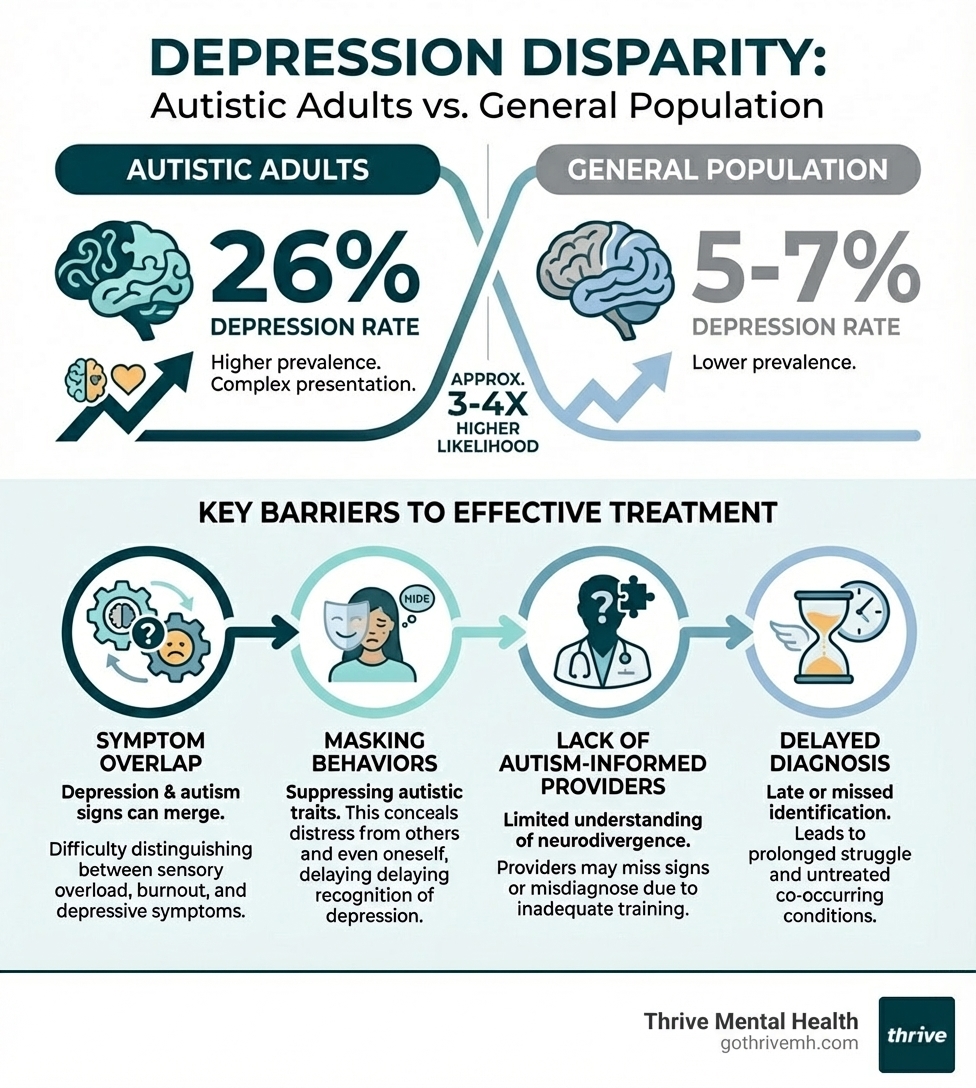
Autistic individuals face higher stress, isolation, and sensory strain, fueling depression rates around 26% vs. ~7% in the general population. Many services aren’t autism-informed, causing missed signs and slow access. Our mission at Thrive is clear pathways to effective, accessible, neurodiversity-affirming treatment.
Why Is Depression So Hard to Spot in Autistic People? [Hidden Signs & What to Watch For]
Diagnosing depression in autistic individuals presents unique challenges. The very nature of autism, characterized by differences in social communication and repetitive behaviors, can mask or mimic symptoms of depression. This symptom overlap often leaves clinicians unsure if they are observing a core feature of autism or a sign of an underlying mood disorder. This is why it’s crucial to seek out providers who are not just generally experienced in mental health, but specifically informed about neurodiversity.
One of the significant problems is alexithymia, a difficulty in identifying and expressing emotions, which is prevalent in autistic individuals. If someone struggles to even name what they’re feeling, how can they articulate “sadness” or “hopelessness” to a therapist? Research suggests that alexithymia may even be a stronger predictor of clinical depression in autistic people than autism itself. This means traditional diagnostic questions like “Are you feeling sad?” might not yield accurate responses.
Another major factor is masking and burnout. Many autistic individuals spend significant energy camouflaging their autistic traits to fit into neurotypical society. This constant effort is emotionally exhausting and can lead to severe burnout, which closely resembles depression. Hiding pain until it explodes is a common experience, and by then, the depression can be severe.
Finally, communication differences play a crucial role. Not everyone says “I’m sad” when they’re depressed. Autistic individuals may express distress through changes in behavior rather than verbalizing emotional states. This necessitates a keen eye and an understanding of individual baseline behaviors to spot the subtle shifts that indicate depression.
7 Hidden Signs of Depression in Autism You Can’t Ignore
Because depression can manifest differently in autistic individuals, it’s vital for caregivers, family members, and individuals themselves to be aware of these less obvious indicators. Here are some signs we often observe:
- More repetitive behaviors (stimming): An increase in self-stimulatory behaviors like rocking, hand-flapping, or vocalizations can be a sign of heightened anxiety or distress often associated with depression. It’s a coping mechanism that intensifies when emotional regulation is challenged.
- Sudden loss of interest in favorite hobbies: Autistic individuals often have intense special interests. A sudden and unexplained withdrawal from these previously cherished activities can be a significant red flag for depression.
- Extreme irritability or meltdowns: While irritability can be part of autism, an increase in frequency, intensity, or a shift in triggers for meltdowns or outbursts can signal underlying depression.
- Sleep changes (too much or too little): Depression commonly disrupts sleep patterns. This might look like difficulty falling or staying asleep, or conversely, sleeping significantly more than usual and still feeling unrefreshed.
- Withdrawing from even online friends: Social interaction can be challenging for autistic individuals, but if someone who previously engaged in online communities or limited in-person interactions begins to withdraw even further, it can indicate a depressive episode.
- Sensory overload gets worse: Heightened sensory sensitivities are common in autism. If an individual reports that lights seem brighter, sounds louder, or textures more irritating than usual, it can be a symptom of increased distress or depression.
- Refusing routines that used to help: Autistic individuals often thrive on routine and predictability. A sudden resistance to or disinterest in established routines that previously provided comfort or structure can be a sign of depression.
These signs, especially when observed in combination and persistently, warrant professional evaluation.
[Related: Depression Symptoms in Autism]
What Actually Works? [Evidence-Based Treatments That Get Results]
Finding effective treatment for co-occurring autism and depression requires a nuanced approach. What works for neurotypical individuals might need significant adaptation for autistic people. At Thrive Mental Health, we focus on evidence-based treatments delivered in a neurodiversity-affirming way.
Our approach centers on:
- Psychotherapy (adapted for autism): This isn’t just standard talk therapy. It’s therapy that understands and respects the autistic way of processing information, communicating, and experiencing the world.
- Medication (SSRIs, antidepressants): When appropriate, medication can be a valuable tool, especially when managed by a psychiatrist with expertise in neurodevelopmental conditions.
- Combination therapy: Research consistently shows that combining psychotherapy with medication is often the most effective path to recovery for depression.
- Virtual and hybrid IOP/PHP programs: These intensive programs offer a structured, supportive environment that goes beyond weekly therapy, providing comprehensive care with greater flexibility.
- Individualized, neurodiversity-affirming care: We believe in tailoring treatment plans to the unique needs and strengths of each individual, rather than trying to “fix” autism.
How Adapted CBT Helps Autistic Adults Recover Faster
Cognitive Behavioral Therapy (CBT) is often considered the “gold standard” for treating depression and anxiety. However, traditional CBT, with its reliance on abstract concepts, verbal expression of emotions, and social inferencing, can be a poor fit for many autistic individuals. This is where adapted CBT comes in.
Adapted CBT modifies the delivery and content to better suit the cognitive and communication styles of autistic people. The goal isn’t to change who someone is, but to equip them with practical tools to manage their mental health.
Here’s how adapted CBT differs from standard CBT:
| Feature | Standard CBT | Adapted CBT for Autism |
|---|---|---|
| Language | Abstract, metaphorical, nuanced | Concrete, literal, explicit |
| Communication Style | Relies heavily on verbal introspection and social cues | Uses direct questioning, visual aids, written exercises, and AAC devices |
| Emotion Identification | Assumes ability to label and describe feelings | Explicitly teaches emotion recognition, often using visual scales and body cues |
| Session Structure | Flexible, open-ended discussions | Predictable, highly structured, clear agenda and goals |
| Motivation/Engagement | Focus on general well-being and symptom reduction | Incorporates special interests, routines, and specific, tangible goals |
| Homework | Often involves journaling, thought records | Uses checklists, visual schedules, and role-playing scenarios |
| Sensory Considerations | Rarely addressed | Actively manages sensory environment, offers breaks, flexible modalities |
By making these crucial adaptations, we help autistic adults engage more effectively in therapy, understand concepts more clearly, and apply coping strategies more consistently. This leads to faster, more sustainable recovery.
[Learn more: Benefits of CBT]
Medication: What You Need to Know Before Starting
Medication can play a vital role in treating depression in autistic individuals, especially when symptoms are severe or persistent. However, it’s not a one-size-fits-all solution, and careful consideration is key.
- SSRIs and antidepressants can help, but side effects may differ: While selective serotonin reuptake inhibitors (SSRIs) are common for depression, some research suggests that first-line pharmacological treatments for depression in ASD patients might differ from standard care for neurotypical individuals. For example, duloxetine, mirtazapine, bupropion, and vortioxetine are sometimes recommended ahead of SSRIs for autistic individuals, as SSRIs can potentially cause behavioral activation. Autistic individuals may also experience side effects differently or more intensely.
- Always work with a psychiatrist who understands autism: This is non-negotiable. A psychiatrist with experience in neurodevelopmental conditions will be better equipped to monitor for unique side effects, adjust dosages appropriately, and understand the complex interplay between autism and medication. They can help steer the “start low and go slow” approach that is often best for autistic patients.
- Medication is a tool, not a cure, combine with therapy for best results: Research has repeatedly shown that a combination of medication and psychotherapy is among the more effective treatments for depression. Medication can help stabilize mood and reduce the intensity of symptoms, making it easier to engage in therapeutic work.
[Research: Combination Therapy Effectiveness] - Insurance often covers medication management (Cigna, Optum, Florida Blue, more): Many major insurance providers in Florida, including Cigna, Optum, and Florida Blue, offer coverage for psychiatric evaluations and medication management. We can help you verify your benefits quickly.
Where Can I Find Treatment for Co-occurring Autism and Depression? [2025 Action Plan]
Navigating care is hard, but it doesn’t have to be. Use this to get specialized help fast.


Your 2025 action plan:
- Find neurodiversity-affirming specialists (not just any therapist). Ask how they adapt care for autistic adults with depression.
- Check insurance (Cigna, Optum, Florida Blue, more). Verify benefits in minutes, don’t guess costs.
- Use virtual/hybrid IOP or PHP if weekly therapy isn’t enough. Available throughout Florida.
- Pick evening or flexible schedules so treatment fits your life.
- Get fast insurance verification so you can start sooner.
How to choose the right program:
- Ask if the program is autism-informed and depression-focused. Request examples of adaptations (visuals, structure, sensory supports).
- Prefer virtual IOP/PHP for privacy, lower sensory load, and quicker results than weekly therapy.
- Verify coverage before you commit, get answers in ~2 minutes.
- Thrive Mental Health: Neurodiversity-affirming virtual IOP, most major insurance accepted, evening options.
[Learn more: [Virtual IOP Programs](https://gothrivemh.com/virtual-intensive-outpatient-programs/)]
Verify your insurance now
Trusted organizations and resources:
- Autistic Self Advocacy Network (ASAN)
- SPARK for Autism
- Autism Society
- Autism and Depression Treatment at Thrive
How to Support an Autistic Loved One with Depression [Family & Caregiver Guide]
Callout: If you’re in crisis, call/text 988 right now. You are not alone.

- Validate feelings. Say, “I hear you,” not “Just be positive.”
- Track changes (sleep, meltdowns, routines, special interests) and share with clinicians.
- Find autism-informed pros and help schedule/prepare for sessions.
- Reduce sensory overload at home; protect quiet spaces.
- Gently encourage special interests and routines.
- Be patient, recovery isn’t linear. Celebrate small wins.
- Protect yourself from burnout. Get your own support.
[Related: Autism Counseling for Adults]
If you or someone you know is in crisis or experiencing suicidal ideation, this is a mental health emergency. Call or text the Suicide and Crisis Lifeline at 988 or visit 988Lifeline.org.
FAQs: Co-occurring Autism and Depression Treatment
How is depression different in autistic adults?
Often shows up as more stimming, irritability, shutdowns, or loss of special interests, not just “feeling sad.” Behavioral change is the key signal.
Is virtual IOP/PHP effective for autism and depression?
Yes. 3-5 days/week of structured, autism-informed care from home often beats weekly therapy for speed and engagement.
What insurance covers this?
Most major plans, Cigna, Optum, Florida Blue, and others, cover IOP/PHP and therapy. Verify your benefits first to know costs.
How do I find a neurodiversity-affirming therapist?
Ask about autism-specific adaptations (visual aids, concrete language, sensory supports). Get referrals from ASAN/Autism Society, or start with Thrive’s autism-informed virtual IOP.
Can I get help in Florida?
Yes, Thrive offers virtual IOP programs across Florida, with evening options available.
Summary: Don’t Wait, Specialized Autism & Depression Treatment Is Here
If you’re searching “where can I find treatment for co-occurring autism and depression,” you’re not alone. Neurodiversity-affirming virtual/hybrid IOP/PHP and adapted therapies can deliver faster, more reliable results, covered by major insurance with flexible schedules.
Ready for support? Thrive offers virtual IOP programs with evening options. Verify your insurance in 2 minutes (no obligation) → Start benefits check or call 561-203-6085. If you’re in crisis, call/text 988.

This article is for informational purposes only and is not a substitute for individualized clinical advice or insurance verification.