


Autism Counseling for Adults: 2025 Guide
If youre in crisis, call/text 988 right now. You are not alone.
Autism Counseling for Adults: Reduce Anxiety and Burnout in WeeksCosts, Insurance, and How to Start [Florida]
Autism counseling for adults helps you build a life that works for your brainnot against it. Many autistic adults feel like they’re speaking a different language, leading to exhaustion from masking traits or a late diagnosis that finally gives words to a lifetime of challenges.
The truth is, you’re not broken. The communication gap between autistic and neurotypical people goes both ways, a concept called the “Double Empathy Problem.” The right counseling helps you bridge that gap without losing yourself.
Quick Guide: Autism Counseling for Adults
- What it is: Therapy custom to autistic adults, often using adapted CBT, ACT, or DBT.
- What it helps with: Managing anxiety, depression, burnout, social challenges, and workplace stress.
- What makes it different: Neurodiversity-affirming care that focuses on your strengths, not “fixing” you.
- Where to find it: Look for therapists with autism expertise; online therapy offers flexibility and comfort.
- Cost: Often covered by insurance (Cigna, Optum, Florida Blue) when treating co-occurring conditions like anxiety or depression.
Adults with autism are more likely to experience anxiety, depression, and sensory sensitivities, which can lead to autistic burnouta state of complete exhaustion from constantly adapting to a neurotypical world. Neurodiversity-affirming therapy doesn’t try to make you act less autistic. Instead, it helps you understand your identity, manage mental health, and build a life that honors who you are.
I’m Anna Green, LMHC, LPC, Chief Clinical Officer at Thrive Mental Health. My work in autism counseling for adults focuses on creating flexible, accessible care that respects your unique strengths while addressing real challengesfrom sensory overload to workplace navigation.
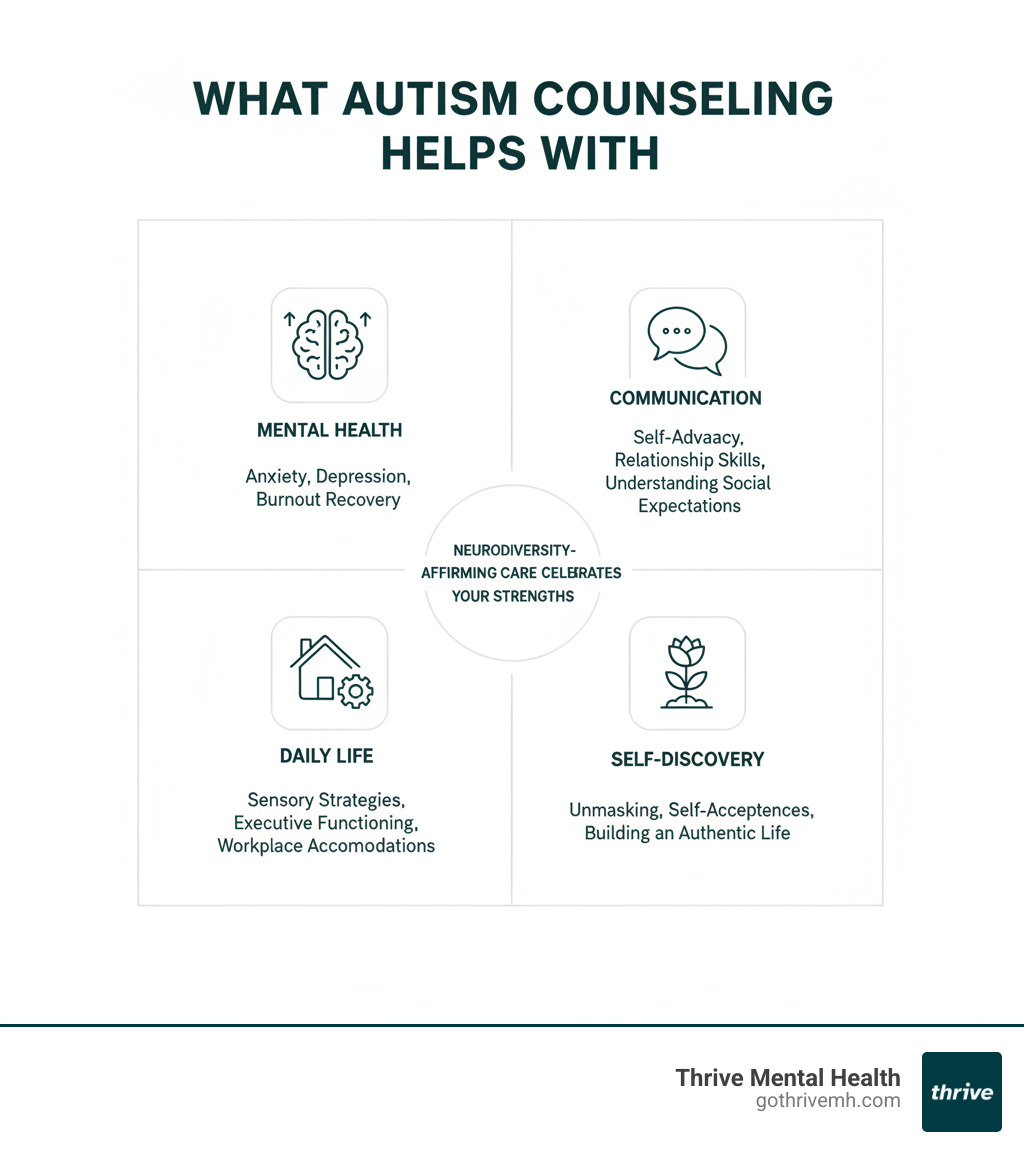
Infographic showing: “What Autism Counseling Helps With”, Four quadrants: 1) Mental Health (anxiety, depression, burnout recovery), 2) Communication (self-advocacy, relationship skills, understanding social expectations), 3) Daily Life (sensory strategies, executive functioning, workplace accommodations), 4) Self-Findy (unmasking, self-acceptance, building an authentic life). Center text: “Neurodiversity-affirming care celebrates your strengths.”
Autism counseling for adults terms to know:
Why Traditional Support Often Fails (And What Actually Works)
For decades, autism support followed a damaging script: identify differences and eliminate them. This “fix-it” mentality, found in non-affirming therapies, can cause lasting trauma by treating your natural way of being as wrong.
This approach perpetuates harmful myths. For example, the idea that autistic people lack empathy is false; many experience it but process or express it differently. The “Double Empathy Problem” shows communication gaps are a two-way street, neurotypical people are equally challenged in understanding autistic communication, but society deems one style “correct.”
The “high-functioning” label is also harmful. It often means your struggles are ignored because you seem “normal enough.” This invalidates the exhausting reality of masking, the constant, draining effort to perform neurotypical behaviors. This relentless performance leads to autistic burnout: a state of complete depletion where skills regress and sensory sensitivities heighten.
The Neurodiversity-Affirming Approach: Support, Not Fixing
A neurodiversity-affirming approach flips the script. Instead of asking, “How can we make you less autistic?” it asks, “How can we help you thrive as an autistic person?” This is the foundation of therapy that actually works.
This model is built on several key principles:
- Focus on Strengths: We identify your unique talents, like deep focus, pattern recognition, or a strong sense of justice, and help you leverage them.
- Honor Sensory Needs: Your sensory experiences are valid. We work with you to create sensory-friendly environments and develop strategies for managing overwhelming situations.
- Support Self-Advocacy: Therapy helps you find your voice to communicate your needs clearly, whether it’s requesting workplace accommodations or setting boundaries in relationships.
- Encourage Authentic Unmasking: We provide a safe space to explore who you are beneath the mask, allowing you to stim, communicate naturally, and reconnect with your authentic self.
The goal is to help you build a life that works for you, not one dictated by neurotypical expectations. It’s about fostering self-esteem and developing skills to steer the world on your own terms. You can learn more in our article on Understanding Autistic People: Insights and Perspectives. Our approach to autism counseling for adults centers your well-being and self-acceptance, not conformity. We address challenges like anxiety and burnout without ever treating your autism as the problem. Learn more about how mental health therapy can support neurodivergent individuals.
Key Therapeutic Approaches in Autism Counseling for Adults
Effective autism counseling for adults isn’t one-size-fits-all. The best approach is collaborative, custom to your unique brain, goals, and communication style. At Thrive Mental Health, we build your treatment plan with you, ensuring the methods we use resonate with how you think.

Finding a therapist who understands autism from a neurodiversity-affirming perspective is crucial. For more on this, see our article on How Mental Health Therapy Can Support Neurodivergent Individuals. Here are some evidence-based approaches we adapt for our autistic clients:
Cognitive Behavioral Therapy (CBT) & Adaptations
Traditional CBT helps identify and shift unhelpful thought patterns. For autistic adults, we adapt it to match your thinking style. The logical, structured nature of CBT is often a great fit. It provides concrete tools to manage anxiety from sensory overload or social exhaustion and challenge internalized negative messages about being “too much” or “not enough.”
Acceptance and Commitment Therapy (ACT) & DBT
ACT focuses on psychological flexibility, accepting uncomfortable thoughts and feelings while committing to actions aligned with your core values. For autistic adults tired of fighting their nature, this is liberating. It teaches mindfulness to observe thoughts without being controlled by them.
Dialectical Behavior Therapy (DBT) offers powerful skills for emotional regulation, distress tolerance, and interpersonal effectiveness. It provides concrete strategies for navigating meltdowns, setting boundaries, and asking for what you need without sacrificing your authentic self.
Other Supportive Therapies and Modalities
Beyond talk therapy, other modalities can be highly effective:
- Sensorimotor Psychotherapy connects the body and mind to process trauma and emotional overwhelm, which is ideal for those with sensory processing differences.
- Neurodiversity-affirming social skills training focuses on understanding social rules and building communication confidence, not on mimicking neurotypical behavior.
- Speech-language therapy can help adults with pragmatic communication, while occupational therapy provides strategies for sensory integration to make daily life more manageable.
What Can Counseling Help With? Real-World Goals and Outcomes
Autism counseling for adults is a partnership. You bring your experiences and goals; your therapist brings specialized knowledge and practical strategies. Together, you work toward self-acceptance, improved well-being, and a life that feels authentic.

Therapy provides validation and concrete skills to reduce anxiety, address depression, and find “autistic joy”, the deep satisfaction that comes from embracing your special interests and being yourself without apology.
Managing Co-Occurring Mental Health Conditions
Research shows the vast majority of autistic people have co-occurring conditions, often due to the stress of navigating a neurotypical world. Therapy can help manage:
- Anxiety: Learn to identify triggers and use personalized coping strategies for social situations or sensory overload.
- Depression: Address feelings of isolation and exhaustion from masking with a therapist who understands the unique presentation of depression in autistic adults. Explore our article on Autism and Depression Treatment for more.
- ADHD and OCD: Get strategies for executive functioning and managing repetitive thoughts that are custom to your neurotype, not generic advice.
Improving Social Skills, Communication, and Relationships
You don’t lack social skills; you have a different communication style. Therapy helps you steer social cues and advocate for your needs without masking. You’ll learn to understand different communication preferences and express yourself authentically. This self-advocacy is key to forming meaningful connections and repairing relationships that may have been strained by misunderstanding.
Thriving in Work, Education, and Daily Life
Workplaces can be a major source of stress. Counseling helps you identify and request reasonable workplace accommodations, such as noise-canceling headphones, flexible schedules, or written instructions. These adjustments level the playing field, allowing you to perform at your best. For more on this, see our guide to Neurodiversity Training for Inclusive Workplaces.
Therapy also provides tools for:
 Understanding Early Warning Signs and SymptomsCoping Strategies
- Managing sensory overload: Identify triggers and create strategies to cope in overwhelming environments.
- Executive functioning: Learn concrete strategies for task initiation, time management, and organization that work with your brain.
- Developing sustainable routines: Structure your days to conserve energy and prevent burnout, creating a rhythm that feels supportive, not draining.
How to Find the Right Therapist & Get Started
Taking the first step toward autism counseling for adults is a powerful act of self-care. Finding the right therapist, someone who practices neurodiversity-affirming care and sees your strengths, is the most important part of the process. At Thrive Mental Health, we offer complimentary consultation calls to help you see if we’re the right fit.

Finding a Qualified Therapist for Autism Counseling for Adults
When searching for a therapist, look for specialists in adult autism. Use online directories with filters for autism, neurodiversity, or ASD. During a consultation, ask direct questions:
- What is your experience working with autistic adults?
- What does neurodiversity-affirming care mean to you?
- How do you adapt therapy (like CBT or ACT) for autistic clients?
- Are you familiar with masking and autistic burnout?
- How do you create a sensory-friendly environment, even in virtual sessions?
Trust your gut. The right therapist will make you feel heard, respected, and safe.
Counseling vs. Coaching: What’s the Difference?
- Counseling/Therapy: Led by a licensed professional, this service addresses mental health conditions like anxiety, depression, and trauma. It digs into emotional processing and past experiences to build resilience.
- Coaching: This is a goal-oriented service focused on developing practical skills for career, organization, or social situations. Coaches are not always licensed therapists.
Thrive Mental Health offers hybrid models that integrate the depth of counseling with the practical strategies of coaching, addressing both mental health and real-world challenges.
Accessing Care: Online vs. In-Person and Insurance
Autism counseling for adults is more accessible than ever.
Online therapy is a preferred option for many autistic adults. It allows you to be in a familiar, controlled environment, reducing sensory stress and the pressure of in-person social cues. Research confirms its effectiveness for autism support.
In-person options are also available. Thrive Mental Health has locations across Florida, as well as in Indiana, California, South Carolina, and Arizona.
Insurance often covers counseling for diagnosed conditions. Plans from Cigna, Optum, Florida Blue, and others may cover services. We make it easy to verify your benefits online. For more intensive support, our Neurodivergent Intensive Outpatient Treatment programs are also frequently covered.
Frequently Asked Questions about Autism Counseling for Adults
It’s natural to have questions. Here are concise, People Also Askstyle answers about autism counseling for adults.
What kind of therapy is best for an autistic adult?
There is no single “best” therapy. The most effective approach is neurodiversity-affirming and custom to you. Adapted CBT, ACT, and DBT help manage anxiety, regulate emotions, and build an authentic life.
Can counseling help with autistic burnout?
Yes. Counseling helps you identify causes (masking, sensory overload), recover with rest and boundaries, and build sustainable routines to prevent future burnout.
How much does autism counseling for adults cost?
Typically $100250+ per session. Many plans (Cigna, Optum, Florida Blue) cover therapy for co-occurring conditions like anxiety or depression. You can also explore our Neurodivergent Intensive Outpatient Treatment, which is often covered.
Is online autism counseling effective?
Yes. Research supports online therapy for autistic adults, and many prefer it for sensory comfort and flexibility. Thrive offers virtual options across Florida.
Does insurance cover autism counseling for adults?
Often, yes. Coverage varies by plan and state. Many clients use Cigna, Optum, and Florida Blue. Verify benefits in minutes here: Start benefits check.
Suggested FAQ schema (JSON-LD)
{
“@context”: “https://schema.org”,
“@type”: “FAQPage”,
“mainEntity”: [
{
“@type”: “Question”,
“name”: “What kind of therapy is best for an autistic adult?”,
“acceptedAnswer”: {
“@type”: “Answer”,
“text”: “There is no single best therapy. Neurodiversity-affirming CBT, ACT, and DBT are effective when adapted to autistic thinking and goals.”
}
},
{
“@type”: “Question”,
“name”: “Can counseling help with autistic burnout?”,
“acceptedAnswer”: {
“@type”: “Answer”,
“text”: “Yes. Counseling targets causes like masking and sensory overload, supports recovery, and helps prevent future burnout.”
}
},
{
“@type”: “Question”,
“name”: “How much does autism counseling for adults cost?”,
“acceptedAnswer”: {
“@type”: “Answer”,
“text”: “$100250+ per session. Many plans (Cigna, Optum, Florida Blue) cover therapy for co-occurring conditions; IOP is often covered.”
}
},
{
“@type”: “Question”,
“name”: “Is online autism counseling effective?”,
“acceptedAnswer”: {
“@type”: “Answer”,
“text”: “Yes. Studies support online therapy, and many autistic adults prefer it for comfort and flexibility.”
}
},
{
“@type”: “Question”,
“name”: “Does insurance cover autism counseling for adults?”,
“acceptedAnswer”: {
“@type”: “Answer”,
“text”: “Often. Coverage varies by plan and state. Many clients use Cigna, Optum, and Florida Blue; verify benefits online.”
}
}
]
}
Take the First Step Towards a More Authentic Life
Finding the right autism counseling for adults is about empowerment. It’s a space to unmask, understand your unique wiring, and build a life that feels genuine, one where you’re not exhausted from pretending. The right therapist celebrates your neurotype and works with your brain, not against it.
At Thrive Mental Health, our programs are designed for neurodivergent adults in Florida. We offer flexible virtual and hybrid programs with evening options because we know rigid structures don’t work for everyone. Our clinicians understand autistic communication, sensory needs, and the path to recovering from burnout.
Taking the first step can be hard, but you don’t have to do it alone.
Ready for support? Thrive offers virtual IOP with evening options. Verify your insurance in 2 minutes (no obligation) → Start benefits check or call 561-203-6085.
If you’re in crisis, call or text 988. Immediate support is available.

This article is for informational purposes only and is not a substitute for individualized clinical advice or insurance verification.