





Your Career is Thriving, But Are You?
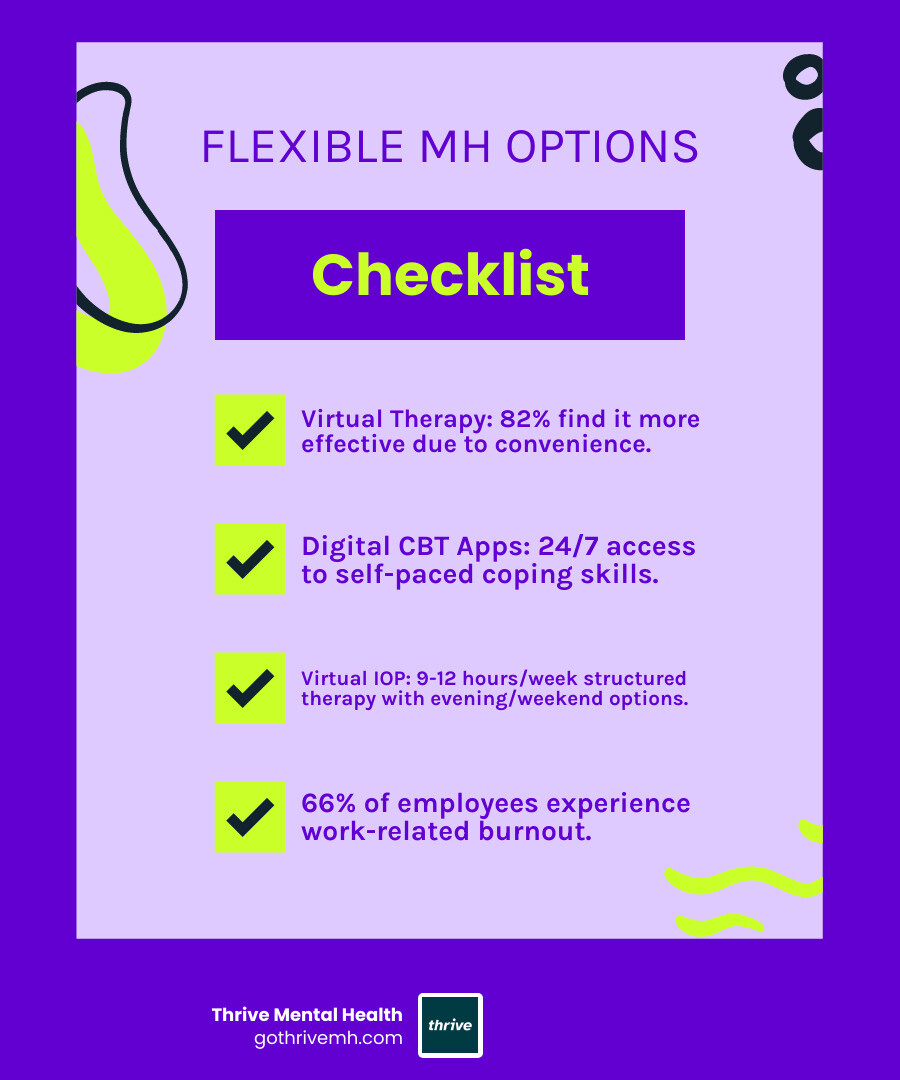
What are the top flexible mental health treatment options for working professionals? Here are the seven most effective solutions that fit demanding schedules:
- Virtual Therapy & Telehealth, therapy sessions via video, phone, or text on your schedule
- Digital CBT & Mental Health Apps, self-paced coping skills and mindfulness training available 24/7
- Employee Assistance Programs (EAPs), free, confidential short-term counseling through your employer
- Virtual Intensive Outpatient Programs (IOP), structured group and individual therapy with evening/weekend options
- Blended & Hybrid Care Models, combination of in-person and virtual sessions for maximum flexibility
- Executive & Professional Coaching, proactive mental fitness and leadership resilience training
- Medication Management via Telepsychiatry, psychiatric evaluations and prescription management online
You’re crushing your quarterly goals. Your inbox is under control. Your calendar is color-coded perfection.
But you’re also exhausted. Anxious. Running on fumes.
66% of employees experience work-related burnout, and professionals like you, the high achievers, are often hit hardest. The same drive that fuels your success can quietly erode your mental health when left unchecked.
The problem isn’t willpower. It’s access. Traditional therapy wasn’t designed for someone who works 50-hour weeks, travels for client meetings, or juggles back-to-back Zoom calls. You need flexible mental health treatment options for working professionals that actually fit your life, not the other way around.
The good news? Modern mental healthcare has evolved. From virtual therapy you can access during lunch breaks to intensive programs with evening hours, there are now real solutions built for demanding schedules. You don’t have to choose between your career and your well-being.
I’m Nate Raine, CEO of Thrive Mental Health, and over the past decade I’ve focused on building systems that make evidence-based care accessible for busy professionals through virtual IOP programs. Understanding what are the top flexible mental health treatment options for working professionals has been central to designing treatment that delivers measurable outcomes without derailing your career.
Handy What are the top flexible mental health treatment options for working professionals? terms:
- What are my options for mental health treatment that’s more intensive than weekly therapy but doesn’t require living at a facility?
- telehealth IOP program
- confidential mental health support
The High Cost of “Always On”: Why Professionals Are at a Breaking Point
The relentless pace of professional life often feels like a badge of honor. We’re expected to be “always on,” connected 24/7, and constantly striving for the next achievement. But this demanding nature takes a heavy toll on our mental well-being, leading to widespread mental health challenges.
Workplace stress isn’t just an inconvenience; it’s a critical factor contributing to anxiety and depression. Studies show that a staggering 66% of employees experience work-related burnout, with 65% citing their job as a “very significant” or “somewhat significant” source of stress. This constant pressure can manifest as persistent worry, difficulty concentrating, irritability, and even physical symptoms like headaches or digestive issues.
For remote professionals, the challenges can be unique. While offering flexibility, remote work can also lead to isolation. A study by Buffer revealed that 23% of remote workers cite loneliness as a significant challenge. This lack of social connection can exacerbate feelings of anxiety and depression, adding another layer to the mental health crisis faced by working professionals.
The impact of these mental health struggles extends far beyond individual well-being. It hits businesses where it hurts: the bottom line. Absenteeism due to mental health issues costs businesses billions globally every year. Furthermore, stress-related healthcare expenses cost businesses nearly $190 billion annually in the U.S. This isn’t just about lost days; it’s about presenteeism, showing up to work but being unable to perform effectively due to mental health struggles. The cost of ignoring mental health is often far higher than the cost of providing support.
What are the top flexible mental health treatment options for working professionals? [7 Solutions]

When you’re navigating a demanding career, finding time for mental health treatment can feel like an impossible task. Traditional therapy models often require rigid scheduling, inconvenient travel, and a significant time commitment that many professionals simply don’t have. This is why flexible, accessible, and effective solutions are not just a luxury, but a necessity.
We understand these challenges intimately. Our mission is to provide evidence-based care that seamlessly integrates into your busy life, allowing you to prioritize your mental health without sacrificing your career aspirations. We believe that everyone deserves access to the support they need, regardless of their schedule or location.
Here are the top flexible mental health treatment options designed with working professionals in mind:
CALLOUT BOX: If you or someone you know is in crisis or having thoughts of suicide, call or text the 988 Suicide & Crisis Lifeline at 988. You are not alone.
1. Virtual Therapy & Telehealth: Your Therapist, On Your Schedule
Virtual therapy, also known as telehealth or teletherapy, has revolutionized mental healthcare access. It allows you to connect with licensed mental health professionals through video, phone, or even text, from the comfort of your home or office.
Benefits for working professionals:
- Best Convenience: Say goodbye to commuting, traffic, and parking woes. You can schedule sessions during a lunch break, before work, or in the evening, eliminating the logistical problems that often deter professionals from seeking help.
- Increased Accessibility: Virtual therapy removes geographical barriers, allowing you to access specialized care no matter where you live or work. This is particularly beneficial for those in Florida, California, Indiana, Arizona, and South Carolina who might not have immediate access to in-person specialists in their area.
- Reduced Stigma: For many, the discreet nature of virtual sessions helps overcome the fear of judgment associated with seeking mental health support. You can engage in therapy privately, knowing your employer is not informed about your personal health decisions.
- Proven Effectiveness: Research consistently shows that virtual care is as effective as traditional in-person therapy for a wide range of mental health conditions, including anxiety, depression, ADHD, bipolar disorder, and PTSD. In fact, some reports indicate that a high percentage of users, as many as 82%, find virtual care more effective than in-person options, often due to the comfort and privacy of being at home.
We recognize the power of virtual therapy and integrate it into many of our programs, ensuring you get the support you need, when and where you need it.
2. Digital CBT & Mental Health Apps: Build Coping Skills 24/7
For professionals seeking self-paced support or tools to complement their therapy, digital Cognitive Behavioral Therapy (CBT) and mental health apps offer invaluable resources. These options empower you to build coping skills, manage stress, and improve emotional well-being on your own terms.
- Online CBT: Therapist-supported online CBT has been shown to be as effective as face-to-face CBT for reducing overall anxiety and symptoms, and improving quality of life in adults with anxiety disorders. These programs often include structured modules, exercises, and guided practices that you can complete at your own pace, with the option for professional feedback.
- Mindfulness & Stress Reduction Apps: Many apps offer guided meditations, breathing exercises, mood trackers, and psychoeducational content to help you manage daily stress, improve focus, and cultivate mindfulness. While mood trackers should be used with caution (as some research suggests they can have detrimental impacts if not implemented carefully), features like video content, reminder texts, and homework diaries have shown strong evidence of benefit for stress reduction.
- Accessibility and Personalization: These tools offer 24/7 access to support, making them incredibly flexible for busy schedules. Many offer personalized experiences, which 59% of employees say is key to successful mental health initiatives.
Digital tools can be a powerful complement to more intensive treatments, allowing you to practice skills and maintain progress between sessions.
3. Employee Assistance Programs (EAPs): Your Company’s Confidential First Step
Employee Assistance Programs (EAPs) are a valuable resource often provided by employers, offering confidential support for a wide range of personal and work-related challenges. EAPs are designed to be a convenient first step for employees and their families seeking mental health support.
- Confidentiality is Key: A major benefit of EAPs is their commitment to confidentiality. As Health Canada’s EAP states, “We do not inform your employer that you or a family member contacted us.” This assurance helps mitigate the fear of judgment that often prevents employees from seeking help.
- Free Short-Term Counseling: EAPs typically offer a limited number of free counseling sessions (often 3-6 sessions) with licensed mental health professionals. These sessions can address immediate concerns like stress, anxiety, relationship issues, or grief.
- Crisis Support & Referrals: EAPs provide 24/7 access for those in distress and can offer referrals to appropriate external community resources if longer-term or specialized treatment is needed. They often respond quickly, with appointments usually offered within 5 business days.
- Overcoming Low Utilization: Despite their benefits, EAPs traditionally face low utilization rates (estimated between 2% and 8%). Factors like lack of awareness, stigma, and concerns about personalization contribute to this. Employers who actively promote their EAPs and ensure clear communication about services and confidentiality can help overcome these barriers.
We encourage professionals to explore their company’s EAP as a confidential and accessible entry point to mental health support.
4. Virtual Intensive Outpatient Programs (IOP): Deeper Support That Fits Your Life
For professionals who need more than weekly therapy but don’t require inpatient care, a Virtual Intensive Outpatient Program (IOP) offers a powerful, flexible solution. IOPs provide structured, evidence-based treatment while allowing you to maintain your work and family responsibilities.
Benefits of Virtual IOPs for Professionals:
- More Intensive Support: IOPs typically involve 9-12 hours of therapy per week, including a combination of group therapy, individual sessions, and psychoeducation. This deeper level of engagement is ideal for addressing more complex mental health challenges like depression, anxiety disorders, and trauma.
- Flexible Scheduling: We understand your schedule is demanding. That’s why our virtual IOP is specifically designed with evening and weekend options. This allows you to receive comprehensive treatment without taking extended time off work.
- Structured & Supportive Environment: Our programs provide a consistent, supportive community where you can connect with peers facing similar challenges. Group therapy fosters a sense of belonging and provides diverse perspectives and coping strategies.
- Measurable Results: We focus on evidence-based treatment and measurable outcomes. Our clinical expertise ensures you receive effective care custom to your unique needs.
- Geographic Accessibility: Our virtual IOPs are available to professionals across Florida, California, Indiana, Arizona, and South Carolina, bringing high-quality care directly to you, wherever you are.
If you find yourself needing more support than a once-a-week therapy session can provide, but less than an inpatient stay, a virtual IOP could be the ideal flexible solution.
5. Blended & Hybrid Care Models: The Best of Both Worlds
Sometimes, the ideal solution isn’t strictly virtual or strictly in-person, but a combination of both. Blended and hybrid care models offer the best of both worlds, providing personalized treatment that adapts to your evolving needs and preferences.
- Combining In-Person Connection with Virtual Flexibility: For some, the therapeutic relationship is strengthened by occasional in-person meetings, while the convenience of virtual sessions for routine check-ins or group therapy is invaluable. A hybrid approach allows you to experience face-to-face accountability when desired, coupled with the flexibility of virtual access.
- Personalized Treatment Plans: These models allow for highly individualized care. Your treatment team can assess which modalities best suit your condition, learning style, and schedule, ensuring a truly bespoke approach to your mental well-being.
- Access to Local Centers: For those in Florida, California, Indiana, Arizona, and South Carolina, we offer hybrid options that leverage our trusted in-person centers for specific components of care, while maintaining the overall flexibility of virtual programming. This ensures you have access to both convenient virtual support and the option for local, in-person connection when it benefits your recovery journey.
This adaptive approach ensures continuity of care and maximizes engagement, crucial for long-term mental health success.

6. Executive & Professional Coaching: Proactive Mental Fitness for Leaders
While not a direct mental health treatment in the clinical sense, executive and professional coaching can serve as a powerful proactive tool for mental fitness, particularly for leaders and high-performing professionals.
- Focus on Resilience and Performance: Coaching helps professionals develop strategies to manage stress, improve emotional intelligence, improve communication, and build resilience. This proactive approach aims to prevent burnout and maintain optimal mental performance.
- Skill Development for Leaders: Coaches can work with you on specific leadership challenges, such as conflict resolution, team motivation, and strategic decision-making, all of which have a direct impact on your mental well-being and that of your team.
- Burnout Prevention: By identifying early signs of stress and developing personalized coping mechanisms, coaching helps professionals build a robust mental toolkit to steer demanding environments without succumbing to burnout.
- Confidential and Goal-Oriented: Professional coaching is typically confidential and highly goal-oriented, focusing on actionable steps and measurable progress toward your professional and personal development goals.
For many professionals, coaching acts as a vital layer of support, helping them maintain mental agility and well-being before clinical intervention becomes necessary.
7. Medication Management via Telepsychiatry: Accessible & Integrated Care
For those whose mental health challenges require pharmacological support, telepsychiatry offers a flexible and integrated solution for medication management. This eliminates many of the traditional barriers to accessing psychiatric care.
- Virtual Psychiatric Evaluations: You can receive comprehensive psychiatric evaluations and diagnoses through secure video conferencing. This means you can connect with a licensed psychiatric provider from your home or office in Florida, California, Indiana, Arizona, or South Carolina, without the need for in-person travel.
- Prescription Management Online: Psychiatric providers can prescribe and monitor medication virtually, ensuring you receive timely refills and adjustments as needed. This convenience is a game-changer for busy professionals who might struggle to fit traditional appointments into their schedules.
- Integrated with Therapy: Telepsychiatry can be seamlessly integrated with your ongoing therapy. Your therapist and psychiatric provider can collaborate to ensure a holistic and coordinated approach to your care, optimizing treatment outcomes.
- Removes Travel Barriers: Whether you’re traveling for work or simply have a packed schedule, telepsychiatry removes the logistical headache of in-person follow-up appointments, making consistent care far more achievable.
Access to psychiatric expertise, combined with the convenience of telehealth, ensures that medication can be a supportive and manageable part of your comprehensive mental health treatment plan.
How to Integrate Treatment Into Your Demanding Schedule
Integrating mental health treatment into an already demanding professional life requires thoughtful planning and a commitment to prioritizing your well-being. It’s not about finding extra hours in the day, but about strategically utilizing existing time and leveraging flexible options.

What are the top flexible mental health treatment options for working professionals looking for a provider?
When seeking flexible mental health treatment options for working professionals, choosing the right provider or platform is crucial. Here’s what to look for:
- Licensed and Experienced Therapists: Ensure the professionals are highly qualified, licensed, and have experience working with professionals. Look for evidence-based practices like Cognitive Behavioral Therapy (CBT), Dialectical Behavior Therapy (DBT), and other modalities proven to be effective. Our programs, for example, are rooted in clinical expertise and evidence-based approaches.
- Insurance Coverage: Confirm that the provider or platform accepts your insurance plan. Many modern providers work with major insurers like Cigna, Optum, Aetna, and Florida Blue, making treatment more affordable. Always verify your benefits upfront.
- User-Friendly Platforms: For virtual options, a secure, intuitive, and reliable platform is essential. It should be easy to schedule, attend sessions, and access resources.
- Flexible Scheduling Options: Look for providers who offer evening, early morning, or weekend appointments to accommodate your work schedule. This is a core feature of our virtual IOP programs.
- Comprehensive Care: Consider if the provider offers a range of services, from individual therapy to group sessions, and if they can integrate medication management or provide referrals for specialized care.
Resources like the Substance Abuse and Mental Health Services Administration (SAMHSA) website can also help you find support and locate services.
How can working professionals integrate mental health treatment into their demanding schedules?
The key to successful integration lies in intentionality and self-advocacy.
- Time-Blocking and Prioritization: Treat your therapy appointments like any other critical meeting. Block out the time in your calendar and guard it fiercely. Many professionals find that scheduling sessions during lunch breaks or immediately before/after work works best.
- Communicating Boundaries: Learn to set clear boundaries with colleagues and clients. This might mean using “do not disturb” features during your session time or communicating your availability clearly.
- Leveraging PTO for Mental Health: If your employer offers Paid Time Off (PTO), use it not just for vacations, but for mental health days or to attend more intensive therapy sessions. Some companies even offer specific mental health days.
- Asynchronous Options: Use digital mental health apps or online CBT programs that allow for self-paced learning and skill-building outside of live sessions. This can provide continuous support without rigid scheduling.
- Overcoming Stigma: The biggest barrier can often be internal. Prioritizing your mental health is a sign of strength, not weakness. While 8 in 10 workers avoid talking about mental health at work due to shame or fear of judgment, a growing number of companies are fostering more supportive environments. You don’t need to disclose details, but recognizing your need for support is a crucial first step.
We empower our clients to advocate for their well-being and provide the flexible structures that make integration possible.
The Long-Term ROI: Why Mental Health is Your Best Career Investment
Investing in your mental health through flexible treatment isn’t just about feeling better today; it’s a strategic move that yields significant long-term returns for your career longevity and overall well-being. Think of it as investing in your most valuable asset: yourself.
- Improved Career Longevity: Addressing mental health challenges proactively helps prevent burnout and fosters resilience, allowing you to sustain your career at a high level for longer. When you’re mentally well, you’re better equipped to adapt to change, manage stress, and steer professional problems.
- Increased Productivity and Creativity: Mental clarity, reduced anxiety, and improved focus directly translate to higher productivity and improved creative problem-solving. When your mind isn’t bogged down by stress, it’s free to innovate and perform at its peak.
- Improved Decision-Making: Unaddressed mental health issues can impair judgment and decision-making. Therapy helps you develop clearer thinking patterns and emotional regulation, leading to more sound professional choices.
- Stronger Relationships: Better mental health improves your communication skills, empathy, and ability to collaborate effectively with colleagues, clients, and superiors. This strengthens your professional network and leadership capabilities.
- Reduced Absenteeism and Presenteeism: By actively managing your mental health, you’re less likely to miss work due to illness and more likely to be fully engaged when you are there. This directly impacts your performance and perceived reliability.
- Tangible Financial Returns: Studies show that mental health programs, including flexible treatment options, can yield an impressive ROI. Some research estimates that the ROI on employee wellness programs can be more than $3.00 for every $1.00 invested in mental health resources. This demonstrates a clear correlation between employee well-being and a company’s bottom line.
- Attracting and Retaining Talent: Companies that prioritize mental health are more attractive to top talent. In fact, some studies show that more than 86% of job seekers see mental healthcare as a key factor in their job search.
Prioritizing your mental health isn’t a luxury; it’s the foundation for a fulfilling, successful, and sustainable career. It’s the smart investment that pays dividends across every aspect of your life.
Frequently Asked Questions about Flexible Mental Health Treatment
Is virtual therapy as effective as in-person therapy?
Yes, extensive research shows that virtual therapy is just as effective as in-person therapy for many common conditions like anxiety and depression. Many people find the comfort and convenience of being at home actually improves the effectiveness of their treatment, though the best format always depends on individual needs and preferences.
Will my employer find out if I use mental health benefits?
No. Services like EAPs and therapy covered by your health insurance are confidential and protected by privacy laws like HIPAA. Your employer receives anonymized, aggregated data at most, never your personal information. Your privacy is paramount.
What is the difference between a virtual IOP and regular weekly therapy?
A virtual Intensive Outpatient Program (IOP) is a more structured and time-intensive treatment. It typically involves multiple hours of therapy per week (e.g., 9-12 hours) including group and individual sessions, designed for those who need more support than a single weekly session can provide. It’s ideal for those needing a higher level of care to address complex issues while still maintaining their daily responsibilities.
Take the Next Step: Flexible Support is Waiting
You’ve built a thriving career, and now it’s time to ensure your mental well-being keeps pace. The era of rigid, one-size-fits-all mental healthcare is over. Today, a wealth of flexible mental health treatment options for working professionals are available, designed to fit seamlessly into your demanding schedule.
We understand the unique pressures you face, which is why we’ve pioneered virtual IOP programs with crucial evening options. Our programs offer the clinical expertise and measurable results you need, delivered with the flexibility you deserve. Whether you’re in Florida, California, Indiana, Arizona, or South Carolina, our evidence-based treatment is accessible to you.
You don’t have to choose between your career and your mental health. You can have both.
Ready for support? Thrive offers virtual IOP programs with evening options. Verify your insurance in 2 minutes (no obligation) → Start benefits check or call 561-203-6085. If you’re in crisis, call/text 988.
You can also learn more about remote mental health support and how it can benefit your journey.

This article is for informational purposes only and is not a substitute for individualized clinical advice or insurance verification.