
Virtual DBT Explained: Emotional Balance at Your Fingertips

What You Need to Know About Virtual Dialectical Behavior Therapy
If you are in crisis or experiencing thoughts of self-harm, please call or text 988 to reach the Suicide & Crisis Lifeline. You are not alone.
Virtual dialectical behavior therapy is a proven, evidence-based treatment that helps you manage intense emotions, reduce self-destructive behaviors, and build healthier relationships—all from the comfort of your own home. It combines video sessions, online skills training, and digital tools to deliver the same core DBT framework used in traditional therapy, without requiring you to travel to an office.
Quick Answer: What is Virtual DBT?
- Evidence-based therapy originally developed for borderline personality disorder, now used for anxiety, depression, PTSD, substance use, and more
- Delivered online through video sessions, messaging apps, and digital platforms
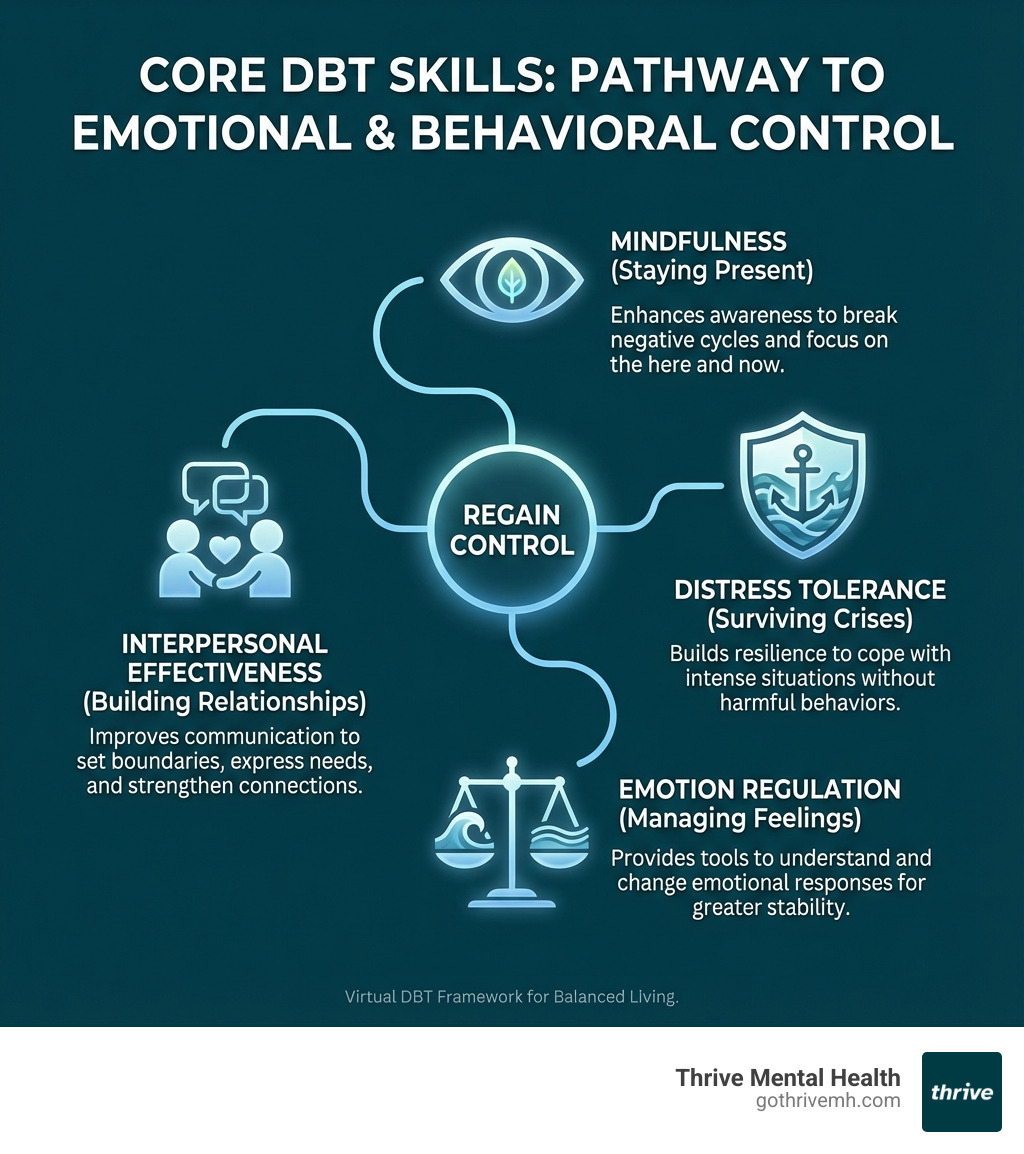
- Teaches 4 core skills: Mindfulness, Distress Tolerance, Emotion Regulation, Interpersonal Effectiveness
- Formats include: Individual therapy, group skills training, self-guided courses, and intensive outpatient programs (IOPs)
- Equally effective as in-person DBT according to research, with added flexibility and accessibility
- Typically takes 6-12 months of active participation to see significant results
You’re not alone if you feel like your emotions control you instead of the other way around. Whether you’re dealing with overwhelming anxiety, recurring depression, trauma responses, or impulsive behaviors that sabotage your goals, virtual DBT offers a lifeline.
Unlike weekly therapy that can feel too slow when you’re struggling, virtual DBT programs—especially intensive outpatient programs (IOPs)—give you structured, frequent support that fits your schedule. You get the same skills training, crisis coaching, and therapeutic guidance as traditional DBT, but delivered through secure video platforms, mobile apps, and online communities.
Research shows that online DBT skills training can be just as effective as in-person training for reducing symptoms of depression, anxiety, emotional dysregulation, and self-harm. Studies have found that virtual cognitive-behavioral therapy (the foundation of DBT) is as effective as face-to-face sessions for treating anxiety and depression. For specific populations like individuals with borderline personality disorder or substance use disorders, online DBT has produced significant reductions in suicidal ideation, self-destructive behaviors, and emotional distress.
The beauty of virtual delivery is simple: you can access expert care without geographical barriers, scheduling conflicts, or the stigma of walking into a clinic. If you’re a busy professional, a college student juggling classes, or someone in a rural area with limited mental health resources, virtual DBT removes the obstacles that keep people from getting help.
I’m Nate Raine, CEO of Thrive Mental Health, where we’ve built evidence-based virtual dialectical behavior therapy programs that integrate data-driven outcomes with compassionate, personalized care across Florida. My background in digital health innovation and behavioral science has shown me how technology can make life-changing treatment accessible to people who need it most.
Virtual dialectical behavior therapy terms made easy:
What Is DBT? A Lifeline for Intense Emotions
At its core, Dialectical Behavior Therapy (DBT) is an evidence-based psychotherapy developed by Dr. Marsha Linehan. It emerged from a blend of traditional Cognitive Behavioral Therapy (CBT) and Eastern mindfulness practices, particularly Zen Buddhism. The term “dialectical” itself refers to the idea of balancing two seemingly opposing forces: acceptance and change. This means we learn to accept ourselves and our current situation without judgment, while simultaneously working to make powerful, positive changes to build a life worth living. It’s a nuanced approach that acknowledges your pain while empowering you to move forward.
For a deeper dive into DBT, explore What is DBT?. If you’re curious about different DBT treatments, you can find More info about DBT treatments here.

Who can virtual dialectical behavior therapy help?
Virtual dialectical behavior therapy is a powerful tool for a wide range of mental health conditions and challenges. While initially developed for Borderline Personality Disorder (BPD)—and recognized as the “gold standard” treatment for it—DBT’s comprehensive skills are now applied to many other struggles. If you find yourself struggling with intense emotions, impulsive behaviors, or relationship difficulties, virtual DBT could be your answer.
We’ve seen how effectively DBT can help individuals struggling with:
- Borderline Personality Disorder (BPD): Managing emotional dysregulation, impulsivity, and relationship instability.
- Suicidal ideation and self-harm behaviors: Providing critical crisis survival and emotion regulation skills to reduce life-threatening actions. The intervention has produced significant reductions in suicidal ideation, alcohol consumption, and emotion dysregulation.
- Anxiety disorders: Learning to observe anxious thoughts without judgment and tolerate distress.
- Depression: Increasing positive emotions and improving coping strategies.
- Bipolar Disorder: Stabilizing mood swings and reducing impulsive actions.
- Post-Traumatic Stress Disorder (PTSD): Regulating intense emotional responses to trauma and improving distress tolerance.
- Substance Use Disorders (SUDs): Addressing emotion dysregulation, which is a transdiagnostic risk factor underlying SUDs, and developing healthier coping mechanisms.
- Eating disorders: Managing emotional triggers related to disordered eating patterns.
DBT is often sought by those who haven’t found success with other therapeutic approaches, as it offers a structured and skill-based pathway to better mental health. For a deeper look at how DBT compares to other therapies, check out A deeper look at DBT vs CBT.
The 4 DBT Skills That Give You Back Control [Explained]
If you’re struggling with urges to self-harm, call or text 988 immediately. Help is available 24/7.
DBT’s effectiveness lies in its practical, teachable skills. These aren’t just abstract concepts; they are concrete strategies you can learn and practice to improve your capabilities and replace ineffective behaviors with more skillful ones. Problematic behaviors often evolve as a way to cope, offering temporary relief, but DBT empowers you to choose long-term solutions.
We focus on four core modules, each designed to give you a specific set of tools to steer life’s challenges. Typically, skills training is taught in groups, with homework assignments to help you integrate these new behaviors into your daily life. The full DBT skills curriculum often runs for 24 weeks, ensuring you get comprehensive training. Learn more about Dialectical Behavior Therapy (DBT) and its components at Dialectical Behavior Therapy (DBT).
Mindfulness: Staying Grounded in the Present Moment
Mindfulness is the foundation of all DBT skills. It teaches you to be fully aware and present in the moment, observing your thoughts, feelings, and sensations without judgment. This skill helps you reduce reactivity and respond more effectively to stressful situations. We learn “what” skills (observe, describe, participate) and “how” skills (non-judgmentally, one-mindfully, effectively) to truly engage with the present. It’s about learning to ride emotional waves without getting pulled under.
Distress Tolerance: Surviving a Crisis Without Making It Worse
Life throws curveballs, and sometimes, you just need to get through a tough moment without making things worse. Distress Tolerance skills are your emergency toolkit. They help you cope with intense emotional pain and difficult situations without resorting to harmful behaviors. This includes crisis survival skills like TIPP (Temperature, Intense exercise, Paced breathing, Paired muscle relaxation), radical acceptance (accepting reality as it is, not as you wish it were), self-soothing (comforting yourself through your senses), and improving the moment (distracting yourself with positive activities). These skills are crucial for those moments when you feel overwhelmed and impulsive.
Emotion Regulation: Understanding and Managing Your Feelings
If you’ve ever felt like your emotions control you, Emotion Regulation skills are here to help you take back the reins. This module teaches you to understand your emotions, reduce your vulnerability to negative emotional states, and change emotions you want to change. We work on identifying and labeling emotions, checking the facts to see if your emotional reaction fits the situation, and practicing “opposite action”—acting in a way that is contrary to your emotional urge to shift your emotional state. The goal is to increase your positive emotional experiences and build a life that feels more balanced and fulfilling.
Interpersonal Effectiveness: Building Healthier Relationships
Healthy relationships are a cornerstone of a life worth living, but they can also be a major source of stress. Interpersonal Effectiveness skills teach you how to communicate your needs, set boundaries, and steer conflicts effectively, all while maintaining your self-respect and strengthening your relationships. We learn skills like DEAR MAN (Describe, Express, Assert, Reinforce, be Mindful, Appear confident, Negotiate) for asking for what you want, GIVE (Gentle, Interested, Validate, Easy manner) for maintaining relationships, and FAST (Fair, Apologies, Stick to values, Truthful) for preserving self-respect. These skills empower you to build connections that truly serve you.
How Virtual Dialectical Behavior Therapy Works [Formats & Tech]
The shift to virtual dialectical behavior therapy isn’t just about convenience; it’s about leveraging technology to make life-changing treatment more accessible and effective. We use secure, high-quality technology to replicate the comprehensive DBT experience you’d receive in person. This includes video conferencing for individual and group sessions, secure messaging apps for between-session coaching, and digital workbooks or apps for skill practice.
The role of technology in virtual DBT is transformative. It removes geographical barriers, allowing individuals throughout Florida to access expert-led programs regardless of their exact location. It also offers flexibility that traditional in-person models often can’t match. For instance, you could squeeze in a quick lesson or practice session on your mobile device while waiting for an appointment, making skills integration into daily life seamless.
Here’s a snapshot of how virtual DBT stacks up against traditional in-person therapy:
| Feature | Virtual DBT | In-Person DBT |
|---|---|---|
| Accessibility | Available from anywhere with internet access | Limited by geographical location and transportation |
| Cost | Often more cost-effective (reduced travel, childcare) | Can incur additional costs (travel, parking, time off) |
| Scheduling | Highly flexible, easier to fit into busy schedules | Fixed appointments, less flexibility |
| Environment | Comfort and privacy of your own home | Requires travel to a clinic, less privacy |
| Engagement | Improved by interactive digital tools, apps, and coaching | Primarily relies on in-session interaction |
| Stigma | Reduced due to privacy and discreet access | Can be a barrier for some individuals |
| Continuity | Easier to maintain consistency, even when traveling | Can be disrupted by travel or logistical challenges |
To explore our virtual DBT IOP program and see how it works, visit Explore our virtual DBT IOP program.
What are the different formats of virtual DBT?
Virtual dialectical behavior therapy offers a variety of formats to suit different needs and preferences:
- Therapist-led individual sessions: One-on-one video calls with a DBT-trained therapist who helps you apply skills to your specific challenges and stay motivated.
- Group skills training: Virtual group sessions where you learn and practice DBT skills alongside others facing similar struggles, led by a trained DBT therapist and often a peer co-facilitator. These groups provide invaluable peer support and a sense of community.
- Self-guided courses: Some platforms offer structured, self-paced modules, often with video lessons and exercises, allowing you to learn skills at your own speed. While beneficial, these are typically less comprehensive than full DBT with therapist support.
- Hybrid models: A combination of virtual individual therapy and in-person group skills training, or vice-versa, offering the best of both worlds.
- Intensive Outpatient Programs (IOPs): Like the programs we offer at Thrive Mental Health, virtual IOPs provide a higher level of structured support than weekly therapy. They typically involve multiple group therapy sessions per week, individual therapy, and 24/7 phone coaching, all delivered virtually. This comprehensive approach is designed for those who need more intensive care but don’t require inpatient hospitalization.
How does virtual DBT differ from in-person therapy?
While the core principles and effectiveness of DBT remain consistent, the virtual format introduces some key differences:
- Convenience: Virtual DBT eliminates travel time, parking hassles, and the need to take significant time off work or school. You can attend sessions from anywhere in Florida with a stable internet connection.
- Anonymity & Comfort: For many, the privacy of their own home makes it easier to open up and engage deeply in therapy. It can also reduce the stigma associated with seeking mental health treatment.
- Accessibility: Virtual options dramatically increase access to specialized DBT treatment, particularly for individuals in rural areas or those with mobility challenges.
- Therapeutic Alliance: Building rapport online can be different. While effective, it might require a slightly different approach from both client and therapist to foster a strong connection.
- Need for Self-Discipline: While virtual DBT offers flexibility, it also requires a degree of self-discipline to log in consistently, manage potential distractions at home, and actively engage in homework assignments.
- Crisis Management: In severe crises, immediate in-person intervention may be more readily available, though virtual programs like our IOPs include robust crisis support systems like 24/7 phone coaching.
Is Virtual DBT Effective? The Surprising Benefits & Real-World Challenges
The question of effectiveness is paramount, and the research is overwhelmingly positive: virtual dialectical behavior therapy is highly effective. Online DBT skills training can be just as effective as in-person training for reducing symptoms of depression, anxiety, and other mental health issues. A meta-analysis of randomized controlled trials found that virtual cognitive-behavioral therapy (CBT), which forms the backbone of DBT, is as effective as in-person CBT for treating anxiety and depression.
For specific populations, the results are even more compelling. Online DBT programs have been shown to be effective for individuals with borderline personality disorder (BPD), leading to significant reductions in self-destructive behaviors and improvements in emotion regulation. Furthermore, research indicates that internet-delivered DBT (iDBT) interventions for Substance Use Disorders (SUDs) have produced significant reductions in suicidal ideation, alcohol consumption, and emotion dysregulation.

Beyond clinical efficacy, virtual DBT offers several real-world benefits:
- Convenience and Flexibility: You can access treatment from your home or office, fitting therapy into your busy life without disruption.
- Cost-Effectiveness: Reduced travel costs, less time off work, and sometimes lower session fees can make virtual DBT more affordable.
- Reduced Stigma: Engaging in therapy from a private space can lessen the perceived stigma, making it easier for individuals to seek and commit to treatment.
- Improved Engagement: Interactive tools, apps, and between-session coaching often lead to higher levels of client satisfaction and engagement.
- Broader Access: It connects you with highly specialized DBT therapists, regardless of your physical location within our service states.
Dive deeper into the research on internet-delivered DBT for SUDs at Research on internet-delivered DBT for SUDs and find How online DBT is revolutionizing care.
Who is the ideal candidate for virtual DBT?
Virtual dialectical behavior therapy is an excellent fit for many individuals, especially those who:
- Are motivated to change: DBT requires active participation and consistent skill practice.
- Are comfortable with technology: Basic proficiency with video conferencing and online platforms is helpful.
- Have busy schedules: The flexibility of virtual sessions makes it easier to integrate therapy into demanding routines.
- Live in rural or underserved areas: Where access to specialized in-person DBT programs might be limited in Florida.
- Need more than weekly therapy: Individuals stepping down from higher levels of care or those with significant challenges often benefit from the structured, frequent support of virtual IOPs.
What are the potential limitations of online DBT?
While highly effective, it’s important to acknowledge that virtual DBT isn’t a perfect fit for everyone or every situation. Some potential challenges include:
- Technology failures: Internet connectivity issues, software glitches, or device problems can disrupt sessions.
- Distractions at home: Maintaining a private, quiet space free from interruptions can be difficult for some.
- Lack of non-verbal cues: Therapists might miss subtle body language or other non-verbal communication that could be more apparent in person.
- Not suitable for severe crises: While virtual programs offer crisis support, individuals in acute, immediate danger may require in-person emergency services.
- Importance of a private space: Ensuring confidentiality and a feeling of safety requires a dedicated, private environment during sessions.
Finding & Paying for Virtual DBT: A Step-by-Step Guide to Insurance & Costs
Finding the right virtual dialectical behavior therapy program is a critical step towards your emotional well-being. We understand that navigating costs and insurance can feel overwhelming, but we’re here to make it as straightforward as possible.
When searching for a program, prioritize those with specialized DBT training for their therapists. This ensures you receive adherent, high-quality care. Always verify credentials and inquire about the program’s structure, including individual therapy, group skills training, and phone coaching.
The cost of virtual DBT can vary widely depending on the program’s intensity (e.g., individual sessions vs. IOP), the provider, and your insurance coverage. However, virtual options often prove more cost-effective due to reduced indirect costs like travel and childcare.
How do I find a virtual DBT program?
Finding a program that fits your needs and is available in Florida is crucial. Here’s how:
- Online Directories: Use reputable online directories that list licensed mental health professionals and programs offering virtual DBT.
- Insurance Provider Lists: Check your insurance company’s website for a list of in-network providers who offer virtual dialectical behavior therapy.
- Referrals from Doctors: Your primary care physician or a current mental health provider can often offer valuable referrals to trusted virtual DBT programs.
- Targeted Search: Search specifically for terms like “virtual DBT Florida,” “online DBT Tampa,” or “DBT IOP Miami” to find providers in your area.
Will my insurance cover virtual dialectical behavior therapy?
Many insurance plans do cover virtual dialectical behavior therapy, especially as telehealth services have become more mainstream. We work with a variety of insurance providers, including:
- Aetna
- Blue Cross Blue Shield
- UnitedHealthcare
- Cigna
- Optum
- Florida Blue
It’s essential to check your specific plan benefits to understand your coverage for mental health services, both in-network and out-of-network. Contact your insurance company directly to confirm your coverage details, including deductibles, co-pays, and any limitations on virtual therapy. Even if your plan doesn’t fully cover mental health services, self-pay options are often available, and virtual therapy can still be more affordable than many in-person co-pays.
For detailed guidance on navigating insurance for DBT, read Understanding insurance coverage for DBT.
Frequently Asked Questions about Virtual DBT
How long does virtual DBT take to work?
DBT is not a quick fix; it’s a comprehensive treatment designed for lasting change. While individual progress varies, full, adherent virtual dialectical behavior therapy programs typically run for 6 to 12 months of active participation. You may start seeing significant improvements in managing intense emotions, reducing self-harm, and improving relationships within the first few months, but consistent commitment to individual therapy, group skills training, and daily practice is key to long-term success.
What is the main difference between DBT and CBT?
While DBT has its roots in Cognitive Behavioral Therapy (CBT), they have distinct focuses. CBT primarily focuses on identifying and changing negative thought patterns and behaviors to improve emotional well-being. DBT, however, expands on CBT by integrating principles of acceptance, mindfulness, and validating emotional experiences. It’s specifically designed for individuals who struggle with severe emotional dysregulation and often find CBT alone insufficient. DBT offers a more structured approach to managing intense emotions, surviving crises, and building healthier relationships, alongside cognitive restructuring.
Can I do DBT on my own?
While there are many self-help workbooks, apps, and online resources available for learning DBT skills, a comprehensive DBT program is most effective when guided by a trained therapist and supported by group sessions. For individuals dealing with complex issues like BPD, suicidal ideation, or severe emotional dysregulation, the structure of individual therapy, group skills training, and phone coaching with a qualified therapist is crucial. This provides personalized guidance, accountability, and the opportunity to apply skills in real-time with expert feedback, which self-guided methods cannot fully replicate.
Take the Next Step Toward Emotional Balance
Virtual dialectical behavior therapy makes expert-led, evidence-based care accessible from anywhere. It provides the tools to manage intense emotions, survive crises, and build a life you value. With formats like virtual IOPs, you can get structured support that fits your life. Thrive Mental Health offers flexible, expert-led virtual programs to help you regain control.
Ready for support? Thrive offers virtual and hybrid IOP/PHP programs with evening options. Verify your insurance in 2 minutes (no obligation) → Start your benefits check or call 561-203-6085. If you’re in crisis, call/text 988.
Reviewed by Anna Green, LMHC, LPC, Chief Clinical Officer at Thrive Mental Health. Anna is licensed in Florida (MH23391), Indiana, South Carolina, North Carolina, and Arizona, and was named to Women We Admire's Top 50 Women Chief Clinical Officers of 2025.
This article is for informational purposes only and is not a substitute for individualized clinical advice or specific insurance verification.