





What does dialectical behavior therapy treat: 7 Key Conditions
Why DBT Has Become Mental Health’s Most Versatile Treatment
If you or someone you know is in crisis or considering suicide, please call or text 988 to reach the Suicide & Crisis Lifeline. You are not alone.
What does dialectical behavior therapy treat? DBT effectively treats a wide range of mental health conditions beyond its original focus on borderline personality disorder, including:
- Borderline Personality Disorder (BPD), reduces self-harm and suicide attempts by up to 77%
- Post-Traumatic Stress Disorder (PTSD), helps manage flashbacks and trauma responses
- Substance Use Disorders, increases consecutive days of abstinence and reduces relapse
- Eating Disorders, 89% of people with binge eating disorder stopped bingeing after treatment
- Depression & Bipolar Disorder, improves mood regulation and prevents relapse
- Anxiety Disorders, teaches distress tolerance and reduces avoidance behaviors
- Self-Harm & Suicidal Behaviors, significantly decreases hospitalizations and crisis episodes
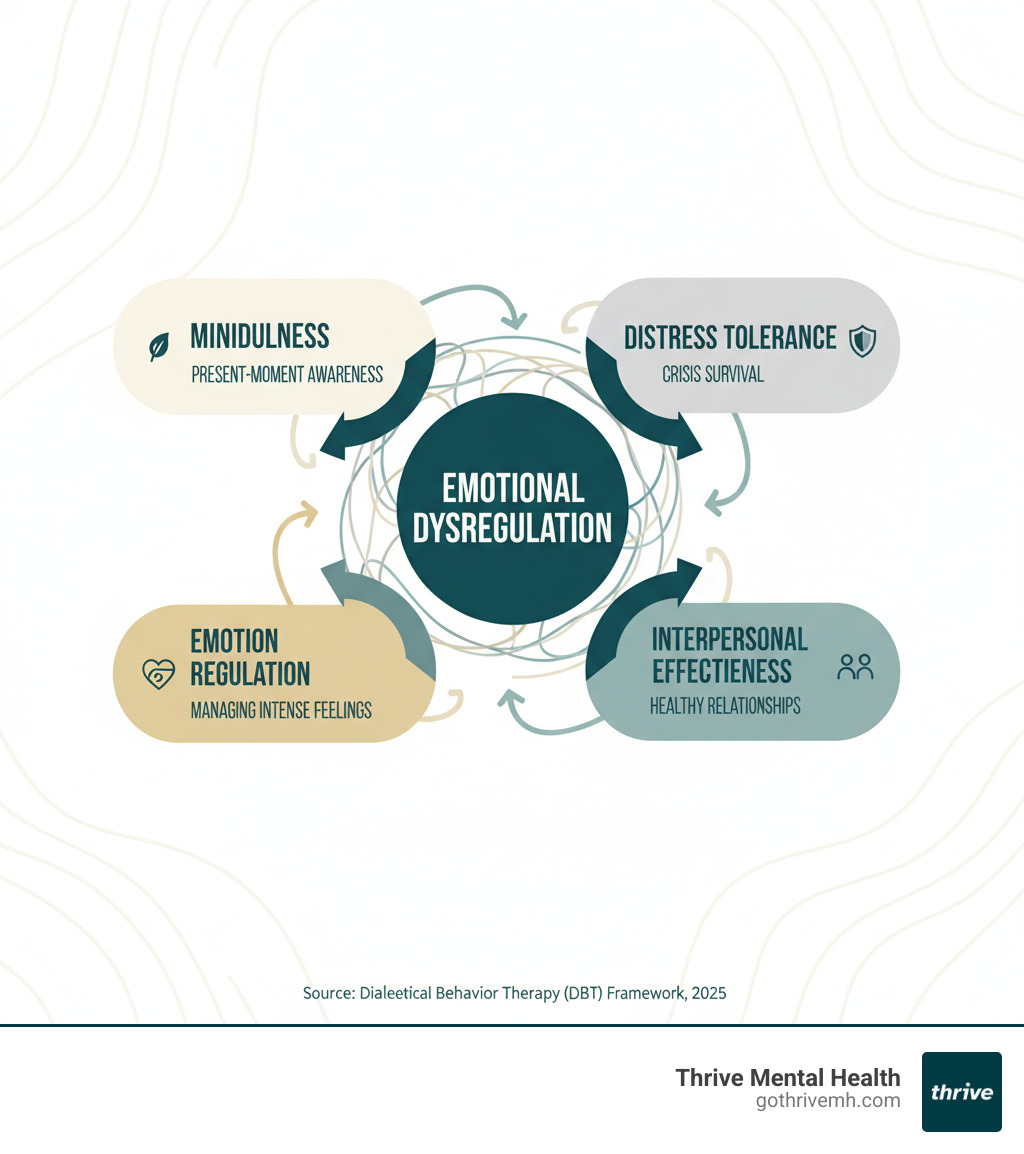
Developed by Dr. Marsha Linehan for chronically suicidal individuals, DBT is now a leading treatment for emotional dysregulation. It combines acceptance and change strategies, teaching four core skills: mindfulness, distress tolerance, emotion regulation, and interpersonal effectiveness.
DBT’s focus on validation sets it apart. It helps people accept intense emotions while learning healthier coping skills for surviving crises and building meaningful relationships, unlike CBT which focuses more on changing thoughts.
As Anna Green, LMHC, LPC, Chief Clinical Officer at Thrive Mental Health, I’ve seen how understanding what does dialectical behavior therapy treat empowers people across Florida. My experience confirms that DBT’s structured, warm, and stigma-free approach can transform lives.
Quick what does dialectical behavior therapy treat definitions:
- dialectical behavior therapy
- dialectical behavior therapy components
- how does dialectical behavioral therapy work
What is Dialectical Behavior Therapy? From Niche Treatment to a Lifeline
Feeling overwhelmed by emotions so intense that “thinking differently” feels impossible? Traditional talk therapy can fall short. This is the gap Dialectical Behavior Therapy was designed to fill.
The word “dialectical” means holding two opposite truths simultaneously. In DBT, this means accepting yourself as you are right now, while also working to change unhelpful patterns. It’s a blend of radical self-acceptance and committed change.
Dr. Marsha Linehan developed DBT in the 1970s out of frustration with traditional therapy’s limits. She worked with chronically suicidal individuals who felt invalidated by standard cognitive-behavioral approaches.
Linehan realized these clients needed to feel understood and validated before they could change. She blended cognitive-behavioral techniques with acceptance strategies and mindfulness, creating a comprehensive treatment that teaches practical skills while honoring intense emotional experiences.
What started as a niche treatment for borderline personality disorder has become a lifeline for anyone struggling with emotional overwhelm. Understanding what does dialectical behavior therapy treat reveals just how versatile this approach has become, from trauma and addiction to eating disorders and depression.
DBT vs. CBT: What’s the Real Difference?
You may wonder how DBT differs from Cognitive Behavioral Therapy (CBT). CBT acts like a thinking coach, helping you identify and replace unhelpful thought patterns.
DBT starts with validation, affirming that your emotions make sense. From there, it teaches practical skills to manage intense feelings and build healthier relationships.
| Feature | Cognitive Behavioral Therapy (CBT) | Dialectical Behavior Therapy (DBT) |
|---|---|---|
| Primary Focus | Changing unhelpful thoughts and behaviors | Managing intense emotions while accepting reality and working for change |
| Emotion vs. Thoughts | Changes thoughts to change emotions | Validates emotions first, then teaches regulation skills |
| Skills Training | Integrated into individual sessions | Dedicated weekly group sessions with structured modules |
| Therapist Relationship | Collaborative problem-solving | Highly validating with phone coaching support |
| Treatment Approach | Challenges distorted thinking patterns | Balances radical acceptance with change strategies |
DBT’s skills training component is a key difference. Unlike CBT, DBT has dedicated group sessions for learning and practicing four specific skill sets, complete with homework and peer support.
The therapist relationship is also unique. DBT therapists are highly validating while pushing for change, even offering phone coaching for crisis support. This recognizes that learning new skills requires real-world practice.
Both approaches are valuable, but DBT was specifically designed for people whose emotions feel too intense for traditional therapy methods. If you’re curious about whether DBT might be right for you, our Virtual IOP Program incorporates these evidence-based DBT principles in a flexible, accessible format for residents throughout Florida.
What Does Dialectical Behavior Therapy Treat? [7 Key Conditions]
When people ask what does dialectical behavior therapy treat, the answer is surprisingly broad. Originally for one condition, DBT is now a versatile approach for a wide spectrum of issues rooted in emotional dysregulation. The common thread is feeling overwhelmed by intense, unpredictable emotions. DBT provides practical skills to manage everything from trauma responses to relationship chaos.

1. Borderline Personality Disorder (BPD)
If you are struggling with thoughts of self-harm, call or text 988 immediately. Help is available 24/7.
BPD is the hallmark condition DBT treats. Individuals with BPD experience intense, overwhelming emotions, fear of abandonment, and may use self-injury or suicidal behaviors to cope with unbearable pain. DBT was designed for this, and the results are significant: research shows 77% of people with BPD no longer met diagnostic criteria after one year of treatment.
DBT teaches skills to ride out emotional storms without making them worse. Instead of self-harm, they learn distress tolerance. Instead of pushing people away, they learn interpersonal effectiveness. This leads to fewer hospitalizations, less anger, more stable moods, and improved quality of life, as confirmed by scientific research on BPD outcomes.
2. Post-Traumatic Stress Disorder (PTSD) & Complex PTSD
For PTSD and complex PTSD, DBT helps manage the invisible wounds of trauma, like flashbacks and emotional numbness. Instead of avoiding triggers, clients learn distress tolerance skills to stay present during overwhelming memories. The DBT-PE protocol, which combines trauma processing with DBT skills, is particularly effective. Studies show 58% of participants with a history of childhood abuse had significant symptom improvement. DBT also helps rebuild safety in relationships through interpersonal effectiveness skills, teaching boundary-setting and trust.
Our Virtual IOP Program offers trauma-informed DBT support from the comfort of your home, accessible to all Florida residents.
3. Substance Use Disorders (SUDs)
DBT addresses Substance Use Disorders (SUDs) by tackling the underlying emotional struggles that often lead to substance use. It provides tools for managing cravings and triggers, teaching distress tolerance skills to ride out urges without acting on them. The approach to relapse is realistic, focusing on shortening relapses and building a life worth living without substance reliance. Research is promising: one study found 98% of American Indian/Alaska Native adolescents with SUDs reported being “recovered” or “improved” after DBT, showing increased consecutive days of abstinence.
4. Eating Disorders (Binge Eating & Bulimia)
For eating disorders like binge eating and bulimia, DBT addresses the emotional drivers behind the behaviors. Instead of focusing only on food and weight, it helps break the cycle of emotional eating. Clients learn emotion regulation skills to manage difficult feelings without turning to food. Mindfulness and acceptance strategies foster a more balanced relationship with their bodies and food. The results are powerful: research on DBT for binge eating found that 89% of participants stopped binge eating completely after treatment, offering significant hope.
5. Depression & Bipolar Disorder
DBT offers powerful tools for depression and bipolar disorder, especially for those who haven’t found relief with other treatments. For bipolar disorder, emotion regulation skills help in managing mood swings by identifying early warning signs. During depressive episodes, distress tolerance and mindfulness skills help clients cope without adding self-criticism. For treatment-resistant depression, DBT provides a new path; studies show combining it with medication is more effective than medication alone. Its focus on emotional regulation can reduce symptoms and prevent relapse.
6. Anxiety Disorders
For anxiety disorders, DBT teaches how to tolerate uncertainty and discomfort rather than avoiding them. Instead of fighting panic, clients learn skills for managing panic attacks by observing and riding them out, which can make them pass more quickly. To combat social anxiety, interpersonal effectiveness skills help in reducing avoidance behaviors, allowing people to engage in life more fully. Research confirms that DBT skills training can significantly reduce anxiety symptoms, teaching people they can live a full life by managing anxiety, not necessarily eliminating it.
7. Self-Harm & Suicidal Behaviors
DBT was built to reduce life-threatening behaviors. Through validation, safety planning, and skills like TIPP and distress tolerance, clients learn to survive urges without acting. Programs emphasize crisis coaching and chain analysis to identify triggers and build safer alternatives, resulting in fewer emergency visits and hospitalizations and stronger confidence in coping.
The 4 Pillars of DBT: Skills to Build a Life Worth Living
Knowing what does dialectical behavior therapy treat is the first step. The real power of DBT is its practical, skills-based approach. It teaches concrete tools for overwhelming emotions and chaotic relationships, often in a group setting where you learn and practice with peers.
Mindfulness: The Foundation of Awareness
Mindfulness is the foundation of DBT. It’s the ability to be present without judgment. This isn’t about long meditation sessions; it’s about learning to observe your thoughts and feelings without reacting automatically. DBT’s practical “What” skills (observe, describe, participate) and “How” skills (non-judgmentally, one-mindfully, effectively) help you pause and choose your response instead of being hijacked by emotions.
Distress Tolerance: Surviving Crisis Without Making It Worse
Distress tolerance skills are a survival kit for life’s unavoidable pain. The goal isn’t to eliminate pain but to tolerate intense emotions without making things worse through self-harm or anger. Key skills include:
 Bilateral Stimulation vs EMDR Terms DemystifiedMental Health
- Radical acceptance: Acknowledging reality as it is, without approval, to reduce suffering.
- Self-soothing: Comforting yourself using your five senses (e.g., calming music, a warm shower).
- TIPP skills: Quick physical interventions for immediate relief (Temperature, Intense exercise, Paced breathing, Paired muscle relaxation).
These tools help you survive crisis moments and stay on track with your goals.
How DBT helps individuals manage intense emotions: The Emotion Regulation Module
If emotions feel like a runaway train, this module helps you regain control. You learn that emotions are information you can understand and influence. You’ll learn to identify what you’re feeling and understand its triggers. A key part is reducing vulnerability by taking care of physical needs like sleep and nutrition. Powerful skills include:
- Opposite Action: Doing the opposite of what your emotion tells you (e.g., socializing when depressed).
- Check the Facts: Examining if your emotional response fits the reality of the situation.
These skills help you respond to triggers thoughtfully instead of reactively.
Interpersonal Effectiveness: Building Healthy Relationships
This module helps you steer relationships complicated by intense emotions. It teaches you to communicate your needs clearly while maintaining self-respect, finding a balance between passivity and aggression. Key acronyms guide you:
- DEAR MAN: A script for asking for what you want or saying no effectively.
- GIVE: Skills for maintaining relationships during conflict (be Gentle, show Interest, Validate, use an Easy manner).
- FAST: Skills for maintaining self-respect (be Fair, no Apologies, Stick to values, be Truthful).
These tools help you confidently set boundaries and handle conflict.
Getting Started with DBT: Treatment, Timelines, and Insurance
Getting started with DBT can feel overwhelming. Understanding the components, timeline, and insurance process can make it much clearer.

What are the core components of a full DBT program?
A comprehensive DBT program has four essential components that work together:
- Individual therapy: Weekly one-on-one sessions with a DBT therapist to apply skills to your specific challenges and track progress.
- Group skills training: Weekly class-like sessions to learn and practice the four DBT modules with peer support.
- Phone coaching: In-the-moment phone support from your therapist to help you use skills during a crisis.
- Therapist consultation team: A behind-the-scenes team of therapists who meet weekly to ensure high-quality, consistent care.
At Thrive Mental Health, our virtual IOP integrates these components for structured, effective care.
How long does DBT treatment typically last?
DBT isn’t a quick fix. A full program typically takes six to twelve months, with many people benefiting from longer treatment, especially for conditions like BPD. Lasting change takes time. Consistent participation leads to significant, long-term improvements in quality of life, relationships, and emotional stability. Our Intensive Outpatient (IOP) program is designed with these realistic timelines in mind, supporting you on your journey to build a life worth living. The prognosis for those who complete DBT is very encouraging.
Finding a DBT Therapist & Using Your Insurance
Look for a licensed mental health professional with specialized DBT training. In Florida, finding a therapist who understands the comprehensive DBT model is key. Your doctor can provide referrals. Insurance coverage is often available; we work with major providers like Cigna, Optum, Florida Blue, and Aetna. Understanding your benefits is the first step.
At Thrive Mental Health, we make this easy. You can verify your insurance coverage now in just a few minutes to understand your options and potential costs. Financial barriers shouldn’t stop you from getting the care you deserve.
Frequently Asked Questions about What Dialectical Behavior Therapy Treats
This section is for informational purposes and is not a substitute for professional medical advice. For a diagnosis and treatment plan, please consult a qualified healthcare provider.
Understanding what does dialectical behavior therapy treat often leads to deeper questions about how DBT works and whether it’s the right fit. Here are the most common questions I hear from people considering this life-changing therapy.
What is the main goal of dialectical behavior therapy?
The primary goal of DBT is to help you build a “life worth living”, a life that feels meaningful and connected to your values. This is achieved by learning practical skills to manage painful emotions, decrease relationship conflict, and cope with distress without harmful behaviors. DBT uniquely balances acceptance and change: you learn to accept reality as it is while working to change what you can control, building a better future.
What are the potential risks or challenges of DBT?
DBT requires a significant time and emotional commitment. It involves weekly individual and group therapy, homework, and phone coaching. The process can be emotionally challenging as it requires you to face painful emotions directly. Finding a comprehensive DBT program with all four components can also be difficult, and the time commitment can be a challenge for busy professionals. While often covered by insurance, it can be more expensive than traditional therapy.
Can you do DBT on your own?
While workbooks and apps can introduce DBT skills, they cannot replace a comprehensive treatment program. The effectiveness of DBT comes from the unique combination of its four components: individual therapy, group training, phone coaching, and a therapist consultation team. This structure provides personalized guidance, practice, and real-time support. For safety reasons, especially for those dealing with self-harm or suicidal thoughts, DBT must be done with trained professionals. Self-study resources are best used as a supplement to professional treatment, not a replacement.
Is DBT covered by insurance?
Often, yes. Many plans with Cigna, Optum, Florida Blue, and Aetna include coverage for intensive outpatient (IOP) and partial hospitalization (PHP) services that use DBT. Coverage varies by plan and state. You can verify your insurance benefits in minutes.
Can I do DBT virtually?
Yes. Many clients prefer virtual DBT for flexibility and privacy. Thrive offers evidence-based DBT in virtual IOP formats, available to all Florida residents, including structured skills groups and coaching support. Learn more about our DBT Virtual IOP.
{
  "@context": "https://schema.org",
  "@type": "FAQPage",
  "mainEntity": [
    {
      "@type": "Question",
      "name": "What is the main goal of dialectical behavior therapy?",
      "acceptedAnswer": {
        "@type": "Answer",
        "text": "The primary goal is to help individuals build a 'life worth living.' This is achieved by teaching practical skills to manage painful emotions, decrease conflict in relationships, and cope with distress without harmful behaviors while balancing acceptance and change."
      }
    },
    {
      "@type": "Question",
      "name": "What are the potential risks or challenges of DBT?",
      "acceptedAnswer": {
        "@type": "Answer",
        "text": "DBT requires time and emotional commitment, including weekly individual and group sessions, homework, and skills practice. It can be challenging to face painful emotions, and finding a comprehensive program with all four components may be difficult in some areas."
      }
    },
    {
      "@type": "Question",
      "name": "Can you do DBT on your own?",
      "acceptedAnswer": {
        "@type": "Answer",
        "text": "Self-study workbooks and apps can help you learn DBT skills, but they do not replace a comprehensive program. The full DBT model includes individual therapy, group skills training, phone coaching, and a therapist consultation team."
      }
    },
    {
      "@type": "Question",
      "name": "Is DBT covered by insurance?",
      "acceptedAnswer": {
        "@type": "Answer",
        "text": "Many insurance plans (e.g., Cigna, Optum, Florida Blue, Aetna) cover DBT delivered through IOP/PHP programs. Coverage depends on your plan and state. Verify benefits with your provider or through Thrive."
      }
    },
    {
      "@type": "Question",
      "name": "Can I do DBT virtually?",
      "acceptedAnswer": {
        "@type": "Answer",
        "text": "Yes. DBT can be effectively delivered via virtual or hybrid programs that include skills groups and coaching. Thrive offers virtual IOP options."
      }
    }
  ]
}
Conclusion: Take the Next Step Towards Emotional Balance
We’ve explored the question: what does dialectical behavior therapy treat? We’ve found that DBT has grown from a niche treatment into one of mental health’s most versatile approaches. It addresses the emotional dysregulation at the heart of conditions from BPD and PTSD to eating disorders and substance use challenges. More than managing symptoms, DBT is about building a life worth living.
The four core skills, mindfulness, distress tolerance, emotion regulation, and interpersonal effectiveness, are practical tools for lasting change. DBT’s unique balance of acceptance and change validates your pain while empowering you to create a different future.
If you recognize yourself in these struggles, know that seeking help is an act of courage. You’ve already taken the first step by being here.
Ready for support? Thrive Mental Health offers virtual IOP programs for Florida residents, with evening options designed to fit your life. Verify your insurance in 2 minutes (no obligation) → Start benefits check or call 561-203-6085. If you’re in crisis, call/text 988.

This article is for informational purposes only and is not a substitute for individualized clinical advice or insurance verification.