






Finding Your Footing: The Search for Specialized Support in Naples
If you keep typing “I’m looking for a therapist in Naples, FL who understands the connection between autism and depression treatment” into Google and coming up empty, you are not the problem.
You are looking for something very specific:
Top 5 considerations for finding the right therapist in Naples:
- Neurodiversity-affirming approach, They see autism as a difference, not a disorder to “fix.”
- Dual expertise, Real experience treating both autism and depression in adults, not just kids.
- Modified therapeutic approaches, Uses CBT, ACT, or DBT adapted for autistic brains (concrete, visual, paced to your processing).
- Flexible communication, Adjusts session style to your sensory and communication needs (video off, chat, written summaries, breaks).
- Insurance coverage, Familiar with major plans like Cigna, Florida Blue, Optum, and able to help you understand what is covered.
More than 41 million adults seek therapy annually, but autistic adults often find that standard care simply does not fit. Research shows depression affects 11% to over 50% of people with autism spectrum disorder, far higher than the general population.
That is not random.
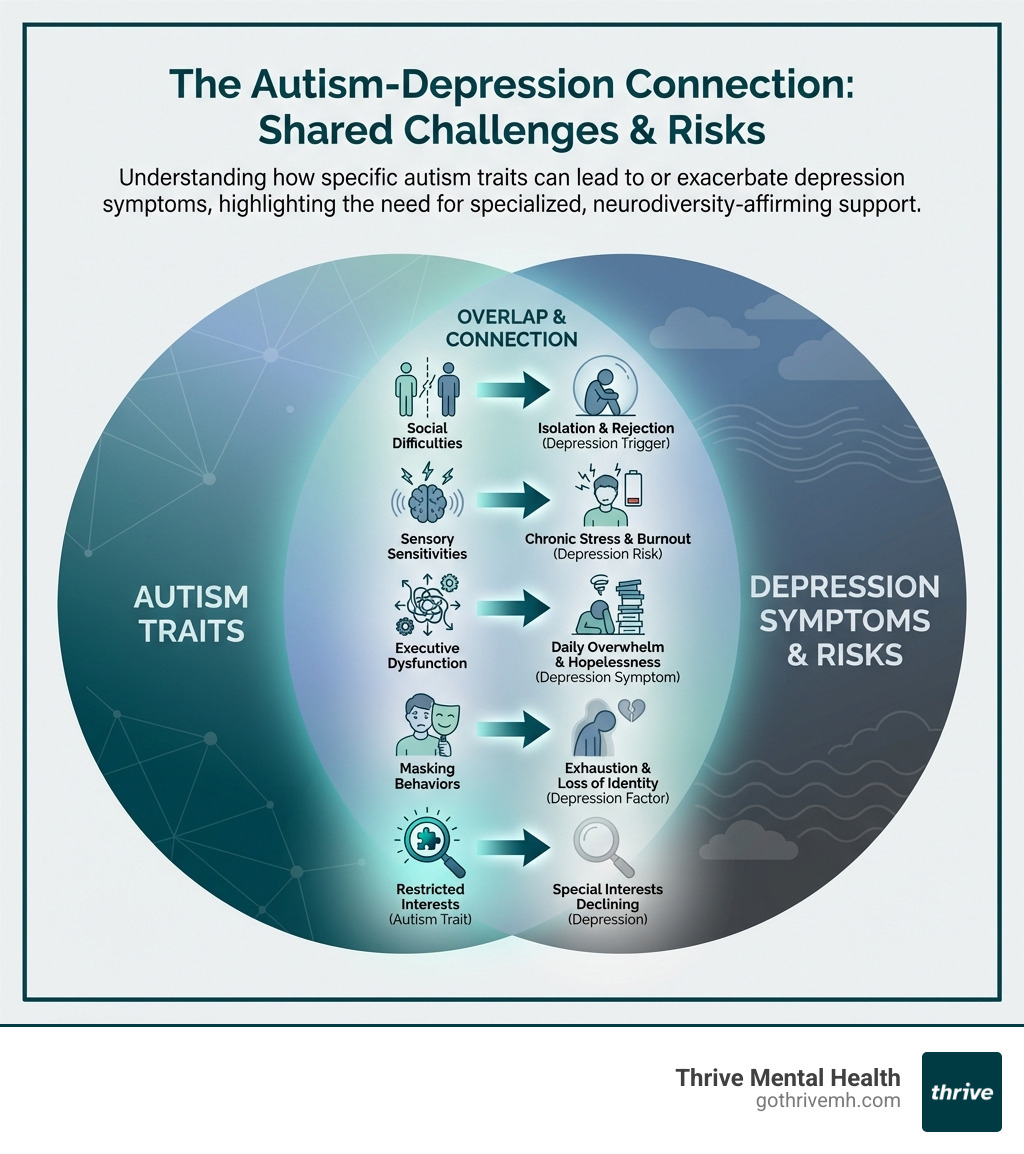
Social masking, sensory overload, executive dysfunction stress, autistic burnout, and years of being misunderstood or dismissed do not just coexist with depression, they drive it.
Most therapists were never trained to understand this. Many still use approaches that pressure autistic adults to mask harder, “act normal,” or ignore sensory needs. That can make depression worse, not better.
What actually works?
- Treatment that aims to reduce suffering, not your autistic traits.
- Skills that work with your neurology instead of against it.
- A therapeutic relationship where you do not have to perform, script, or hide.
I’m Nate Raine, CEO of Thrive Mental Health. I have spent over a decade building behavioral health programs across Florida and the rest of the country, focused on making evidence-based, accessible care a reality. I have seen first-hand why the search for “I’m looking for a therapist in Naples, FL who understands the connection between autism and depression treatment” is so urgent, and why specialized, neurodiversity-affirming care changes outcomes.
At Thrive, that includes virtual Intensive Outpatient (IOP) programs for adults who need more than once-a-week sessions but less than inpatient care. You can learn more about our approach in Florida here:
- Mental wellness centers in Naples, Florida.
- I need more than weekly therapy but don’t want to go to a hospital. What are my options in West Palm Beach?
- Florida Virtual Therapy
In this guide, you will learn:
- Why depression is so common for autistic adults.
- How depression can look different in autism (and get misdiagnosed).
- The exact therapist qualities to look for in Naples.
- What to do when weekly therapy is not enough, and how IOP/PHP can help.
If you are exhausted by trial-and-error therapy that does not fit your brain, this article is designed to help you find a better path.
The Hidden Connection: Why Depression is So Common with Autism
Crisis Disclaimer: If you or someone you know is in crisis or considering self-harm, please call or text 988 to reach the Suicide & Crisis Lifeline. You are not alone.
If you are in immediate crisis or feel unsafe, call or text 988 right now. You are not alone, and help is available 24/7.
For many autistic adults, depression is not a random extra diagnosis tacked on top of autism. It is tightly woven into the day-to-day work of surviving in a world that was not built for their brains.
Autism is a neurodevelopmental condition, not a mental illness. But it does increase the risk of anxiety, ADHD, and mood disorders like depression. Studies suggest depression affects anywhere from 11% to over 50% of autistic individuals, depending on age, support level, and environment.
Why so high? Because so many core parts of the autistic experience create chronic stress, exhaustion, and isolation.
Common drivers include:
- Social camouflage (masking): Learning to hide stimming, force eye contact, script conversations, or copy neurotypical behavior can help you “pass”, but it is mentally and physically draining. Over time, it can lead to burnout, identity confusion, and deep exhaustion.
- Burnout: Autistic burnout is not just being tired. It is a collapse after sustained stress, sensory overload, masking, demands without accommodations, often marked by losing skills, increased sensitivity, and hopelessness. Burnout is a major pathway into depression.
- Social rejection and bullying trauma: Being left out, mocked, micromanaged, or misunderstood across school, work, and relationships leaves scars. Repeated rejection shapes how you see yourself and can feed worthlessness and despair.
- Executive dysfunction stress: Difficulty initiating tasks, organizing, switching focus, or managing time does not just cause inconvenience. It can cost jobs, grades, relationships, and self-esteem, and make everyday life feel impossible.
- Sensory overload: Lights that hurt, sounds that feel like physical pain, uncomfortable fabrics, crowded spaces, when your nervous system is constantly under assault, it wears you down. Chronic sensory stress can worsen both anxiety and depression.
These are not “symptoms” you are supposed to erase. They are realities that your treatment has to respect and work with.

How Depression Manifests Differently in Autistic Individuals
In autistic adults, depression often does not look like the textbook version most clinicians are trained on. That is how people get missed, or misdiagnosed.
This “diagnostic overshadowing” happens when:
- Depressive symptoms get written off as “just autism,” or
- Autistic traits get misread as a mood disorder.
Some key differences to know:
- Atypical presentation: Instead of saying “I feel sad,” someone might show more anger, irritability, or shutdown. Facial expression might look flat even when emotions are intense.
- Alexithymia: Many autistic people struggle to identify or name what they feel. Depression might show up as stomach pain, headaches, or saying “I feel weird” rather than “I feel hopeless.”
- More meltdowns or shutdowns: Under depression, the threshold for overload gets lower. You might see more frequent meltdowns, shutdowns, or retreating to bed or a dark room.
- Loss of interest in special interests: Special interests are usually a lifeline. When depression hits hard, even those can feel empty or exhausting, that is a major red flag.
- Heightened sensory sensitivity: Depression can make everything louder, brighter, rougher. Sensory input that was manageable before might become unbearable.
- Social withdrawal vs. healthy solitude: Autistic people often genuinely need alone time. Depression is different: you may want connection but feel unable to reach out, or you may lose interest in people you usually care about.
Because of these nuances, standard depression screeners can miss autistic adults or give confusing results. This is why it is crucial to work with a therapist or program that:
- Understands both autism and mood disorders.
- Knows how to ask questions in clear, concrete language.
- Looks at behavior, history, and context, not just a checklist score.
For many adults in Florida, that kind of nuanced evaluation happens best in structured settings like an Intensive Outpatient Program (IOP) or Partial Hospitalization Program (PHP), where clinicians have time to see patterns across multiple sessions and groups rather than relying on a single 50-minute intake.
What to Look For: I’m looking for a therapist in Naples, FL who understands the connection between autism and depression treatment.
When you say, “I’m looking for a therapist in Naples, FL who understands the connection between autism and depression treatment,” you are not just asking for a name.
You are asking for:
- Someone who will not try to erase your autistic traits.
- Someone who actually understands how burnout, masking, sensory overload, and executive dysfunction feed depression.
- Someone who can adapt therapy so it finally fits your brain.
A neurodiversity-affirming therapist starts from the premise that autism is a natural variation in human wiring. Their goal is not to make you more “normal”, it is to reduce suffering, increase access to your strengths, and help you build a life that actually works for you.
Specialized experience in both autism and depression is non-negotiable. A therapist who only knows one side of that equation may:
- Push strategies that rely on masking.
- Ignore sensory and processing needs.
- Misread burnout as laziness or “noncompliance.”
The right therapist in Naples will create an individualized treatment plan that integrates:
- Your sensory profile.
- Your communication preferences.
- Your executive functioning needs.
- Your values, goals, and support system.
The relationship itself matters just as much as the techniques. Mental health professionals are held by ethical standards through organizations like the American Psychological Association (APA), but autistic adults often need more than “standard” care. You need a space where:
- You are not punished for stimming, avoiding eye contact, or needing pauses.
- You can be honest about suicidal thoughts or shutdowns without being immediately dismissed or overreacted to.
- You do not have to pretend to be okay just to make your therapist comfortable.

Key Qualities of an Effective Therapist for Autism and Depression
When you are vetting therapists in Naples, here are non-negotiable traits to look for:
-
Validates autistic experience:
- Does not treat autism as something to cure.
- Names masking, burnout, and sensory overload as real issues, not excuses.
-
Understands sensory needs:
- Willing to dim lights, minimize noise, or let you use headphones or fidgets.
- Helps you build sensory coping strategies for work, school, or home in Florida environments.
-
Flexible communication style:
- Uses clear, concrete language instead of vague metaphors.
- Comfortable with slower pacing, written communication, or telehealth.
-
Focuses on strengths:
- Sees your pattern recognition, honesty, deep focus, or special interests as assets.
- Uses those strengths directly in your depression treatment plan.
-
Collaborates with you:
- Sets goals together, not for you.
- Respects your autonomy around medication, disclosure, and masking.
-
Experience with adult diagnosis:
- Understands the grief, relief, and identity work that can follow a late autism diagnosis.
- Helps you rewrite your life story in a way that honors what you have survived.
Therapeutic Approaches That Actually Work for I’m looking for a therapist in Naples, FL who understands the connection between autism and depression treatment.
For autistic adults with depression, the how of therapy matters as much as the what. In Naples and across Florida, approaches that tend to work best are:
-
Modified Cognitive Behavioral Therapy (CBT):
- Uses visual aids, step-by-step plans, and concrete examples instead of abstract talk.
- Emphasizes behavioral activation (small, doable actions) more than debating thoughts.
- Names and works with issues like masking, social anxiety, and black-and-white thinking.
-
Acceptance and Commitment Therapy (ACT):
- Helps you accept that some thoughts/sensations will show up, and act based on your values anyway.
- Can be powerful for accepting an autistic identity and building a meaningful life around what matters most to you.
-
Dialectical Behavior Therapy (DBT):
- Offers structured skills for emotion regulation, distress tolerance, mindfulness, and communication.
- Particularly useful if you experience intense emotions, relationship conflict, or self-harm urges.
-
Mindfulness-Based Stress Reduction (MBSR):
- Teaches non-judgmental awareness of body sensations and thoughts.
- Can help you detect early signs of sensory overload or shutdown and intervene sooner.
-
Social skills development (neurodiversity-affirming):
- Focuses on creating mutual understanding and reducing anxiety, not on faking neurotypical behavior.
- May include role-plays, scripts, or planning for real-life situations in Naples (workplaces, family, dating).
While people attend therapy for many specific motives, autistic adults with depression often need more structure and intensity than a single weekly appointment. That is where Intensive Outpatient (IOP) programs, like the ones Thrive runs across Florida, South Carolina, Indiana, Arizona, and California, can be life-changing.
 Intervene Like You Mean It: Understanding Crisis Intervention Mental Health ServicesMental Health
To avoid another mismatch, use this checklist when you talk to a potential therapist or program:
- “What is your experience working with autistic adults who also experience depression?”
- “What is your approach to neurodiversity-affirming care?”
- “How do you adapt your therapeutic techniques (e.g., CBT, ACT, DBT) for autistic clients?”
- “How do you address sensory sensitivities in your practice and treatment plans?”
- “Can you describe how you tailor communication to meet a client’s individual needs?”
- “How do you differentiate between autistic traits, autistic burnout, and depression symptoms?”
- “What is your philosophy on ‘masking’ and how do you address it in therapy?”
- “Do you offer both in-person and telehealth options, and how do you ensure the environment is comfortable?”
- “What role do families or support systems play in your treatment approach?”
- “What is your experience with late autism diagnosis in adults?”
If you find that most local therapists cannot answer these clearly, it may be a sign that a specialized program, such as Thrive’s virtual therapy options or higher levels of care like IOP, will be a better fit.
When Weekly Therapy Isn’t Enough: Higher Levels of Care in Florida
Sometimes, finding a solid therapist in Naples is only half the story. If depression is severe or long-standing, once-a-week sessions can feel like trying to stop a hurricane with an umbrella.
Signs you may need more intensive support include:
- Persistent symptoms: You are doing the work in therapy, but your mood, energy, or interest in life barely budge.
- Crisis situations: Suicidal thoughts, self-harm, or feeling unsafe more days than not.
- Major functional impairment: Struggling to maintain work, classes, relationships, or basic self-care in Florida’s day-to-day life.
- Feeling stuck or overwhelmed: You understand the skills intellectually but cannot implement them when it matters.
In those cases, a higher level of care can offer the structure and intensity that traditional outpatient cannot. Two key options are:
- Intensive Outpatient Program (IOP): Several therapy hours per week (often 3-5 days), while you still live at home.
- Partial Hospitalization Program (PHP): More hours per week (often daytime, most weekdays) but still not 24/7 hospital-level care.
These are designed for people who need more than weekly therapy but less than inpatient.
What IOP/PHP typically provide:
- Structured support: Regular individual sessions, group therapy, and skills training at predictable times.
- Peer community: You connect with others who also live with depression, anxiety, and sometimes autism, reducing isolation and shame.
- Skill-building: Focused practice in emotion regulation, distress tolerance, social communication, and executive functioning.
- Integrated care: Access to psychiatry, medication management, and coordinated treatment planning.
For autistic adults with depression in Naples and across Florida, these programs work best when they explicitly acknowledge:
- Autistic burnout.
- Sensory needs.
- Communication differences.
- The extra load of masking and navigating neurotypical environments.
How Virtual IOP/PHP Programs Offer a Lifeline
Traditional in-person programs can be overwhelming, bright hospital lights, crowded waiting rooms, long drives in Florida traffic. For many autistic adults, that sensory and logistical load is enough to keep them from getting help.
At Thrive Mental Health, our virtual IOP programs are built to solve that problem.
- Accessible from anywhere in Florida (including Naples): Join from home, your car, or a quiet office, wherever feels safest.
- Flexible scheduling, including evenings: Keep your job, school, or caregiving responsibilities while getting intensive care.
- Expert-led, evidence-based treatment: We use adapted CBT, ACT, DBT, and skills groups with clinicians trained in complex presentations like autism plus depression.
- Measurable outcomes: You track your progress over time, mood, functioning, coping skills, so you can see what is changing.
- Insurance-friendly: We work with major insurers such as Cigna, Florida Blue, and Optum, which can significantly lower out-of-pocket costs.
Our programs blend:
- Individual therapy (personalized to your needs and identity).
- Group therapy (skills practice, connection, real-time feedback).
- Educational modules (understanding how your brain works and what helps).
All of it is designed for adults and young professionals who are too often told to “just try harder” in standard therapy.
If you are in Naples and “I’m looking for a therapist in Naples, FL who understands the connection between autism and depression treatment” has been your ongoing search, it may be time to consider that:
- You do not need to be “bad enough” for inpatient to deserve more help.
- You are allowed to need more structure.
- IOP or PHP might finally match the intensity of what you are going through.
To understand how virtual care works and whether it fits your situation, you can explore Thrive’s guide to virtual therapy, or read our article on mental wellness centers in Naples, Florida for more local context.
Frequently Asked Questions about Autism and Depression Treatment
How can my family support me if I’m autistic and have depression?
Family and support systems can make a huge difference. Practical steps that help:
- Learn together: Read about autism, depression, autistic burnout, and masking so your reactions are based on understanding, not fear.
- Lower the demand level at home: Reduce unnecessary social, sensory, or task demands during tough periods. Build in quiet, recovery time.
- Support sensory needs: Offer noise-canceling headphones, flexible lighting, predictable routines, or a designated low-stimulation space.
- Validate, do not minimize: Comments like “It can’t be that bad” or “Just think positive” can increase shame. Instead, reflect back what you hear: “This sounds really heavy. I’m glad you told me.”
- Help with logistics: Offer support scheduling appointments, driving to sessions in Naples, or helping steer insurance and paperwork.
What is the difference between autistic burnout and depression?
They often overlap but are not the same thing.
-
Autistic burnout is:
- Triggered by chronic stress, masking, lack of accommodations, and sensory overload.
- Marked by exhaustion, increased sensitivity, and sometimes loss of skills.
- Often improves when demands are reduced and supports increase.
-
Depression is:
- A mood disorder with persistent low mood, loss of interest, sleep/appetite changes, and negative thoughts about self and the future.
- Can be triggered by burnout, trauma, or life events, but can also exist independently.
Many autistic adults experience both at once. A clinician experienced in autism and mood disorders, ideally within a structured setting like IOP or PHP, can help untangle what is what and plan treatment accordingly.
Are there specific depression screening tools for autistic adults?
There is no single, universally accepted “autism-only” depression test yet. Common challenges include:
- Alexithymia: Difficulty naming emotions can skew scores.
- Literal interpretation: Some questions on standard forms can be confusing or misleading.
- Different presentations: Irritability, shutdown, or increased stimming might signal depression even if the person does not endorse feeling “sad.”
Some modified self-report tools exist, but the most reliable approach is:
- A detailed clinical interview.
- Conducted by someone who understands autism.
- Combined with input about functioning, routines, and behavior changes.
Can medication help if I’m autistic and depressed?
For some autistic adults, antidepressants or other medications are part of an effective treatment plan. Important points:
- Medication is not a cure for autism, and it should not be used with that goal.
- It may reduce symptoms like severe low mood, anxiety, or sleep problems so you can actually use therapy skills.
- Because autistic people can respond differently to medications and side effects, close monitoring and conservative dosing are key.
Medication decisions should always be made with a prescriber who:
- Understands autism.
- Listens to your sensory and physical reactions.
- Coordinates with your therapist or IOP/PHP team.
When should I consider IOP or PHP instead of just weekly therapy?
Consider a higher level of care if:
- You have tried weekly therapy and are still not functioning or feeling safe.
- You cannot keep up with work, school, or self-care.
- You are experiencing frequent suicidal thoughts, self-harm, or crisis-level distress.
- You need more structure, accountability, and support than one appointment a week can give.
Programs like Thrive’s Intensive Outpatient (IOP) in Florida are built exactly for that gap: when you need more help, but a hospital stay still feels like too much.
Take the Next Step Toward Healing in Naples
If you have been searching for “I’m looking for a therapist in Naples, FL who understands the connection between autism and depression treatment” for months or years, it can start to feel like no one really gets it.
You deserve better than trial-and-error therapy.
The right support will:
- Validate your autistic experience instead of trying to erase it.
- Adapt tools like CBT, ACT, or DBT to how your brain processes information.
- Respect your sensory needs, communication style, and need for downtime.
- Directly target depressive symptoms, hopelessness, shutdown, loss of interest, without demanding more masking.
Sometimes, a skilled weekly therapist is enough. But when:
- Depression keeps pulling you under,
- You cannot keep up with work, school, or relationships,
- You are white-knuckling your way through each week,
a higher level of care like Intensive Outpatient (IOP) or Partial Hospitalization (PHP) can give you the structure, repetition, and community you need to actually stabilize and grow.
Thrive Mental Health delivers virtual IOP programs for adults and young professionals across Florida (including Naples, Tampa Bay, Miami, Orlando, West Palm Beach, Sarasota, Jacksonville, and more) as well as California, Indiana, Arizona, and South Carolina. Our programs are:
- Evidence-based: Using adapted CBT, ACT, DBT, and skills groups.
- Flexible: With virtual and hybrid options, including evening schedules.
- Accessible: We work with major insurers like Cigna, Florida Blue, and Optum to help reduce cost barriers.
If you want a deeper dive into how virtual care works and what to expect, explore our guide to virtual therapy and our overview of mental wellness centers in Naples, Florida.
Summary: If you are autistic, depressed, and living in or near Naples, the most effective path forward is neurodiversity-affirming care that understands how autism and depression interact. That might mean a specialized therapist, a structured IOP/PHP program, or both. You do not have to steer this alone.
Ready for support? Thrive offers virtual IOP programs with evening options. Verify your insurance in 2 minutes (no obligation) → Start benefits check or call 561-203-6085. If you’re in crisis, call/text 988.

This article is for informational purposes only and is not a substitute for individualized clinical advice or insurance verification.