






You Are Not Alone, and Help Is Available Now
If you or someone you know is in immediate danger or crisis, call or text 988 now. You are not alone.
Mental health crisis support services are lifesaving resources designed to help when you’re overwhelmed, feeling unsafe, or unable to cope. Whether you’re experiencing suicidal thoughts, severe anxiety, substance use challenges, or emotional distress that feels unmanageable, these services connect you to trained professionals who can help, right now.
Here’s what you need to know about crisis support:
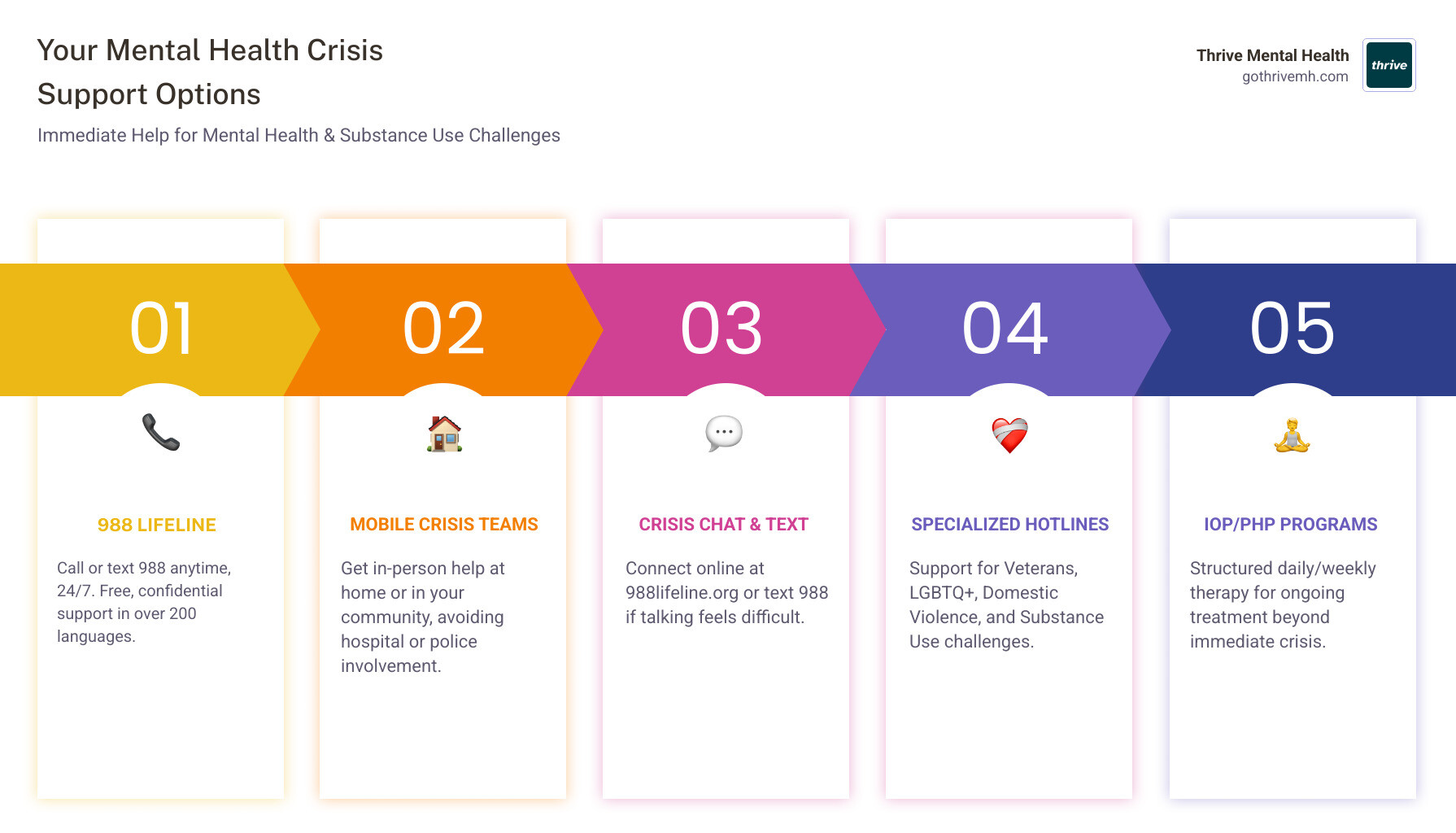
- 988 Suicide & Crisis Lifeline: Call or text 988 anytime, 24/7. Free, confidential support in over 200 languages.
- Mobile Crisis Teams: Get in-person help at home or in your community, no hospital or police needed.
- Crisis Chat & Text Options: If talking feels hard, you can chat online at 988lifeline.org or text 988.
- Specialized Hotlines: Veterans Crisis Line, The Trevor Project (LGBTQ+ support), Domestic Violence Hotline, and SAMHSA National Helpline for substance use.
- Intensive Outpatient Programs (IOP/PHP): When you need more than weekly therapy but don’t require hospitalization, structured programs offer daily or weekly group and individual therapy.
Studies show that after speaking with a trained crisis counselor, most people feel less depressed, less suicidal, less overwhelmed, and more hopeful. One in five Americans struggle with mental health or substance use challenges, and too many go untreated. Crisis services exist to bridge that gap and get you connected to care fast.
I’m Nate Raine, CEO of Thrive Mental Health, and over the past decade I’ve worked to expand access to evidence-based care. At Thrive, we are dedicated to serving communities across Florida, providing integrated mental health crisis support services and intensive outpatient programs. Our mission is to ensure that every Floridian has access to both immediate intervention and the long-term support needed for real recovery.
Basic mental health crisis support services glossary:
What Is a Mental Health Crisis? [And When to Get Help NOW]
A mental health crisis isn’t just a bad day; it’s a situation where a person’s actions, feelings, and behaviors can lead to them hurting themselves or others, or put them at risk of being unable to care for themselves or function in the community. It’s a deeply personal experience, often defined by the individual themselves, emphasizing a recovery-oriented, trauma-informed approach.
When overwhelming feelings take over, and you find yourself unable to function, experiencing suicidal thoughts, struggling with substance use challenges, battling extreme anxiety, or sinking into a profound sense of hopelessness, you are likely in a crisis. These moments can feel isolating, but it’s crucial to remember that help is available and effective. Studies have shown that after speaking with a trained crisis counselor, most people are significantly more likely to feel less depressed, less suicidal, less overwhelmed, and more hopeful.
CALLOUT BOX: If you are having thoughts of harming yourself, call or text 988 immediately. A trained counselor is available 24/7 to offer free, confidential support.
Signs It’s Time to Reach Out for Support
Recognizing the signs of a mental health crisis in yourself or a loved one is the first step toward getting help. Here are some key indicators:
- Significant changes in behavior: This could include sudden shifts in mood, energy levels, or daily routines.
- Withdrawing from others: Isolating oneself from friends, family, and usual activities.
- Increased substance use: Using alcohol or drugs more frequently or in higher amounts to cope.
- Expressing hopelessness: Verbalizing feelings of despair, worthlessness, or having no future.
- Giving away possessions: A potential warning sign of suicidal ideation, especially if combined with other indicators.
- Severe mood swings: Rapid and dramatic shifts between extreme emotions like euphoria and deep sadness.
- Inability to cope with daily tasks: Struggling to maintain personal hygiene, go to work/school, or manage household responsibilities.
- Symptoms of psychosis: Experiencing hallucinations, delusions, or disorganized thinking.
- Reckless or impulsive behavior: Engaging in actions that are unusually risky or out of character.
If you observe these signs, it’s time to act. Mental illness and substance use disorders are treatable conditions.

Your First Line of Defense: Understanding 988 & Other Crisis Hotlines
When a mental health crisis strikes, immediate support can make all the difference. That’s where crisis hotlines, especially the 988 Suicide & Crisis Lifeline, come in as your first line of defense. These services offer a direct and confidential connection to help, often within minutes.
The 988 Suicide & Crisis Lifeline is a national crisis network, funded by the U.S. Department of Health and Human Services (HHS) through the Substance Abuse and Mental Health Services Administration (SAMHSA) and administered by Vibrant Emotional Health. It connects you to a network of over 200 state and local call centers, providing free, confidential support 24/7. This system is designed to be as accessible and responsive as possible, ensuring that no one has to face a crisis alone.
How the 988 Suicide & Crisis Lifeline Works
Accessing the 988 Lifeline is straightforward and designed for immediate ease of use:
- Call 988: Simply dial 988 from any phone to connect with a trained crisis counselor.
- Text 988: If talking feels too difficult, you can text 988.
- Chat online with 988: Visit 988lifeline.org/chat/ to chat with a counselor online.
These services are available around the clock, 24/7/365. The 988 Lifeline offers support in over 200 languages over the phone, with text and chat support available in English and Spanish. For Deaf/Hard of Hearing individuals, TTY users can use their preferred relay service or dial 711 then 988, or access a videophone service. You don’t need health insurance to use 988; it’s free, confidential, and judgment-free.
What to Expect: Services Offered by Crisis Hotlines
When you connect with 988 or a similar crisis hotline, you’re reaching out to trained crisis counselors and peer specialists who are there to listen and help. They can provide:
- Short-term counseling: This involves immediate support, helping you develop coping strategies and techniques for maintaining healthy living while waiting for longer-term care. It’s custom to your needs, varying in frequency and length.
- Suicide prevention and other crisis intervention: Counselors are trained to assess risk, de-escalate intense situations, and provide immediate support to ensure safety. This includes risk assessments to determine the appropriate intervention, which may involve connecting you with Emergency Medical Services (EMS) or Mobile Crisis Teams (MCT) if necessary.
- Peer support: Many crisis lines, including 988, use Peer Support Specialists. These individuals have lived experience with mental illness and behavioral health care, allowing them to offer compassionate support, crisis diversion, and referrals from a place of deep understanding.
- Information and referrals: Counselors can provide valuable information about mental health and substance use services, helping to connect you with local resources and ongoing treatment options. They can even perform warm transfers to mobile crisis services or emergency services as needed.
Specialized Hotlines for Specific Needs
While 988 is a universal entry point, several other vital hotlines cater to specific populations or concerns:
- Veterans Crisis Line: Reach caring, qualified responders with the Department of Veterans Affairs. Many responders are veterans themselves. Call 988 and press 1, chat online, or text 838255.
- The Trevor Project: Offers 24/7 crisis services for LGBTQ+ people. Call 1-866-488-7386, text START to 678-678, or chat online at TheTrevorProject.org/Get-Help/.
- Domestic Violence Hotline: If you or someone you know is experiencing domestic violence, call 1-800-799-SAFE (7233), text START to 88788, or chat online.
- SAMHSA National Helpline: For referrals to substance use and mental health treatment programs, call 1-800-662-HELP (4357) or visit FindTreatment.gov.
- Disaster Distress Helpline: Provides 24/7 crisis counseling and support for people experiencing emotional distress related to natural or human-caused disasters. Call or text 1-800-985-5990. Deaf/Hard of Hearing ASL users can call the hotline via their videophone-enabled device or click on “ASL Now” at samhsa.gov/ddh.

Beyond the Phone: A Guide to Different Types of Mental Health Crisis Support Services
While crisis hotlines offer immediate, invaluable support, sometimes a crisis requires more than a phone call. This section covers the full spectrum of mental health crisis support services, from on-site intervention to structured treatment programs designed for longer-term stability and recovery.
Immediate In-Person Help: Mobile Crisis Teams & Emergency Rooms
When a crisis escalates beyond what phone support can manage, or when a person is unwilling or unable to seek help themselves, in-person interventions become crucial.
- Mobile Crisis Teams (MCT): These are groups of mental health professionals who respond to mental health emergencies outside of a hospital or clinical setting. Their goal is to provide immediate, on-site care that allows individuals to stay in their community and avoid hospitalization or arrest. MCTs are often comprised of a multidisciplinary team, which may include licensed social workers, professional counselors, peer support specialists, nurses, and psychologists. They offer rapid response, assessment, intervention, de-escalation, and referrals.
- Crisis Intervention Team (CIT): Many communities integrate CITs, which involve law enforcement officers trained to respond to mental health crises. The goal of CIT is to reduce the need for arrest in favor of referrals to appropriate treatment resources and supports, and to promote safety for all involved. This collaboration aims to connect individuals with mental health professionals rather than funneling them into the carceral system.
- When to Call 911: While 988 is generally the first point of contact for mental health crises, 911 remains essential for immediate, life-threatening emergencies. If a person is in imminent danger of harming themselves or others, or if there’s a medical emergency, call 911. 988 counselors can make a warm transfer to 911 if they determine it’s necessary for safety.
- Comprehensive Psychiatric Emergency Program (CPEP) / Emergency Room: For urgent psychiatric care that requires immediate medical assessment or stabilization, a Comprehensive Psychiatric Emergency Program (CPEP) or the emergency room at your local hospital are options. These facilities can provide immediate medical and psychiatric evaluation, crisis stabilization, and determine the next steps for care.
Finding Ongoing Treatment: How to Access Mental Health and Substance Use Services
Once the immediate crisis has stabilized, the next critical step is to connect with ongoing treatment. The 988 Lifeline can provide information and referrals for a variety of mental health and substance use services. However, navigating the landscape of treatment options can be daunting.
- Florida’s Mental Health Resources: In Florida, state and county agencies oversee local mental health and addiction services. The Florida Department of Children and Families (DCF) is a key resource, and they work with regional Managing Entities to provide care. Contacting these agencies can provide directories, referrals, and information on programs available in your area, helping you navigate the path to recovery within the state.
- SAMHSA Treatment Locator: For a comprehensive, confidential, and anonymous list of certified substance use and mental health treatment facilities across the U.S., visit the SAMHSA Behavioral Health Treatment Services Locator. This tool is invaluable for finding appropriate care.
- Insurance Coverage: Understanding your insurance benefits is key. Many providers, including Thrive Mental Health, work with major insurance carriers like Cigna, Optum, and Florida Blue, among others, to make treatment accessible. It’s always a good idea to verify your insurance benefits directly with your provider or the treatment center. Health insurance is not required to access emergency crisis services like 988, but it can be crucial for ongoing treatment.
Structured Programs for Deeper Support: IOP and PHP
For individuals who need more intensive support than weekly therapy but don’t require 24/7 inpatient care, structured programs like Intensive Outpatient Programs (IOPs) and Partial Hospitalization Programs (PHPs) offer a vital bridge to recovery.
- Intensive Outpatient Programs (IOP): IOPs provide multiple hours of therapy per week, often three to five days a week, allowing individuals to live at home and maintain some daily responsibilities while receiving comprehensive treatment. This includes group therapy, individual counseling, and family therapy.
- Partial Hospitalization Programs (PHP): PHPs offer an even higher level of care, typically operating five days a week for several hours a day, similar to a hospital day program but without the overnight stay. They provide highly structured therapeutic environments, medical oversight, and intensive support for those needing significant stabilization.
At Thrive Mental Health, we specialize in delivering virtual IOP programs for adults and young professionals across Florida. Our programs combine clinical expertise, flexible scheduling, and measurable results, designed for people who need more than once-a-week therapy but less than inpatient care. We offer both virtual IOP programs, making evidence-based treatment accessible anywhere in the state, and trusted in-person centers in major communities including Tampa Bay, St. Petersburg, Miami, Orlando, Boca Raton, West Palm Beach, Jacksonville, Fort Lauderdale, Naples, and Sarasota. These structured programs are crucial mental health crisis support services for long-term healing and stability for Floridians.
Frequently Asked Questions about Crisis Support
What is the difference between calling 988 and 911?
988 is specifically for mental health, substance use, and suicidal crises, connecting you to trained crisis counselors who can provide emotional support, de-escalation, and referrals. Its primary goal is to provide help without involving law enforcement or emergency services unless absolutely necessary. 911, on the other hand, is for medical, fire, or police emergencies where there is an immediate threat to life or property. While 988 counselors can dispatch 911 if an immediate safety risk is identified, the aim is to offer a specialized, less intrusive response for behavioral health crises.
Is calling a crisis line confidential?
Yes. Services like the 988 Lifeline are designed to be confidential and free. You do not have to provide any personal information if you prefer not to. The only time confidentiality may be broken is if there is an immediate, active threat of harm to yourself or others, which includes credible threats of suicide or violence. In such cases, crisis counselors are obligated to dispatch emergency services to ensure your safety or the safety of others.
What if I don’t have insurance? Can I still get help?
Absolutely. Crisis hotlines like 988 are free to use and do not require insurance. For ongoing treatment, many states and counties offer services on a sliding scale based on income, or through federally funded health centers that provide low-cost or free care. You can use the SAMHSA Treatment Locator to find these resources. Additionally, many community mental health centers and non-profit organizations are dedicated to providing accessible care regardless of your ability to pay.
Your Path Forward: From Crisis to Recovery
Experiencing a mental health crisis can be one of the most challenging times in a person’s life, but it’s also an opportunity for profound growth and recovery. Taking the courageous first step to reach out for mental health crisis support services is a testament to your strength and commitment to well-being.
Recovery is not just possible; it’s a journey that millions start on every year, finding hope, building resilience, and creating fulfilling lives. By connecting with crisis hotlines, mobile crisis teams, and structured treatment programs like IOP and PHP available right here in Florida, you’re not just navigating a difficult moment, you’re building a robust support system and laying the foundation for lasting mental health. Let this crisis be a turning point, a catalyst for seeking the care you deserve.
Ready for support in Florida? Thrive offers virtual IOP programs across the state, with evening options available. Verify your insurance in 2 minutes (no obligation) -> Start benefits check or call 561-203-6085. If you’re in crisis, call/text 988.
Start your recovery with our vital mental health services

This article is for informational purposes only and is not a substitute for individualized clinical advice or insurance verification.