
Top Mentalization-Based Therapy Workbooks: Mentalize Your Way to Wellness

If you are struggling with thoughts of self-harm or suicide, please call or text 988 immediately. You are not alone, and help is available.
What is Mentalization? Understand the Core of MBT Before You Read
A mentalization based therapy book teaches you to understand your own emotions while recognizing that others experience the world differently than you do. If you’re searching for the right resource, here are the top options:
Best Mentalization-Based Therapy Books:
- Cambridge Guide to Mentalization-Based Treatment (MBT) by Anthony Bateman, Peter Fonagy, and Chloe Campbell – Comprehensive clinical guide covering individual therapy, group therapy, and applications across disorders (416 pages, published 2023)
- Handbook of Mentalizing in Mental Health Practice by Anthony Bateman and Peter Fonagy – Foundational text for understanding MBT theory and practice
- Mentalization-Based Treatment for Borderline Personality Disorder by Anthony Bateman and Peter Fonagy – The original clinical manual focused on BPD treatment
- MBT-Adapted Workbooks – Specialized resources for adolescents, families, eating disorders, and trauma
What These Books Teach:
- How to identify when you’ve stopped mentalizing under stress
- The “stop and rewind” technique to recover perspective
- Ways to understand others’ mental states without jumping to conclusions
- Exercises to improve emotional regulation and interpersonal relationships
You keep ending up in the same painful relationship patterns. Your emotions swing from idealization to devastation. You know something’s wrong, but weekly therapy isn’t moving fast enough.
The problem isn’t you—it’s that you’ve lost the ability to mentalize.
Mentalization is your capacity to understand that your feelings aren’t facts and that other people’s actions come from their own mental states, not your assumptions. When this ability collapses under stress—which happens to anyone with trauma, attachment wounds, or borderline personality disorder—relationships become chaotic and emotions feel unbearable.
A mentalization based therapy book offers a structured path back. These resources teach you to recognize when you’ve slipped into “psychic equivalence” (where feelings feel like absolute truth) or “pretend mode” (where you intellectualize without connecting to real emotion). The best MBT books don’t just explain theory—they provide exercises to restore your mentalizing capacity in real time.
But here’s what the research shows: MBT isn’t just about reading. Studies demonstrate that individuals who participated in structured MBT programs experienced significant reductions in self-harm, suicidal ideation, and emotional distress—with benefits lasting years after treatment ended. A mentalization based therapy book works best when paired with professional support that creates the safe therapeutic relationship where mentalizing can actually heal.
As Nate Raine, CEO of Thrive Mental Health, I’ve seen how integrating evidence-based approaches like those found in a mentalization based therapy book with structured IOP/PHP programs accelerates recovery for clients at our locations throughout Florida. The right book can be a powerful starting point—but sustainable change requires both the right tools and the right clinical support.
If you’re in crisis, call/text 988 right now. You are not alone.
Before diving into a mentalization based therapy book, it’s crucial to grasp what mentalization truly means. At its heart, mentalization is the fundamental human capacity to understand behavior—both your own and that of others—in terms of underlying mental states. This means recognizing that actions are driven by thoughts, feelings, beliefs, desires, and intentions. It’s about “seeing yourself from the outside” (understanding your own internal world) and “seeing others from the inside” (imagining and understanding the internal worlds of others).
This ability is a cornerstone of emotional intelligence, empathy, and healthy relationships. When we mentalize effectively, we can better predict behavior, steer complex social situations, and respond to others with greater understanding and compassion. This core principle is why MBT is such a powerful therapeutic approach for improving emotional regulation, empathy, and interpersonal relationships.
The theoretical foundation of MBT is deeply rooted in attachment theory and psychodynamic concepts. Pioneering researchers, particularly Peter Fonagy, highlighted the crucial role of secure attachment in the development of mentalizing capacity. Secure attachment relationships in childhood provide a safe base for children to explore their own minds and those of their caregivers. As one scientific review notes, parental mentalization and sensitivity are strong predictors of infant-parent attachment, underscoring the intergenerational nature of this capacity. You can explore more about this connection in our guide to Attachment Based Mentalization Therapy.
Effective mentalizing helps us regulate our emotions by allowing us to process and understand them rather than being overwhelmed. It fosters empathy by enabling us to step into another person’s shoes, even when their perspective differs from our own. This understanding is key to building and maintaining stable, fulfilling relationships. Our article Understanding Mentalization Based Therapy offers further insights into this fascinating process.
Why Mentalizing Fails Under Stress
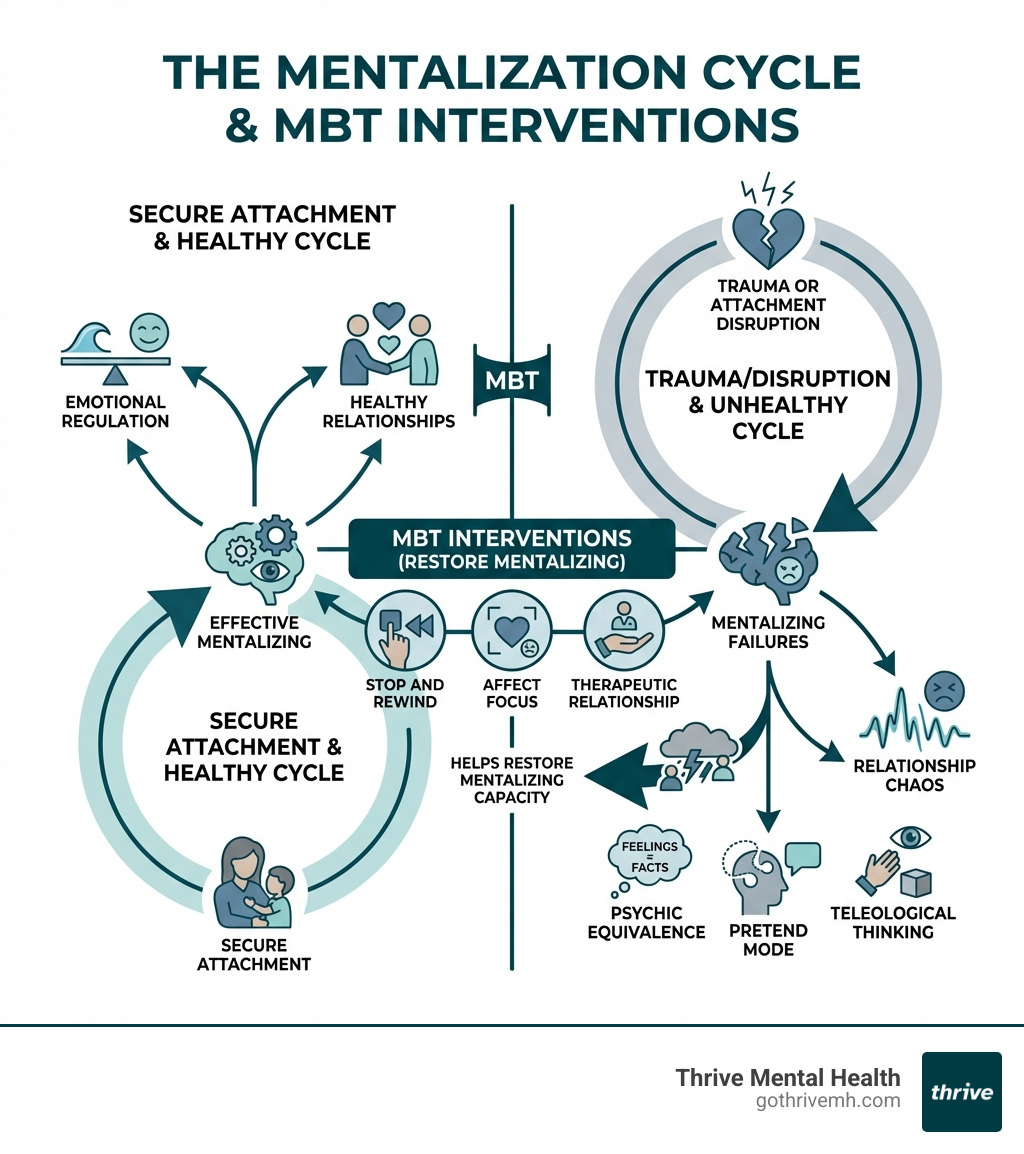
While mentalizing is a natural human capacity, it is also fragile, especially under conditions of intense stress or emotional arousal. When overwhelmed, our ability to mentalize can collapse, leading to what MBT refers to as “pre-mentalistic modes” of functioning. These modes are defensive reactions that distort our perception of reality and hinder our ability to understand ourselves and others.
- Psychic Equivalence Mode: In this mode, our internal feelings and thoughts are experienced as absolute, undeniable reality. If we feel someone is angry with us, it must be true, regardless of external evidence. This can lead to rigid, black-and-white thinking, often seen in the “splitting” defense mechanism prevalent in Borderline Personality Disorder (BPD), where individuals view people or situations in extreme, all-or-nothing terms.
- Pretend Mode: Here, thoughts and feelings are detached from reality and experienced as unreal or playful. We might intellectualize complex emotions without truly feeling their impact, or engage in superficial discussions without genuine emotional connection.
- Teleological Mode: In this mode, only physical actions and their observable consequences are considered real or meaningful. Internal states are dismissed, and only what can be seen or done matters. This can manifest as impulsive behavior, as the internal world is ignored in favor of immediate, concrete action.
Beyond these modes, individuals might engage in hypermentalizing, where they over-analyze or incorrectly attribute complex mental states to others, often leading to paranoia or misinterpretations, especially in high-stress situations. The impact of trauma is particularly significant here; trauma can severely disrupt mentalizing capacity, leading to chronic difficulties in understanding self and others, which is often a feature in conditions like PTSD. Our Mentalization Based Therapy PTSD Guide digs deeper into this. For individuals with BPD, mentalization collapse is a hallmark, contributing to their intense emotions, unstable relationships, and shifting sense of identity. The APA defines splitting in BPD as a pattern of viewing people, situations, or even oneself in extreme ways, with no middle ground, often in response to distress or fear.
The Goal of a Mentalization Based Therapy Book
The primary goal of a mentalization based therapy book and the therapy itself is to help individuals restore and strengthen their mentalizing capacity, particularly during times of emotional intensity. This involves several key objectives:
- Restoring Mentalizing: Guiding individuals back to a balanced mentalizing stance, moving away from pre-mentalistic modes.
- Fostering Curiosity: Encouraging a genuine interest in one’s own and others’ internal experiences, replacing assumptions with exploration.
- Building Epistemic Trust: Helping individuals develop a fundamental trust in the information they receive from reliable social sources, which is often compromised in individuals with a history of trauma or insecure attachment. This trust is crucial for learning and growth within a therapeutic relationship and beyond.
- Creating a “We-Mode”: Facilitating the capacity for shared attention and understanding of collective mental states, moving beyond purely individual perspectives to a more collaborative, interpersonal way of relating.
- Improving Relationships: By enhancing self-understanding and empathy for others, mentalizing directly leads to more stable, secure, and satisfying interpersonal connections.
These books offer techniques and frameworks to achieve these goals, often emphasizing practical exercises and real-world application. For those seeking professional guidance, our comprehensive virtual therapy programs at Thrive Mental Health provide a supportive environment for developing these skills. Find More info about our approach to therapy.
The Foundational Mentalization Based Therapy Book & Its Authors

When we talk about a mentalization based therapy book, we inevitably refer to the foundational texts by Peter Fonagy and Anthony Bateman. These two researchers are the intellectual architects behind MBT, having developed the practice over the past two decades. Their contributions have shaped our understanding of mentalization and its clinical application, particularly for complex mental health conditions.
The “Cambridge Guide to Mentalization-Based Treatment (MBT)” (published in 2023) stands out as a comprehensive resource. It offers a practical guide to MBT, covering its theoretical underpinnings, core principles, and clinical models for both individual and group psychotherapy. This 416-page book is designed for clinicians, requiring no prior exposure to MBT, providing essential tools for immediate implementation. It has been cited by 54 publications, demonstrating its impact in the field.
Key components of MBT, as outlined in these foundational texts, include:
- The Therapist’s Stance: Clinicians are encouraged to adopt a “not-knowing stance,” approaching the patient’s internal world with genuine curiosity and humility, rather than making assumptions. This fosters an environment of collaborative exploration.
- Clinical Process: The therapy follows a structured process, moving through stages designed to stabilize the patient, explore mentalizing failures, and ultimately strengthen their capacity to mentalize. This includes a clear focus on the formulation agreed upon with the patient.
- Case Formulation: A collaborative process where the therapist and patient develop a shared understanding of the patient’s difficulties, particularly how mentalizing failures contribute to their symptoms and interpersonal struggles.
- Crisis Planning: Integral to MBT, especially for patients with a history of self-harm or suicidality, ensuring safety and developing strategies to maintain mentalizing during acute distress.
Fonagy and Bateman’s work emphasizes that secure attachment facilitates a healthy self-image and healthy interpersonal interaction. Their books provide a roadmap for clinicians to create a therapeutic relationship that can serve as a new, secure attachment experience for patients, allowing them to safely explore their internal worlds and build epistemic trust.
What You’ll Learn from a Core MBT Text
A comprehensive mentalization based therapy book like the “Cambridge Guide” or “Handbook of Mentalizing in Mental Health Practice” will equip you with a deep understanding of MBT’s practical applications. You’ll gain insights into:
- Psychoeducation: Learning about mentalization itself, its importance, and how it can break down. Understanding these concepts helps patients normalize their struggles and engage actively in the therapeutic process.
- Identifying Mentalizing Failures: Recognizing the signs of psychic equivalence, pretend mode, teleological mode, and hypermentalizing in real-time, both in yourself and others.
- Affect Focus: Learning to identify, label, and understand emotions. MBT emphasizes exploring the affective narratives—the stories we tell ourselves about our feelings and their origins.
- The “Stop and Rewind” Technique: A core MBT intervention where, during moments of emotional intensity or relational breakdown, the therapist encourages the patient to pause, reflect on what just happened, and consider alternative mental states that might have been at play. This helps reactivate mentalizing.
- Transference Relationship: Utilizing the relationship between the patient and therapist as a living laboratory to observe and repair mentalizing failures in real-time. The therapist actively mentalizes the patient’s experience of them, helping the patient understand their own projections and expectations.
- Practical Exercises: Many MBT texts include exercises and vignettes to help readers apply the concepts to their own lives or clinical practice.
Using a Foundational Mentalization Based Therapy Book for Self-Study
For individuals seeking to understand and improve their own mentalizing capacity, a mentalization based therapy book can be an invaluable resource. These books offer a structured framework for self-reflection and personal growth. Patients can benefit from learning the core concepts, identifying their own mentalizing patterns, and practicing techniques like “stop and rewind” in their daily lives.
However, it’s crucial to acknowledge the limitations of self-help. While a book can provide knowledge and exercises, it cannot replicate the dynamic, interactive, and corrective experience of a therapeutic relationship. Mentalizing is inherently relational, developed and refined in interaction with another mind. Therefore, a mentalization based therapy book is best used as a complementary tool alongside professional guidance.
When to seek professional guidance? If you find yourself consistently struggling with intense emotions, unstable relationships, impulsive behaviors, or a shifting sense of self—symptoms often associated with Borderline Personality Disorder—professional support is essential. For individuals in Florida, Thrive Mental Health offers comprehensive IOP and PHP programs designed to provide this structured support.
Here are some key takeaways from foundational MBT literature that you can begin to explore:
- Mentalizing is a flexible skill that can be developed and strengthened.
- Our capacity to mentalize is often compromised under stress, leading to predictable patterns of thinking and relating.
- Curiosity, rather than certainty, is the gateway to better mentalizing.
- Understanding the difference between your internal reality and external reality is crucial for emotional stability.
- Relationships are key arenas for both mentalizing failures and their repair.
Beyond BPD: Finding an MBT Book for Other Conditions
While MBT was originally developed as an effective treatment for Borderline Personality Disorder (BPD), its principles and applications have expanded significantly. The core concept of improving mentalizing capacity is now recognized as beneficial for a wide range of mental health challenges. A modern mentalization based therapy book will reflect this broader applicability.
The “Cambridge Guide to Mentalization-Based Treatment (MBT)” explicitly covers clinical illustrations for specific disorders such as depression, psychosis, trauma, and eating disorders, in addition to various personality disorders (borderline, antisocial, narcissistic, and avoidant). This highlights MBT’s transdiagnostic nature.
- MBT for Adolescents: Adolescence is a critical period for mentalizing development. MBT has been adapted for adolescents struggling with depression and self-harm, showing positive outcomes in reducing these behaviors.
- MBT for Families and Couples: Enhancing mentalizing within family systems can improve communication and reduce conflict. For couples, MBT helps partners understand each other’s perspectives and emotional states, fostering deeper connection. One study showed MBT-FACTS (Family and Carer Treatment Service) to be effective for families of people with BPD.
- MBT for Eating Disorders: These conditions often involve difficulties with emotional regulation and self-perception, areas where MBT can offer significant support.
- MBT for Depression: By helping individuals understand the mental states underlying their depressive symptoms and interpersonal patterns, MBT can facilitate recovery.
- MBT for Trauma (T-MBT): Trauma can severely impair mentalizing. Trauma-focused MBT helps individuals process traumatic experiences while maintaining their capacity to reflect on internal states, preventing mentalizing collapse. Our Mentalization Based Therapy PTSD Guide provides more information.
- MBT for Antisocial Personality Disorder: While challenging, MBT can be adapted to help individuals with ASPD develop a greater understanding of others’ intentions and feelings, potentially reducing harmful behaviors. Recent research indicates MBT is being studied for a broad range of personality disorders.

Adapting MBT for Different Populations
The flexibility of MBT means that its principles can be adapted to various populations and settings, going beyond traditional individual therapy. A specialized mentalization based therapy book might focus on these adaptations:
- Mentalizing in Schools: Implementing mentalizing principles in educational settings can help children and adolescents develop social-emotional skills, manage conflicts, and understand peer dynamics.
- Mentalizing in Care Settings: For individuals in residential or community care, MBT-informed approaches can improve staff-patient interactions and foster a more therapeutic environment.
- Group vs. Individual Therapy Formats: MBT is effectively delivered in both individual and group settings. Group MBT (MBT-G) provides a rich environment for observing and reflecting on diverse mental states in real-time, offering multiple opportunities for mentalizing practice.
Workbooks are often customized for specific issues, offering custom exercises and examples that resonate with the unique challenges faced by different populations. For adults in Florida seeking intensive support, our Intensive Outpatient Programs (IOP) at Thrive Mental Health provide structured, evidence-based treatment that can incorporate MBT principles.
MBT vs. DBT: Which Approach (and Book) Is Right for You?
When exploring evidence-based therapies for complex emotional and relational difficulties, particularly Borderline Personality Disorder, two prominent approaches often come up: Mentalization-Based Treatment (MBT) and Dialectical Behavior Therapy (DBT). While both are highly effective, they have distinct philosophies and methods. A mentalization based therapy book will offer a different perspective than a DBT workbook.
Dialectical Behavior Therapy (DBT), developed by Marsha Linehan, is widely recognized as the “gold standard” for BPD. It’s a comprehensive, skills-based approach that teaches concrete strategies for:
- Mindfulness: Being present and aware.
- Distress Tolerance: Coping with painful emotions without making things worse.
- Emotion Regulation: Understanding and managing intense emotions.
- Interpersonal Effectiveness: Navigating relationships and asking for what you need.
DBT is structured, often involving individual therapy, group skills training, phone coaching, and a therapist consultation team. It focuses heavily on behavioral change and skill acquisition.
Mentalization-Based Treatment (MBT), on the other hand, prioritizes the process of understanding mental states. As we’ve discussed, it aims to improve your capacity to mentalize. While it also leads to behavioral changes, the route is through improved insight and relational understanding. MBT is described as a simpler, more common-sense approach than DBT, focusing on the “here and now” of interpersonal interactions and the underlying mental states.
Here’s a comparison to help you decide which mentalization based therapy book or DBT workbook might be a better fit:
| Feature | Mentalization-Based Treatment (MBT) | Dialectical Behavior Therapy (DBT) |
|---|---|---|
| Philosophy | Rooted in attachment theory and psychodynamic concepts; focuses on restoring mentalizing capacity. | Rooted in cognitive-behavioral therapy, behaviorism, and Zen Buddhism; focuses on acceptance and change. |
| Primary Target | Impaired mentalizing, leading to emotional dysregulation, unstable self-image, and relational chaos. | Emotional dysregulation, impulsivity, suicidal ideation, self-harm, and interpersonal difficulties. |
| Key Interventions | “Stop and rewind,” affect focus, not-knowing stance, exploring transference, fostering epistemic trust. | Mindfulness, distress tolerance skills, emotion regulation skills, interpersonal effectiveness skills, phone coaching. |
| Ideal Patient Profile | Benefits those who struggle with understanding intentions, have difficulties with empathy, and experience relational breakdowns due to misinterpretations. | Benefits those with severe emotion dysregulation, high impulsivity, chronic suicidality, and self-harm behaviors. |
| Training | Requires less formal training for practitioners compared to DBT. | Requires extensive formal training, adherence to a structured curriculum, and participation in a consultation team. |
You can learn more about the distinctions between these approaches in our article CBT vs DBT vs MBT: Key Differences Therapy.
Choosing Between an MBT or DBT Workbook
The choice between an MBT or DBT workbook often depends on your primary struggles and learning style.
- If your main challenge is emotion dysregulation that manifests as intense, overwhelming feelings, impulsivity, self-harm, or suicidal ideation, a DBT workbook might be more immediately helpful. It offers concrete skills to manage these crises. Check out our resources on Dialectical Behavior Therapy.
- If you primarily experience interpersonal chaos, feeling misunderstood, misunderstanding others, or struggling with empathy and a stable sense of self, a mentalization based therapy book could be more beneficial. It helps you understand the underlying cognitive and emotional processes that drive relational difficulties.
Many individuals, especially those with BPD, benefit from combining approaches. For instance, DBT skills might be used to stabilize acute crises, while MBT helps build a deeper, more sustainable capacity for relational understanding. In our Florida-based programs, we often integrate elements from various evidence-based therapies to create personalized treatment plans, ensuring clients receive the most effective support for their unique needs.
We understand that access to these therapies is crucial. Thrive Mental Health works with various insurance providers, including Cigna, Optum, and Florida Blue, to make evidence-based treatments accessible. We believe that financial barriers shouldn’t prevent you from getting the support you need.
Frequently Asked Questions about Mentalization-Based Therapy Books
What is the best book to learn about mentalization?
The “Cambridge Guide to Mentalization-Based Treatment (MBT)” by Anthony Bateman, Peter Fonagy, and Chloe Campbell (published 2023) is considered an excellent, comprehensive guide for both clinicians and interested individuals. It offers a thorough overview of MBT’s theory, clinical process, and applications across various mental health conditions and populations. For foundational understanding, “Handbook of Mentalizing in Mental Health Practice” by Bateman and Fonagy is also highly recommended.
Can you do Mentalization-Based Therapy on yourself?
While a mentalization based therapy book can provide valuable insights and exercises for self-reflection and personal growth, true Mentalization-Based Therapy is a relational process that requires interaction with a trained therapist. Mentalizing is developed and practiced in the context of a secure attachment relationship. Self-study can improve your understanding and provide tools, but it cannot replace the dynamic, corrective feedback and support of a therapeutic relationship. We encourage using books as a complement to professional treatment, not a substitute. For those in Florida seeking professional guidance, Thrive Mental Health offers expert-led therapy programs that provide this essential support.
Is MBT a type of CBT?
No, MBT is not a type of Cognitive Behavioral Therapy (CBT). While both are evidence-based psychotherapies, they have different theoretical foundations and primary focuses. CBT primarily targets maladaptive thoughts and behaviors, aiming to change them directly. MBT, on the other hand, is rooted in attachment theory and psychodynamic concepts, focusing on improving an individual’s capacity to understand mental states (their own and others’) to indirectly lead to changes in emotions, thoughts, and behaviors. MBT can be seen as integrating elements from various approaches, including psychodynamic and systemic therapies, but it maintains its distinct identity.
Ready for Real Support? Go Beyond the Book
A mentalization based therapy book offers a powerful entry point into understanding yourself, your emotions, and your relationships with greater clarity. It’s a tool for cultivating curiosity, fostering empathy, and building the resilience needed to steer life’s complexities. However, the deepest healing and most sustainable change often occur within a supportive, expertly guided therapeutic environment.
At Thrive Mental Health, we integrate the profound insights of mentalization-based approaches into our structured Intensive Outpatient (IOP) and Partial Hospitalization (PHP) programs. Designed for adults and young professionals who need more than weekly therapy but less than inpatient care, our programs offer clinical expertise, flexible scheduling, and measurable results. With expert-led virtual programs and trusted in-person centers across Florida, we make evidence-based treatment accessible to you.
We believe that understanding the “why” behind your struggles, as illuminated by a mentalization based therapy book, is a critical first step. But the “how” of healing—the practical application, the real-time support, and the safe space to practice new ways of relating—is where our programs truly shine. We provide the structured environment and expert guidance to help you mentalize your way to lasting wellness.
Ready for support? Thrive offers virtual and hybrid IOP/PHP programs with evening options. Verify your insurance in 2 minutes (no obligation) → Start benefits check or call 561-203-6085. If you’re in crisis, call/text 988.