


Mentalization Based Therapy for PTSD [2025]: 7 Gains in 90 Days, and Why Waiting Costs You Another Year
If you or a loved one are in crisis or considering self-harm, please call or text the 988 Suicide & Crisis Lifeline. You can connect with people who can support you, for free, 24/7. You are not alone.
If you’re in crisis, call/text 988 right now. You are not alone.
Mentalization based therapy for ptsd is an approach that helps trauma survivors understand their own thoughts and feelings, and those of others, to heal relationship patterns disrupted by trauma.
Quick Overview:
- What it is: A therapy that improves your ability to understand mental states (yours and others’).
- How it helps PTSD: Addresses emotional dysregulation, interpersonal conflict, and mistrust caused by trauma.
- Best for: Complex trauma, C-PTSD, and people who struggle with relationships after trauma.
- Duration: Typically 12-18 months in individual or group formats.
- Evidence: Strong support for trauma-related symptoms, especially in complex presentations.
Trauma doesn’t just cause flashbacks; it changes how you see yourself and relate to others. You might misread intentions or feel disconnected from your own emotions. While traditional treatments focus on the memory, MBT focuses on understanding.
This is because trauma can disrupt mentalization: your ability to make sense of your own mind and the minds of others. When that capacity breaks down, relationships suffer, trust feels impossible, and emotions become overwhelming.
I’m Anna Green, LMHC, LPC, Chief Clinical Officer at Thrive Mental Health. I’ve seen how mentalization based therapy for ptsd helps people rebuild the relational foundation that trauma took away.
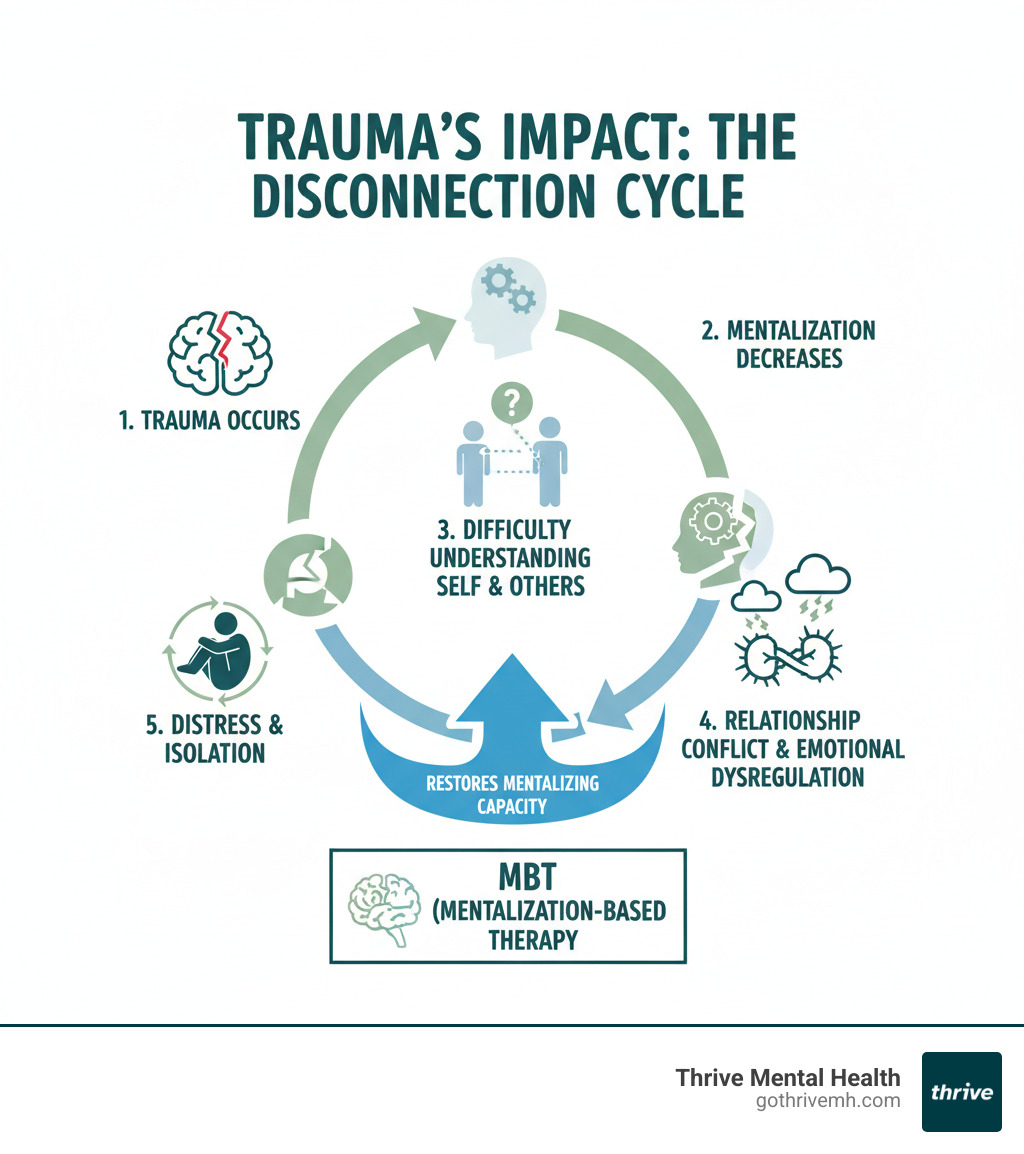
Simple mentalization based therapy for ptsd glossary:
What is Mentalization-Based Therapy (MBT)?
Think of mentalization as your mind’s ability to understand the why behind human behavior. It’s how you interpret your own actions and others’ as being driven by thoughts, feelings, and intentions beneath the surface. Mentalization based therapy for ptsd helps you develop two key skills: seeing yourself from the outside (reflecting on your inner world) and seeing others from the inside (imagining their mental state).
Developed by Peter Fonagy and Anthony Bateman, MBT builds on attachment theory. They found that people with Borderline Personality Disorder (BPD) often struggled with this capacity, and MBT proved highly effective. You can read more in a foundational theory of MBT.
MBT is a transdiagnostic approach, meaning it addresses core problems, like emotional dysregulation and interpersonal conflict, that appear across many conditions. Since trauma, especially complex trauma, directly damages the ability to mentalize, MBT is a natural fit for healing the relational wounds of PTSD.
Understanding Mentalization vs. Theory of Mind
While related, they aren’t the same. Theory of Mind is the basic cognitive understanding that others have separate minds. Mentalization is the active, emotional process of using that knowledge in real-time, especially when feelings are intense. It’s what helps you regulate emotions and steer relationships. For trauma survivors, this distinction is crucial. You can explore these differences here: Key psychological concepts explained.
How Trauma Disrupts Mentalization
Trauma, particularly developmental trauma or Complex PTSD (C-PTSD), fundamentally changes how you understand yourself and others. A child’s brain may shut down its mentalizing capacity as a defense against confusing or frightening caregiver behavior.
This shutdown appears in what MBT calls non-mentalizing modes:
- Psychic Equivalence Mode: Your internal feeling becomes reality. Anxious thoughts feel like absolute truths, and flashbacks feel like they’re happening now.
- Pretend Mode: Thoughts and feelings are disconnected from reality. You might discuss trauma intellectually without any emotional connection, as if it’s someone else’s story.
- Teleological Mode: Only physical actions are trusted. Emotional reassurance is dismissed unless proven by concrete, visible behavior.
Trauma also creates a loss of epistemic trust, a fundamental mistrust in others as reliable sources of information. This leads to the intense emotional dysregulation common in C-PTSD. Mentalization based therapy for ptsd steps in to help rebuild the capacity trauma took away.
How Mentalization Based Therapy for PTSD Works
Mentalization based therapy for ptsd rebuilds your ability to understand your own mind and the minds of others. Instead of assuming they know what you’re thinking, your therapist takes a curious, “not-knowing” posture, inviting you to explore your experiences together.
This approach focuses on the present moment, using misunderstandings as opportunities for healing. The therapy works in both individual and group formats, creating a safe laboratory to practice relational skills. This collaborative process is essential for trauma survivors who have learned that others cannot be trusted to understand them.
Benefits and Effectiveness for Trauma Survivors
Engaging in mentalization based therapy for ptsd helps rebuild core capacities that trauma impairs. The primary benefits include improved emotional regulation, stronger interpersonal connections, and increased self-awareness. By learning to understand your internal states, you can respond to situations with more choice and less impulsivity, leading to decreased dissociation and a greater sense of wholeness.
Comparing MBT to Other PTSD Therapies
Each trauma therapy has a different focus. This table shows how MBT compares to other common approaches.
| Therapy | Primary Focus | Core Mechanism | Ideal Candidate |
|---|---|---|---|
| Mentalization-Based Therapy (MBT) | Understanding mental states (yours and others’) in relationships | Restoring capacity to mentalize; exploring relational patterns in the present moment | Complex trauma or C-PTSD with significant relationship difficulties, emotional dysregulation, or identity disturbance |
| Trauma-Focused CBT (TF-CBT) | Thoughts and behaviors related to trauma | Identifying and restructuring unhelpful thought patterns; gradual exposure to trauma memories | Single-incident trauma with clear cognitive distortions and avoidance patterns |
| EMDR | Processing traumatic memories | Bilateral stimulation to reprocess stuck memories and reduce their emotional charge | Specific traumatic memories causing distress; those who can tolerate direct memory work |
What Does the Evidence Say?
MBT has a strong evidence base for Borderline Personality Disorder, which shares many features with C-PTSD. Emerging research on mentalizing in complex trauma shows that MBT’s focus on relational and emotional disruption is a promising pathway for healing complex trauma.
How Mentalization Based Therapy for PTSD Works
Mentalization based therapy for ptsd takes a different path than many trauma therapies. Instead of focusing on memories, it gently rebuilds your ability to understand what’s happening inside your mind and the minds of others.
Your therapist adopts a “not-knowing posture”, a genuine curiosity about your experience. This collaborative stance is powerful, creating a safe space to explore. Misunderstandings aren’t avoided; they become opportunities to slow down and look at what’s happening in the present moment.
Mentalization based therapy for ptsd is offered in individual and group formats. Group therapy provides a real-time space to practice these skills. At Thrive Mental Health, we integrate MBT principles into our programs, making this specialized care accessible to residents across Florida. You can learn more about our flexible options in our Virtual Therapy programs.
What to Expect in an MBT Session
An MBT session is a collaborative exploration. The focus is on affect, the outward expression of your feelings. Your therapist will help you connect thoughts to feelings and see how they drive your actions. Moments of emotional intensity or disconnection, known as mentalizing breakdowns, are gently examined as opportunities for insight.
Your therapist actively participates by modeling mentalization, creating a secure base where you can explore difficult emotions without fear of judgment. For trauma survivors, this safe therapeutic relationship is the foundation for healing.
Key Techniques Used in Mentalization Based Therapy for PTSD
MBT uses flexible principles rather than rigid exercises:
- Stop and Rewind: When a misunderstanding occurs, you pause and rewind to examine the moment, exploring different perspectives.
- Affective Focus: You learn to identify, label, and understand your feelings and how they influence your thoughts and actions.
- Exploring the “gap”: You look at the space between what was said and what was meant to uncover hidden assumptions and misinterpretations.
- Clarification, challenge, and validation: Your therapist clarifies to ensure understanding, gently challenges non-mentalizing thoughts, and validates your emotional experience.
- Pacing and process: The therapist monitors your emotional arousal, adjusting to keep you within your window of tolerance and ensuring safety.
The Role of the Therapist in MBT for PTSD
In mentalization based therapy for ptsd, your therapist is an active, engaged partner. We model mentalization by openly wondering about internal states, demonstrating how to think about feelings without panic. We maintain a curious stance, which helps you develop your own curiosity about your inner world.
We carefully manage arousal levels to keep you in a state where you can process difficult material without being overwhelmed. Most importantly, we foster a secure attachment through the therapeutic relationship itself, creating a corrective emotional experience where you can rebuild trust and begin to heal.
Benefits and Effectiveness for Trauma Survivors
Mentalization based therapy for ptsd aims to rebuild your life by addressing how trauma changes your relationship with yourself and others. As your ability to mentalize strengthens, you’ll notice profound shifts.
 7 Mental Health Strategies Designed for Tech Industry ProfessionalsMental Health
- Improved emotional regulation: Emotions become more manageable when you understand their source. You learn to pause and choose your response rather than reacting impulsively.
- Stronger relationships: You become better at reading others’ intentions and communicating your own needs, reducing conflict and fostering connection.
- Reduced impulsivity: By stepping back from intense feelings, the urge to engage in self-destructive behaviors lessens.
- Deeper self-awareness: You understand your patterns and triggers without shame, which is empowering.
- Decreased dissociation: As you build the capacity to stay present with difficult emotions, the need to disconnect from them reduces.
Comparing MBT to Other PTSD Therapies
While therapies like TF-CBT and EMDR target traumatic memories, MBT focuses on the relational and internal disruptions trauma causes. It’s especially helpful if your trauma has made it difficult to trust others or understand your own emotions.
| Therapy | Primary Focus | Core Mechanism | Ideal Candidate |
|---|---|---|---|
| MBT | Understanding self and others’ thoughts, feelings, and intentions in the context of relationships | Strengthening mentalizing capacity through reflection, building secure therapeutic attachment, and processing emotions via improved reflective function | People with complex trauma, relationship difficulties, emotional dysregulation, and identity struggles, especially when early or repeated trauma has disrupted attachment and sense of self |
| Trauma-Focused CBT (TF-CBT) | Directly processing traumatic memories and changing unhelpful thought patterns and behaviors | Cognitive restructuring, gradual exposure to trauma memories, relaxation techniques, and psychoeducation about trauma | People with specific trauma memories who can tolerate direct exposure work, particularly effective for single-incident or clearly defined traumas |
| EMDR | Processing distressing trauma memories to reduce their emotional intensity | Bilateral stimulation (eye movements, tapping) to help the brain reprocess and integrate traumatic memories | People with specific, distressing trauma memories; can be adapted for complex trauma with careful preparation and stabilization work |
At Thrive Mental Health, we recognize recovery isn’t one-size-fits-all. Our programs, available to individuals throughout Florida, incorporate MBT alongside other approaches. You can learn more through our virtual therapy programs or our IOP program.
What Does the Evidence Say?
MBT has a strong evidence base for Borderline Personality Disorder, which shares core features with C-PTSD, such as emotional dysregulation and relationship difficulties. Research on mentalizing in complex trauma shows that deficits in mentalization are a central feature of complex trauma presentations.
Because MBT is transdiagnostic, addressing underlying processes that cut across different diagnoses, it directly targets the root of the problem. For survivors whose wounds are primarily relational, mentalization based therapy for ptsd offers a profound and lasting form of healing.
Is MBT the Right Choice for Your PTSD Recovery?

Deciding on the right therapy can be difficult. Mentalization based therapy for ptsd is particularly well-suited for individuals who:
- Struggle with relationships, trust, or intense conflict.
- Experience significant emotional dysregulation, impulsivity, or mood swings.
- Have a history of complex or developmental trauma that has impacted their sense of self.
- Feel disconnected from their own feelings or thoughts.
- Have not found relief with other trauma-focused therapies.
MBT is typically a longer-term therapy (12-18 months) and requires a willingness to engage in self-reflection. For the deep, relational wounds of complex trauma, it offers a profound healing journey.
Finding a Qualified MBT Therapist
Finding a qualified therapist is crucial. Look for professionals with specific training in MBT from reputable centers like the Anna Freud Centre or McLean Hospital. Ask about their experience with MBT for trauma and their collaborative, curious approach. At Thrive Mental Health, our clinicians are trained in multiple evidence-based modalities to provide the highest quality care.
Insurance and Access to Care
Many insurance plans, including major carriers like Cigna, Optum, and Florida Blue, offer coverage for psychotherapy. At Thrive Mental Health, we aim to make expert-led care accessible throughout Florida. We offer virtual and hybrid programs, allowing us to serve clients across the state. You can learn more about our structured programs, including our Intensive Outpatient (IOP) program, which is available to all Florida residents. We encourage you to verify your insurance benefits with us to understand your coverage.
Frequently Asked Questions about MBT for PTSD
This section is for informational purposes and is not a substitute for professional medical advice.
What is mentalization-based therapy for PTSD?
It’s a therapy that helps you understand your own and others’ thoughts and feelings in the moment, improving emotional regulation and relationships after trauma.
How long does MBT take and what happens in sessions?
MBT typically lasts 12-18 months. Sessions focus on slowing down, noticing feelings, and exploring misunderstandings safely with a curious, collaborative therapist.
Is MBT effective for Complex PTSD and relationship problems?
Yes. MBT targets core C-PTSD issues like emotional swings, mistrust, and conflict by rebuilding mentalizing capacity and secure attachment.
Can MBT be done online or in groups?
Yes. MBT works in individual, group, and virtual formats, making it accessible while still effective.
How does MBT compare to EMDR or TF-CBT?
EMDR and TF-CBT process trauma memories directly. MBT rebuilds the relational and emotional foundation that trauma disrupts, especially useful when trust and identity are impacted.
Suggested JSON-LD FAQ schema markup:
{
  "@context": "https://schema.org",
  "@type": "FAQPage",
  "mainEntity": [
    {
      "@type": "Question",
      "name": "What is mentalization-based therapy for PTSD?",
      "acceptedAnswer": {
        "@type": "Answer",
        "text": "It’s a therapy that helps you understand your own and others’ thoughts and feelings in the moment, improving emotional regulation and relationships after trauma."
      }
    },
    {
      "@type": "Question",
      "name": "How long does MBT take and what happens in sessions?",
      "acceptedAnswer": {
        "@type": "Answer",
        "text": "MBT typically lasts 12-18 months. Sessions focus on slowing down, noticing feelings, and exploring misunderstandings safely with a curious, collaborative therapist."
      }
    },
    {
      "@type": "Question",
      "name": "Is MBT effective for Complex PTSD and relationship problems?",
      "acceptedAnswer": {
        "@type": "Answer",
        "text": "Yes. MBT targets core C-PTSD issues like emotional swings, mistrust, and conflict by rebuilding mentalizing capacity and secure attachment."
      }
    },
    {
      "@type": "Question",
      "name": "Can MBT be done online or in groups?",
      "acceptedAnswer": {
        "@type": "Answer",
        "text": "Yes. MBT works in individual, group, and virtual formats, making it accessible while still effective."
      }
    },
    {
      "@type": "Question",
      "name": "How does MBT compare to EMDR or TF-CBT?",
      "acceptedAnswer": {
        "@type": "Answer",
        "text": "EMDR and TF-CBT process trauma memories directly. MBT rebuilds the relational and emotional foundation that trauma disrupts, especially useful when trust and identity are impacted."
      }
    }
  ]
}
Take the Next Step in Your Healing Journey
If you’ve read this far, you’re already taking a courageous step toward healing. Mentalization based therapy for ptsd isn’t a quick fix; it’s about rebuilding your capacity to understand yourself and connect with others in a way that trauma may have made feel impossible.
When you can pause and reflect instead of just reacting, everything can change. Relationships become less frightening, emotions become more manageable, and you can start to feel like yourself again.
At Thrive Mental Health, our programs are built around you. We offer flexible options, including Intensive Outpatient (IOP) programs and virtual therapy for individuals throughout Florida. We work with major insurance providers like Cigna, Optum, and Florida Blue, serving communities across the Sunshine State. With our virtual options, we can reach you wherever you are in Florida. For a deeper dive into skills you can practice now, explore our related guide on mentalization-based therapy activities.
Explore care options:
- Virtual care: Virtual Therapy
- Structured programs: Intensive Outpatient Program (IOP)
- Check coverage: Verify Insurance
Healing from complex trauma takes time and the right support. You don’t have to do it alone.
Ready for support? Thrive offers virtual IOP with evening options. Verify your insurance in 2 minutes (no obligation) → Start benefits check or call 561-203-6085. If you’re in crisis, call/text 988.

This article is for informational purposes only and is not a substitute for individualized clinical advice or insurance verification.