
The Ultimate List of DBT Skills for Emotional Mastery

Stop Guessing, Start Healing: Your Guide to DBT
If you’re in crisis, call/text 988 right now. You are not alone.
DBT skills are practical, evidence-based techniques that help you manage intense emotions, steer crises, improve relationships, and build a life worth living. If you’re tired of feeling overwhelmed by your emotions or stuck in destructive patterns, these skills can give you real tools to take control.
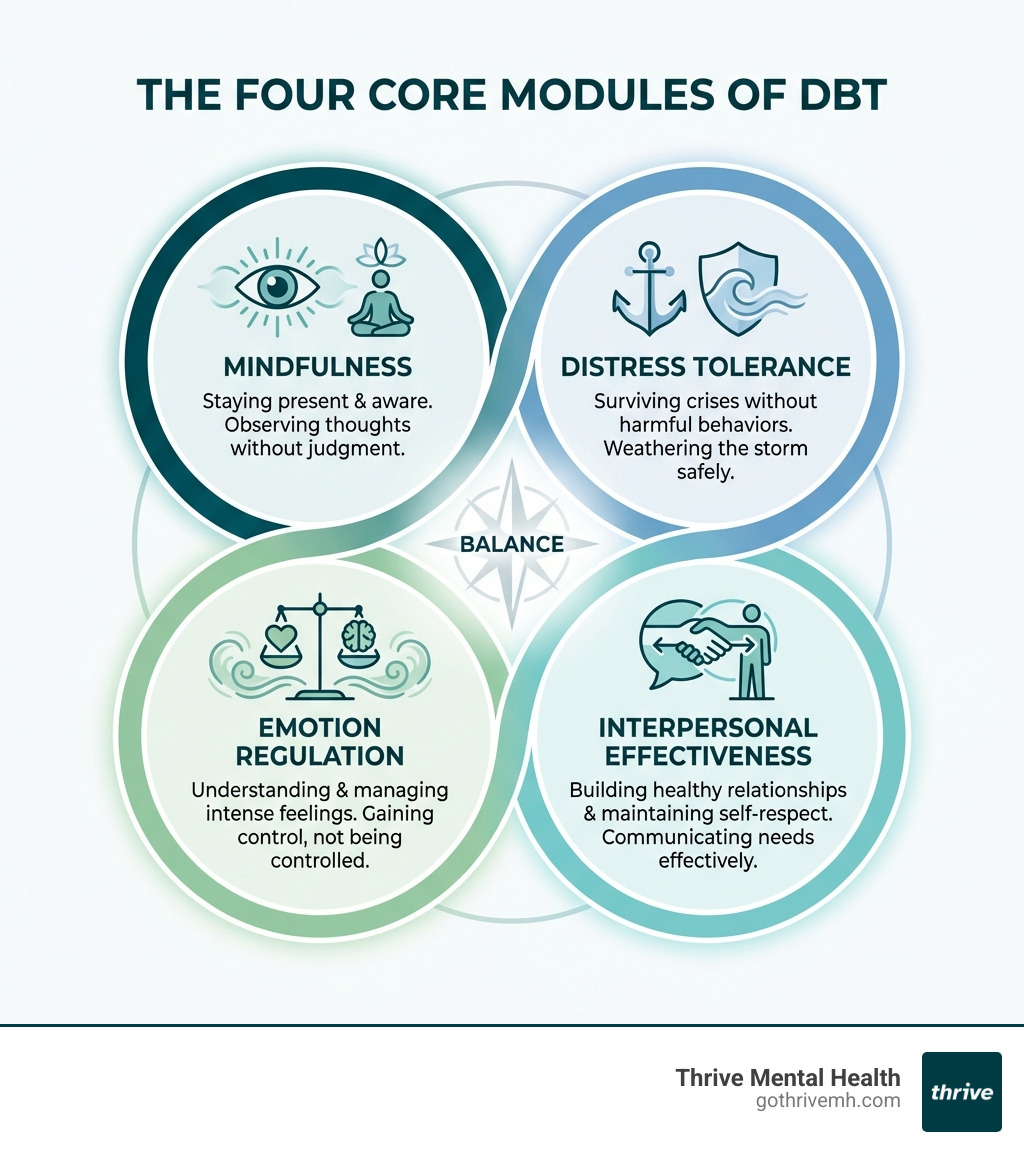
Here are the four core modules of DBT skills you need to know:
- Mindfulness – Stay present and observe your thoughts without judgment
- Distress Tolerance – Survive a crisis without making things worse
- Emotion Regulation – Understand and manage your feelings instead of being controlled by them
- Interpersonal Effectiveness – Get your needs met while keeping relationships and self-respect intact
If you feel like your emotions run the show, you’re not alone. Maybe traditional therapy wasn’t enough, or you’re a high-performer needing something that actually works—not just weekly check-ins that barely scratch the surface.
Developed by Dr. Marsha Linehan for BPD, DBT is now proven to work for anyone dealing with emotional intensity—including depression, anxiety, and PTSD. Research shows 77% of DBT patients no longer met BPD criteria after one year of treatment.
The core idea is dialectical: holding two truths at once. You’re doing the best you can, and you need to do better. DBT teaches you to accept yourself while working to change unhelpful patterns.
DBT provides a toolbox of specific skills for immediate use—not abstract concepts. It offers concrete strategies like the TIPP skill to calm your nervous system or DEAR MAN to ask for what you need with dignity.
As Nate Raine, CEO of Thrive Mental Health, I’ve spent over a decade building programs integrating DBT skills into our intensive outpatient and virtual care models for clients across Florida. At Thrive, we see these skills transform lives daily, delivering faster, measurable results.
Dbt skills terms to learn:
- dialectical behavior therapy components
- how does dialectical behavioral therapy work
- what does dialectical behavior therapy treat
What is Dialectical Behavior Therapy (DBT) and Who Does It Help?
Dialectical Behavior Therapy (DBT) is a specialized CBT that teaches skills to manage intense emotions, reduce self-destructive behaviors, and improve relationships. Its core principle, “dialectics,” balances two truths: accepting yourself as you are and working towards change.
DBT is based on the Biosocial Theory, which posits that emotional dysregulation arises from high biological sensitivity combined with an invalidating environment, making it hard to regulate emotions.
Who benefits from DBT? Originally for Borderline Personality Disorder (BPD), its effectiveness has expanded dramatically to help anyone with severe emotional dysregulation, self-harm, or suicidal behavior.
Today, DBT is a powerful tool for a wide range of mental health challenges, including:
- Borderline Personality Disorder (BPD): DBT is the gold standard for BPD, reducing impulsivity, emotional instability, and suicidal ideation. Studies show its remarkable effectiveness in helping individuals achieve stability and well-being Evidence of DBT effectiveness.
- Post-Traumatic Stress Disorder (PTSD): For those struggling with the aftermath of trauma, DBT skills can help manage flashbacks, emotional numbness, and hyperarousal.
- Depression: When depressive episodes are characterized by intense emotional swings or difficulty coping, DBT offers practical strategies for mood management.
- Anxiety: From generalized anxiety to panic attacks, DBT provides tools to tolerate distressing feelings and reduce avoidance behaviors.
- Substance Use Disorders: DBT helps individuals cope with cravings and triggers without resorting to substances, replacing destructive habits with healthier coping mechanisms.
- Eating Disorders: By addressing emotional dysregulation and body image issues, DBT can be a crucial component in recovery.
- Anyone experiencing intense emotional overwhelm: Even without a diagnosis, if you’re overwhelmed by emotions, relationship struggles, or unhelpful coping strategies, DBT offers a path to emotional control and a life worth living.
At Thrive Mental Health, we help individuals across Florida find a more balanced life with DBT skills. Learn more about this transformative approach: More info about Dialectical Behavior Therapy.
Module 1: Mindfulness Skills to Reclaim Your Focus from Chaos
Imagine a world where your thoughts don’t control you, where you can observe your emotions without being swept away by them. That’s the promise of mindfulness, the foundational module of DBT. It’s about becoming fully present in the moment, reducing judgment, and gaining control over your attention.
The goal of DBT mindfulness is to pay attention to the present moment without judgment. It’s not about clearing your mind, but observing thoughts and feelings as they pass. This practice keeps you grounded when emotions feel overwhelming.
DBT breaks mindfulness into two sets of skills: “What” skills and “How” skills.
-
“What” Skills (What you do when you’re mindful):
- Observe: Just notice. Pay attention to what you see, hear, smell, taste, and touch. Notice your thoughts and feelings without getting caught up in them.
- Describe: Put words to your observations. Label your thoughts, feelings, and sensations without judgment. “I notice a feeling of sadness,” instead of “I am sad.”
- Participate: Throw yourself completely into the present activity. Become one with what you’re doing, whether it’s washing dishes, listening to music, or having a conversation.
-
“How” Skills (How you do it mindfully):
- Non-judgmentally: See things as they are, without labeling them as “good” or “bad.” Just notice the facts.
- One-mindfully: Focus on one thing at a time. If your mind wanders, gently bring it back to the present moment.
- Effectively: Do what works. Focus on your goals and what will be most helpful in the situation, rather than what feels “right” or “fair.”
What are the core mindfulness dbt skills?
Beyond the “What” and “How” skills, DBT introduces several powerful concepts to deepen your mindfulness practice:
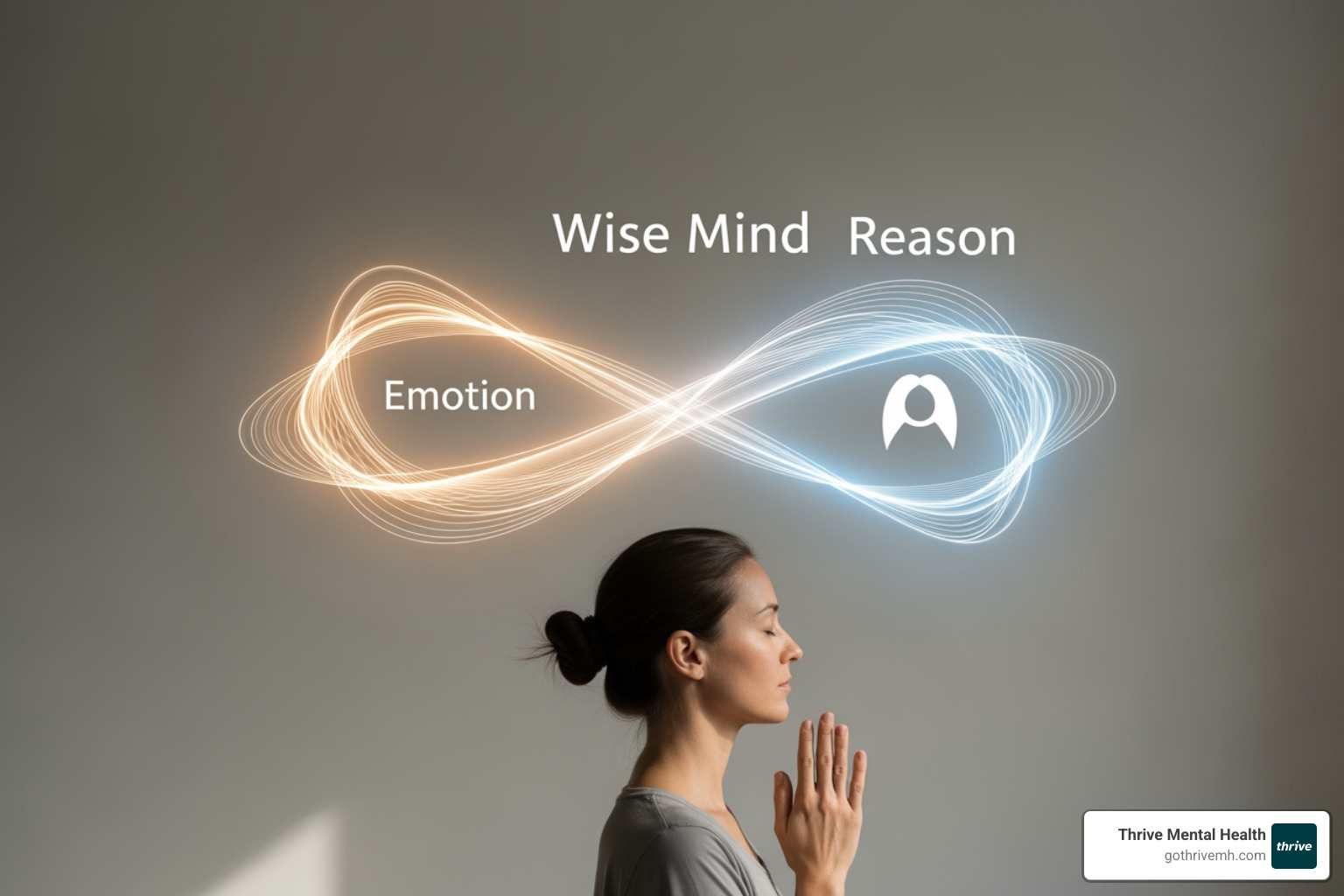
- Wise Mind: Wise Mind is the balance between “Emotion Mind” (feelings, impulses) and “Reasonable Mind” (logic, facts). It’s your intuition, helping you make decisions that are both emotionally intelligent and rational.
- Walking the Middle Path: This skill helps you see that two opposing ideas can both be true, reducing black-and-white thinking. For example, you can love someone and be angry at them, or want to change and accept yourself.
- Observing thoughts without attachment: Instead of getting tangled in your thoughts, you learn to step back and watch them pass by. This creates space between you and your thoughts, reducing their power over your emotions.
- Grounding techniques: These simple practices bring you back to the present when overwhelmed. Effective grounding methods include focusing on your breath, feeling your feet on the ground, or the 5-4-3-2-1 technique (noticing things you can see, touch, etc.).
Here’s a list of simple mindfulness exercises to try today:
- Conscious Breathing: Take a few deep breaths, focusing entirely on the sensation of air entering and leaving your body. If your mind wanders, gently redirect it to your breath.
- Mindful Eating: Choose a small piece of food. Notice its color, texture, and smell. Take a bite, savoring the taste and how it feels in your mouth. Chew slowly, paying attention to every sensation.
- Awareness Exercises: Take a few moments to notice all the sounds around you, without judgment. Then shift your focus to sensations in your body, or to what you can see.
- Loving Kindness Meditation: Silently repeat phrases like “May I be happy, may I be healthy, may I be safe, may I live with ease.” Extend these wishes to loved ones, neutral people, and even those with whom you struggle.
Module 2: Distress Tolerance Skills to Survive a Crisis Without Making It Worse
Life throws curveballs. Sometimes, you can’t change a difficult situation, and the pain is intense. This is where Distress Tolerance skills come in—they’re your emergency toolkit. The goal of distress tolerance is to help you get through a crisis, tolerate painful emotions, and avoid making things worse with impulsive or destructive actions. It’s about enduring suffering when immediate solutions aren’t available, without letting that suffering define you.
These skills teach you how to accept reality as it is, even if it’s painful, and to cope with intense emotions without resorting to unhelpful behaviors. They are about crisis survival and developing a “tolerance muscle” for discomfort.
Key concepts in this module include:
- Radical Acceptance: This isn’t about approving of a situation, but about accepting it fully, without fighting against reality. It means acknowledging the facts of a painful situation without judgment, which reduces suffering that comes from resisting what is.
- Turning the Mind: This is the act of choosing to accept reality, turning away from denial or fighting. It’s a conscious decision to move towards acceptance.
- Willingness vs. Willfulness: Willingness is about being open to doing what is effective, even if it’s difficult. Willfulness is the opposite—refusing to accept reality, trying to control what can’t be controlled, or giving up.
You can explore more about these powerful techniques with DBT Distress Tolerance exercises and worksheets.
How do you use TIPP and ACCEPTS skills?
When you’re in a crisis and your emotions are skyrocketing, you need rapid-response DBT skills. TIPP and ACCEPTS are two of the most effective.
TIPP Skill (for rapid physiological change): This skill helps to quickly change your body chemistry to calm down intense emotions.
- T – Temperature: Drastically change your body temperature. Splashing cold water on your face, holding ice cubes in your hands, or taking a cold shower can activate your dive reflex, slowing your heart rate and calming your nervous system.
- I – Intense Exercise: Engage in vigorous exercise for 10-15 minutes. Running, jumping jacks, or a fast walk can help release pent-up energy and shift your mood.
- P – Paced Breathing: Slow your breathing down. Breathe deeply from your diaphragm, exhaling slowly. Try counting to 4 on the inhale, holding for 2, and exhaling to 6.
- P – Paired Muscle Relaxation: Tense a muscle group for 5-7 seconds, then completely relax it. Work through different muscle groups in your body.
ACCEPTS Skill (for distraction and self-soothing): When you can’t solve a problem immediately, ACCEPTS helps you distract yourself from overwhelming emotions and urges.
- A – Activities: Engage in distracting activities (e.g., hobbies, chores, watching a movie).
- C – Contributing: Do something to help someone else or a cause (e.g., volunteering, helping a friend).
- C – Comparisons: Compare your current situation to times when you were less skilled or to others who are coping less effectively.
- E – Emotions: Create different emotions by listening to music, watching a funny movie, or engaging in activities that evoke joy.
- P – Pushing Away: Mentally push away the situation or emotion. Imagine putting it in a box and setting it aside for later.
- T – Thoughts: Distract your mind with other thoughts (e.g., puzzles, reading, counting, planning).
- S – Sensations: Create intense sensations (e.g., holding ice, taking a hot shower, eating spicy food).
You can also use Self-soothing with five senses to comfort yourself in a crisis:
- Sight: Look at beautiful art, nature, or comforting photos.
- Hearing: Listen to calming music, nature sounds, or a favorite podcast.
- Smell: Light a scented candle, use aromatherapy, or smell your favorite flower.
- Taste: Enjoy a comforting drink, a favorite snack, or a soothing tea.
- Touch: Take a warm bath, cuddle with a pet, or wrap yourself in a soft blanket.

Module 3: Emotion Regulation Skills to Stop Riding the Emotional Rollercoaster
Do your emotions feel like a wild, unpredictable rollercoaster? Emotion Regulation skills are designed to help you understand, manage, and ultimately reduce the intensity and frequency of unwanted emotions. The goal isn’t to get rid of emotions—that’s impossible and unhealthy—but to stop them from controlling your life.
This module focuses on:
- Understanding emotions: Learning to identify what you’re feeling, what triggers those feelings, and what their purpose might be.
- Reducing emotional vulnerability: Taking proactive steps to make yourself less susceptible to intense negative emotions.
- Decreasing emotional suffering: Learning techniques to shift unwanted emotions and prevent them from escalating.
DBT recognizes that effective emotion regulation involves both reducing negative emotions and increasing positive ones. To understand how DBT stands apart in its approach to managing emotions, you might find this guide helpful: Comprehensive Guide to CBT, MBT, and DBT.
What are the essential emotion regulation dbt skills?
Let’s explore some of the most impactful DBT skills for emotion regulation:
PLEASE Skill (for reducing vulnerability): This is your daily self-care checklist. Neglecting your physical health makes you emotionally vulnerable.
- Physical illness: Take care of your body. Address any physical ailments, see a doctor when needed, and manage chronic conditions.
- L – Balanced eating: Eat regularly and nutritiously. Avoid skipping meals or relying on sugary snacks, which can cause mood swings.
- E – Avoid mood-altering substances: Steer clear of alcohol, non-prescribed drugs, and excessive caffeine, which can interfere with emotional stability.
- A – Prioritize restorative sleep: Aim for 7-9 hours of quality sleep each night. Sleep deprivation drastically impacts mood and coping abilities.
- S – Engage in physical activity: Regular exercise releases endorphins, reduces stress, and improves mood.
Build Mastery: Do things that make you feel competent and effective. Accomplishing tasks, learning new skills, or excelling in a hobby can boost your sense of self-efficacy and increase positive emotions.
Cope Ahead: Mentally rehearse coping effectively with an upcoming difficult situation. Visualize yourself successfully navigating the challenge using your DBT skills, planning exactly what you’ll do and say.
Opposite Action: This is a powerful skill for changing unwanted emotions. If an emotion is unhelpful or unwarranted, do the opposite of what the emotion urges you to do. For example, if you feel depressed and want to isolate, engage in social activity. If you feel angry and want to lash out, practice gentleness.
Problem-Solving: If a problem is causing your distress, and it’s solvable, then solve it! Identify the problem, brainstorm solutions, weigh the pros and cons, choose the best solution, and implement it.
Module 4: Interpersonal Effectiveness Skills to Build Relationships That Don’t Drain You
Relationships are complex, and they can be a major source of both joy and pain. Interpersonal Effectiveness skills teach you how to steer social interactions effectively, get your needs met, maintain healthy relationships, and keep your self-respect—all at the same time. The goal is to improve the quality of your relationships and reduce interpersonal conflict without sacrificing your integrity.
This module helps you:
- Ask for what you want and say no effectively: Communicate your needs and boundaries clearly and respectfully.
- Build and maintain relationships: Foster positive connections and repair damaged ones.
- Keep your self-respect: Act in ways that align with your values and beliefs, even when it’s difficult.
For a comprehensive overview of how these skills fit into the broader DBT framework, check out this DBT Skills List.
How do you use DEAR MAN, GIVE, and FAST?
These three acronyms are your roadmap for successful interpersonal interactions. They provide structured ways to approach conversations, ensuring you achieve your goals while preserving your relationships and self-respect.
DEAR MAN (for objective effectiveness – getting what you want): Use this when you need to ask for something, say no, or resolve a conflict.
- D – Describe: Describe the situation clearly and factually. Stick to the facts, without judgment.
- E – Express: Express your feelings and opinions clearly, using “I” statements.
- A – Assert: Assert yourself by asking for what you want or saying no clearly. Don’t beat around the bush.
- R – Reinforce: Reinforce the other person by explaining the positive outcomes of getting what you want or the negative outcomes of not getting it.
- M – (Stay) Mindful: Stay focused on your objective. If the other person tries to distract you, gently bring the conversation back to your point.
- A – Appear Confident: Use a confident voice tone, make eye contact, and maintain an open posture.
- N – Negotiate: Be willing to give to get. Offer alternative solutions or compromise if necessary.
GIVE (for relationship effectiveness – keeping the relationship): Use these skills while using DEAR MAN to make sure you’re treating the other person respectfully and maintaining the relationship.
- G – Gentle: Be gentle and respectful. No attacks, threats, or judging.
- I – Interested: Act interested in the other person. Listen to their perspective and validate their feelings.
- V – Validate: Validate the other person’s feelings and thoughts. Show that you understand their perspective, even if you don’t agree with it.
- E – Easy Manner: Use a light-hearted, easy manner. Smile, use humor, and be approachable.
FAST (for self-respect effectiveness – keeping your self-respect): Use these skills to ensure you maintain your integrity and self-respect during the interaction.
- F – Fair: Be fair to yourself and others. Don’t be overly apologetic or self-sacrificing.
- A – (No) Apologies: Don’t over-apologize. Apologize only when genuinely warranted.
- S – Stick to values: Stick to your values. Don’t compromise your beliefs or integrity for the sake of the relationship or outcome.
- T – Truthful: Be truthful. Don’t lie, exaggerate, or be manipulative.
Putting DBT Into Practice: What to Expect from Treatment
Understanding DBT skills is one thing; truly integrating them into your life is another. A comprehensive DBT program is designed to give you the structure and support you need for lasting change. It’s an intensive, multi-component approach that goes beyond weekly talk therapy.
Let’s quickly compare DBT with its cousin, CBT, to highlight their unique strengths:
| Feature | Cognitive Behavioral Therapy (CBT) | Dialectical Behavior Therapy (DBT) |
|---|---|---|
| Primary Focus | Changing unhelpful thoughts and behaviors. | Balancing acceptance of experiences with active change strategies. |
| Structure | Typically individual therapy, sometimes group. | Multi-component: individual therapy, group skills training, phone coaching, therapist consultation team. |
| Skills | Cognitive restructuring, behavioral experiments, exposure. | Mindfulness, Distress Tolerance, Emotion Regulation, Interpersonal Effectiveness. |
| Therapist Stance | Collaborative, directive, focuses on identifying and modifying dysfunctional patterns. | Collaborative, validating, accepting, but also challenging for change; emphasizes dialectical balance and teaches specific skills. |
A standard DBT program typically includes four essential components:
- Individual Therapy: Weekly one-on-one sessions where you work with a DBT therapist to apply the skills to your specific life challenges and target behaviors. This is where personalized strategies are developed.
- Group Skills Training: This is often the core of learning DBT skills. In a group setting, you learn and practice the four modules (Mindfulness, Distress Tolerance, Emotion Regulation, and Interpersonal Effectiveness) alongside others. The skills curriculum typically takes 24 weeks to get through.
- Phone Coaching: Your therapist is available for brief, in-the-moment phone calls between sessions to help you apply skills to real-life crises and prevent unhelpful behaviors. This provides crucial support when you need it most.
- Therapist Consultation Team: This is a team of DBT therapists who meet regularly to support each other, ensure treatment fidelity, and prevent therapist burnout. While you don’t participate, it ensures your therapist is receiving the best possible support to help you.
A standard DBT program requires a one-year commitment to fully integrate the skills and achieve lasting change. This commitment ensures you have enough time to learn, practice, and apply the skills across various situations in your life.
At Thrive Mental Health, we offer virtual and in-person Intensive Outpatient (IOP) and Partial Hospitalization (PHP) programs across Florida that deeply integrate DBT skills training. Our programs are designed for adults and young professionals in Florida who need more than once-a-week therapy but less than inpatient care. This intensive format allows for rapid skill acquisition and real-time application. Learn more about Navigating Intensive Outpatient Therapy with DBT.
We understand that access to care is crucial. We work with major insurance providers like Cigna, Optum, Florida Blue, and many others to make our evidence-based programs accessible. Our team can help you understand your benefits and steer coverage for DBT in Florida. For more details, explore Understanding Insurance for DBT.
Frequently Asked Questions about Learning DBT Skills
Can I learn DBT skills on my own from a book?
While workbooks and online resources can provide a valuable introduction to DBT skills and concepts, DBT is designed to be taught by a trained professional. The combination of individual therapy (for personalized application), group practice (for learning and rehearsing skills), and in-the-moment phone coaching (for crisis intervention) is crucial for truly mastering the skills and applying them effectively, especially for complex issues like severe emotional dysregulation or trauma. Think of it like learning to drive: you can read the manual, but you need an instructor and practice behind the wheel to truly learn.
How long does it take to see results from DBT?
Many people start feeling a greater sense of control and notice improvements in their emotional well-being within a few weeks of consistently practicing DBT skills. However, a standard DBT program takes 24 weeks to cover the full skills curriculum, and a one-year commitment is often recommended for deep integration and lasting change. The key is consistent practice and applying the skills to real-life situations. The more you put in, the more you get out.
What is the biggest misconception about DBT?
A common misconception is that DBT is only for people with Borderline Personality Disorder or those in constant crisis. While it was developed for these populations, the truth is that the practical, life-changing DBT skills can benefit anyone struggling with emotional intensity, relationship issues, anxiety, depression, or even just seeking personal growth. These skills are universal tools for building a more balanced, fulfilling life, regardless of diagnosis.
Ready to Master Your Emotions? Here’s Your Next Step.
You’ve just explored the core of DBT skills: Mindfulness to anchor you in the present, Distress Tolerance to steer crises, Emotion Regulation to take control of your feelings, and Interpersonal Effectiveness to build stronger relationships. The power of these skills lies not just in understanding them, but in consistent practice and application. They are the tools you need to stop guessing at how to handle life’s challenges and start healing.
At Thrive Mental Health, we don’t just teach these skills; we help you weave them into the fabric of your daily life. Our expert-led programs, available throughout Florida, are designed to give you the support, structure, and personalized guidance you need to achieve emotional mastery. It’s time to stop feeling overwhelmed and start thriving. Take control of your mental health and build a life worth living.
Ready to take the next step? Explore Virtual DBT Intensive Outpatient Programs offered by Thrive Mental Health.
Ready for support? Thrive offers virtual and hybrid IOP/PHP programs with evening options. Verify your insurance in 2 minutes (no obligation) → Start benefits check or call 561-203-6085. If you’re in crisis, call/text 988.