
Unpacking PHP: Everything You Need to Know About Partial Hospitalization Programs

When Weekly Therapy Isn’t Enough: What a Partial Hospital Program Can Do
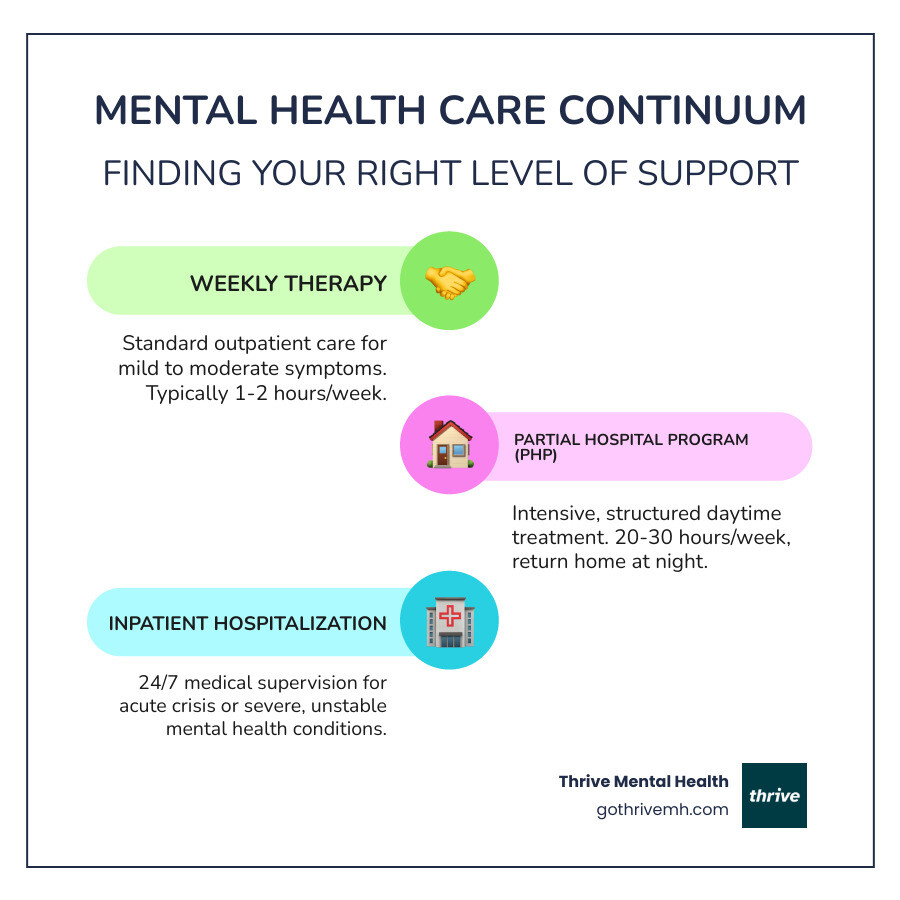
What is a partial hospital program? A Partial Hospitalization Program (PHP) is an intensive, structured mental health treatment providing 20-30 hours of care per week—more than traditional therapy but less restrictive than inpatient hospitalization. You attend treatment during the day and return home at night.
Quick Answer:
- Structure: Daytime treatment only (home at night)
- Intensity: 20-30 hours/week of therapy, psychiatry, and skills training
- Team: Psychiatrist, therapist, nurse, case manager
- Who it helps: People in crisis who need more than weekly therapy but don’t need 24/7 hospital care
- Insurance: Typically covered by major plans (Cigna, Optum, Florida Blue, Aetna, UnitedHealthcare)
If weekly therapy isn’t enough to manage severe depression, anxiety, or trauma, a PHP offers a faster path to recovery. You get daily structure and expert care without giving up your freedom.
Many people wait too long to increase their level of care, suffering as their symptoms worsen. A PHP interrupts that cycle by providing intensive support right when you need it most.
I’m Nate Raine, CEO of Thrive Mental Health. Here in Florida, I’ve seen how PHPs transform lives by bridging the gap between weekly therapy and full hospitalization. This guide explains how they work, who they help, and if one is right for you.
What is partial hospital program basics:
- iop vs php
- Which partial hospitalization programs offer flexible scheduling for full-time employees?
- Find a partial hospitalization program that is covered by United Health Company insurance.
If Weekly Therapy Isn’t Enough, Don’t Wait: Partial Hospitalization Can Save Your Life
What Is a Partial Hospital Program? [How It Works, Who It Helps]
A Partial Hospitalization Program (PHP) is a structured, intensive outpatient treatment for individuals with significant mental health or substance use challenges. Often called a “day hospital,” participants attend treatment for several hours daily, five days a week, and return home in the evenings. This model provides a high level of clinical care while allowing you to stay connected to your home and support systems.
At Thrive Mental Health, our physician-led, team-based PHPs focus on rapid stabilization and building sustainable coping skills. We offer flexible scheduling for individuals throughout Florida, with virtual programs also available in California, Indiana, Arizona, and South Carolina.
The primary goal of a PHP is to provide intensive, coordinated treatment for those with acute psychiatric symptoms or in a crisis that might otherwise require inpatient hospitalization. It serves as a critical intervention to prevent escalation or as a step-down from an inpatient stay, helping clients stabilize and reintegrate into daily life.
Internal Link: PHP Program at Thrive
PHP vs. Weekly Therapy: Why PHP Gets Faster Results
When you’re facing acute symptoms, weekly therapy may not be enough. A what is a partial hospital program provides the intensity needed for rapid change.
- Intensity and Immersion: A PHP involves 20 to 30 hours of therapy per week, compared to 1-2 hours in standard outpatient care. This immersive environment allows for deeper work and consistent skill-building.
- Daily Practice, Daily Progress: You practice new coping skills daily in a supportive clinical setting. This constant reinforcement accelerates progress and helps solidify new, healthy behaviors.
- Avoiding or Stepping Down from Hospitalization: A PHP can be a critical alternative to inpatient hospitalization, providing intensive support to manage a crisis. It also serves as a structured “step-down” for those leaving an inpatient facility, preventing relapse and promoting long-term recovery.
- Lower Cost, Less Disruption: Because PHPs don’t require overnight stays, they are more cost-effective than inpatient programs. You can remain at home, minimizing disruption to your life and family.
Internal Link: PHP vs IOP: What’s the Difference?
What Are the Main Goals of a PHP?
The core objectives of a what is a partial hospital program are to provide comprehensive support and foster lasting recovery.
- Rapid Symptom Relief and Crisis Stabilization: The immediate priority is to alleviate severe symptoms like intense anxiety, deep depression, or suicidal ideation in a safe, structured environment.
- Building Sustainable Coping Skills: We equip clients with practical tools for emotional regulation, distress tolerance, and interpersonal effectiveness to manage daily stressors.
- Medication Management and Education: Regular psychiatric consultations ensure your medication is effective. We provide education to empower you in managing your treatment plan.
- Preventing Relapse or Hospitalization: By providing intensive treatment, we aim to prevent symptoms from worsening to the point of requiring inpatient care or to reduce the risk of readmission.
- Enhancing Functional Abilities: PHPs focus on helping clients improve daily functioning, from personal care to re-engaging with work, school, or social activities.
- Fostering Self-Awareness: Therapy helps you understand your mental health condition, triggers, and patterns, which is foundational for personal growth.
Internal Link: PHP Mental Health Services
Who Should Consider a PHP? [Are You a Good Fit?]
A clinical assessment determines the right level of care, but you might be a good candidate for a what is a partial hospital program if:

- You need more support than weekly therapy: Your symptoms aren’t improving or are worsening with traditional outpatient care.
- You’re stepping down from inpatient care: A PHP provides a structured transition from a hospital stay back to daily life.
- You’re at risk of hospitalization: Your symptoms are severe, but you don’t require 24-hour supervision for safety.
- You have a safe home environment: A stable living situation is crucial since you return home each night.
- You’re motivated for change: PHPs require active participation in individual and group sessions.
- You can maintain your safety: PHPs are not for individuals who are an immediate danger to themselves or others or who require medical detox.
Internal Link: PHP Mental Health Ultimate Guide
What Conditions Do PHPs Treat?
A what is a partial hospital program can treat a wide range of conditions requiring intensive intervention, including:
- Major Depression: For severe depressive episodes where daily functioning is impaired.
- Bipolar Disorder: To manage mood swings, stabilize mood, and prevent relapses.
- Anxiety & Panic Disorders: To identify triggers and learn coping mechanisms to reduce anxiety and panic attacks.
- PTSD & Trauma: To process traumatic experiences and reduce PTSD symptoms in a safe environment.
- Substance Use Disorders: For structured support in early recovery, focusing on relapse prevention.
- Eating Disorders: Providing structured meal support, nutritional counseling, and therapy.
- Schizophrenia and other Psychotic Disorders: To support symptom management and social functioning after stabilization.
- Personality Disorders: For conditions like Borderline Personality Disorder, using modalities like DBT in a structured setting.
Internal Link: What Is Depression?
Insurance & Eligibility: What You Need to Know
Navigating insurance for a what is a partial hospital program should be straightforward.
Clinical Assessment is Required: Before admission, a comprehensive assessment is done to confirm a PHP is the medically necessary level of care for you.
Most Commercial Insurance Accepted: Thrive Mental Health is in-network with most major commercial insurance providers, including:
- Cigna
- Optum
- Florida Blue
- Aetna
- UnitedHealthcare
We are dedicated to making our programs accessible to all Floridians, with virtual services extending to California, Indiana, Arizona, and South Carolina.
Medicare and Medicaid: Coverage varies by state and program type. Contact us to discuss your specific plan and location.
Fast, No-Obligation Insurance Verification: We offer a quick, confidential insurance verification process. Check your benefits in minutes to understand your coverage and make an informed decision.
Internal Link: Verify Insurance for PHP/IOP
PHP vs. Other Levels of Care: What’s Best for You?
Understanding the mental health care continuum helps you choose the right path. A what is a partial hospital program sits between inpatient hospitalization and less intensive options like an Intensive Outpatient Program (IOP) or weekly therapy. At Thrive Mental Health, we help individuals across Florida find the right level of care for their needs.
| Feature | Inpatient Hospitalization | Partial Hospitalization Program (PHP) | Intensive Outpatient Program (IOP) | Standard Outpatient Therapy |
|---|---|---|---|---|
| Intensity | Highest (24/7 medical supervision & support) | High (20-30 hours/week) | Moderate (9-12 hours/week) | Low (1-2 hours/week) |
| Setting | Hospital or residential facility | Outpatient facility (return home at night) | Outpatient facility (return home at night) | Office, virtual, or community setting |
| Structure | Highly structured, constant supervision | Highly structured, daily programming | Structured, but allows for more independence | Flexible, self-directed |
| Medical Needs | Acute medical/psychiatric crisis, danger to self/others | Acute symptoms, at risk of hospitalization, or step-down from inpatient | Moderate symptoms, need for structured support, step-down from PHP | Mild to moderate symptoms, ongoing support, maintenance |
| Duration | Days to weeks (until stable) | Typically 2-4 weeks | Typically 6-12 weeks | Ongoing, as needed |
| Cost | Highest | High (more cost-effective than inpatient) | Moderate | Lowest |
| Daily Life | Fully interrupted | Daily activities outside program hours maintained | Most daily activities maintained | Minimal interruption |
PHPs are for those who need intensive support but can safely be at home at night. IOPs are a step down, offering 9-12 hours of therapy per week with more flexibility for work or school.
Internal Link: Intensive Outpatient Programs (IOPs)
Why Choose PHP Over IOP?
The choice between a PHP and an IOP depends on your current needs. You might choose a what is a partial hospital program over an IOP if:
- You need immediate stabilization: PHPs offer more clinical hours and structure, which is crucial for acute symptoms, high relapse risk, or transitioning from inpatient care.
- You require more daily structure: The 5-day-a-week schedule helps rebuild routine and healthy habits for those struggling with disorganization.
- You benefit from constant skill reinforcement: More time in treatment means more opportunities to practice and integrate new coping skills, leading to faster change.
- You need a bridge from inpatient care: A PHP provides a high level of support to ensure a safe transition back to community living after a hospital stay.
If your symptoms significantly impact daily functioning and you need robust, daily support to stabilize, a PHP is likely the right choice.
Internal Link: Comprehensive Guide to Local Mental Health Facilities
Inside a Partial Hospital Program: What to Expect Each Day
A typical day in a what is a partial hospital program at Thrive Mental Health is structured for maximum therapeutic benefit. Here’s a general overview of a 4-6 hour day, 5 days a week:

- Morning Check-in: Start the day with a group check-in to set intentions and connect with peers.
- Group Therapy: The morning is dedicated to group sessions on topics like mood regulation, coping skills, and communication.
- Individual Therapy: You’ll have scheduled one-on-one sessions with a licensed therapist to work on personal goals.
- Psychiatric Consults: Regular meetings with a psychiatrist for medication management and assessment.
- Lunch Break: A supervised break for informal social interaction.
- Skills Training: Afternoons focus on skill-building groups, such as CBT or DBT skills, mindfulness, and stress reduction.
- Experiential Therapies: Many PHPs include art, movement, or other creative therapies to help process emotions.
- End-of-Day Wrap-up: The day concludes with a group reflection on progress and challenges.
This intensive schedule, typically Monday through Friday, ensures you receive consistent, comprehensive support.
Internal Link: Virtual Partial Hospitalization Program
Who’s on Your Care Team?
An effective what is a partial hospital program uses a multidisciplinary team. At Thrive Mental Health, your team includes:
- Psychiatrist: Oversees medical care, diagnostics, and medication management.
- Licensed Therapist (LCSW, LMFT, LPC): Leads individual and group therapy sessions, guiding you through modalities like CBT and DBT.
- Registered Nurse (RN): Monitors physical health, administers medication, and provides health education.
- Case Manager: Coordinates care, connects you with community resources, and assists with discharge planning.
- Dietitian (if needed): Provides specialized nutritional guidance for conditions like eating disorders.
- Experiential Therapist: Uses creative modalities like art or music for self-expression and emotional processing.
This integrated team works together to address all aspects of your well-being.
Internal Link: Expert Mental Health Professionals
What Therapies Are Used in PHP?
We use a range of evidence-based therapies in our what is a partial hospital program, delivered in both individual and group settings:
- Cognitive Behavioral Therapy (CBT): Helps you identify and change negative thought patterns and behaviors.
- Dialectical Behavior Therapy (DBT): Teaches skills in mindfulness, distress tolerance, emotional regulation, and interpersonal effectiveness.
- EMDR (Eye Movement Desensitization and Reprocessing): A specialized therapy to help process traumatic memories and reduce their emotional impact.
- Family Therapy: Improves communication and conflict resolution to build a stronger support system at home.
- Art Therapy: Uses creative expression to reduce stress and gain insight when words are difficult.
- Mindfulness & Stress Reduction: Teaches practices like meditation and deep breathing to manage stress and anxiety.
- Motivational Interviewing: A client-centered approach to help you find your own motivation for change.
Combining these therapies creates a rich environment that promotes lasting healing for our clients throughout Florida. Our virtual programs also make these services accessible to residents of California, Indiana, Arizona, and South Carolina.
Life After PHP: How to Stay on Track
Completing a what is a partial hospital program is a major step, but recovery is an ongoing journey. At Thrive Mental Health, we prioritize continued support by starting your discharge plan on day one.
Discharge Planning Starts Immediately: Our team works with you from the beginning to create a personalized aftercare plan. We help you identify triggers, create a crisis plan, and build a support system for life after PHP.
Step Down to a Lower Level of Care: After PHP, most people transition to a less intensive level of care to gradually reintegrate into daily life. Options include:
- Intensive Outpatient Programs (IOP): Offering 9-12 hours of therapy per week, IOPs provide structured support with more flexibility.
- Standard Outpatient Therapy: Weekly or bi-weekly individual or group therapy sessions provide ongoing maintenance and support.
Aftercare and Relapse Prevention: Your aftercare plan will include recommendations for continuing care, such as:
- Ongoing Therapy: Continue with individual or group therapy to reinforce skills.
- Medication Management: Maintain regular psychiatric follow-ups for medication stability.
- Support Groups: Peer-led groups provide community and encouragement. For substance use, 12-step programs can be effective. For those who prefer a non-spiritual, science-based approach, SMART Recovery is an excellent option.
- Building a Support System: We help you lean on healthy relationships with family and friends, which is critical for long-term well-being.
Internal Link: Mental Health Recovery Program
How Thrive Supports Your Long-Term Recovery
Our commitment to you extends beyond your time in a what is a partial hospital program. We support your continuous journey to wellness.
- Recovery-Focused Care: We partner with you in your healing, focusing on your strengths and empowering you to define a meaningful life.
- Self-Management Skills: We teach you to recognize early warning signs, use coping strategies, and advocate for your own mental health needs.
- A Continuum of Care: We ensure a clear path for continued support, whether it’s stepping down to our IOP or connecting with our virtual networks.
- Flexible Virtual and Hybrid Options: Our programs in Florida offer the flexibility to get high-quality care without disrupting your life, ensuring consistency in your recovery. We also provide virtual services in California, Indiana, Arizona, and South Carolina.
We provide the tools and guidance you need to not just recover, but to thrive.
Internal Link: Building Resilience: Online Coping Strategies
FAQs: Partial Hospitalization Programs [Quick Answers]
How long does a PHP last?
Most programs run 2–4 weeks, based on your individual needs and insurance authorization. Some programs can be as short as 5-7 days.
Can I work or go to school during PHP?
It’s challenging. PHPs typically require 4–6 hours/day, 5 days/week. While some individuals manage part-time work or school, it often requires significant adjustment. Some programs offer evening options to accommodate this.
Is PHP covered by insurance?
Yes—most major commercial insurance plans, including Cigna, Optum, Florida Blue, Aetna, and UnitedHealthcare, cover PHP if it’s medically necessary. We can help you verify your benefits quickly.
What’s the difference between PHP and IOP?
PHP is more intensive (20+ hours/week) and provides a higher level of supervision and structure compared to IOP (9–12 hours/week). PHP is for higher needs or as a step-down from inpatient; IOP is a step down from PHP or for those needing significant but less intense support.
Do I have to go to a hospital for PHP?
No—Thrive offers virtual and hybrid options so you can get expert care from the comfort of your home in Florida. We also serve clients virtually in California, Indiana, Arizona, and South Carolina.
Summary: What Is a Partial Hospital Program? [Key Takeaway]
A Partial Hospitalization Program gives you daily, expert mental health care—more than weekly therapy, less than inpatient hospitalization—so you can recover fast, stay safe, and keep your life on track. It’s a crucial stepping stone for individuals needing intensive support to stabilize acute symptoms, build essential coping skills, and prevent relapse or hospitalization. Covered by most major insurance providers, Thrive Mental Health offers accessible PHP programs for residents throughout Florida. Our virtual and hybrid options also extend services to California, Indiana, Arizona, and South Carolina. Our multidisciplinary team and evidence-based therapies ensure you receive the comprehensive, person-centered care needed for lasting recovery.
Ready for support? Thrive offers virtual and hybrid IOP/PHP programs with evening options. Verify your insurance in 2 minutes (no obligation) → Start benefits check or call 561-203-6085. If you’re in crisis, call/text 988.
If you’re in crisis, call/text 988 right now. You are not alone.