




Understanding the LGBTQIA+ Acronym
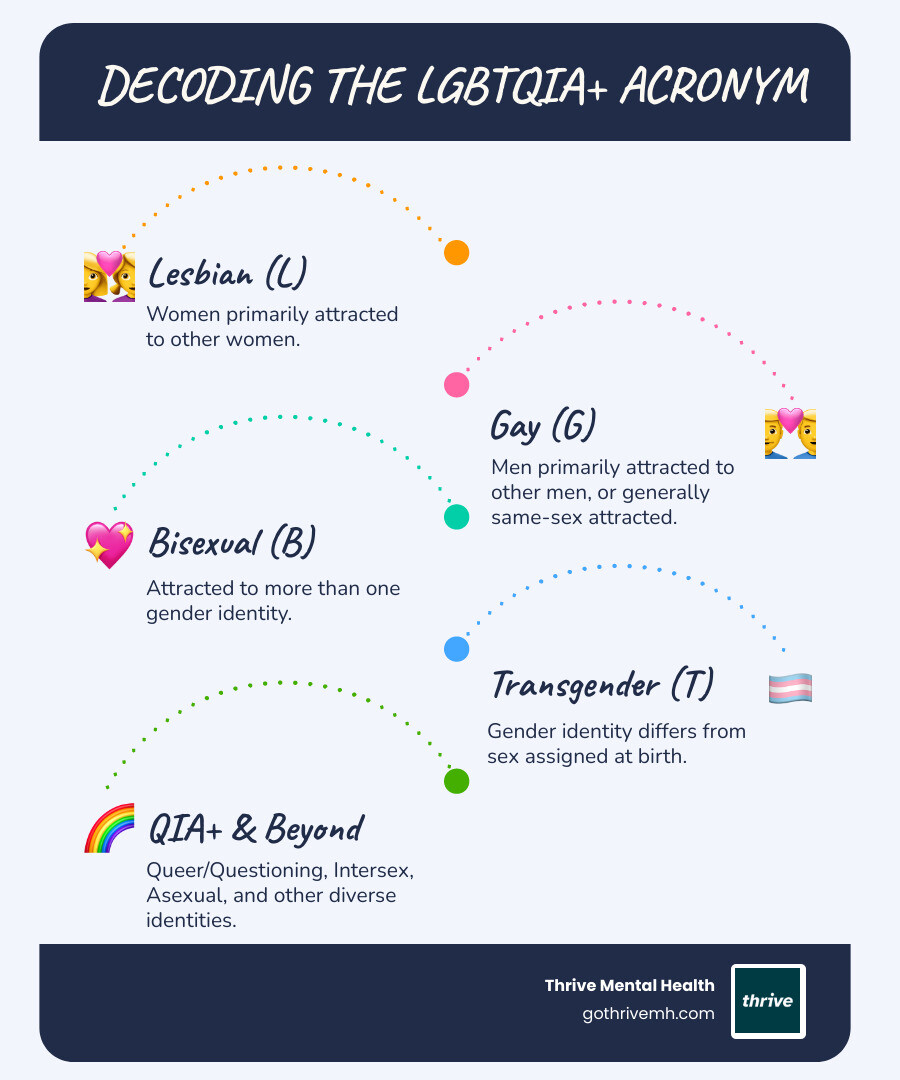
The LGBTQIA+ acronym stands for:
- L: Lesbian (women attracted to women)
- G: Gay (men attracted to men, or generally same-sex attracted individuals)
- B: Bisexual (attracted to more than one gender)
- T: Transgender (gender identity differs from sex assigned at birth)
- Q: Queer (an umbrella term, often reclaimed) or Questioning (exploring identity)
- I: Intersex (born with variations in sex characteristics)
- A: Asexual (little to no sexual attraction)
- +: All other diverse gender identities and sexual orientations not explicitly listed
Understanding diverse identities is more important than ever. The LGBTQIA+ acronym brings together many different gender and sexual identities that often face marginalization.
Learning what these letters mean helps foster inclusivity and understanding. Language around identity is always evolving, and this guide will help you steer these terms with ease.
This guide is from Thrive Mental Health. We are dedicated to creating inclusive environments and expanding access to mental health care for the LGBTQIA+ community in Florida.
Decoding the Acronym: A Guide to the LGBTQIA+ Community
Welcome back! The LGBTQIA+ acronym is a colorful umbrella for a wide range of sexual orientations and gender identities. It reflects our growing understanding of human diversity. At Thrive Mental Health, we believe in affirming every person’s unique journey, and understanding these terms is a big step toward that.
What Each Letter in LGBTQIA+ Represents
Let’s break down each part of the acronym:
-
L, Lesbian: Describes a woman who is primarily attracted to other women. Some non-binary people who feel a strong connection to womanhood may also identify as lesbian.
-
G, Gay: While “gay” can be a general term for anyone attracted to the same gender, it most often refers to men who are attracted to other men.
-
B, Bisexual: A person who is attracted to people of the same gender and other genders. This attraction can be physical, romantic, or emotional and can change over time. The 1990 “Bisexual Manifesto” affirmed that this term includes transgender, binary, and non-binary people.
-
T, Transgender: An umbrella term for people whose internal gender identity doesn’t match the sex they were assigned at birth. Being transgender is about one’s inner self, not their appearance or medical history.
-
Q, Queer or Questioning:
- Queer: A reclaimed umbrella term for identities that don’t fit societal norms. Once a slur, many now use it with pride. It’s best to only use it if someone self-identifies this way.
- Questioning: Refers to people who are exploring their sexual orientation or gender identity, acknowledging that identity can be a journey.
-
I, Intersex: Describes people born with natural variations in their sex characteristics (genitals, chromosomes, etc.) that don’t fit typical definitions of male or female. Intersex is about biology, not gender identity. About 1.7% of the population is intersex, as common as having red hair.
-
A, Asexual: Often called “ace,” this term describes someone who feels little to no sexual attraction. Asexuality is a spectrum, and ace people can still have fulfilling romantic relationships. The “A” also covers Aromantic individuals, who feel little to no romantic attraction.
For more detailed definitions, see GLAAD’s Media Reference Guide.
The Importance of the “+” in LGBTQIA+
The ‘+’ is a powerful symbol of inclusivity, representing all gender identities and sexual orientations not explicitly listed. Language is always evolving, and the ‘+’ ensures the acronym remains all-encompassing. This visibility helps people feel seen and valued, which boosts self-esteem and mental well-being.
Identities covered by the ‘+’ include:
- Pansexual: Attraction toward people of all genders and sexes.
- Genderfluid: A person whose gender identity and expression change over time.
- Non-binary: An umbrella term for gender identities that are not exclusively “man” or “woman.”
- Agender: A person who identifies as not having a gender.
- Demisexual: Feeling sexual attraction only after forming a strong emotional bond.
- Two-Spirit: An Indigenous American identity term for various gender and sexual identities with historical and spiritual significance within many Native cultures.
Other Key Terms to Know
-
Cisgender: A person whose gender identity matches the sex they were assigned at birth.
-
Non-binary: As mentioned, this is an umbrella term for someone whose gender identity is not just “woman” or “man.” You can learn more about nonbinary identities to deepen your understanding.
-
Gender Nonconforming (GNC): Describes gender expression that differs from conventional masculine or feminine expectations.
-
Ally: A person who actively supports the equal rights and fair treatment of a group they don’t belong to. True allyship requires action and learning.
-
Pronouns: Words used to refer to someone without using their name (e.g., they/them, she/her, he/him). Using someone’s correct pronouns is a fundamental way to show respect.
-
Deadnaming: Using the former name of a trans or non-binary person without their consent. This is hurtful and invalidates their identity.
-
Misgendering: Referring to someone using language that does not align with their gender identity. This can be deeply painful.
The Difference Between Gender Identity, Sexual Orientation, and Expression
Gender identity, sexual orientation, and gender expression are often confused, but they are distinct aspects of a person. Simply put: your gender identity is who you are, your sexual orientation is who you love, and your gender expression is how you show yourself to the world.
Here’s a breakdown of these crucial distinctions:
-
Gender Identity: Your internal, deeply felt sense of being a man, woman, both, neither, or somewhere else on the gender spectrum. It is how you know yourself to be and may not correspond to your sex assigned at birth.
-
Sexual Orientation: This refers to who you are emotionally, romantically, or sexually attracted to. It is independent of one’s gender identity.
-
Gender Expression: This is how you externally present your gender through clothing, mannerisms, and other presentations. These expressions are often characterized as “masculine,” “feminine,” or “androgynous” and may not align with societal expectations or even one’s own gender identity.
-
Sex Assigned at Birth: This is a medical classification, typically assigned at birth based on external genitalia. It is usually categorized as “male” or “female” but is not the same as gender identity.
This table helps compare the concepts:
| Aspect | What it is | Example |
|---|---|---|
| Gender Identity | Your internal sense of self as a man, woman, or other. | “I know I am a woman, even though I was assigned male at birth.” |
| Sexual Orientation | Who you are romantically, emotionally, or sexually attracted to. | “I am attracted to other women.” |
| Gender Expression | How you outwardly present your gender through appearance and behavior. | “I express my gender through masculine clothing and a deep voice.” |
| Sex Assigned at Birth | Biological classification at birth based on physical characteristics. | “I was assigned female at birth.” |
Understanding these differences is key to respecting individual identities.

The History and Evolution of LGBTQIA+ Language
The language we use for LGBTQIA+ identities has evolved significantly, driven by social movements and a quest for visibility.
Early terms like “homosexual” were often clinical. In the 1970s, the community reclaimed the word “gay” as a term of pride. Initially, the movement focused on “gay” and “lesbian” identities, leading to acronyms like “GL.” To ensure their visibility, lesbians advocated for their explicit inclusion, leading to the common use of “Gay and Lesbian.”
The AIDS crisis of the 1980s and 90s was a pivotal, though tragic, chapter. As thousands of gay men were disowned by their families, the lesbian community provided immense support and care. In recognition of this solidarity, the acronym became firmly established as “LGB.”
The “T” for transgender was added in the early 2000s, making “LGBT” the standard. This was a crucial step, recognizing that gender identity is separate from sexual orientation and that transgender people face unique forms of discrimination.
The “Q” was officially added in 2016, though it had been in use for years. It can stand for “Queer,” a reclaimed term for non-conforming identities, or “Questioning,” for those exploring their identity. This addition reflected a desire for a more encompassing term, especially among younger generations.
Today, the full LGBTQIA+ acronym, including “I” for Intersex, “A” for Asexual, and the “+”, represents our ongoing commitment to embracing the full spectrum of human identity.
This evolution was fueled by decades of activism, starting with events like the Stonewall Uprising in 1969. Community-building has been a vital tool against heterosexism, homophobia, and other societal pressures. A unified language has enabled political advocacy and helped advance anti-discrimination efforts, a fight that continues today in communities across Florida and the nation.
LGBT History Month is celebrated in October in the United States and February in the United Kingdom, highlighting a history that stretches back centuries. The language will continue to evolve, reflecting our growing understanding. You can learn more on the history of LGBTQ+ rights to appreciate this rich background.
How to Be a Supportive Ally
True allyship to the LGBTQIA+ community is an ongoing journey of learning and action. It’s about creating spaces where everyone feels safe and valued.
Listen and learn. Listen to the experiences of LGBTQIA+ people without making them responsible for your education. Be open to new perspectives and put aside assumptions.
Use correct names and pronouns. This is a profound sign of respect. Normalize sharing your own pronouns (e.g., “I’m Alex, and I use they/them pronouns”). If you’re unsure, ask respectfully. If you make a mistake, apologize briefly, correct yourself, and move on.
Challenge prejudice. Your voice matters. When you hear an anti-LGBTQIA+ comment, a simple “I disagree” or “That’s not okay” can shift the conversation and show support.
Don’t make assumptions. You can’t know someone’s sexual orientation or gender identity by their appearance or who their partner is. Let people tell you who they are.
Educate yourself. Seek out books, documentaries, and online resources from LGBTQIA+ creators. Following advocates on social media can keep you informed on current issues.
Amplify LGBTQIA+ voices. Use your platform, whatever it may be, to share and support LGBTQIA+ stories and initiatives, especially those from marginalized voices within the community.
Respect privacy. Coming out is a personal decision. Never “out” someone, as it can put them at risk and violates their agency over their own story.

Allyship also means supporting inclusive policies at work, frequenting inclusive businesses, and showing up for your community. It’s about consistent action, not perfect performance.
Common Misconceptions and the Importance of Representation
Despite growing awareness, harmful misconceptions about LGBTQIA+ identities persist. Dispelling these myths and promoting positive representation are crucial for the well-being of the community.
Let’s address some common misconceptions. Bisexuality is not a phase or a sign of confusion; it is a valid and enduring sexual orientation. In fact, bisexual people make up the largest single group within the adult LGBTQIA+ community in the U.S.
Similarly, asexuality is a valid orientation, not a medical condition or a choice. Asexual people can form deep, fulfilling romantic relationships without experiencing sexual attraction.
Another harmful myth is that transgender identity is a choice or a mental illness. Being transgender is an innate part of a person’s identity. While gender dysphoria, the distress from a mismatch between one’s gender identity and assigned sex, is a treatable condition, being transgender itself is not an illness. So-called “conversion therapy” is widely discredited and deeply harmful.
These stereotypes have severe consequences. LGBTQIA+ individuals face higher mental health risks due to discrimination and isolation. Statistics show the impact: LGBTQIA+ adults are more than twice as likely as heterosexual adults to experience a mental health condition, and transgender individuals are nearly four times as likely. For LGBTQIA+ youth, harassment and rejection contribute to higher rates of homelessness and suicide attempts. In Florida, Thrive Mental Health provides affirming IOP programs designed to address these specific challenges in a supportive environment. You can find more research on health considerations for LGBTQ youth to understand these challenges.
This is why positive representation is so vital. Seeing authentic LGBTQIA+ stories in media and society helps individuals feel seen and valid, which can significantly improve self-esteem and mental well-being. It also educates the broader public, breaking down stereotypes and building empathy.
Increased visibility and understanding are powerful tools against discrimination. While there is still work to be done, especially in representing BIPOC LGBTQIA+ individuals, the growing presence of authentic stories is a crucial step toward a more accepting world.
Conclusion: Fostering Understanding and Seeking Support
We’ve journeyed through the LGBTQIA+ acronym, its history, and the key differences between gender, sex, and orientation. The most important takeaway is that identity is personal and self-defined. The most respectful action we can take is to listen when someone tells us who they are and use the language they choose for themselves.
Language will continue to evolve, reflecting our growing ability to recognize and celebrate the full spectrum of human experience.
However, challenges remain. Many LGBTQIA+ people still face discrimination and rejection, which can take a serious toll on mental health. The statistics on anxiety, depression, and isolation in the community highlight the need for affirming support.
That’s where quality mental health care is crucial. At Thrive Mental Health, we provide affirming care that celebrates your identity. Our virtual and in-person intensive outpatient (IOP) programs are designed to provide a safe, understanding environment. We’re proud to offer these inclusive mental health services across Florida, including in Tampa Bay, St. Petersburg, and Central Florida. You can learn more about our inclusive mental health services in Florida and how we make quality care accessible.
Reaching out for support is a sign of strength. If you or someone you know is struggling, please know that help is available. You are not alone.
Here are some excellent organizations that provide additional support:
- The Trevor Project: Offers 24/7 crisis support for LGBTQIA+ young people under 25.
- PFLAG: Connects LGBTQIA+ individuals with supportive families, friends, and allies.
- GLSEN: Works to create safer, more inclusive schools for LGBTQIA+ students.
The journey toward full acceptance continues. Whether you’re part of the LGBTQIA+ community or an ally, your actions matter. Together, we can build a world where everyone is free to be their authentic self.

This article is for informational purposes only and is not a substitute for individualized clinical advice or insurance verification.