





Understanding the Human Superpower We All Possess
When you see someone slam their laptop shut and storm out of a meeting, your brain automatically wonders why. Are they frustrated, embarrassed, or dealing with something personal? This everyday mind-reading isn’t magic, it’s define mentalization in action.
Mentalization is the ability to understand behavior (your own and others’) based on underlying mental states like thoughts, feelings, needs, and beliefs. It’s how we connect what’s happening inside someone’s mind to what shows up in their behavior. When this skill works well, relationships flow smoothly. When it breaks down, misunderstandings and emotional chaos often follow.
Here’s what mentalization looks like:
- Self-focused: Realizing you’re snapping at your partner because you’re stressed about work, not because of them.
- Other-focused: Guessing your friend’s quietness might mean they’re processing bad news, not that they’re mad at you.
- In relationships: Asking “What might be going through their mind?” instead of assuming you know.
- In conflict: Pausing to consider multiple perspectives before reacting.
At Thrive Mental Health, our Florida-based programs have seen how strengthening this core skill transforms relationships and mental wellbeing. Understanding what’s happening in your own mind, and making educated guesses about others’, is essential for emotional health.
Define mentalization terminology:
What is Mentalization? A Core Definition
Researchers Peter Fonagy and Anthony Bateman define mentalization as seeing ourselves from the outside and others from the inside. It’s an imaginative mental activity that helps us understand human behavior by looking at underlying mental states, needs, desires, feelings, beliefs, and goals.
The word “imaginative” is key. We can never truly know what’s happening in someone else’s mind, or even fully grasp our own. We have to make educated guesses. This imaginative leap makes the social world predictable and meaningful, allowing us to anticipate actions and understand reactions.
The roots of this concept are related to “theory of mind.” Early research showed that by age four, most children understand that someone will act based on their own belief, even if that belief is false. This milestone sets the stage for more sophisticated mentalizing. You can explore some of the foundational scientific research on the development of belief understanding that helped shape our understanding.
How We Define Mentalization and Its Key Components
Mentalization isn’t a single skill but operates along several dimensions:
- Implicit vs. Explicit: Mentalizing can be automatic and fast (implicit) or slow and deliberate (explicit). You might implicitly sense a friend’s mood from their tone, or explicitly reflect on a complex misunderstanding.
- Self vs. Other-Focused: We use mentalization to understand our own inner world (self-focused) or to make sense of someone else’s (other-focused).
- Cognitive vs. Affective: This is the balance between thinking about mental states (cognitive) and connecting with the emotions behind them (affective). Both are needed for a complete picture.
- Internal vs. External Focus: Good mentalizing connects inner experiences (thoughts, feelings) with observable external information (behavior, context).
Mentalization vs. Theory of Mind, Empathy, and Mindfulness
These concepts are often confused. Here’s a quick breakdown:
| Concept | Definition | Relationship to Mentalization |
|---|---|---|
| Mentalization | The ability to understand behavior (one’s own and others’) in terms of underlying mental states (thoughts, feelings, needs, beliefs). It’s an imaginative mental activity of “thinking about thinking.” | Mentalization is the broader concept, encompassing the dynamic, often implicit, process of attributing mental states to explain behavior. It’s sometimes described as “understanding misunderstanding.” |
| Theory of Mind | The cognitive ability to attribute mental states (beliefs, intentions, desires, knowledge) to oneself and others, and to understand that others’ beliefs and perspectives may be different from one’s own. | Theory of Mind (ToM) is a core component within mentalization, often focusing on the cognitive understanding of beliefs, particularly false beliefs. While ToM is largely cognitive, mentalization integrates affective understanding and is more dynamic, encompassing both implicit and explicit processes. Research on mentalization often built upon earlier work on ToM. |
| Empathy | The capacity to understand or feel what another person is experiencing from their frame of reference, often involving feeling with them. | While related to mentalization, empathy is primarily about emotional resonance and shared feeling, whereas mentalization is about understanding the reasons behind feelings and behaviors. You can mentalize without necessarily feeling empathetic, and vice versa. They are complementary; mentalization focuses on intellectual understanding of mental states, while empathy focuses on emotional perception. Neural studies even suggest they can be dissociated on a brain level. |
| Mindfulness | A mental state achieved by focusing one’s awareness on the present moment, while calmly acknowledging and accepting one’s feelings, thoughts, and bodily sensations. | Mindfulness shares common ground with mentalization, particularly in fostering self-awareness and attention to internal states. It can improve mentalizing by improving our ability to observe our own thoughts and feelings without judgment, which is a key part of self-focused mentalizing. However, mindfulness primarily focuses on present-moment awareness and acceptance, while mentalization specifically involves interpreting behavior through mental states. |
In short, Theory of Mind is a cognitive building block of mentalization. Empathy is about feeling with someone, while mentalization is about understanding why they feel that way. Mindfulness helps you observe your own mind, which strengthens self-focused mentalization.
The measurable side of mentalization is often called Reflective Functioning, which assesses how well someone can reflect on and understand mental states in themselves and others.
The Roots of Mentalizing: Attachment, Development, and Trauma

We aren’t born with the ability to mentalize. It develops gradually through our earliest relationships. When a parent wonders why their baby is crying, Are you hungry? Scared? Uncomfortable?, they are performing the simple act that builds mentalization.
When caregivers mirror a child’s feelings (e.g., reflecting a distressed face while saying, “Oh, you’re so frustrated!”), they show the child that their inner world is real, understandable, and manageable. The parent’s face acts like a mirror, helping the baby recognize their own emotions.
Secure attachment is the ideal environment for mentalization to grow. Consistent, caring responses teach children that their inner world makes sense and that others can understand it. This builds a coherent sense of self and the confidence to explore their own minds and the minds of others. Research shows that parents skilled at understanding their children’s mental states tend to raise children who are also skilled mentalizers. You can read more about how this works here: Research on parental reflective functioning.
How Trauma Disrupts the Ability to Mentalize
When early relationships are a source of fear instead of safety, the development of mentalization can be derailed. Childhood abuse and neglect send a terrifying message: my feelings are dangerous, and it’s not safe to think about what’s happening in anyone’s mind.
For a child with a frightening caregiver, trying to understand that person’s intentions is overwhelming. If the person meant to protect you is the one who hurts you, the mind may shut down its ability to look inside minds altogether. This survival strategy is called defensive non-mentalizing, a kind of “mind-blindness” that protects the child from unbearable truths but causes relationship problems later in life.
Trauma can also lead to internalizing the abuser’s critical voice, creating a “foreign self”, a cruel internal presence that can take over during stress, leading to self-harm. Many survivors also develop hypervigilance, constantly scanning for external threats while losing touch with their own internal world.
A 2023 meta-analysis confirmed that childhood trauma significantly impairs our ability to mentalize, with earlier and more severe trauma having a greater impact. Childhood maltreatment and mentalizing capacity meta-analysis.
The good news is that this skill can be rebuilt. Understanding these roots helps us approach healing with compassion and hope.
When Mentalizing Falters: The Link to Mental Health

When our mentalizing capacity is compromised, our psychological well-being suffers. Impaired mentalization is a transdiagnostic issue, meaning it’s a vulnerability factor across many mental health conditions. It’s like navigating the social world with a faulty compass.
Struggling to interpret our own or others’ mental states can lead to:
- Psychopathology: Research links poor mentalization to anxiety, depression, and personality pathology.
- Difficulties with emotion regulation: Without understanding why we feel a certain way, managing intense emotions becomes incredibly challenging.
- Impulsivity: An inability to pause and reflect on our mental states or consider consequences can lead to impulsive actions.
- Strained relationships: Constant misunderstandings, mistrust, and conflict can make the social world feel hostile and isolating.
The Critical Role of Mentalization in Borderline Personality Disorder (BPD)
No condition highlights impaired mentalization more clearly than Borderline Personality Disorder (BPD). Fonagy and Bateman argue that BPD is largely a disorder of mentalization, especially under stress. When their capacity collapses, individuals with BPD can shift into non-mentalizing modes:
- Psychic Equivalence: The inner world is treated as identical to outer reality. The feeling “I think you hate me” becomes the fact “You do hate me,” with no room for other possibilities.
- Pretend Mode: Thoughts and feelings are completely disconnected from reality, as if they are “just pretend.” This leads to a sense of unreality and emotional detachment.
- Teleological Mode: Only concrete, physical actions are seen as real. A person might only believe they are cared for if someone performs a specific act, as words are not enough. This can lead to self-harm to make internal pain “real.”
These modes contribute to core BPD symptoms like affect dysregulation, impulsivity, and self-harm and suicidality. Mentalization-Based Treatment (MBT) was developed to address these deficits and has been shown to reduce self-harm by improving mentalizing capacity.
 Anxiety Relief Awaits: Discover CBT Therapists in Fort WayneMental Health
At Thrive Mental Health, we understand the profound impact of personality disorders. Our specialized programs in Florida are designed to address these complex challenges. Learn about our specialized programs for personality disorders in Florida.
Rebuilding the Skill: Treatment and Everyday Life
The hopeful truth is that mentalization is a skill that can be learned and strengthened at any age. Even if early experiences were difficult, you are not stuck. This capacity can be rebuilt, offering genuine hope for recovery and more satisfying relationships.
What is Mentalization-Based Treatment (MBT)?
Mentalization-Based Treatment (MBT) is a therapy designed specifically to rebuild mentalizing abilities. Developed by Peter Fonagy and Anthony Bateman, it has strong research backing, especially for borderline personality disorder.
In MBT, the therapist takes a “not knowing” stance, showing genuine curiosity about your inner world rather than claiming to have the answers. Instead of saying “You seem angry,” a therapist might ask, “What do you think was going through your mind just then?” This collaborative approach helps you practice the very skill you’re trying to build.
The therapy focuses on helping you recognize when your mentalizing breaks down, typically when emotions run high. By pausing and reflecting, you learn to consider alternative perspectives. The goal isn’t just symptom reduction but a fundamental improvement in your ability to understand yourself and others, leading to better emotional control and healthier relationships.
At Thrive Mental Health, our flexible programs in Florida incorporate evidence-based therapies that strengthen core skills like mentalization. Learn more about our evidence-based therapies in Florida.
How to Improve Your Mentalizing in Daily Relationships
You can start strengthening your mentalizing skills today with these practices:
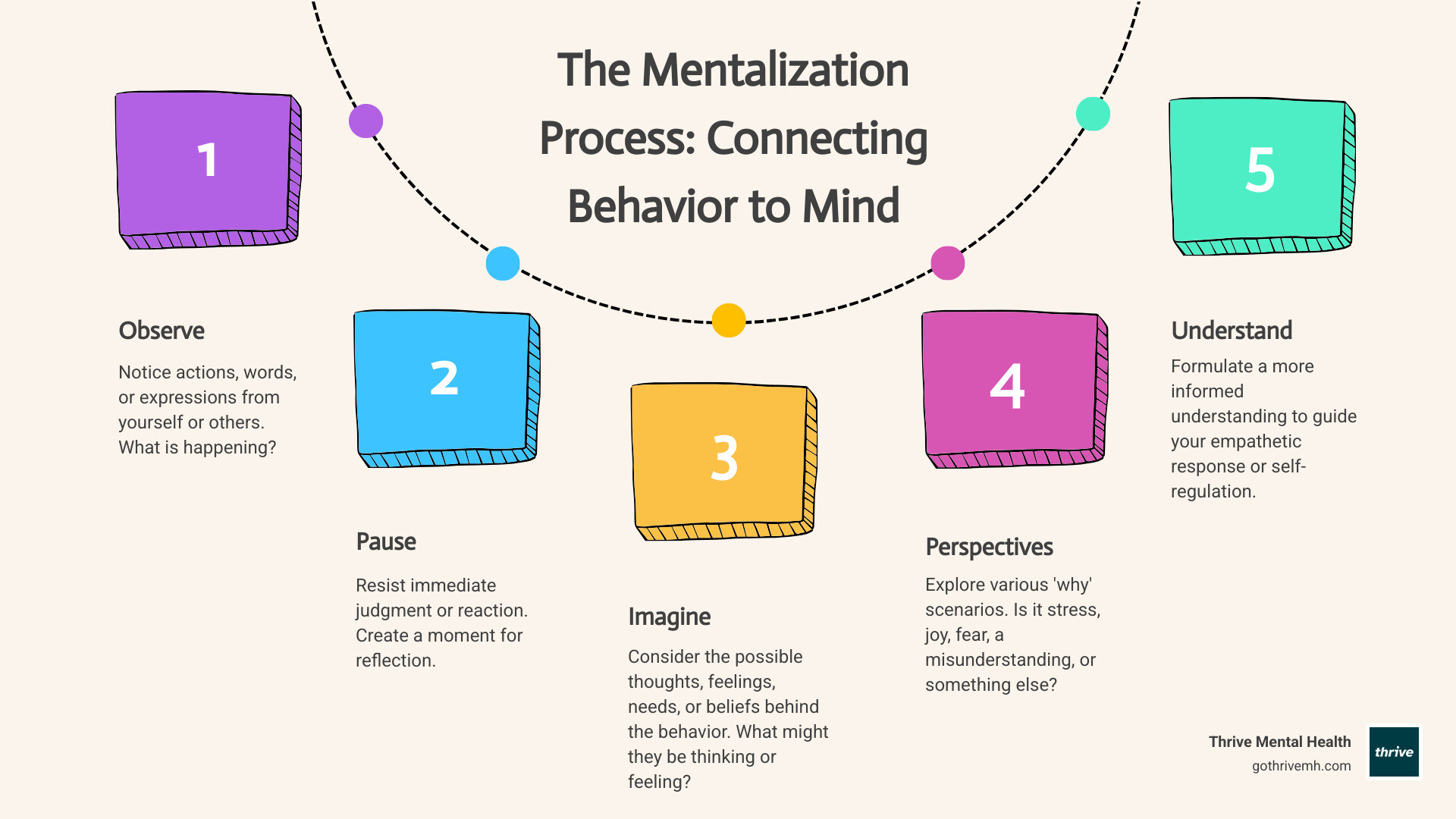
- Pause before you react. When you feel a surge of emotion, take a breath. Ask yourself: “What am I feeling? What story am I telling myself?” This creates space between feeling and reacting.
- Get curious instead of certain. Instead of assuming you know what someone is thinking, ask open-ended questions like, “Help me understand what that was like for you.”
- Check in with yourself. The better you understand your own mental landscape, the easier it is to steer others’. Try journaling or reflecting on your day.
- Brainstorm multiple explanations. If a coworker is quiet, don’t assume they’re mad. Consider other possibilities: maybe they’re stressed, tired, or preoccupied. This builds mental flexibility.
- Slow down when emotions are high. Mentalizing works best when we’re calm. In heated moments, consciously pace the conversation to allow for thoughtful responses.
- Get comfortable with not knowing. Mentalizing is about making educated guesses, not being psychic. The goal is curious exploration, not absolute certainty.
These skills are the foundation of healthy communication and can improve every area of your life.
Frequently Asked Questions about Mentalization
Let’s explore some common questions to better define mentalization and how it works.
How is mentalization measured?
Clinicians assess this complex skill using several methods. The gold standard is the Reflective Functioning Scale (RFS), which analyzes how people talk about their relationships and emotions, often during an Adult Attachment Interview.
Questionnaires are also used, such as the Parental Reflective Functioning Questionnaire (PRFQ) for parents, and self-report measures like the Mentalization Scale (MentS) or Reflective Functioning Questionnaire (RFQ).
What part of the brain is responsible for mentalization?
Mentalization doesn’t live in one spot; it relies on a network of brain regions working together. Key players include the medial prefrontal cortex (mPFC) for self-reflection and perspective-taking, the temporoparietal junction (TPJ) for distinguishing our mind from others’, and the temporal poles for integrating social information.
This network is highly sensitive to stress, which helps explain why mentalizing can be so easily disrupted. Recent research also shows that the neurotransmitter dopamine plays a direct role in our mentalizing abilities. Recent research on dopamine and mentalizing.
Can you have too much mentalization?
Yes. While good mentalization is healthy, it’s possible to overdo it. Hyper-mentalizing is when someone gets stuck in exhausting loops of over-analyzing what others might be thinking or feeling, often spinning elaborate theories from minor cues.
This can lead to anxious rumination or intrusive mentalizing, where a person becomes wrongly convinced they know exactly what’s in another’s mind. The goal is flexible, balanced mentalizing, staying curious and grounded in reality rather than getting lost in mental rabbit holes.
Conclusion
To define mentalization is to describe one of our most essential human abilities: understanding ourselves and others by looking beneath the surface of behavior. It’s the superpower that helps us steer relationships, manage emotions, and make sense of our social world.
This skill develops in our earliest relationships, can be disrupted by trauma, and is a cornerstone of mental health. When mentalization falters, it can lead to emotional dysregulation, impulsivity, and conflict, which is particularly evident in conditions like Borderline Personality Disorder.
But the most important takeaway is one of hope: mentalization is a skill that can be learned and strengthened at any stage of life. Through therapy like MBT or daily practices of self-reflection and curiosity, we can rebuild our capacity to understand minds, our own and others’.
At Thrive Mental Health, we know that healing happens in relationship and that building stronger mental health skills takes support. Our flexible intensive outpatient (IOP) programs are designed for adults and young professionals who want to develop these crucial abilities.
Our evidence-based approach is custom to your unique journey. Whether you’re struggling with relationship patterns, emotional regulation, or simply want to deepen your self-understanding, our expert-led programs can meet you where you are. With both virtual and in-person options throughout Florida, you can get the support you need in a way that works for you.
The ability to mentalize is a pathway to more fulfilling relationships and better emotional health. With the right support, this skill can transform how you experience yourself and connect with the world.
Contact us to learn how our programs in Florida can support your journey toward stronger mental health and deeper understanding.

This article is for informational purposes only and is not a substitute for individualized clinical advice or insurance verification.