
A Comprehensive Guide to Bilateral Stimulation Exercises for Trauma

Bilateral Stimulation Exercises for Trauma: 5 Reset Steps
Need a higher level of mental health care?
Thrive offers virtual IOP for adults across Florida, California, Indiana, Arizona, North Carolina, and South Carolina (Texas launching July 2026). Joint Commission accredited. In-network with major commercial carriers. Start with a free, confidential consultation — no pressure, no commitment.
Why Bilateral Stimulation Exercises for Trauma Are Your Brain’s Natural Healing Toolkit
Bilateral stimulation exercises for trauma are simple, rhythmic techniques that activate both sides of your brain to help process distressing memories and calm your nervous system. If you’re struggling with anxiety, flashbacks, or feeling “stuck” after a traumatic experience, these exercises offer a scientifically-backed way to find relief—at home or with a therapist.
Quick Answer: Core Bilateral Stimulation Exercises for Trauma
- The Butterfly Hug – Cross your arms over your chest and gently tap alternating shoulders.
- Alternating Foot Taps – Tap your feet left-right while sitting, focusing on the rhythm.
- Bilateral Eye Movements – Follow a moving object side-to-side with your eyes.
- Auditory Tones – Listen to alternating sounds through headphones (left ear, right ear).
- Rhythmic Walking – Take mindful walks, noticing the natural left-right pattern of your steps.
These techniques are a core part of EMDR therapy, where 84–90% of single-trauma survivors become PTSD-free after just three sessions. While self-guided exercises provide immediate stress relief, processing deep trauma safely requires professional guidance.
The Problem: Traumatic memories get “stuck,” triggering your fight-or-flight response even when you’re safe. This keeps you in a state of high alert that talk therapy alone can’t always resolve.
The Solution: Bilateral stimulation (BLS) engages both brain hemispheres through alternating sensory input (tapping, sounds, or movement). This mimics the brain’s natural processing during REM sleep, helping traumatic memories lose their emotional charge by increasing activation in brain regions linked to memory processing.
Here’s the critical distinction: Using BLS for everyday stress relief is different from using it to process deep trauma. Self-guided exercises are powerful for grounding and emotional regulation. However, attempting to reprocess traumatic memories alone can intensify distress or trigger flashbacks. The safest and most effective use of BLS for deep healing is within EMDR therapy, guided by a trained clinician.
This guide will teach you how bilateral stimulation exercises for trauma work, show you 5 techniques you can try now, and explain when professional support is essential. You’ll learn what works, what’s safe, and what to avoid.
As the CEO of Thrive Mental Health, I’ve seen thousands of clients, particularly across our Florida locations, achieve lasting healing through our evidence-based trauma programs, which integrate BLS as part of comprehensive, outcome-focused care. Let’s explore how these techniques can help you.
What is Bilateral Stimulation and How Does It Rewire a Traumatized Brain?
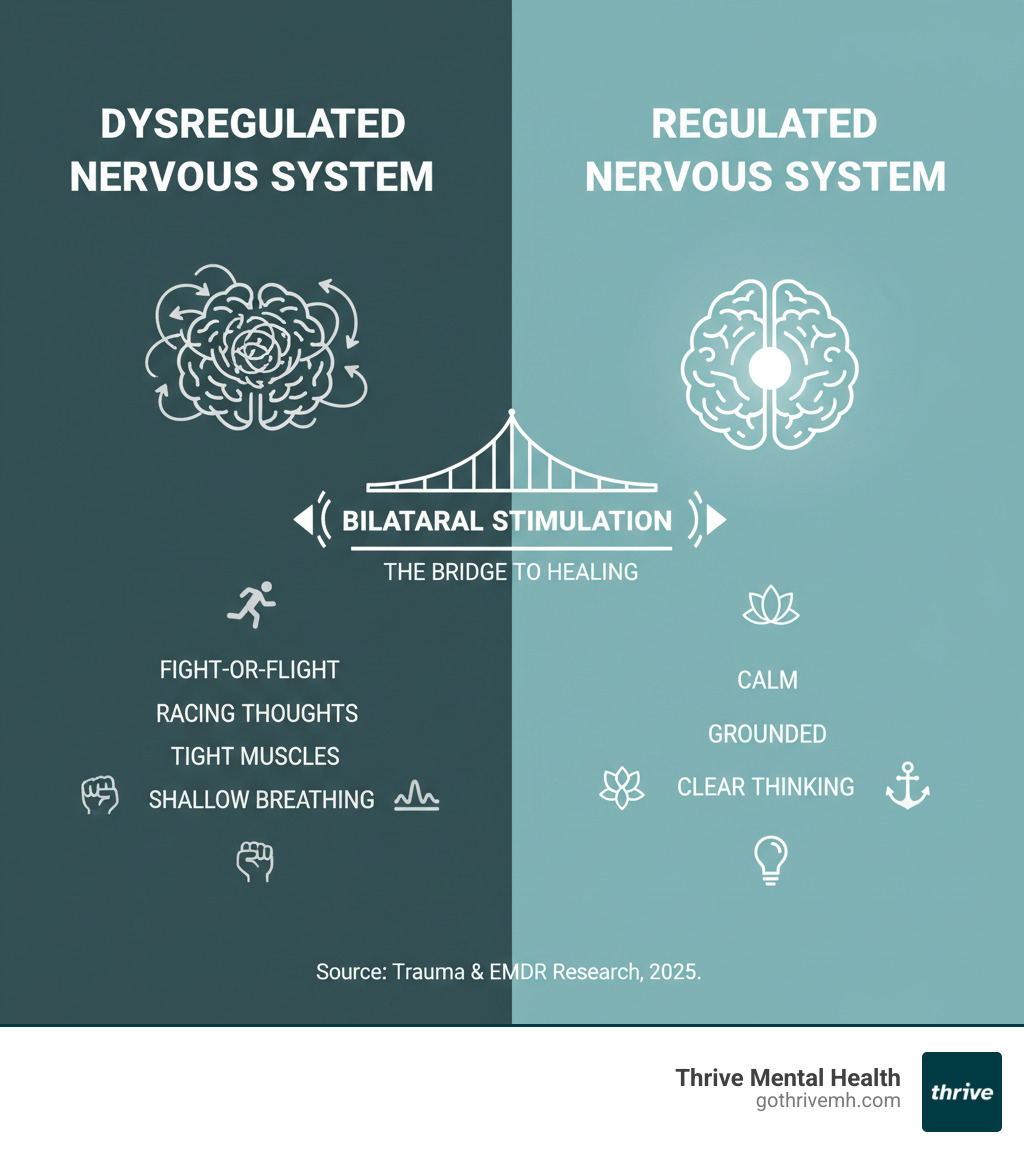
Bilateral stimulation (BLS) is your brain’s natural “sync” button. Trauma disrupts your brain’s filing system, leaving memories and emotions stuck and your nervous system on high alert. Bilateral stimulation exercises for trauma restore order by engaging both sides of your brain through simple, rhythmic patterns like alternating taps, sounds, or eye movements.
Unlike simple distraction, BLS activates sophisticated healing mechanisms. Trauma can disrupt communication between your brain’s logical left hemisphere and emotional right hemisphere. You might know you’re safe, but your body feels terrified. BLS acts as a bridge, helping these two sides coordinate again. Research published in PubMed shows that rhythmic stimulation supports both cognitive function and emotional regulation, similar to the natural processing that occurs during REM sleep.
This process also involves working memory taxation. When you focus on a distressing memory while doing BLS, your brain’s temporary workspace gets occupied. This “taxes” the system, leaving less capacity to hold onto the vivid emotional charge of the trauma. The memory doesn’t disappear, but it loses its overwhelming power.
BLS also activates your parasympathetic nervous system—the “rest and digest” mode—which calms the “fight or flight” response. This gentle, predictable rhythm signals safety, helping your body shift out of high alert. This process leverages neuroplasticity, your brain’s ability to adapt, by strengthening and creating new neural pathways around the ones trauma created.
A study in PLOS ONE found that BLS significantly altered activation patterns in the limbic system (emotions and memory), prefrontal cortex (executive control), and amygdala (fear alarm), all of which are crucial for healing.
How BLS Calms Your “Fight or Flight” Response
If you’ve experienced trauma, you know the exhausting feeling of being constantly on edge (hyperarousal). Your amygdala, the brain’s threat detector, becomes overactive. BLS helps calm this alarm system, reducing fear and anxiety. The rhythmic input can also stimulate the vagus nerve, your body’s main pathway for activating calm.
This process helps reduce hypervigilance—the constant scanning for threats—allowing you to feel safer and be more present. Because trauma is stored in the body (somatic experience), BLS helps release physical tension like tight shoulders or a clenched jaw. Many BLS exercises also serve as powerful grounding techniques, anchoring you to the present moment when you feel overwhelmed.
The Critical Link Between Bilateral Stimulation and EMDR Therapy
While you can use bilateral stimulation exercises for trauma for self-soothing, their most powerful application is within Eye Movement Desensitization and Reprocessing (EMDR) therapy. EMDR is a first-line PTSD treatment recommended by the World Health Organization and the American Psychological Association.
EMDR is based on the Adaptive Information Processing (AIP) model, which posits that trauma can overwhelm the brain’s natural ability to heal, leaving memories “stuck.” BLS is the engine that helps unstick these memories. In EMDR, a therapist guides you to focus on a distressing memory while engaging in BLS. This dual attention helps your brain reprocess the memory, moving it from a raw, emotionally charged state to a less disturbing one.
Through desensitization, the memory loses its power to trigger intense distress. EMDR is more than just eye movements; it’s an 8-phase protocol that includes history-taking, coping skills, and systematic processing. The therapist’s guidance is essential for safety and effectiveness. Studies show that after just a few sessions, a high percentage of trauma survivors no longer meet PTSD criteria.
At Thrive Mental Health, we integrate EMDR into our specialized programs across Florida, offering both virtual and in-person Intensive Outpatient Programs to provide the structured support needed for deep healing. We also serve clients in California, Indiana, Arizona, and South Carolina.
5 Simple Bilateral Stimulation Exercises for Trauma You Can Do Right Now
These bilateral stimulation exercises for trauma are your emotional first-aid kit, perfect for moments of high anxiety or stress. They are powerful for immediate self-soothing and emotional regulation, helping you feel calmer and more present. However, they are not designed for processing deep, unresolved trauma on your own, which requires professional guidance.
Safety First: If any exercise brings up intense distress or flashbacks, stop gently. Try a simple grounding technique, like naming five objects you see. Consistent overwhelm is a signal to seek professional support. At Thrive Mental Health, we offer specialized virtual and in-person programs across Florida designed for this.
Here are five techniques you can try right now.
The Butterfly Hug: A Step-by-Step Guide

This widely used self-soothing technique is gentle, discreet, and effective for a racing mind.
- Cross your arms over your chest, with the tips of your middle fingers resting just below your collarbone on the opposite side.
- Begin alternating gentle taps—left hand, right hand—in a steady, comfortable rhythm that feels soothing.
- Breathe slowly and deeply as you tap. Observe any thoughts or feelings without judgment. Continue for one to five minutes, or until you feel calmer.
Auditory BLS: Using Sound to Center Yourself
Auditory BLS uses alternating sounds to quiet a racing mind. You’ll need headphones for the full effect.
- Listen to bilateral audio tracks, which are designed with sounds or music that pan from one ear to the other. You can find free options online, like this auditory BLS track, to reduce mental chatter.
- Create your own playlist with music that has strong left-right channel separation or rhythmic, alternating beats.
Rhythmic Movement: How Walking and Running Process Stress

Walking and running are forms of natural bilateral stimulation exercises for trauma. The alternating movement of your arms and legs helps shift your nervous system out of fight-or-flight mode.
- Mindful Walking: Choose a quiet route and focus on the sensation of your feet on the ground and the rhythm of your breath. Even a 10-minute walk can make a difference.
- Running: PTSD UK notes that running induces a mindful state that helps process emotions and manage stress by decreasing hyperarousal and releasing endorphins.
Visual Stimulation: Eye Movements
This is the form of BLS most associated with EMDR. For self-soothing, you can try a simple version.
- Pick two points in your environment (e.g., the left and right edges of a wall) and smoothly move your eyes back and forth between them.
- Use online tools or apps that display a moving dot for you to follow with your eyes.
The movement should be comfortable, not strained. Take breaks if your eyes get tired.
Tactile Stimulation: Tapping on Thighs or Shoulders
Beyond the Butterfly Hug, you can use other forms of tactile BLS.
- Alternating hand taps on your thighs is a great option when sitting. Simply tap your left hand on your left thigh, then your right hand on your right thigh, in a gentle rhythm.
- Shoulder taps (using each hand to tap the shoulder on the same side) are another simple variation.
- Wearable technology like handheld devices or wristbands can also provide alternating vibrations for discreet stimulation.
These are tools for immediate relief. For deep-seated trauma, professional support is essential.
When Self-Help Isn’t Enough: Why Professional EMDR Therapy is Crucial for Deep Healing
Bilateral stimulation exercises for trauma are powerful for calming your nervous system, but they are not a substitute for trauma therapy. Think of self-guided BLS as first aid for symptoms; it helps you regulate in the moment but doesn’t heal the underlying injury.
Attempting to process deep trauma alone can be risky:
- Emotional Intensification: Without a therapist, focusing on traumatic memories can feel like opening a floodgate, leading to overwhelm and potential retraumatization.
- Resurfacing Memories: BLS can open up repressed or forgotten memories. A therapist helps you process these safely, but on your own, you may feel flooded and unable to cope.
- Dissociation: This is a serious risk, especially with complex trauma. A trained therapist can recognize the signs and bring you back to safety, preventing a frightening or destabilizing experience.
- Contraindications: Unsupervised BLS can be risky if you have epilepsy, a recent TBI, severe dissociative disorders, or other specific medical conditions. Always consult a healthcare provider if you have concerns.
If you’re dealing with severe trauma, complex PTSD, or chronic anxiety, or if traumatic memories consistently interfere with your life, it’s time for professional help. For residents of Florida, Thrive Mental Health offers specialized virtual and in-person Intensive Outpatient (IOP) and Partial Hospitalization (PHP) programs that provide more support than weekly therapy. Learn more about our Florida-based programs here.
Finding a Qualified EMDR Therapist
When seeking an EMDR therapist, look for EMDRIA certification, the gold standard from the EMDR International Association. Ask potential therapists about their experience with trauma and their specific approach to EMDR. A strong therapeutic alliance—a sense of trust and connection—is just as important as credentials.
Many insurance plans, including Florida Blue, Cigna, and Optum, cover EMDR therapy. Thrive Mental Health is proud to be an in-network provider in Florida, working with these and other major insurers to make treatment accessible. We also serve clients in California, Indiana, Arizona, and South Carolina.
What to Expect from Bilateral Stimulation Exercises for Trauma in a Therapy Session

EMDR therapy is a structured 8-phase protocol that uses BLS safely and effectively.
- History Taking: Your therapist learns your background and identifies target memories for processing.
- Preparation: You learn coping skills and grounding techniques, like a “safe place” visualization, to ensure you have an emotional safety net.
- Assessment: You and your therapist identify a specific target memory, including the negative belief, emotions, and body sensations attached to it.
- Desensitization: While holding the memory in mind, you engage in BLS (eye movements, tapping, or tones). The therapist guides you in sets, allowing your brain to process the memory until its emotional charge fades.
- Installation: BLS is used to strengthen a positive belief, such as “I am safe now” or “I am strong.”
- Body Scan: You check for any lingering physical tension, which can be released with more BLS.
- Closure: This phase ensures you leave the session feeling grounded and stable.
- Reevaluation: At the next session, you and your therapist check that the healing is holding and determine the next steps.
Throughout this process, your therapist monitors your nervous system to keep you within your “window of tolerance,” ensuring you can process difficult material without becoming overwhelmed. This expert guidance is what makes EMDR a profound healing experience.
Frequently Asked Questions about Bilateral Stimulation
Does bilateral stimulation work without formal EMDR therapy?
Yes, for calming the nervous system, reducing immediate stress, and grounding yourself. Self-guided exercises like the Butterfly Hug are excellent for managing day-to-day anxiety. However, for processing the root of significant trauma, BLS should only be used within the structured, safe framework of EMDR therapy with a trained professional.
How long should I practice self-guided bilateral stimulation?
For self-soothing, short sessions of 1-5 minutes are ideal. The goal is to gently guide your nervous system toward calm, not to push through discomfort. Consistency is more important than duration. If you feel overwhelmed, dizzy, or fatigued, stop and try a different grounding technique, like the 5-4-3-2-1 method.
Can bilateral stimulation make anxiety worse?
When used for self-soothing, BLS should reduce anxiety. However, attempting to process deep-seated trauma on your own with BLS can intensify emotions and feel overwhelming, potentially making anxiety worse. This is why deep trauma processing requires a qualified EMDR therapist who can create a safe environment for healing.
If you’re dealing with significant trauma or find that self-guided practices increase your distress, it’s a sign to seek professional support. Thrive Mental Health offers specialized virtual and in-person IOP and PHP programs across Florida that integrate EMDR. Learn more about our Florida mental health support programs or call our Florida-based team at 561-203-6085 to verify your insurance in minutes.
If you’re in crisis right now, please call or text 988. You are not alone, and immediate support is available.
Conclusion: Take the Next Step Toward Healing
You’ve learned how bilateral stimulation exercises for trauma can be a powerful tool for your well-being. Techniques like the Butterfly Hug and mindful walking offer real, in-the-moment relief from stress and anxiety. They are invaluable for emotional regulation.
But self-help has its limits. For the deep work of healing trauma—reprocessing memories, calming flashbacks, and resolving the anxiety that colors your life—you need more than a technique. You need the safety, structure, and expert guidance of professional EMDR therapy.
Thrive Mental Health was created to make effective trauma treatment accessible, with a primary focus on serving communities throughout Florida. Our virtual and in-person IOP and PHP programs offer evidence-based care, including EMDR, with flexible scheduling that fits your life. We are in-network with major insurance providers in Florida, including Florida Blue, Cigna, and Optum.
Healing is a journey, and you don’t have to walk it alone. Taking the step to get professional support can be the difference between managing symptoms and achieving true, lasting recovery.
Ready for support in Florida? Thrive offers virtual and hybrid IOP/PHP programs with evening options. Verify your insurance in 2 minutes (no obligation) → Start your Florida benefits check or call our Florida admissions team at 561-203-6085. If you’re in crisis, call/text 988.
