
Ready for Change? Discover Adult Intensive Outpatient Programs Near You

Why an Adult Intensive Outpatient Program Near Me Could Be Your Fastest Path Forward
Adult intensive outpatient program near me is one of the most searched mental health terms for a reason: people are stuck. They’ve tried weekly therapy. It’s not enough. But they can’t—or don’t want to—put their life on pause for inpatient care.
If that’s you, here’s what you need to know right now:
Quick Answer: What Is an Adult IOP and Where Can I Find One?
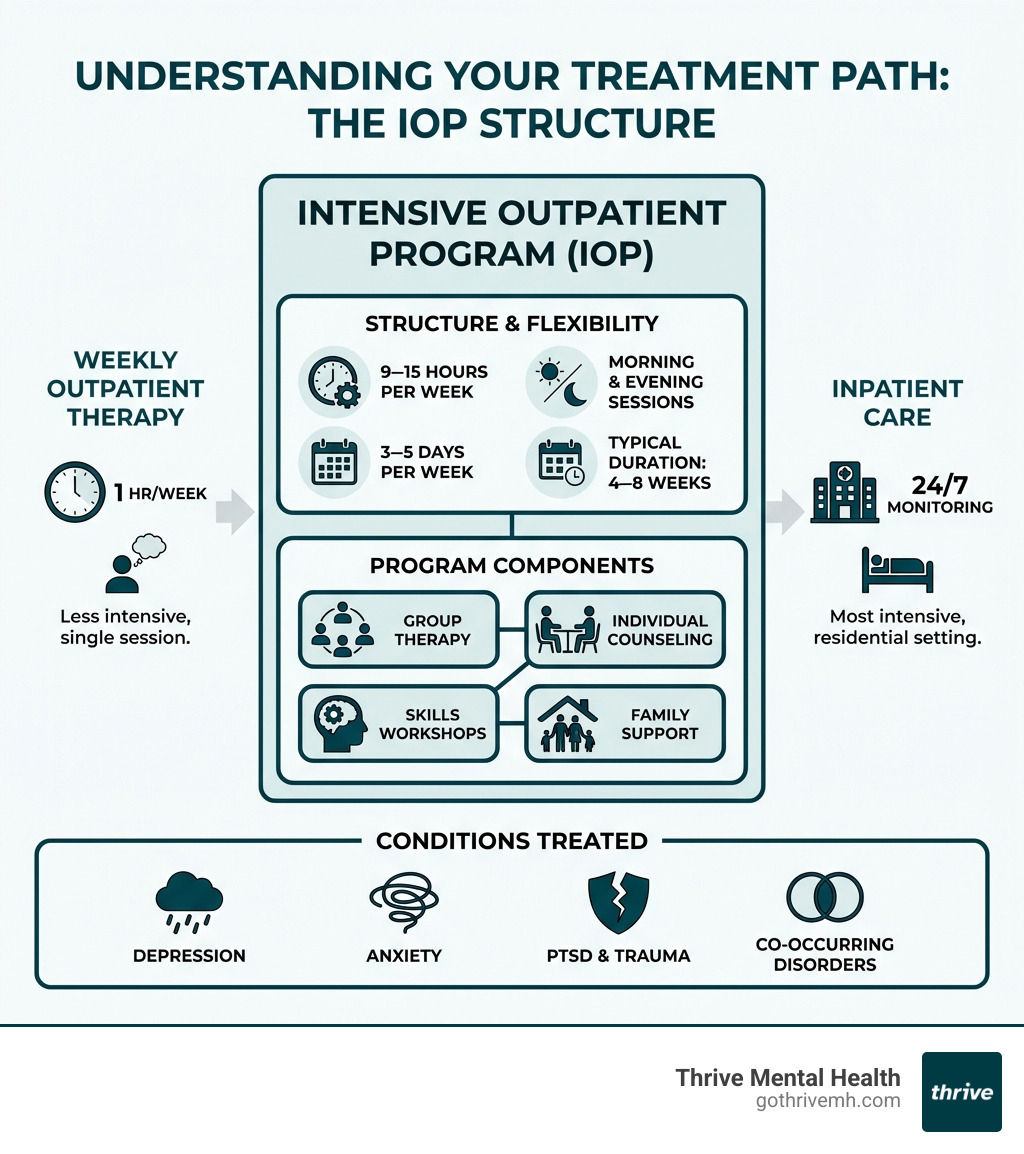
- What it is: Structured mental health treatment (9–15 hours/week) that lets you live at home and keep working or going to school
- Who it’s for: Adults with depression, anxiety, PTSD, trauma, or co-occurring disorders who need more than weekly therapy but don’t need 24/7 care
- Where to find it: Thrive Mental Health offers virtual and in-person IOPs throughout Florida
- Cost: Most major insurance plans (Cigna, Optum, Aetna, BCBS, Florida Blue) cover IOP—verify your benefits in 2 minutes
- Schedule: Morning or evening sessions, 3–4 days/week, typically 4–8 weeks
- Start time: Admission can begin in as little as 24 hours
IOPs work because they give you real support, real structure, and real results—without requiring you to drop everything. You’ll get evidence-based therapies like CBT, DBT, and EMDR. You’ll work with a clinical team that actually gets it. And you’ll build skills that stick, not just talk about your feelings once a week.
I’m Nate Raine, CEO of Thrive Mental Health, and I’ve spent over a decade building behavioral health systems that integrate data, clinical excellence, and real-world access to care—including the high-performing IOP/PHP programs we offer across Florida. If you’re searching for an adult intensive outpatient program near me, this guide will show you exactly what to expect, who it’s for, and how to get started.
Key terms for adult intensive outpatient program near me:
- Which intensive outpatient programs offer flexible scheduling?
- What are the top intensive outpatient programs for anxiety treatment?
- dbt intensive outpatient programs near me
What Is an Adult Intensive Outpatient Program (IOP)? [The Fast Lane Between Weekly Therapy and Inpatient Care]
An Adult Intensive Outpatient Program (IOP) is a structured mental health treatment program that provides a higher level of care than traditional weekly therapy sessions, but without requiring you to live at a facility. Think of it as the sweet spot for intensive healing that fits into your everyday life.
IOP Defined: More Support Than Weekly Therapy, Less Disruption Than Inpatient.
At its core, an adult intensive outpatient program near me offers comprehensive psychiatric treatment and services designed to foster positive behavioral changes. Unlike a single weekly therapy session, an IOP involves multiple hours of therapy per week, delivered through a combination of group, individual, and sometimes family sessions. This increased frequency and intensity allow for deeper therapeutic work and skill development. It’s about getting the support you need to make significant progress without putting your life entirely on hold.
Step-Up/Step-Down Care: Perfect if You Need More Than Talk Therapy, But Don’t Need 24/7 Supervision.
IOPs play a crucial role in the continuum of mental health care. They are often a “step-up” for individuals who find that traditional outpatient therapy isn’t enough to manage their symptoms or achieve their treatment goals. If you’re struggling with daily life, experiencing increased symptoms, or finding it hard to implement coping strategies learned in less intensive settings, an IOP can provide that necessary boost.
Conversely, IOPs also serve as a “step-down” from higher levels of care, such as inpatient hospitalization or Partial Hospitalization Programs (PHP). For someone transitioning out of a more restrictive environment, an IOP offers continued, structured support while they reintegrate into their home, work, or school routines. This transitional care is vital for maintaining stability and preventing relapse.
Structure + Flexibility: 9–15 Hours/Week, 3–5 Days/Week. Keep Your Job, Stay at Home, Get Real Help.
One of the greatest advantages of an adult intensive outpatient program near me is its inherent flexibility. While intensive, these programs are specifically designed to accommodate your existing responsibilities. Most IOPs involve anywhere from nine to 15 hours of therapy weekly, usually spread across three to five days.
This schedule allows you to live at home, continue with your job, attend school, or care for your family while receiving robust mental health treatment. Many programs offer morning or evening sessions to fit diverse schedules. This balance between intensive care and real-world integration is key to practicing new coping skills in everyday situations, leading to more sustainable recovery.
To learn more about how IOPs fit into the broader spectrum of mental health care, explore our guide: What’s an IOP?
Why IOPs Work When Weekly Therapy Isn’t Enough
If you’ve been in weekly therapy and feel like you’re just treading water, an IOP offers a more immersive and impactful experience.
- Group Therapy: Real support from people who get it. Group sessions are a cornerstone of IOPs, offering a powerful dynamic where you connect with peers facing similar challenges. You’ll share experiences, gain new perspectives, and practice interpersonal skills in a safe, supportive environment. This shared journey can significantly reduce feelings of isolation and build a strong sense of community.
- Individual Counseling: One-on-one breakthroughs. Alongside group sessions, you’ll engage in individual therapy with a dedicated clinician. This personalized attention allows for deeper exploration of your specific issues, development of custom coping strategies, and ongoing support for your unique recovery path.
- Skills Workshops: Learn, practice, repeat—see results fast. IOPs are highly focused on skill-building. You’ll participate in psychoeducational groups and workshops where you learn and practice evidence-based techniques for managing emotions, improving relationships, handling stress, and preventing relapse. The intensive nature means you apply these skills in real-time between sessions, solidifying your progress.
For a deeper dive into the advantages, see: The Benefits of an Intensive Outpatient Program
Is an IOP Right for You? [Who Needs Intensive Outpatient Care—And Who Doesn’t]
Deciding if an adult intensive outpatient program near me is the right choice can feel overwhelming. It’s a significant step, but understanding who benefits most can help clarify your path forward.
![Person looking out a window, considering change | Alt text: “Considering an adult intensive outpatient program near me”]
If you’re in crisis or having thoughts of self-harm, call or text 988 right now. You are not alone.
Conditions Treated in Adult IOPs
Adult IOPs are designed to treat a wide range of mental health conditions that disrupt daily functioning. These programs are effective for individuals experiencing moderate to severe symptoms that haven’t responded sufficiently to less intensive treatments.
Common conditions addressed include:
- Depression: For those experiencing persistent low mood, loss of interest, or significant impairment in daily life. IOP for Depression can provide the intensive support needed.
- Anxiety disorders: Including generalized anxiety disorder, panic disorder, and social anxiety, where overwhelming worry or fear impacts functioning.
- PTSD & Trauma: For individuals struggling with the aftermath of traumatic experiences, including post-traumatic stress disorder. Our programs offer specialized approaches to help process and heal from Trauma.
- Bipolar disorder: To help stabilize mood swings, manage symptoms, and develop coping strategies for both manic and depressive episodes.
- Obsessive-Compulsive Disorder (OCD): Providing structured therapy to manage intrusive thoughts and compulsive behaviors, often utilizing specialized techniques like ERP. Learn more about Obsessive-Compulsive Disorder (OCD).
- Personality disorders: Such as Borderline Personality Disorder, where DBT is often a core component of treatment.
- Eating disorders: For individuals needing structured support around disordered eating patterns and body image issues, without requiring 24/7 supervision.
Who’s a Good Fit for an IOP?
An IOP is ideal for adults who:
- Are struggling with daily life, work, or relationships: If your mental health challenges are significantly impacting your ability to function in these areas, but you can still maintain some level of independence.
- Are not improving with weekly therapy alone: You’ve tried traditional outpatient counseling, but your symptoms persist or worsen, indicating a need for more intensive intervention.
- Have recently been discharged from a higher level of care: Such as an inpatient program or PHP, and need continued structured support to transition back to daily life.
- Are motivated for change, have stable housing, and are not in immediate crisis: IOP requires your active participation and a safe home environment. It’s not suitable if you are actively suicidal, experiencing psychosis, or need constant supervision.
For more insights into whether an IOP is right for you, read: Top Reasons to Consider an Intensive Outpatient Program
How IOPs Treat Co-Occurring Disorders (Dual Diagnosis)
Many individuals experience both a mental health disorder and a substance use disorder simultaneously. This is often referred to as a “dual diagnosis” or “co-occurring disorders.” IOPs are uniquely equipped to treat these complex cases through an integrated approach.
- Integrated mental health + substance use care: Instead of treating each condition separately, IOPs address them concurrently. This means therapy for depression might be woven into discussions about relapse prevention, recognizing that these issues are often intertwined.
- Address root causes, not just symptoms: By providing comprehensive treatment, IOPs help you explore the underlying factors contributing to both your mental health challenges and substance use patterns, leading to more holistic and sustainable recovery.
Our programs, including virtual options, are designed to support individuals with dual diagnoses. Learn more about our approach to Areas of Care: Virtual IOP/Dual Diagnosis.
IOP vs. Other Mental Health Programs: What’s the Real Difference?
Understanding the different levels of mental health care can be confusing. Here’s a clear breakdown of where an adult intensive outpatient program near me fits in, especially compared to Partial Hospitalization Programs (PHP) and traditional outpatient therapy.
| Level of Care | Time Commitment | Where You Live | Clinical Intensity | Best For… |
|---|---|---|---|---|
| PHP | 5–6 hrs/day | Home | High | Step-down from higher care, severe symptoms |
| IOP | 3–4 hrs/day | Home | Moderate | Need more than weekly therapy |
| Outpatient | 1 hr/week | Home | Low | Mild symptoms, maintenance |
PHP vs. IOP: Which Is Right for You?
The main distinction between a PHP and an IOP lies in the intensity and time commitment.
- PHP: More hours, more structure, for severe symptoms. A Partial Hospitalization Program (PHP) is a step above an IOP. It typically involves treatment for 5-6 hours a day, five days a week. PHPs offer a high level of clinical intensity, often serving as a direct step-down from inpatient care for individuals with more severe symptoms who still require significant daily support but can return home at night. If you’re looking for an adult intensive outpatient program near me and your symptoms are very disruptive, a PHP might be the more appropriate starting point.
- IOP: Flexible, for moderate symptoms or step-down care. As we’ve discussed, IOPs offer a moderate level of intensity, usually 3-4 hours a day, three to five days a week. This allows for greater flexibility and is ideal for those whose symptoms are stable enough to manage daily responsibilities, or for individuals stepping down from a PHP.
We’ve written a detailed guide to help you differentiate these two crucial levels of care: What is the Difference Between PHP and IOP? For a comprehensive overview of PHP, see our PHP Mental Health Ultimate Guide.
Inside an Adult Intensive Outpatient Program: What to Expect
When you commit to an adult intensive outpatient program near me, you’re signing up for a structured yet dynamic experience designed to accelerate your healing. Here’s a glimpse into what a typical program entails.
![Therapist leading a small group, in-person or virtual | Alt text: “Inside an adult intensive outpatient program near me at Thrive”]
Your Weekly Schedule & Program Length
Flexibility is a hallmark of IOPs. While the intensity is higher than traditional therapy, the scheduling is designed to integrate with your life.
- 3-hour sessions, 3–4 days/week: Most IOPs involve sessions that last around three hours, three to four days per week. This structure ensures consistent engagement and progress.
- Morning or evening options—work, school, and family friendly: Many providers, including Thrive Mental Health, offer both morning and evening tracks. This means you can attend sessions before work or school, or after your daytime responsibilities are complete, making it possible to maintain your commitments while prioritizing your mental health.
- Most programs: 4–8 weeks, custom to your needs: The typical duration for an IOP ranges from four to eight weeks, though some programs may extend to 12 weeks or more depending on individual needs and progress. Your treatment plan will be individualized, and the length of your program will be determined by your specific goals and clinical recommendations.
For a deeper understanding of program durations, refer to our Intensive Outpatient Program Duration Guide.
Evidence-Based Therapies You’ll Get
IOPs use a variety of scientifically-backed therapeutic approaches to provide effective treatment. At Thrive, we prioritize modalities proven to deliver results.
- CBT (Cognitive Behavioral Therapy): Helps you identify and change negative thought patterns and behaviors that contribute to your distress.
- DBT (Dialectical Behavior Therapy): Focuses on emotional regulation, distress tolerance, interpersonal effectiveness, and mindfulness skills.
- EMDR (Eye Movement Desensitization and Reprocessing): Particularly effective for processing trauma and reducing its emotional impact.
- Somatic Experiencing: Helps you release trauma held in the body, promoting nervous system regulation.
- Art Therapy: Offers a creative outlet for expressing emotions and processing experiences that might be difficult to articulate verbally.
- Group and individual sessions: You’ll engage in both group therapy, which fosters peer support and shared learning, and individual sessions for personalized attention.
These modalities are often combined with psychoeducation, teaching you about your condition and effective management strategies. For a comprehensive look at the therapies offered, check out our Treatment Modalities: Virtual IOP page.
Family Therapy & Support Systems
Mental health challenges often impact the entire family system. Recognizing this, many IOPs, including ours, integrate family involvement into the treatment process.
- Family involvement = better outcomes: Research consistently shows that when family members are involved in a loved one’s treatment, outcomes are significantly improved. Family therapy provides a safe space to address communication breakdowns, set healthy boundaries, and build a stronger support network.
- Build communication, heal relationships, strengthen your support network: Through guided sessions, families can learn new ways to communicate, understand the nature of the mental health condition, and develop strategies to support recovery effectively. This not only aids the individual in treatment but also strengthens the family unit as a whole.
Explore how we incorporate family support: Family Therapy and Coaching Virtual IOP.
Life After IOP: What Happens Next?
Completing an IOP is a significant achievement, but it’s not the end of the journey. Effective aftercare planning is crucial for maintaining your progress and preventing relapse.
- Aftercare planning, relapse prevention, step-down to outpatient: Before you complete the program, your clinical team will work with you to develop a personalized aftercare plan. This might involve transitioning to less intensive weekly outpatient therapy, continuing with individual counseling, or engaging in specialized follow-up groups. The focus is on equipping you with strategies for long-term symptom management and relapse prevention.
- Alumni programs, community resources: Many providers offer alumni programs or connect you with community resources to ensure ongoing support. These networks provide a sense of belonging and continued accountability, which are vital for sustained recovery.
Your journey to lasting wellness is important to us. Learn more about ongoing support with our Mental Health Recovery Program.
How to Find and Pay for an Adult Intensive Outpatient Program in Florida
Finding the right adult intensive outpatient program near me means knowing where to look and how to steer the financial aspects. At Thrive Mental Health, we aim to make this process as straightforward as possible for our clients in Florida.
![Person searching for IOPs on a laptop | Alt text: “Searching for an adult intensive outpatient program near me in Florida, California, Indiana, Arizona, or South Carolina”]
How to Find an IOP Near You
Your search for an adult intensive outpatient program near me can start in several places:
- Use Thrive’s Intensive Outpatient Programs page: We provide comprehensive information about our virtual and in-person IOPs available throughout Florida.
- Ask your therapist or doctor for a referral: Your current mental health professional or primary care physician can offer valuable recommendations based on your specific needs and local resources.
- Search by location: You can look for guides specific to your area, such as our Miami Adult IOP Guide. We offer services throughout Florida, including Tampa Bay, St. Petersburg, Orlando, Boca Raton, West Palm Beach, Jacksonville, Fort Lauderdale, Naples, and Sarasota.
Virtual IOPs: Get Help from Anywhere—No Commute, No Excuses
For many, a virtual Intensive Outpatient Program (IOP) is a game-changer. It offers the same high-quality, evidence-based treatment as in-person programs, with added benefits.
- Telehealth = privacy, flexibility, access from home: Virtual IOPs allow you to receive intensive therapy from the comfort and privacy of your own home, eliminating commute times and geographical barriers. This is especially beneficial for individuals in rural areas or those with limited transportation.
- Evening and weekend options: Just like our in-person programs, virtual IOPs often provide flexible scheduling, including evening and weekend sessions, to fit around your work, school, or family commitments.
- Measurable results: Research shows virtual IOPs are just as effective as in-person programs, delivering comparable outcomes in symptom reduction and skill acquisition.
Find the convenience and effectiveness of a Virtual Intensive Outpatient Program Near Me. See how this innovative approach is changing care: How Virtual IOP is Revolutionizing the Industry: A Detailed Demo.
Insurance & Costs: What You Need to Know
The cost of an IOP is a common concern, but most intensive outpatient programs are covered by insurance.
- Most IOPs accept major insurance: Thrive Mental Health works with many leading insurance providers, including Cigna, Optum, Aetna, Blue Cross Blue Shield, United Healthcare, and Florida Blue. We believe in making quality care accessible.
- Free insurance verification—know your costs up front: We offer a free, no-obligation insurance verification process. This allows you to understand your specific benefits, deductibles, and out-of-pocket costs before committing to a program.
- How to read your benefits: Understanding your mental health insurance benefits can be complex. We can help you steer this process.
Get started with understanding your coverage: Virtual IOP Insurance. For general guidance on deciphering your policy, read: How to Read Mental Health Insurance Benefits.
FAQs: Adult Intensive Outpatient Program Near Me
Can I keep my job or go to school during IOP?
Yes. Thrive’s IOPs offer morning and evening sessions so you don’t have to choose between recovery and your responsibilities.
How much does an IOP cost with insurance?
Costs vary, but most major plans (Cigna, Aetna, BCBS, Optum, Florida Blue) cover IOP. Verify your insurance in 2 minutes.
How fast will I see results?
Most people notice progress within the first 2–4 weeks. Consistent attendance = faster results.
What’s the main goal of an IOP?
Stabilize symptoms, build real-life coping skills, and get you back to living—not just surviving.
Is virtual IOP as effective as in-person?
Yes. Research shows virtual IOPs deliver results equal to in-person care, with added convenience and privacy.
Summary: Why Choose an Adult Intensive Outpatient Program Near Me?
An adult intensive outpatient program near me offers a powerful solution for individuals seeking robust mental health support without the disruption of inpatient care. These programs provide flexible scheduling, evidence-based therapies, and crucial skill-building, all while allowing you to maintain your daily life. Whether you’re dealing with depression, anxiety, trauma, or co-occurring disorders, an IOP can stabilize symptoms, foster coping mechanisms, and pave the way for lasting recovery. Thrive Mental Health is dedicated to making this high-quality treatment accessible through our virtual and in-person IOPs across Florida.
Ready for support? Thrive offers virtual and hybrid IOP/PHP programs with evening options. Verify your insurance in 2 minutes (no obligation) → Start benefits check or call 561-203-6085. If you’re in crisis, call/text 988.