
The Ultimate Guide to Betrayal Trauma Recovery Stages

Betrayal Trauma Recovery Stages: 5 Steps to Heal
Why Understanding Betrayal Trauma Recovery Stages Can Save You Years of Pain
When someone you deeply trust—a partner, spouse, or parent—shatters that trust, the pain is unlike any other. This is betrayal trauma, and it strikes at the core of your safety, leaving you questioning everything. Understanding the betrayal trauma recovery stages is the first step to reclaiming your life.
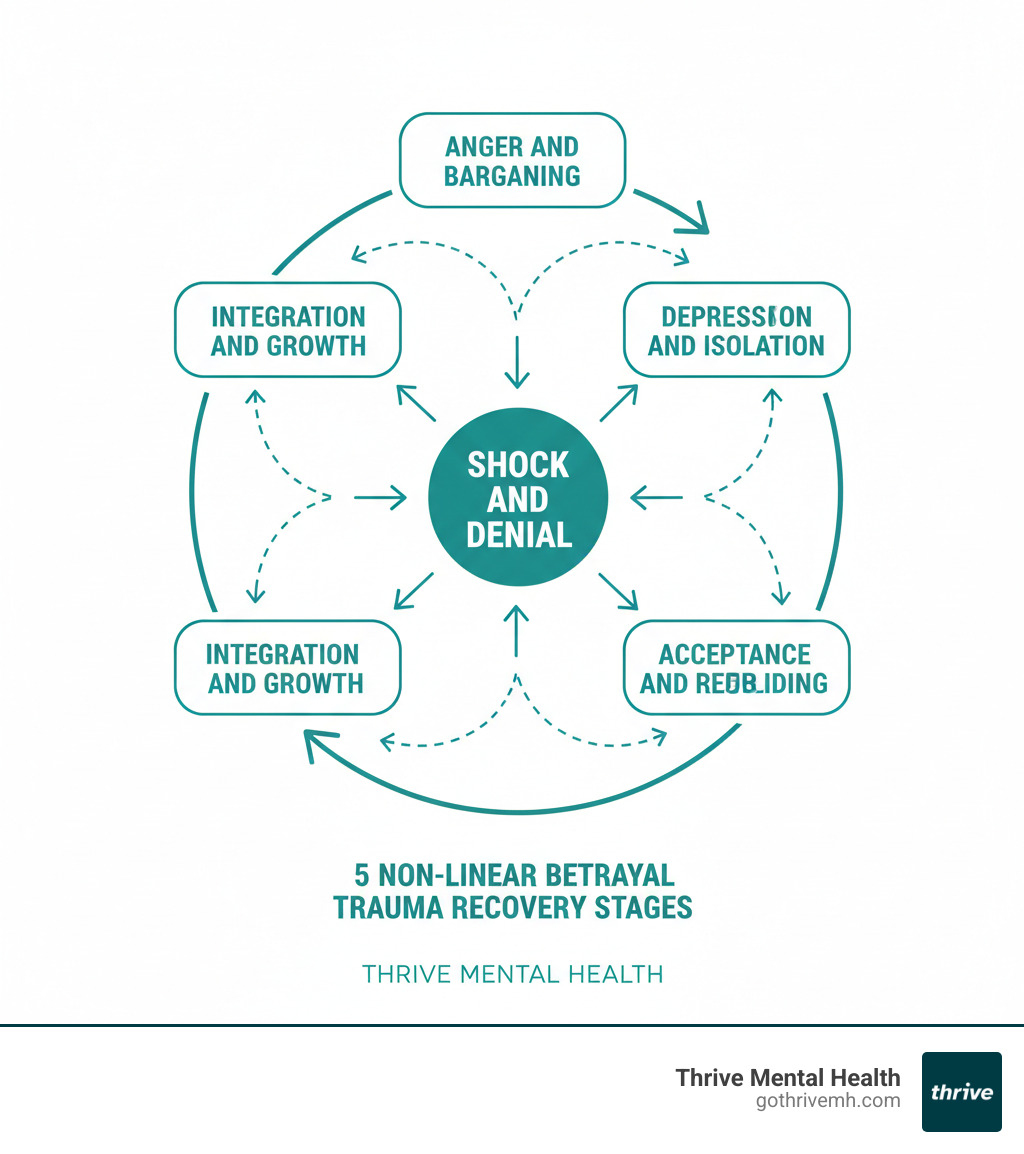
The 5 stages of betrayal trauma recovery are:
- Shock and Denial – Numbness, disbelief, and questioning reality
- Anger and Bargaining – Rage, blame, and “what if” scenarios
- Depression and Isolation – Deep sadness, withdrawal, and feelings of hopelessness
- Acceptance and Rebuilding – Facing reality and reclaiming your identity
- Integration and Growth – Moving forward with new boundaries and self-trust
These stages aren’t linear; you might bounce between them, and that’s normal. What’s not normal is staying stuck for years. Research shows that untreated betrayal trauma can last a year or longer, mirroring the grief of losing a loved one and causing anxiety, depression, and even physical pain. But you can heal faster. Knowing where you are in the recovery stages gives you a roadmap to stop self-blame and seek the right help.
I’m Nate Raine, CEO of Thrive Mental Health. Here in Florida, we specialize in trauma-informed IOP and PHP programs that guide people through the betrayal trauma recovery stages with measurable, compassionate outcomes.
What Is Betrayal Trauma? [Why It Hurts More Than You Expect]
Betrayal trauma isn’t just “heartbreak.” It’s a devastating violation of your core safety that comes from the people you depend on most—a partner, spouse, or parent. When they break your trust through infidelity, lying, or emotional abuse, it shatters your fundamental sense of security.
Coined by psychologist Jennifer Freyd, the term highlights why this trauma hits differently: it comes from someone you trust. This creates cognitive dissonance, the sickening feeling when reality contradicts your beliefs about a person. Your mind struggles to reconcile “this person loves me” with “this person is hurting me.” You may also experience betrayal blindness, an unconscious defense mechanism where you ignore or forget the betrayals to preserve the relationship you depend on.
The emotional fallout is immense and mirrors the grief of losing a loved one. Common effects include:
- Shock and disbelief, feeling like you’re in a fog.
- Intense grief and sadness that comes in waves.
- Morbid preoccupation with what happened, replaying every detail.
- Tanked self-esteem as you question your judgment and worth.
- Anxiety, panic attacks, and hypervigilance that disrupt daily life.
- Depression and hopelessness that make getting out of bed feel impossible.
- Insomnia, intrusive thoughts, and flashbacks.
- Difficulty trusting others or establishing healthy relationships.
Research confirms that betrayal leads to these symptoms, making it a uniquely damaging form of trauma. Recognizing these signs in yourself is the first step toward healing. You’re not overreacting; you’re having a normal response to an abnormal violation of trust.
How Betrayal Trauma Hijacks Your Brain and Body
Betrayal trauma isn’t just in your head; it takes over your entire body. Your nervous system gets stuck in “fight-or-flight” mode, constantly pumping out stress hormones. This leads to persistent fatigue, headaches, and digestive issues.
Your memory also gets scrambled. Some details become razor-sharp while others fragment. You might find yourself obsessing over conversations, searching for answers. The cruelest effect is losing trust in your own intuition. Because someone you trusted proved untrustworthy, you begin to question your own judgment, making it nearly impossible to feel confident in your decisions.
These changes are real and measurable. Your nervous system has been hijacked. But they aren’t permanent. With the right support, your brain and body can recalibrate, and you can learn to feel safe again.
The 5 Betrayal Trauma Recovery Stages [Roadmap to Healing]
Healing from betrayal follows a predictable, though not linear, pattern. Think of these betrayal trauma recovery stages as a map of the territory you’ll cross on your journey back to wholeness. You’ll likely cycle through stages or feel multiple emotions at once. That’s not failure—that’s healing.

Stage 1: Shock and Denial—Why You Feel Numb and Disconnected
When betrayal hits, your brain’s natural anesthesia kicks in to protect you from overwhelming pain. You might feel numb, disconnected, or think, “This can’t be real.” This isn’t weakness; it’s your mind buying time to process the trauma. You might function on autopilot while feeling scrambled and unable to make even small decisions.
Self-care for the shock stage:
- Be gentle with yourself. Allow your feelings without judgment.
- Use mindful breathing to ground yourself when you feel chaotic.
- Avoid making major decisions. Your judgment is impaired by shock.
- Seek support from trusted friends or family who offer a safe space.
Stage 2: Anger and Bargaining—How to Channel Rage Into Recovery
As shock fades, intense anger often takes its place. This is a healthy, crucial phase. The rage you feel—at the betrayer, at yourself, at the world—is your psyche reasserting that what happened was wrong. Alongside anger comes bargaining: the “what if” and “if only” scenarios your brain creates to try and regain control. The key is to channel this energy constructively.
- Acknowledge your anger through journaling or talking with a therapist.
- Use physical activity like running or boxing to discharge adrenaline.
- Practice assertive communication to reclaim your voice and set boundaries.
- Recognize when bargaining becomes unhealthy and keeps you stuck in the past.
Research: Betrayal Increases Blame
Stage 3: Depression and Isolation—The Hardest Betrayal Trauma Recovery Stage
If you’re having thoughts of self-harm or suicide, call or text 988 right now. You are not alone.
This is often the most challenging stage. As anger subsides, a profound emptiness, sadness, and hopelessness can settle in. You’re mourning the loss of the relationship, the future you envisioned, and parts of yourself. You might withdraw from others, even though isolation makes the loneliness crushing.
- Do not go it alone. Reach out to trusted friends, family, or support groups.
- Consider professional help. A therapist specializing in betrayal trauma can provide coping mechanisms. Thrive’s Virtual IOP for Depression offers structured support from the comfort of your home in Florida. Our programs are also available to residents in California, Indiana, Arizona, or South Carolina.
- Practice self-compassion. Treat yourself with the kindness you’d offer a friend.
- Engage in small acts of self-care, like a warm bath or listening to music.
Stage 4: Acceptance and Rebuilding—How to Regain Your Identity and Confidence
In this stage, you shift from being defined by what happened to shaping what comes next. Acceptance doesn’t mean condoning the betrayal; it means acknowledging reality so you can move forward. You start asking, “Who do I want to become because of this?”
This is where you reclaim your identity by exploring new interests and setting goals. Rebuilding self-trust is central. Start by making small choices that align with your values and listening to your intuition again. Each time you honor your own judgment, you prove you can trust yourself. This stage is about learning to live with the betrayal without letting it define you.
How Goal-Setting Restores Self-Esteem (PDF)
Stage 5: Integration and Growth—Thriving Beyond the Trauma
The final stage isn’t about forgetting; it’s about incorporating the experience into your life story as a catalyst for growth. The trauma revealed a strength you didn’t know you had. You move forward with increased self-awareness, stronger boundaries, and a renewed capacity for healthy connections.
- Reflect on your journey and the resilience you’ve finded.
- Set higher standards for how you’ll be treated in all relationships.
- Practice self-forgiveness and release any lingering self-blame.
- Celebrate the new self you’ve become: wiser, stronger, and more authentic.
When Self-Help Isn’t Enough: Why Professional Treatment Speeds Up Recovery
Self-help books and apps are useful, but they’re often not enough for the deep wounds of betrayal trauma. If you’ve been stuck in a loop of anger, depression, or hypervigilance for months, it’s not a personal failure. It’s a sign your nervous system needs expert intervention to reset.
Untreated betrayal trauma can drag on for years, but with structured care, most people see progress in weeks to months. It’s time to seek help if you experience:
- Overwhelming symptoms like panic attacks or insomnia that disrupt daily life.
- Loss of interest in activities you once loved or withdrawal from friends and family.
- Thoughts of self-harm or suicide. (Call or text 988 immediately).
Professional therapy offers what self-help can’t: an expert who can guide you through targeted interventions. A therapist provides a safe space and uses evidence-based methodologies like Cognitive-Behavioral Therapy (CBT) and Eye Movement Desensitization and Reprocessing (EMDR) to process trauma and change negative thought patterns. You’ll learn practical coping strategies to manage emotions and rebuild trust in yourself.
Don’t let cost be a barrier. Major insurance providers like Cigna, Aetna, Florida Blue, and Optum often cover betrayal trauma treatment, including Intensive Outpatient (IOP) and Partial Hospitalization (PHP) programs.
Thrive’s PHP Programs
Verify Your Insurance
How Thrive’s Virtual IOPs Cut Recovery Time in Half
At Thrive Mental Health, we see clients who’ve been stuck for years get unstuck in weeks. Our virtual Intensive Outpatient Programs (IOPs) provide the structured, daily support needed to break out of trauma loops without putting your life on hold.
Here’s how we accelerate healing:
- Structured Support: You engage in treatment multiple times per week, building momentum that rewires your nervous system.
- Group and Individual Therapy: You get custom one-on-one sessions plus the profound healing of connecting with others who understand.
- Flexible Scheduling: With day and evening options, you can get treatment without sacrificing your career or family commitments.
- Virtual Access: We bring expert care directly to you, serving residents across Florida from the Panhandle to the Keys. Our virtual programs are also available in California, Indiana, Arizona, and South Carolina.
- Measurable Results: We use trauma-informed approaches and track outcomes to ensure you’re getting specialized care that works.
Recovery doesn’t have to take years. With the right support, you can move through the betrayal trauma recovery stages faster than you think.
Thrive’s Virtual Therapy Options
Rebuilding Trust and Relationships After Betrayal Trauma
One of the deepest wounds of betrayal is the shattering of trust—not just in others, but in yourself. As you move through the betrayal trauma recovery stages, you’ll face the question: “Can I ever trust again?” The answer is yes, but it requires intentional work and clear boundaries.

Can You Ever Trust Again? [What Works—And What Doesn’t]
Rebuilding trust starts with trusting yourself first. You must rebuild confidence in your own intuition and your ability to spot red flags. Before you can feel safe with anyone else, you must feel safe with your own judgment.
If you’re considering rebuilding with the person who betrayed you, genuine remorse and consistent accountability are non-negotiable. Words mean nothing without changed behavior. The betrayer must demonstrate, through actions over time, that they are committed to earning back your trust. This process requires open communication and clear boundaries to protect your emotional well-being.
Trust rebuilds in small, consistent steps and cannot be rushed. What doesn’t work is ignoring red flags, blaming yourself, or suppressing your intuition. Sometimes, not rebuilding trust with the betrayer is the healthiest choice. Walking away isn’t failure—it’s self-preservation.
Forgiveness: The Truth About Letting Go (Even If You Never Reconcile)
Let’s clear up the biggest misconception: forgiveness is not about them. It doesn’t mean condoning the behavior, excusing it, or even reconciling. Forgiveness is about freeing yourself from the emotional prison of resentment and rage.
Holding onto anger is like drinking poison and expecting the other person to get sick. Forgiveness is the process of releasing that emotional burden so you can reclaim your energy and move forward.
What’s liberating is that you can heal completely without ever forgiving the betrayer. Your recovery is independent of their actions or remorse. Some find peace through forgiveness; others find it by simply letting go of the emotional hold. Both paths are valid. The goal is to stop replaying the betrayal so you can redirect your energy toward rebuilding your own life.
FAQ: Betrayal Trauma Recovery Stages—What People Ask Most
How long does betrayal trauma recovery take?
Everyone’s timeline is different. With professional help like an IOP, many people see significant progress in 6–12 months. Without structured support, the pain can drag on for years. Getting help doesn’t just speed up recovery; it allows you to truly move forward.
How do I know which betrayal trauma recovery stage I’m in?
Pay attention to your main emotions. Are you numb (Stage 1), enraged (Stage 2), or hopeless (Stage 3)? Are you starting to set new goals (Stage 4) or feeling stronger from the experience (Stage 5)? The stages often overlap and repeat. A therapist can help you identify where you are and what you need to progress.
What does successful betrayal trauma recovery look like?
Success isn’t about forgetting. It’s about the trauma no longer controlling you. It looks like:
- Fewer triggers disrupting your day.
- Stronger self-esteem and clearer boundaries.
- Healthier relationships built on respect, not fear.
- A sense of purpose that extends beyond the trauma.
Is virtual therapy as effective as in-person for betrayal trauma?
Yes. Research shows virtual IOPs and PHPs are just as effective as in-person treatment, with added benefits like increased privacy and flexibility. For residents throughout Florida, you can attend sessions from the comfort of your home, making it easier to get consistent care. We also serve clients in California, Indiana, Arizona, and South Carolina.
Thrive’s Virtual Therapy Options
Does insurance cover betrayal trauma treatment?
Yes, most major health insurance plans like Cigna, Aetna, Florida Blue, and Optum cover treatment for betrayal trauma, including IOP and PHP programs. We can help you understand your coverage so you can focus on healing.
Verify Your Insurance
Summary: Betrayal Trauma Recovery Stages—Your Fast-Track to Healing Starts Here
Navigating the betrayal trauma recovery stages is a difficult but transformative journey. You’ve learned that this trauma is a profound wound that impacts your brain, body, and sense of self. We’ve explored the five stages—shock, anger, depression, acceptance, and integration—and confirmed that you don’t have to face them alone.
While self-care is vital, professional treatment through structured programs like Thrive Mental Health’s virtual IOPs can significantly accelerate your healing. We offer expert-led, evidence-based care for residents across Florida, as well as in California, Indiana, Arizona, and South Carolina. Don’t let unresolved trauma define your future. Your fast-track to healing starts here.
Related: 7 Signs You Need Trauma Therapy Now
Ready for support? Thrive offers virtual and hybrid IOP/PHP programs with evening options. Verify your insurance in 2 minutes (no obligation) → Start benefits check or call 561-203-6085. If you’re in crisis, call/text 988.