
Beyond the Screen: Fun and Therapeutic Activities for Teens

Why Traditional Therapy Isn’t Always Enough for Teens
Therapy ideas for teenagers go far beyond sitting on a couch and talking about feelings. If you’re searching for ways to help your teen engage in therapy, here’s what actually works:
Quick Answer: Most Effective Therapy Ideas for Teenagers
- Art & Creative Expression – Painting emotions, worry journals, music playlists
- Mindfulness & Grounding – 5-4-3-2-1 technique, body scans, gratitude exercises
- Interactive Games – Coping Skills Bingo, Feelings Wheel, problem-solving scenarios
- Movement Activities – Nature walks, yoga, team challenges
- Digital Tools – Teletherapy platforms, mood tracking apps, virtual reality exposure
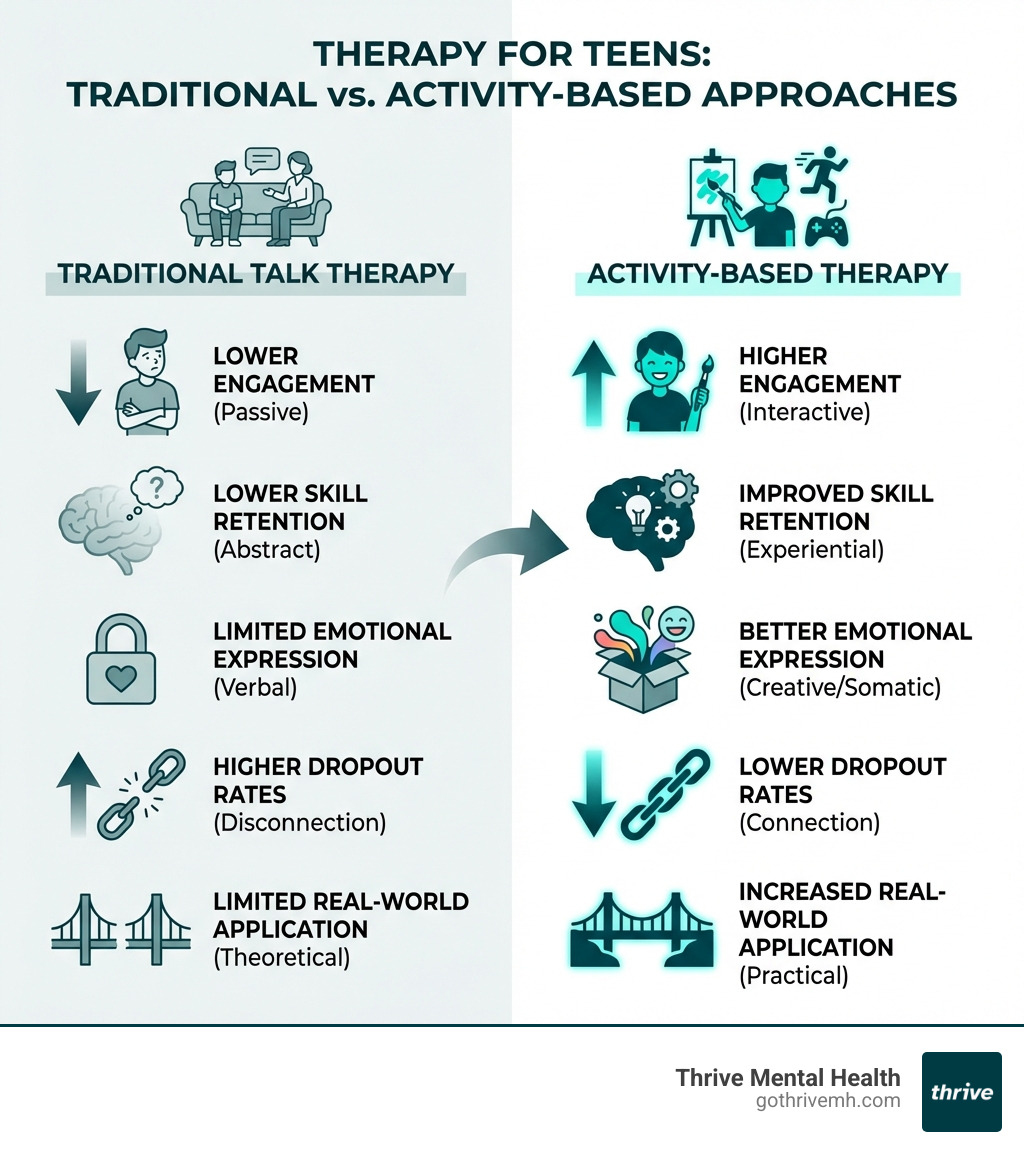
Here’s the problem: nearly half of teens who start therapy drop out. That’s not because they don’t need help—it’s because traditional talk therapy can feel awkward, boring, or just plain uncomfortable for adolescents.
When teens are asked to “just talk about it,” many shut down. They cross their arms, give one-word answers, or stare at their phones. This doesn’t mean they don’t want help. It means they need a different way in.
Activities work where words fail. Research shows that integrating creative, interactive, and movement-based activities into therapy sessions helps teens:
- Express emotions they can’t put into words
- Build practical coping skills they’ll actually use
- Stay engaged instead of dropping out
- Develop emotional resilience that lasts beyond treatment
Art therapy, mindfulness exercises, games, and outdoor activities aren’t just “fun add-ons”—they’re evidence-based tools that make therapy more effective. Teens learn better by doing than by sitting still and talking.
I’m Nate Raine, CEO of Thrive Mental Health. For over a decade, we’ve seen what works—and what doesn’t—in teen therapy. Across our programs in Florida, we’ve moved beyond just talk. We integrate evidence-based, engaging therapy ideas for teenagers because we know that when treatment is interactive, outcomes improve. It’s not about forcing conversation; it’s about creating connection.
The activities in this guide aren’t random suggestions. They’re structured, therapeutic interventions that address anxiety, depression, trauma, and behavioral challenges. Whether your teen struggles to open up, feels overwhelmed by emotions, or just needs new coping tools, these approaches can help.
Basic therapy ideas for teenagers terms:
Release Emotions Without Words: Creative Art & Expression Activities
For many teenagers, especially those struggling with complex emotions, words can feel inadequate or even intimidating. This is where creative expression shines. Art and expressive activities provide a safe, non-verbal outlet for teens to explore their inner world, process difficult experiences, and communicate feelings that might otherwise remain bottled up. The benefits are profound: improved self-expression, improved emotional regulation, and significant stress relief.
Creative activities are powerful therapy ideas for teenagers because they bypass the need for direct verbal confrontation, which can be particularly challenging for adolescents. Instead, teens can project their thoughts and feelings onto a canvas, into a song, or through a story, gaining insight and finding catharsis in the process. In our Florida-based programs, we’ve seen how these approaches help teens steer the emotional rollercoasters of adolescence, whether they’re dealing with academic pressures, social anxieties, or deeper mental health concerns.
Creative art therapy ideas for teenagers
Art therapy, in particular, has been shown to increase self-esteem and a sense of value, providing a unique avenue for healing. Our Florida programs often incorporate a variety of creative modalities, recognizing that each teen will resonate with different forms of expression.
- Painting Emotions: Provide a range of paints, brushes, and paper, then invite your teen to paint how a specific emotion (like anger, sadness, or joy) feels to them, or how a challenging situation makes them feel. There’s no right or wrong way to do this; the goal is expression, not perfection. This allows for a cathartic release and can later be a starting point for discussion.
- Collage Making: Supply old magazines, newspapers, scissors, and glue. Encourage your teen to cut out images, words, or phrases that resonate with their current feelings, aspirations, or challenges, and arrange them into a collage. This can be a less intimidating way to express thoughts and feelings, helping teens visually represent experiences and build self-awareness.
- Sculpting Feelings with Clay: Using modeling clay or play-doh, teens can physically mold their emotions or abstract concepts. This tactile experience can be incredibly grounding and help externalize internal states, making them easier to observe and discuss.
- Creating a “Worry Journal”: Journaling is a proven tool for relieving anxiety and stress and improving overall mental health. A worry journal is a dedicated space for teens to write down their worries, fears, anxieties, and frustrations. This practice helps teens identify and express these feelings in a healthy way, rather than bottling them up. It also helps them recognize patterns in their thoughts and develop strategies for coping.
- Music Selection Playlists: Music is uniquely healing and linked to mood regulation. Ask your teen to create playlists for different moods—perhaps one for feeling calm, another for feeling energized, or one for processing sadness. Discussing their top 5 songs and why they chose them can open up conversations about identity, coping mechanisms, and personal experiences. Music can help teens relax and cope with different stressors.
- Song Lyric Analysis: Choose a song (either one of their favorites or one suggested by the therapist) and analyze the lyrics together. What emotions are conveyed? How do the lyrics relate to their own experiences? This can be a powerful way to explore complex themes and feelings in a relatable context.
- Writing a Letter to Your Future Self: This activity encourages teens to reflect on their current challenges, hopes, and dreams, and to offer advice or encouragement to their future selves. It fosters self-understanding and can be a powerful tool for tracking personal growth over time.
For more structured approaches and specific exercises, exploring various Art Therapy Activities for Adolescents can provide a wealth of resources.
Find Calm in the Chaos: Powerful Mindfulness & Grounding Exercises
Adolescence is a time of intense change and often, overwhelming emotions. Academic pressures, social dynamics, and the sheer pace of modern life can leave teens feeling anxious, stressed, and disconnected. Mindfulness and grounding exercises offer invaluable tools to steer this chaos, helping teens anchor themselves in the present moment and cultivate inner calm. The benefits are far-reaching: significant anxiety reduction, improved focus, and improved emotional resilience.
Mindfulness is the practice of being fully present and engaged in the current moment without judgment. Research consistently shows that activities like mindfulness, guided meditation, deep breathing, and body scans can reduce negative thoughts and other mental health symptoms. These practices equip teens with the ability to observe their thoughts and feelings without being consumed by them, fostering a greater sense of control and peace. We emphasize these foundational skills in our Florida-based Anxiety Management for Teens and Stress Management for Teens programs, empowering them with lifelong tools.
Effective mindfulness therapy ideas for teenagers
- 5-4-3-2-1 Grounding Technique: This simple yet effective exercise helps teens quickly bring themselves back to the present moment when feeling overwhelmed. Instruct them to identify:
- 5 things they can see
- 4 things they can touch (and actually feel them)
- 3 things they can hear
- 2 things they can smell
- 1 thing they can taste
This sensory focus can interrupt anxious thought spirals and foster immediate calm.
- Guided Body Scan Meditation: In a quiet space, guide your teen through a body scan. This involves directing their attention to different parts of their body, noticing any sensations (warmth, tension, tingling) without judgment. This practice improves body awareness, promotes relaxation, and helps teens identify where they hold stress.
-
Mindful Breathing Exercises: Deep breathing is a cornerstone of mindfulness. It helps to regulate the nervous system, reduce stress, and improve focus. Studies have found that mindfulness can improve focus and amplify concentration, and diaphragmatic breathing can reduce stress and improve attention.
Here are 3 simple breathing exercises for immediate calm:
- Box Breathing: Inhale for a count of four, hold for four, exhale for four, hold for four. Repeat several times.
- 4-7-8 Breathing: Inhale quietly through your nose for 4 counts, hold your breath for 7 counts, and exhale completely through your mouth, making a “whoosh” sound for 8 counts.
- Belly Breathing (Diaphragmatic Breathing): Place one hand on your chest and one on your belly. Breathe deeply so that your belly rises, while your chest remains relatively still. Focus on the sensation of your breath.
- Gratitude Scavenger Hunt: Research shows that gratitude creates positive feelings, increasing a child’s well-being and life satisfaction. This exercise can be done anywhere—at home, in a park, or even during a car ride. Challenge your teen to identify as many things as possible that they are genuinely grateful for in their immediate environment. This shifts focus from negative thoughts to positive appreciation, boosting mood and life satisfaction.
Break the Ice & Build Skills: Engaging Therapy Ideas for Teenagers That Aren’t Boring
Traditional therapy can often feel like an interrogation to a teenager. But when therapy is engaging, interactive, and even fun, teens are far more likely to participate, stay committed, and ultimately, benefit. Incorporating games and interactive tools into therapy sessions is one of the most effective therapy ideas for teenagers because it leverages their natural inclination towards play and social interaction. These activities are not just time-fillers; they are carefully designed interventions that build essential communication skills, improve problem-solving abilities, and foster crucial social skills.
A challenge in adolescent therapy is engagement, with nearly half of adolescents who receive treatment dropping out. Games provide a low-pressure environment where teens can practice new behaviors, express themselves, and connect with their therapist and peers without the intensity of direct questioning. This approach helps to normalize therapy, making it a space for growth and findy rather than a dreaded obligation. Our Florida-based Therapy Games for Teens and Group Therapy for Teens programs are designed with this principle in mind, ensuring that every session is both productive and appealing.

How to use games and interactive tools in therapy
- Coping Skills Bingo: Create Bingo cards with various coping skills (e.g., “took a walk,” “listened to music,” “talked to a friend,” “practiced deep breathing”). Teens can mark off skills they’ve used or would like to try. This game helps teens identify a diverse range of healthy coping mechanisms and encourages them to experiment with new strategies.
- Two Truths and a Lie: A classic icebreaker that works wonders in building rapport and helping teens learn about each other in group settings. Each teen shares three statements about themselves—two true and one false—and others guess the lie. This fosters connections and encourages lighthearted self-disclosure.
- The Human Knot: A fantastic team-building activity for group therapy. Participants stand in a circle, reach across, and grab hands with two different people. The goal is to untangle the “knot” without letting go of hands. This exercise promotes communication, cooperation, and collaborative problem-solving.
- Problem-Solving Scenarios Game: Prepare cards with common teen-relevant scenarios (e.g., “You got a bad grade on a test,” “A friend is pressuring you to do something you’re uncomfortable with”). Teens draw a card and brainstorm solutions, discussing the pros and cons of each. This improves decision-making skills and builds resilience.
- The Feelings Wheel Game: Use a physical or digital Feelings Wheel (a circular chart of emotions). Teens spin the wheel or choose an emotion and then share a time they felt that emotion, or what triggers it for them. This helps teens identify and articulate their emotions more clearly, improving emotional literacy and communication.
- Using Online Tools like Word Clouds or Interactive Question Wheels: For virtual sessions, tools like Wordclouds.com can be used to create a visual representation of words important to the teen, or wheelofnames.com can randomly select names or icebreaker questions for group engagement. These digital tools make therapy accessible and engaging for tech-savvy adolescents. Our virtual counseling for teens often leverages these innovative methods.
Making It Work: How to Get Your Teen on Board with Therapy
Getting a teenager to engage in therapy can sometimes feel like navigating a minefield. Adolescence is a period marked by a strong desire for autonomy, a heightened sensitivity to judgment, and often, a natural reluctance to discuss personal struggles with adults. The key to successful therapy with teens isn’t forcing compliance, but rather creating an environment where they feel safe, respected, and genuinely heard. Addressing resistance, encouraging participation, and building trust are paramount.
We understand that a “one-size-fits-all” approach simply doesn’t work for teenagers. Our philosophy centers on meeting teens where they are, recognizing their unique developmental stage, and respecting their individuality. This means tailoring our approach, fostering a non-judgmental atmosphere, and empowering them to take an active role in their healing journey.
How can therapists tailor activities to individual teen needs?
Tailoring activities to a teen’s individual needs and interests is crucial for boosting engagement and making therapy relevant.
- Assessing Interests and Strengths: Before suggesting activities, we take the time to understand what genuinely interests your teen. Do they love art, music, gaming, sports, or nature? Do they thrive in group settings or prefer one-on-one activities? Understanding their strengths and passions allows us to integrate elements they already enjoy into their therapeutic process. For instance, a teen with a strong interest in music might benefit from music therapy sessions, while a visual artist might thrive with drawing or collage making.
- Collaborative Goal-Setting: We involve teens in setting their own therapeutic goals and choosing activities. When teens feel they have a say in their treatment plan, they are far more invested. This collaborative approach fosters a sense of ownership and autonomy, which is vital for adolescents.
- Offering Choices: Instead of dictating activities, we present a menu of options. “Would you prefer to draw or write today?” or “We could try a grounding exercise or a problem-solving game—which sounds better?” This simple act of offering choice can significantly reduce resistance and increase participation.
- Modifying Activities for Success: Activities are always adapted to suit the teen’s comfort level and abilities. For example, if a teen is shy, we might start with a less intimidating art activity before moving to group games. For teens with sensory sensitivities, we adjust the environment or materials. Simplifying instructions, providing visual aids, and offering supportive materials ensure that every teen can experience success and build confidence.
- Starting Slow: We recognize that building trust takes time. We begin with low-pressure, easy-to-engage activities and gradually introduce more challenging ones as rapport strengthens. This empathetic approach ensures that teens feel secure and understood throughout their therapeutic journey.
How can technology support therapy activities for teens?
Technology is an inseparable part of a teenager’s life. Rather than viewing it as a distraction, we integrate technology as a powerful tool in our therapy ideas for teenagers. From virtual sessions to interactive apps, technology can improve accessibility, engagement, and the overall effectiveness of therapy.
- Teletherapy Platforms: Virtual counseling for teens through teletherapy platforms offers unparalleled convenience and accessibility. Teens can engage in therapy from the comfort and privacy of their own homes throughout Florida, eliminating transportation barriers and fitting sessions into busy schedules. Research consistently demonstrates that online therapy can be as effective as traditional in-person approaches, providing a stress-free environment where teens can build a trusting relationship with their therapists. Our Virtual IOP Teens Complete Guide provides more information on how we leverage these platforms for intensive care.
- Mental Health Apps for Mood Tracking: Many apps are designed to help teens track their moods, identify triggers, practice mindfulness, and access coping strategies. These apps can complement therapy by providing daily support and helping teens apply therapeutic concepts between sessions. They can be particularly useful for teens who spend a lot of time on their digital devices, turning screen time into a tool for self-awareness and emotional regulation.
- Virtual Reality (VR) for Exposure Therapy: For teens dealing with specific phobias or anxieties, VR technology can create immersive therapeutic experiences. It allows therapists to simulate stress-inducing situations (e.g., public speaking, social gatherings) in a controlled, safe environment, enabling teens to practice coping skills and gradually confront their fears.
- Using Online Games and Tools: As mentioned earlier, websites like Wordclouds.com, wheelofnames.com, and various interactive game sites can be adapted for therapeutic use, making sessions more dynamic and engaging, especially in a virtual setting.
Frequently Asked Questions about Therapy Activities for Teens
What if my teen refuses to participate in therapy activities?
It’s common for teens to show reluctance, and it’s important not to force participation, which can backfire.
- Start by understanding their reluctance with empathy: Ask why they’re hesitant. Is it fear of judgment, feeling silly, or simply not understanding the purpose? Validate their feelings.
- Offer choices and a sense of control: Instead of “You have to do this,” try “We have a few options; which one feels least uncomfortable?”
- Explain the “why” behind the activity: Help them understand how the activity relates to their goals or challenges. “This isn’t just for fun; it’s a different way to understand what’s bothering you.”
- Model participation yourself: If appropriate, the therapist can demonstrate or even participate alongside the teen, showing vulnerability and making it less intimidating.
- Start with low-pressure, simple activities: Begin with something quick and easy that doesn’t require deep introspection or much output, gradually building up to more complex tasks.
How do I know which therapy activity is right for my teenager?
Choosing the right activity involves a collaborative approach and careful consideration of several factors:
- Consider their personality: Is your teen an introvert who prefers quiet, reflective activities like journaling or individual art, or an extrovert who thrives in interactive games or group challenges?
- Consider their interests: What are their hobbies? What do they spend their free time doing? Integrating their passions (music, gaming, sports, art) into therapy makes it far more engaging and relevant.
- Consider their therapeutic goals: Are they working on anxiety management, emotional expression, social skills, or coping with trauma? The activity should align with these specific objectives.
- Collaborate with the teen and their therapist: The best approach is to involve your teen in the decision-making process. The therapist can offer professional guidance on activities that align with clinical goals, while the teen’s input ensures buy-in and relevance.
Can these activities replace traditional talk therapy?
Generally, no. While these activities are incredibly powerful and often essential for engaging teens, they are typically used to supplement, not replace, traditional talk therapy. Here’s why:
- Opening the Door: Activities often serve as a bridge. They can open the door to deeper verbal processing by helping teens access and express emotions they can’t easily put into words. Once emotions are externalized through art or movement, it becomes easier to discuss them.
- Building Rapport: Engaging in shared activities helps build trust and rapport between the teen and therapist, creating a safe foundation for more direct conversations.
- Skill Practice: Many activities are designed to teach and practice coping skills, emotional regulation, and communication in a hands-on way. These skills then become topics for discussion and integration into daily life during talk therapy.
- Holistic Approach: The most effective therapy for teens often involves a blend of modalities, combining the insights gained from talk therapy with the experiential learning and emotional release offered by activity-based approaches.
Your Teen Can Heal—Here’s How to Start
The journey through adolescence is complex, marked by significant emotional highs and lows. It’s a critical phase for self-exploration and developing emotional resilience. When traditional “talk therapy” falls flat, engaging therapy ideas for teenagers offer a powerful alternative, changing therapy from a chore into a space for genuine growth and findy. We’ve seen how activity-based therapy makes treatment more engaging and effective, helping teens steer challenges like anxiety, depression, and social pressures.
By incorporating creative expression, mindfulness, games, and technology, we empower teens to build lifelong coping skills, improve self-awareness, and improve communication. This comprehensive approach ensures that the right support helps teens thrive, developing the resilience needed to face life’s complexities head-on.
At Thrive Mental Health, we integrate these evidence-based, engaging activities into our virtual and in-person Intensive Outpatient (IOP) and Partial Hospitalization (PHP) programs across Florida. Our programs are designed for teens who need more than once-a-week therapy but less than inpatient care, offering flexible scheduling and expert-led support. We work with major insurance providers like Cigna, Optum, and Florida Blue, among others, to make this essential care accessible to Florida families. Find more info about art therapy programs and how they can benefit your teen.
Ready for support? Thrive offers virtual and hybrid IOP/PHP programs with evening options. Verify your insurance in 2 minutes (no obligation) → Start benefits check or call 561-203-6085. If you’re in crisis, call/text 988.