
Where to Find Exposure and Response Prevention Therapy for Adults

Best ERP Clinics for Adults 2025: Fast Relief!
Why Finding the Right ERP Clinic Could Change Your Life
Clinics offering exposure and response prevention therapy for adults provide the gold-standard treatment for OCD, anxiety, and phobias—helping you break free from cycles of fear that weekly talk therapy can’t touch.
Quick Answer: Where to Find ERP Therapy for Adults
- Specialized mental health clinics with certified ERP therapists.
- Intensive Outpatient (IOP) and Partial Hospitalization (PHP) for faster results with moderate to severe symptoms.
- Virtual therapy platforms like Thrive Mental Health, offering flexible ERP care across Florida.
- Insurance-covered options—most major plans (Cigna, Aetna, Optum, Florida Blue) cover ERP at qualified clinics.
If obsessive thoughts force you to check, clean, or repeat behaviors just to feel safe, you’re not broken. You’re stuck in a cycle that can be broken. Exposure and Response Prevention (ERP) is the most effective therapy for OCD and anxiety disorders, with 50–60% of adults seeing significant symptom reduction. The catch? Most therapists don’t specialize in ERP, and finding the right clinic makes all the difference.
You’ve likely tried talk therapy. Maybe it helped a little, but the intrusive thoughts returned. That’s because OCD and anxiety need a different approach—one that retrains your brain by facing fears, not just talking about them. ERP targets the root cause: the compulsions that feed your obsessions.
The problem is that not all clinics offer real ERP, and weekly sessions may not be enough for severe symptoms. That’s where intensive programs come in, providing the support and accountability for faster progress.
I’m Nate Raine, CEO of Thrive Mental Health. At Thrive, we’ve designed programs specifically for adults seeking clinics offering exposure and response prevention therapy for adults—combining expert ERP therapists, flexible virtual options, and insurance-friendly IOP/PHP programs across Florida. This guide will show you how to find the right clinic and get started fast.
Stop OCD and Anxiety from Controlling Your Life: Why ERP Therapy Works
If you’re trapped by intrusive thoughts—forced to check, clean, or avoid things just to keep anxiety at bay—you know something needs to change. Exposure and Response Prevention (ERP) is the gold-standard treatment for OCD and anxiety disorders. It’s a specialized form of Cognitive Behavioral Therapy (CBT) that teaches you to face your fears head-on instead of avoiding them.
OCD operates on a brutal cycle:
- Obsessions: Unwanted, intrusive thoughts, images, or urges that create intense anxiety.
- Compulsions: Repetitive behaviors or mental rituals you perform to reduce that anxiety or prevent a feared outcome.
While compulsions offer temporary relief, they strengthen the obsession. Each time you perform a ritual, you teach your brain the fear is real and requires a response. The anxiety drops, then returns stronger. ERP gets you off this hamster wheel entirely.
Through a process called habituation, ERP retrains your brain by gradually exposing you to triggers without letting you perform compulsions. You learn the feared outcome doesn’t happen, and the anxiety decreases on its own. You don’t need the rituals. It’s neuroscience in action, and it’s why clinics offering exposure and response prevention therapy for adults are the go-to for people ready for real change.
Over 2% of adults will struggle with OCD, yet most suffer for years with ineffective treatment. At Thrive, we connect you to expert-led, evidence-based care that works. Explore Thrive’s approach to evidence-based care for OCD.
What Conditions Can ERP Treat in Adults?
ERP’s power extends beyond OCD to any condition driven by fear and avoidance.
- Obsessive-Compulsive Disorder (OCD): ERP’s primary application, targeting contamination fears, checking rituals, intrusive thoughts, and more.
- Social Anxiety Disorder: Gradually exposes you to feared social situations to build genuine confidence.
- Panic Disorder: Exposes you to the physical sensations of panic (e.g., increased heart rate) to teach you they aren’t dangerous.
- Phobias: Systematically desensitizes you to specific fears like flying, heights, or needles.
- Generalized Anxiety Disorder (GAD): Helps you confront situations you avoid due to worry and reduces reassurance-seeking.
- Post-Traumatic Stress Disorder (PTSD): Uses exposure-based techniques to process traumatic memories and reduce avoidance.
- Body Dysmorphic Disorder (BDD): Reduces compulsive mirror-checking, comparing, and reassurance-seeking about appearance.
Real Results: How ERP Changes Lives
Studies show 50–60% of adults who complete ERP see significant, long-term symptom reduction. But what does that mean for you?
- Lasting Relief: You learn long-term strategies, not just short-term fixes. The skills become second nature.
- Regaining Control: You make decisions based on your values, not your fears. Anxiety no longer runs the show.
- Restoring Relationships: You break free from reassurance-seeking and accommodation patterns, allowing for authentic connection.
- Refinding Daily Freedom: You start living again instead of just surviving, pursuing goals you thought were impossible.
At Thrive, we see these changes happen faster in our intensive programs. When you’re ready to accelerate your progress, learn more about Thrive’s Virtual IOP for OCD—How It Works.
What to Expect: The ERP Process from First Session to Recovery

Starting ERP can feel intimidating because it means facing your fears. But you won’t do it alone. Clinics offering exposure and response prevention therapy for adults use a structured, collaborative approach that meets you where you are.
Here’s what the process looks like.
Step 1: Assessment and Your Fear Hierarchy
Your first session is about understanding your story. Your therapist will identify your specific triggers, compulsions, and avoidance behaviors. Together, you’ll build a “fear ladder” (or fear hierarchy), ranking feared situations on a 0-100 anxiety scale (Subjective Units of Distress Scale, or SUDS). This roadmap ensures you start with manageable challenges and work your way up. You’ll also learn the science behind why ERP works (psychoeducation), which builds confidence in the process.
Step 2: Inside an ERP Session
With your roadmap in place, the work begins. An ERP session involves two key parts:
- Gradual, Guided Exposure: You’ll collaboratively face items on your fear ladder. This might be in-vivo (real-life, like touching a doorknob), imaginal (imagining a feared thought), or interoceptive (creating feared physical sensations like a racing heart).
- Response Prevention: This is the critical part. During and after the exposure, you resist the urge to perform your compulsion. You don’t wash, check, or seek reassurance. This is how your brain learns the anxiety will pass on its own.
Sessions typically last 50 to 90 minutes to allow enough time for the exposure and for anxiety to naturally decrease.
Step 3: How Long Does ERP Take? What’s Hard?
Most adults see significant results within 12 to 20 sessions. Intensive programs like Thrive’s IOP or PHP can accelerate this timeline. Be prepared: you will feel anxious during exposures. That discomfort is proof you’re rewiring your brain. Your therapist will guide you through these moments.
Commitment is everything. ERP’s success depends on practicing between sessions. Good programs also build in relapse prevention, teaching you how to handle setbacks and maintain progress long-term. At Thrive’s Virtual IOP for OCD, we equip you with skills to stay better, not just get better.
How to Find Clinics Offering Exposure and Response Prevention Therapy for Adults—And Get the Right Care Fast

Finding qualified clinics offering exposure and response prevention therapy for adults can be challenging. Generic therapy won’t work for OCD and anxiety disorders; you need a specialist who knows ERP inside and out. The right clinic can transform your recovery, while the wrong one can leave you spinning your wheels.
This guide will show you how to find a true ERP specialist in Florida.
How to Choose a Qualified ERP Therapist (Not Just Any Counselor)
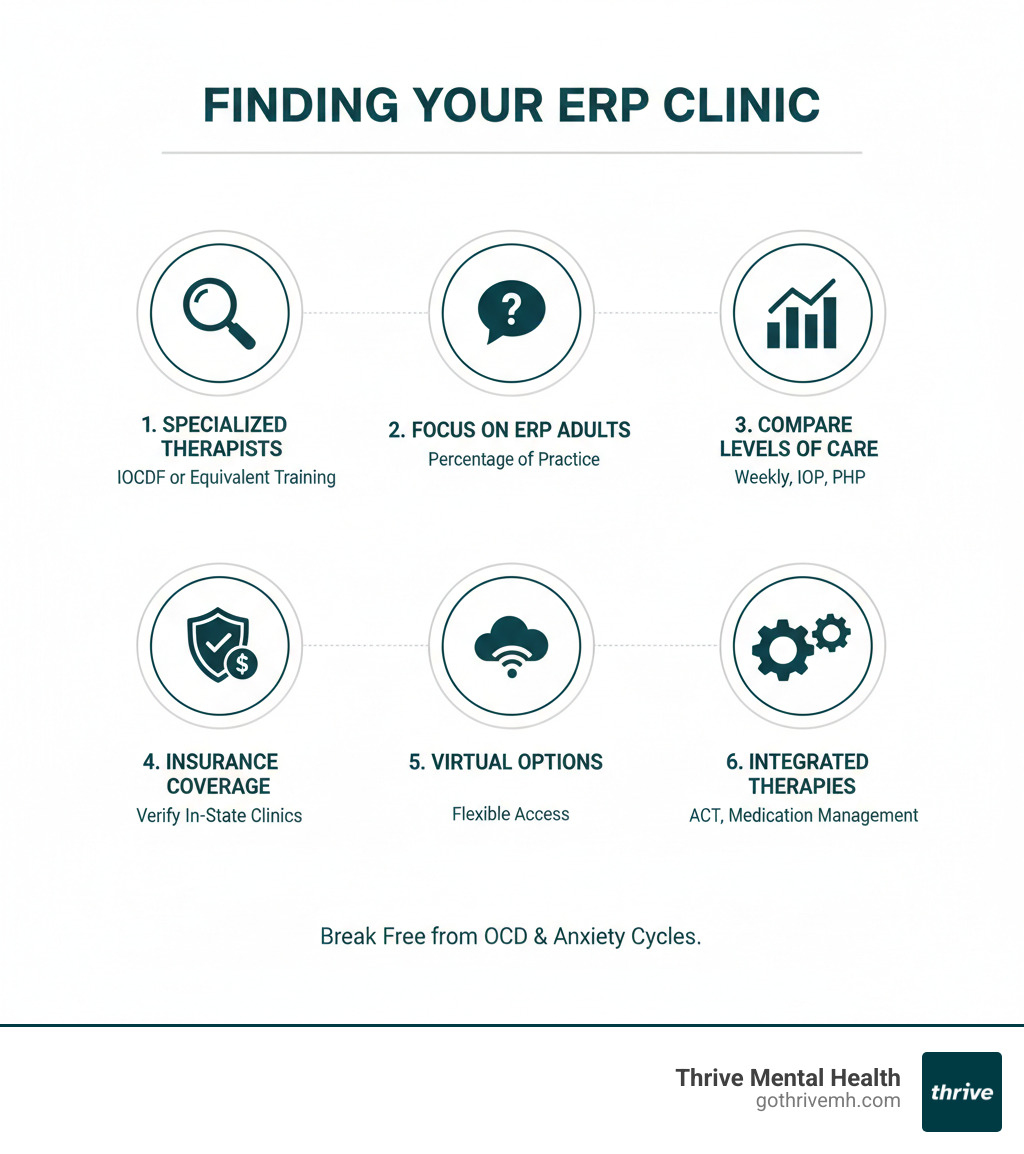
Not all therapists who claim to “do ERP” are specialists. A true expert has invested years in mastering this approach. When vetting a therapist, ask these questions:
- “What specific, advanced training have you completed in ERP?” Look for dedicated workshops, supervised practice, and ongoing consultation.
- “What percentage of your practice is treating OCD and anxiety with ERP?” A specialist will say it’s a significant portion, often 50% or more.
- “Are you certified?” Look for certification through reputable organizations like the International OCD Foundation (IOCDF). This signals a deep commitment to the practice.
At Thrive, our clinicians are dedicated ERP specialists. You can meet Thrive’s ERP specialists here and see their training and experience.
Levels of Care: Weekly Therapy vs. Intensive Programs
The right level of care depends on how much your symptoms disrupt your life. If you’ve tried weekly therapy without success, you may need a higher level of care.
| Level of Care | Who It’s For | What to Expect |
|---|---|---|
| Weekly Therapy | Mild to moderate symptoms that don’t severely disrupt daily life. | 1 session/week, steady progress, requires strong self-motivation. |
| Intensive Outpatient (IOP) | Moderate to severe symptoms; not improving with weekly therapy. | 3–5 days/week, faster results, structured support. |
| Partial Hospitalization (PHP) | Severe, daily functional impairment; need for intensive stabilization. | 5 days/week, most comprehensive outpatient care. |
Thrive Mental Health specializes in virtual and hybrid IOP/PHP programs across Florida. We offer the intensity needed for real change with the flexibility for real life. See if intensive treatment is right for you: Learn about Thrive’s IOP/PHP options for OCD.
ERP vs. Other Treatments: What Actually Works?
Traditional talk therapy often makes OCD worse by allowing you to vent about fears without confronting them. ERP beats talk therapy for OCD because it’s an active, behavioral intervention. You do something about the fear, which is what breaks the cycle.
SSRIs (medication) can help reduce the intensity of anxiety, making it easier to engage in ERP. However, medication alone doesn’t teach you long-term skills. Experts agree that ERP is the gold standard, providing tools that last even after medication is tapered.
The best results often come from combining ERP with medication. At Thrive, we also integrate Acceptance and Commitment Therapy (ACT), which teaches psychological flexibility. This combination doesn’t just reduce symptoms—it helps you build a life you value.
Costs, Insurance, and Affordable ERP Therapy for Adults

Investing in your mental health is critical, but you need to know the cost and how insurance can help.
What Does ERP Therapy Cost?
Costs for clinics offering exposure and response prevention therapy for adults vary. Weekly therapy sessions typically range from $100 to $250+, depending on location and therapist credentials.
Intensive Outpatient (IOP) and Partial Hospitalization (PHP) programs may seem more expensive upfront, but they often provide better value. By delivering faster results in a shorter timeframe, the total cost can be lower than months or years of weekly therapy. At Thrive, we offer sliding scale options and payment plans to make our intensive programs accessible.
Using Insurance for ERP Therapy
Good news: most major insurance plans cover ERP, especially structured IOP and PHP programs. Thrive Mental Health is in-network with Cigna, Aetna, Optum, Florida Blue, and many other leading providers, which means lower out-of-pocket costs for you.
Our team can help you understand your benefits, whether we are in-network or out-of-network with your plan. We’ll verify your insurance coverage in about 2 minutes—for free, with no obligation. We handle the paperwork so you can focus on recovery.
Our programs are covered for adults in Florida. Don’t let insurance confusion stop you. Verify your insurance in 2 minutes and get clarity on your costs.
FAQs: Clinics Offering Exposure and Response Prevention Therapy for Adults
How do I know if I need ERP therapy?
If obsessions or compulsions disrupt your life, relationships, or work, ERP can help—no matter how “mild” or “severe” you think your symptoms are. If your concerns cause distress, reduce your quality of life, or interfere with any aspect of your daily functioning, ERP is likely a highly effective treatment option.
Is ERP therapy available online?
Yes. Thrive’s virtual ERP programs are as effective as in-person care, with flexible scheduling and expert therapists. Research shows no significant differences in efficacy between remotely-delivered CBT (which includes ERP) and face-to-face CBT for OCD symptoms. This means you can access gold-standard treatment from the comfort and privacy of your home in Florida.
How fast will I see results with ERP?
Most adults notice improvement within 4–8 weeks, typically corresponding to 12–20 sessions. Intensive programs, like Thrive’s IOP and PHP, are designed to accelerate this process, often leading to faster, more profound results due to the higher frequency and intensity of treatment.
Does insurance cover ERP therapy?
Most major plans (Cigna, Aetna, Optum, Florida Blue) cover ERP at Thrive. We make it easy to verify your benefits with a free, 2-minute insurance check, so you know exactly what to expect.
What if I’m in crisis or having thoughts of self-harm?
If you’re in crisis, call or text 988 right now. You are not alone.
Take Back Your Life—Don’t Wait for OCD and Anxiety to Get Worse
You’re here because you’re ready. Ready to stop obsessions from dictating your life and break free from compulsions that steal your peace. Clinics offering exposure and response prevention therapy for adults exist to help you do exactly that—fast.
At Thrive Mental Health, we know that adults with severe OCD and anxiety need more than weekly sessions. They need expert-led, evidence-based ERP delivered with the intensity to create real change. That’s why we designed virtual and hybrid Intensive Outpatient (IOP) and Partial Hospitalization (PHP) programs for adults across Florida.
OCD and anxiety don’t get better on their own—they get worse. The longer you wait, the more life shrinks around your fears. But ERP works. The research is clear, and thousands of adults have walked this path to a freer, more confident life.
You don’t have to figure this out alone. You don’t have to let fear win.
Ready for support? Thrive offers virtual and hybrid IOP/PHP programs with evening options. Verify your insurance in 2 minutes (no obligation) → Start benefits check or call 561-203-6085. If you’re in crisis, call/text 988.