






How cognitive behavioral therapy works: 5 Fast Transformations
Stuck in Anxiety or Stress? Here’s How to Rewire Your Brain, Backed by Science, Covered by Insurance
How cognitive behavioral therapy works is simple: it teaches you to spot and change the thought patterns that fuel anxiety and stress, so you can break the cycle and take back control. It’s a structured, goal-driven approach focused on what’s happening right now.
CBT is the most researched form of therapy for anxiety, depression, PTSD, and more. It works as well as, or better than, medication, giving you skills that last a lifetime. Most people see real results in just 5-20 sessions.
At Thrive Mental Health, we offer virtual CBT programs (IOP) with evening options, designed for busy professionals. We’re in-network with Cigna, Optum, Florida Blue, and more, serving clients in Florida.
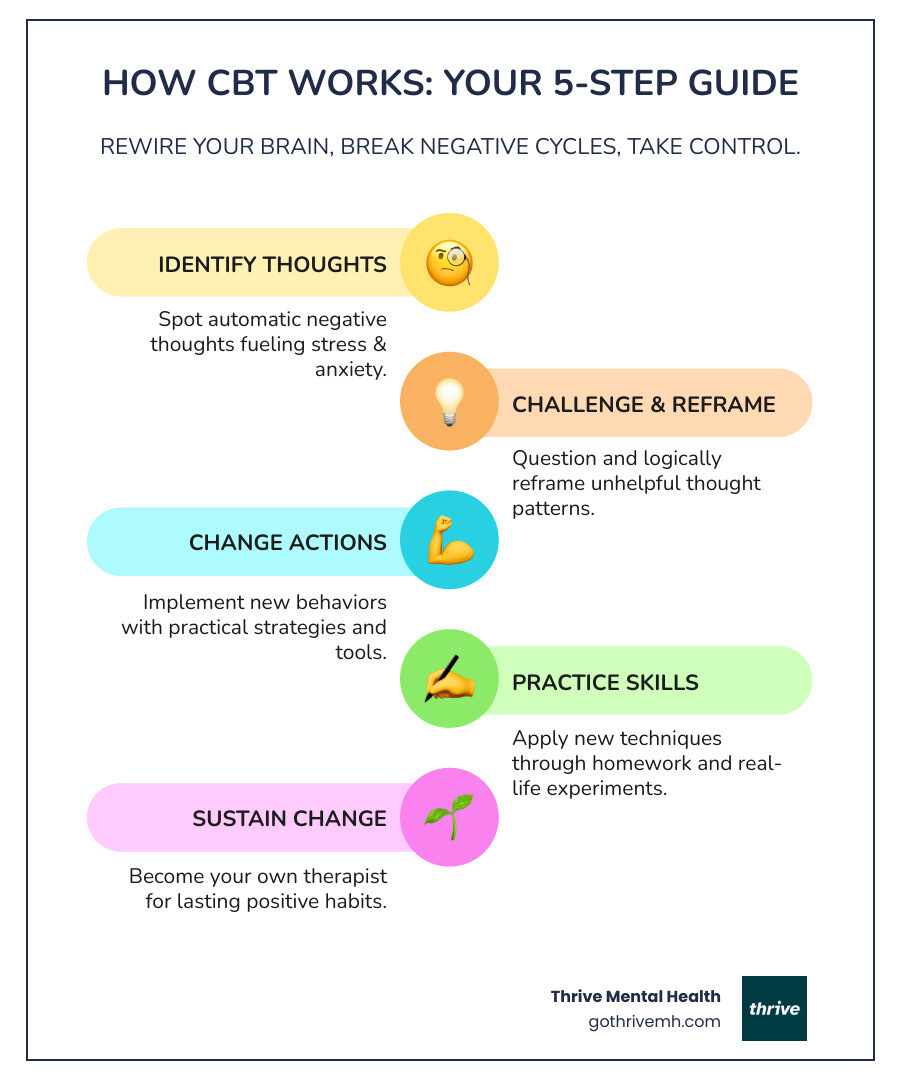
Key how cognitive behavioral therapy works vocabulary:
What Is CBT? The Fastest, Most Effective Way to Change How You Think and Act
Cognitive Behavioral Therapy (CBT) is a structured, goal-driven therapy that helps you change how you think and act, quickly. It’s not about years on a couch discussing your childhood; it’s about learning practical skills today to feel better tomorrow.
Developed by Dr. Aaron Beck, CBT is the gold standard for treating anxiety, depression, PTSD, and more because it’s proven to work. Research shows it’s as effective as medication, but the skills you learn last a lifetime. At Thrive Mental Health, we integrate CBT into our virtual IOP programs, giving you expert-led care with the flexibility you need.
Why CBT Works: Your Thoughts, Feelings, and Actions Are Linked
The core idea of CBT is that your thoughts, feelings, and behaviors are connected in a cycle. A negative thought (“I’m going to fail”) triggers a negative feeling (anxiety), which drives a behavior (avoidance), reinforcing the original thought. CBT teaches you to break this cycle. By changing the thought or the behavior, you change the feeling. It’s not just talk, it’s skill-building for real life. Learn more by Exploring the Basics of Cognitive Behavioral Therapy (CBT).
How CBT Stands Out: Fast Results, Real Skills, No Endless Therapy
CBT is different from traditional talk therapy. It’s present-focused, structured, and collaborative. The goal is to make you your own therapist by teaching you skills you can use independently long after your sessions end. This is why it’s so effective at preventing relapse and is widely covered by insurance providers like Cigna, Optum, and Florida Blue.
Here’s how CBT compares to traditional talk therapy:
| Feature | Cognitive Behavioral Therapy (CBT) | Traditional Talk Therapy |
|---|---|---|
| Focus | Present-day problems and solutions | Past experiences and unconscious patterns |
| Duration | Short-term, usually 5-20 sessions | Often long-term and open-ended |
| Skills | Practical coping strategies, thought challenging | Self-awareness, emotional processing |
| Patient Role | Active participant, practices skills | Explores past with therapist guidance |
| Insurance | Widely covered by Cigna, Optum, etc. | Coverage can be limited for long-term care |
CBT delivers tools for change, fast. Most people see progress in 5 to 20 sessions. That’s how cognitive behavioral therapy works.
How Cognitive Behavioral Therapy Works: Step-by-Step Breakdown
Understanding how cognitive behavioral therapy works means seeing it as a hands-on process. You’re not just talking about problems; you’re learning to dismantle the cycles that keep you stuck and build new, effective patterns.

Step 1: Spot and Challenge Automatic Negative Thoughts
Your brain constantly produces rapid-fire automatic thoughts that shape your feelings and actions. Many of these thoughts are distorted and unhelpful. For example, a simple text like “Can we talk later?” might trigger an automatic thought: “They’re mad at me,” causing anxiety.
CBT teaches you to pause and identify these thoughts. Using a thought record, you’ll log the situation, thought, and emotion. Then, you’ll challenge the thought: What’s the evidence for or against it? Is there another way to see this? This process, called cognitive restructuring, rewrites the negative scripts in your brain. You’ll learn to spot common cognitive distortions like all-or-nothing thinking, catastrophizing, and mind-reading, which is How CBT Can Transform Negative Thought Patterns.
Step 2: Change Your Actions, Build Habits That Reinforce Recovery
Sometimes the fastest way to change how you feel is to change what you do. CBT uses action-oriented strategies to break cycles of depression and anxiety.
- Behavioral Activation: For depression, this involves re-engaging with positive activities, even when you lack motivation. Action comes first; feelings follow.
- Exposure Therapy: For anxiety and phobias, you’ll gradually face feared situations in a controlled way. This teaches your brain that what you fear isn’t as dangerous as it seems.
- Relaxation Techniques: Tools like deep breathing and mindfulness help you manage stress in the moment.
At Thrive, you’ll practice these skills in and out of sessions, creating change that sticks. That’s how cognitive behavioral therapy works.
What to Expect in a Thrive CBT Program: Your Roadmap to Results
Joining a Thrive Mental Health CBT program means you get a structured, results-driven roadmap to recovery. Our virtual Intensive Outpatient (IOP) program offers clinical expertise with the flexibility of evening options, serving clients across Florida.

Anatomy of a CBT Session: What Happens Each Time
Every session is structured for progress. A typical hour includes:
- Mood Check-in: Briefly track your progress and feelings.
- Homework Review: Discuss what worked and what was challenging.
- Agenda Setting: Collaboratively decide on the session’s focus.
- Skill Building: Learn and practice new CBT techniques.
- Next Steps: Summarize takeaways and assign new homework.
Your Role vs. Your Therapist’s Role: A True Partnership
CBT is a partnership. Your job is to bring honesty and a willingness to practice. Your Thrive therapist’s job is to provide expertise, tools, and guidance in a safe space. As the Mayo Clinic notes, therapy works best when you are an active participant. You’re not a passive patient; you’re building skills for life.
CBT Homework: The Secret to Fast, Lasting Change
Real change happens between sessions. Homework is central to CBT’s success. You’ll use tools like thought records, behavioral experiments, and activity scheduling to apply what you learn in your daily life. This consistent practice is what rewires your brain and makes the skills second nature, ensuring the changes stick long after your program ends.
Is CBT Right for You? [Conditions, Benefits, and Real Results]
Cognitive behavioral therapy is for anyone who wants to break free from unhelpful patterns, whether it’s anxiety, depression, or everyday stress. As one of the most researched and effective therapies, it’s recommended by leading health organizations and covered by most major insurance providers, including Cigna, Optum, and Florida Blue.

What Conditions Does CBT Treat?
CBT is a versatile therapy proven to be effective for a wide range of mental, emotional, and even physical health challenges. Our CBT for Mood Disorders programs are custom to address these diverse needs.
 Et Tu, Brute? Navigating the Pain of Betrayal TraumaMental Health
CBT effectively treats:
- Anxiety Disorders: (Generalized anxiety, social anxiety, panic disorder, phobias)
- Depression: (Major depressive disorder, postpartum depression)
- PTSD and Trauma: Processing traumatic memories and reducing their emotional grip.
- OCD: Using Exposure and Response Prevention (ERP) to break the cycle of compulsions.
- Eating Disorders: Challenging distorted body image and unhealthy behaviors.
- Substance Use Disorders: Identifying triggers and building coping strategies.
- Other Conditions: CBT also helps manage symptoms of bipolar disorder, ADHD, personality disorders, insomnia, and chronic pain.
If you are experiencing suicidal thoughts, please call or text 988 immediately. Help is available, and you are not alone.
How Fast Does CBT Work? What Results Can You Expect?
Most clients at Thrive see significant results within 5-20 sessions, often noticing positive changes in the first few weeks. This isn’t a temporary fix; research shows how cognitive behavioral therapy works to create lasting change and prevent relapse, often more effectively than medication alone. The skills you learn are tools for life, empowering you to become your own therapist. Because it’s proven to work, our programs are in-network with major insurance providers across Florida.
How Does CBT Address Current Problems Versus Past Issues?
Unlike traditional therapy that may spend years unpacking your childhood, how cognitive behavioral therapy works is by focusing relentlessly on the here and now. While the past provides context, it’s not the main event. We’re not asking why you developed a pattern years ago; we’re asking how that pattern is affecting you today and what you can do to change it.
Think of it like fixing a broken engine: you need to know what’s wrong now to get moving again. CBT is problem-oriented and solution-focused. We identify the specific thoughts, feelings, and behaviors causing you distress in your current life and give you tools to manage them effectively. This present-focused approach is why CBT delivers results in weeks, not years. Our programs at Thrive in Florida are designed to get you better, faster.
When Might Medication Be Used in Conjunction with CBT?
While CBT is powerful on its own, how cognitive behavioral therapy works is sometimes improved with medication. This isn’t a weakness; it’s a strength of an integrated treatment plan.
Medication can be a crucial tool when symptoms of depression or anxiety are so severe they prevent you from engaging in therapy. It can provide the initial stability needed to do the work. For many, especially those with severe or chronic conditions, research shows that CBT combined with medication is more effective than either treatment alone.
This approach addresses both brain chemistry and psychological patterns. At Thrive, our therapists work hand-in-hand with psychiatrists and nurse practitioners to ensure your treatment is seamless. Medication isn’t a sign that therapy is failing; it’s often the tool that helps therapy succeed.
Who Provides CBT, and How Can One Find a CBT Therapist?
CBT is delivered by qualified mental health professionals, including licensed psychologists, therapists, counselors, and clinical social workers. At Thrive Mental Health, our team is extensively trained in evidence-based CBT.
Finding the right therapist is key. Here’s how:
- Get Referrals: Ask your primary care physician or trusted friends.
- Verify Credentials: Ensure any therapist is licensed in Florida.
- Confirm Specialization: Look for a therapist experienced with your specific concerns, like anxiety or PTSD.
- Schedule a Consultation: Use an initial call to see if it’s a good fit. The therapeutic relationship is crucial for success.
- Consider Virtual Therapy: Online CBT is just as effective as in-person care and offers greater flexibility.
Thrive Mental Health simplifies this process. We match you with a qualified CBT therapist in our virtual IOP programs. We’re in-network with major providers like Cigna, Optum, and Florida Blue. Verify your insurance in 2 minutes to get started.
FAQs: How Cognitive Behavioral Therapy Works, Your Top Questions Answered
How long does CBT take to work?
Most Thrive clients see meaningful results in 5-20 sessions, often noticing positive changes within the first few weeks. Unlike traditional therapy that can last for years, CBT is designed for rapid, lasting results.
Is CBT covered by insurance?
Yes. CBT is an evidence-based therapy widely covered by insurance. Thrive is in-network with Cigna, Optum, Florida Blue, and many other major providers. You can verify your insurance in 2 minutes (no obligation) on our site.
Can I do CBT online?
Absolutely. Research shows online CBT is just as effective as in-person sessions. Thrive offers fully virtual IOP programs across Florida, with evening options available.
Does CBT focus on the past?
No. CBT is focused on the present. We address the thoughts and behaviors causing problems right now to help you move forward quickly, rather than spending years analyzing the past.
What is the main goal of CBT?
The main goal is to teach you the skills to become your own therapist. You’ll learn to manage your thoughts, feelings, and behaviors independently, equipping you with a toolkit for lifelong mental wellness. That’s the real power of how cognitive behavioral therapy works.
Summary: How Cognitive Behavioral Therapy Works, The Takeaway
How cognitive behavioral therapy works is by giving you practical tools to break the negative thought-feeling-behavior cycles that keep you stuck. It’s a fast, proven, and present-focused therapy that delivers results in weeks, not years.
You learn to identify, challenge, and change the patterns that fuel anxiety, depression, and stress. The goal isn’t endless talk; it’s to equip you with skills that last a lifetime, making you your own therapist.
At Thrive Mental Health, our virtual IOP programs deliver expert-led CBT across Florida. We’re in-network with Cigna, Optum, Florida Blue, and more, making life-changing care accessible.
Ready for support? Thrive offers virtual IOP programs with evening options. Verify your insurance in 2 minutes (no obligation) or call 561-203-6085. If you’re in crisis, call/text 988.

This article is for informational purposes only and is not a substitute for individualized clinical advice or insurance verification.