
Find Your Zen: Art Therapy for Ultimate Relaxation
Ditch the Stress, Not Your Sanity
Art therapy for relaxation is a proven, science-backed approach that uses creative expression to reduce stress, lower anxiety, and promote emotional healing—no artistic skill required.
Quick Answer: How to Use Art Therapy for Relaxation
- Start simple – Try mindful doodling, mandala drawing, or clay sculpting for 15-20 minutes
- Focus on the process – Release judgment about the outcome; it’s about expression, not perfection
- Create regularly – Even short sessions lower cortisol (your stress hormone) by up to 75%
- Stay present – Engage your senses and let the creative act bring you into a “flow state”
If you’re reading this, you’re probably exhausted. Stress is suffocating. Your brain won’t shut off. Your body feels tight. Weekly therapy isn’t cutting it, and you need relief now—not six months from now.
Here’s the truth: art therapy for relaxation works faster than you think. Research shows that 75% of people who spent just 45 minutes creating art experienced measurable drops in cortisol, the hormone that keeps you wired and anxious. You don’t need to be Picasso. You don’t even need to like what you make. You just need to make.
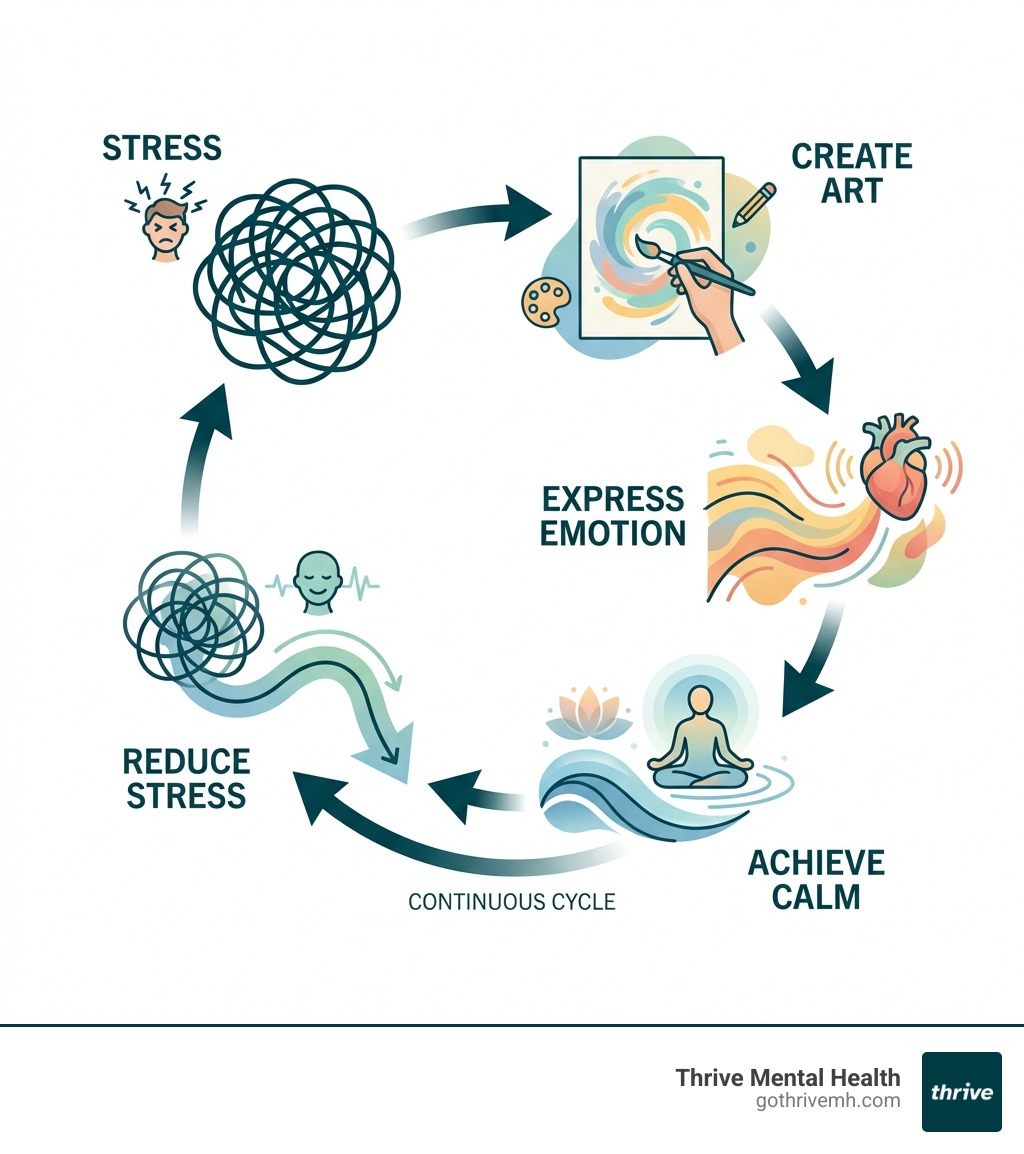
Art therapy isn’t an art class. It’s not about technique, critique, or creating something Instagram-worthy. It’s a therapeutic process that uses painting, drawing, sculpting, or even doodling to help you express emotions you can’t put into words. It’s about finding calm in the chaos, one brushstroke at a time.
The modern stress epidemic is real. Burnout, anxiety, and overwhelm are at all-time highs—especially for driven professionals and college-aged adults juggling impossible demands. Traditional therapy can feel slow. Art therapy offers a tangible escape, a way to externalize what’s stuck inside and create space for healing.
And no, you don’t need to be “creative.” You just need to show up.
As Nate Raine, CEO of Thrive Mental Health, I’ve spent over a decade building evidence-based mental health programs that integrate creative modalities, including art therapy for relaxation, to help people access faster, measurable relief. At Thrive, we’ve seen how combining therapeutic creativity with structured care transforms outcomes for individuals who need more than weekly talk therapy.
What Is Art Therapy (And Why Isn’t It Just an Art Class?)
You might be wondering, “What exactly is art therapy, and how is it different from the art class I took in high school?” That’s a great question, and understanding the distinction is key to open uping its power for relaxation.
Art therapy is a mental health profession that uses active art-making, the creative process, applied psychological theory, and human experience within a psychotherapeutic relationship. As the American Art Therapy Association defines it, it enriches the lives of individuals, families, and communities. The term “art therapy” was actually coined by British artist Adrian Hill in 1942, who is considered its founder.
The core difference lies in the goal and focus. In art therapy, the emphasis is on the process of creation and emotional expression, not on producing a “good” piece of art. It’s about what you experience, feel, and find during the act of making, rather than the aesthetic quality of the final product. A licensed art therapist guides this process, helping you explore your inner world, communicate nonverbally, and work through emotions.
Think of it this way: In a traditional art class, the teacher might show you how to mix colors or perfect your brushstrokes. They’re focused on skill acquisition and technical proficiency. In art therapy, the therapist might encourage you to simply choose colors that represent your mood, or to make marks without any specific intention. They’re focused on your emotional well-being and helping you gain insight into your feelings.
For a clearer picture, let’s look at a comparison:
| Feature | Art Therapy | Art Class |
|---|---|---|
| Goal | Healing, self-findy, emotional release | Skill acquisition, technical proficiency |
| Focus | Process, inner experience, meaning | Product, aesthetic quality, technique |
| Guidance | Licensed therapist, psychological theories | Art instructor, artistic principles |
| Outcome | Insight, stress reduction, coping skills | Finished artwork, improved artistic ability |
You can learn more about the professional side of this field, including art therapy and counseling, if you’re interested in the deeper therapeutic applications.
The Goal: Healing vs. A Masterpiece
Our primary goal in art therapy is always healing and self-findy. We use artistic activities to help you process emotions, gain insight into challenges, and develop healthier coping mechanisms. It’s a journey inward, facilitated by external creation. The beauty of the final piece is secondary – if it even matters at all. What matters is the release, the understanding, and the peace you find along the way.
The Guidance: Therapist vs. Teacher
In a formal art therapy setting, you’ll work with a licensed professional. These therapists are trained in both art and psychotherapy, using psychological theories to create a safe, non-judgmental space for your exploration. They guide you, not by telling you what to create, but by asking questions that help you connect with your art and your emotions. This is a stark contrast to an art instructor, whose role is to impart technique and offer constructive criticism on your artistic output. The therapist’s role is to help you heal, not to make you a better artist.
The Science of Calm: How Art Rewires Your Stressed-Out Brain
The benefits of engaging in art therapy for relaxation aren’t just anecdotal; they’re backed by science. When we immerse ourselves in creative expression, our brains and bodies respond in profound ways, leading to significant physiological and psychological relief.
Lower Your Stress Hormones in Under an Hour
One of the most compelling findings is art’s ability to directly impact our stress hormones. A Drexel University study found that 75% of participants experienced lowered cortisol levels after just 45 minutes of creating art. Cortisol is the body’s primary stress hormone, responsible for initiating our “fight-or-flight” response. While essential for survival, chronically high cortisol levels can wreak havoc on our physical and mental health. Engaging in art can interrupt this stress cycle, offering a tangible biological shift towards calm.
And it’s not just cortisol. Studies have shown that creative outlets can also lead to increased dopamine levels. Dopamine, often referred to as the “feel-good” neurotransmitter, is frequently low in individuals experiencing anxiety, depression, and excessive stress. By boosting dopamine, art-making can help lift mood and foster a greater sense of well-being.
The research is clear: “Studies have shown that most people who try art as a form of therapy or stress relief have experienced significant reductions in their cortisol levels.” We’re talking about real, measurable changes in your body, not just a fleeting good mood.
Find Your Focus Through Mindfulness and “Flow”
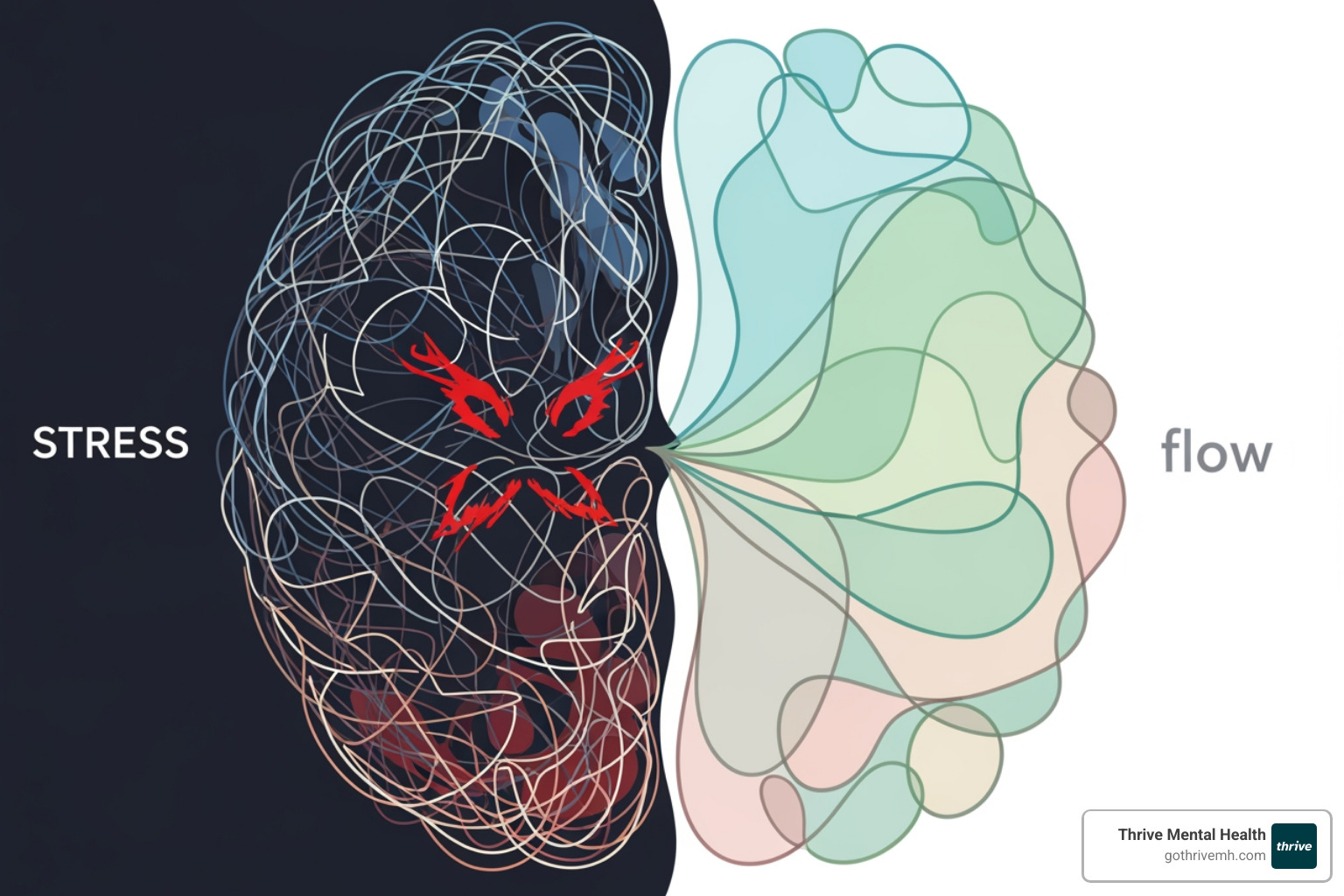
Beyond hormones, art-making cultivates mindfulness and helps us achieve a state of “flow.” Mindfulness is about being present, fully engaged in the moment without judgment. When you’re absorbed in creating, you’re naturally drawn into the present. Your worries about the past or future fade, replaced by focused attention on colors, textures, and movements.
This deep immersion often leads to a “flow state”—a term coined by psychologist Mihaly Csikszentmihalyi. In flow, you lose track of time, your self-consciousness diminishes, and you experience a sense of effortless concentration. It’s a deeply meditative and restorative experience. This engagement with art, whether through repetitive motions or sensory exploration, acts as a powerful antidote to mental chatter, allowing your mind to rest and reset.
The psychological and physiological benefits extend to long-term stress management, as the act of creating art promotes emotional release. It provides a non-verbal language for complex feelings, allowing us to externalize and process what might be too difficult to articulate with words. This expressive outlet is a vital component in overall mental well-being and can be a powerful tool in our approach to healing. Our programs at Thrive Mental Health in Florida often integrate such creative modalities to help clients explore and heal. You can explore more about the healing power of art therapy on our blog.
Your At-Home Studio: 7 Simple Exercises for Instant Relaxation
You don’t need to be an art prodigy or have a fully stocked studio to engage in art therapy for relaxation. The beauty of these exercises is their accessibility and the fact that no artistic talent or experience is required. The focus is on the process, the sensory experience, and the emotional release.
We’ve curated seven simple, effective art therapy exercises you can easily do at home. Gather some basic supplies, find a quiet space, and let’s begin your journey to calm.
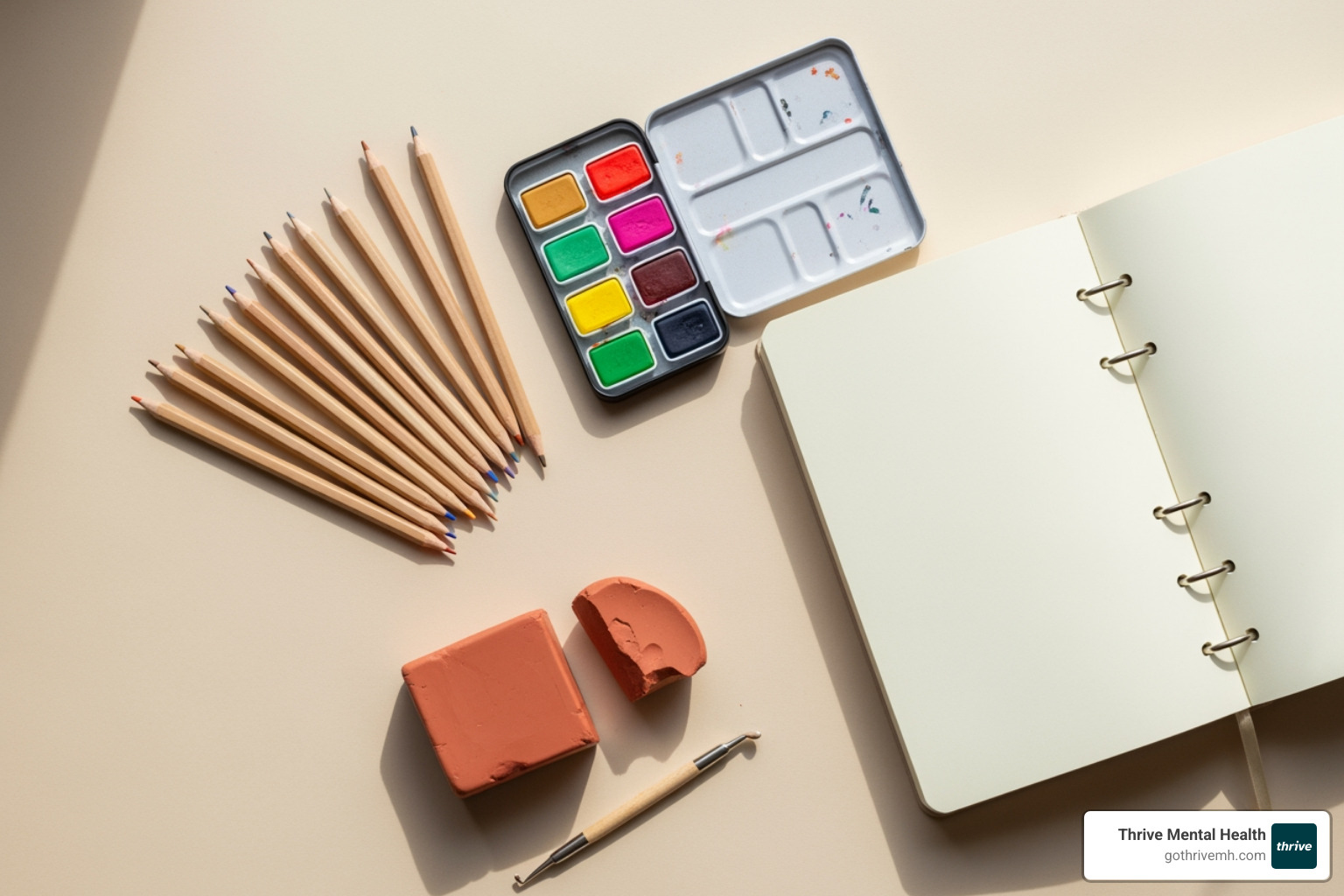
Basic Supplies You Might Need:
- Paper (any kind!)
- Pens, pencils, markers, or crayons
- Watercolors and brushes
- Modeling clay or playdough
- Old magazines, newspapers, or fabric scraps
- Smooth stones
- Glue or tape
For more ideas, check out these art therapy activities for adults.
1. Mindful Doodling: Let Your Pen Wander
Mindful doodling is about letting go of control and simply allowing your pen to move across the paper. There are no expectations, no right or wrong.
How to do it: Close your eyes for a moment, take a deep breath, and feel the pen in your hand. Then, with eyes closed or softly unfocused, start making simple shapes, lines, or scribbles. Focus on the sensation of the pen on the paper. “Make lines simply because it feels good to make them,” suggests Art in Coaching. You’ll be surprised how calming this non-judgmental act can be.
2. Mandala Drawing: Create Your Circle of Calm
Mandalas, meaning “circle” in Sanskrit, are geometric designs that represent the cosmos or deities in various spiritual traditions. Drawing them can be incredibly meditative.
How to do it: Start by drawing a large circle on your paper. Then, without judgment, begin to fill it with patterns, shapes, and colors, working from the center outwards or vice versa. The repetitive nature and symmetry of mandalas can help focus your mind and reduce negative emotions. A study by the National Library of Medicine indicates that mandala drawing has the power to reduce negative emotions in its creators. You can use printable templates or draw freehand.
3. Clay Sculpting: Mold Your Emotions
Working with clay is a wonderfully tactile and grounding experience. The act of shaping and molding can be deeply therapeutic, allowing you to physically express and transform feelings.
How to do it: Take a piece of modeling clay or even playdough. Begin to squeeze, roll, and shape it without a specific goal in mind. You might find yourself intuitively molding it to represent a feeling—stress, anger, joy—or simply enjoying the sensation of the material in your hands. As Spotted Rabbit Studio notes, “Sculpting with clay can become a powerful metaphor for personal growth and development.” You can then reshape it, smash it, or display it—the choice is yours.
4. Visual Journaling: Paint Your Inner World
Visual journaling combines the power of art with the reflective practice of writing. It’s a fantastic way to explore your emotions and experiences non-verbally and verbally.
How to do it: Get a blank notebook or sketchbook. On one page, create a drawing, painting, or collage that expresses how you’re feeling. On the opposite page, write about your thoughts, feelings, or experiences related to the artwork. The beauty of an art journal is that “everything is welcome and everything belongs,” according to Mindful Art Studio. There’s no pressure for perfection, making it a truly forgiving and insightful art form. For more inspiration, check out our blog on easy mental health drawing.
5. Watercolor Painting: Accept the Flow
Watercolor is an ideal medium for relaxation because its fluid nature encourages letting go of control. It’s about observing and allowing, rather than forcing.
How to do it: Take some watercolor paper and a cup of water. Using a brush, wet the entire paper surface with plain water. Then, choose 2-3 colors of watercolor paint. Drip, brush, or splatter the paint onto the wet paper. Watch as the colors merge and spread, creating organic, unpredictable patterns. Focus on the movement and the blending of colors. This exercise is deeply mindful and can be incredibly soothing. You can even use a straw to blow the paint, creating unique textures. For a visual guide, you can watch a tutorial here.
6. Collage Creation: Piece Together Your Thoughts
Collage is a versatile art form that involves assembling different materials—paper, fabric, photos, text—onto a surface. It’s a non-linear way to express complex thoughts and emotions.
How to do it: Gather old magazines, newspapers, fabric scraps, photos, or anything that catches your eye. Without overthinking, cut out images, words, and textures that resonate with you or represent your current feelings. Arrange and glue them onto a piece of paper or cardboard. The act of selecting and arranging can be highly meditative, and the final piece can offer surprising insights into your inner world. Creating a collage can be a great outlet for expressive arts therapy, allowing you to piece together different parts of your experience.
7. Story Stones: Narrate Your Inner Journey
Story stones are a simple yet powerful way to explore narratives and themes that are meaningful to you, often used by educators and therapists.
How to do it: Find a few smooth, flat stones. Using paints or markers, draw simple images or symbols on each stone. These could be anything: a house, a tree, an emotion, an animal, a journey. Once dry, arrange the stones and use them to tell a story. This can be a story about your day, a past experience, a wish for the future, or even a metaphorical representation of a challenge you’re facing. As Alleluiarocks.com explains, story stones allow you to use your imagination and explore narratives in a tangible way.
Beyond a Hobby: Making Art Therapy a Pillar of Your Well-Being
Integrating art therapy for relaxation into your routine is more than just picking up a casual hobby; it’s about building a powerful tool for long-term stress management and overall well-being. The magic happens when creativity becomes a consistent, non-negotiable part of your self-care.
We often think of self-care as a luxury, but for many of us navigating demanding lives in Florida, it’s a necessity. Art therapy helps build resilience, equipping you to face daily stressors with greater calm and clarity.
Building a Routine for Lasting Art Therapy for Relaxation
Consistency is key. Even dedicating 15-20 minutes a few times a week can make a significant difference. Think of it as an appointment with yourself—a sacred time for creative decompression.
- Schedule it: Just like you would a workout or a meeting, block out “Art Time” in your planner.
- Create a dedicated space: It doesn’t need to be fancy. A corner of a desk, a small table, or even a lap desk can become your creative sanctuary. Having your supplies readily available makes it easier to start.
- Start small: Don’t feel pressured to create a masterpiece every time. A few minutes of mindful doodling or coloring can be just as effective as a longer session.
- Make it a habit: The more you do it, the more natural it becomes. Soon, you’ll crave that creative outlet as a way to de-stress.
This regular practice contributes to long-term stress management by training your brain to switch into a more relaxed, mindful state. It helps build a foundation of calm that supports your overall well-being. Learn more about how art therapy enhances mental health.
The Power of Non-Judgment in Art Therapy for Relaxation
Perhaps the most liberating aspect of art therapy for relaxation is the emphasis on non-judgment and acceptance. We’re conditioned to strive for perfection, to critique our output. But in this context, that mindset is counterproductive. The goal isn’t a museum-worthy piece; it’s emotional release and self-expression.
Letting go of perfectionism means embracing the “mess.” It means understanding that there’s no “right” or “wrong” way to express yourself. This acceptance extends beyond the canvas, fostering a more compassionate and accepting internal dialogue. When you can be non-judgmental about your art, you’re practicing being non-judgmental about yourself. This self-compassion creates a safe internal space for emotional exploration and growth.
Exploring Different Modalities for Stress Reduction
While visual arts are central to art therapy, the broader field of creative arts interventions offers diverse paths to relaxation. Each modality brings its unique benefits:
- Painting and Drawing: These are excellent for direct emotional expression, allowing you to translate feelings into colors, shapes, and forms. Painting, particularly with fluid mediums like watercolors, encourages letting go of control and embracing the unpredictable.
- Clay and Sculpting: The tactile nature of clay provides a grounding experience. It allows for physical manipulation of emotions, offering a tangible way to “work through” feelings and build a sense of agency.
- Music Therapy: Music has a profound impact on mood and the nervous system. Whether listening to soothing melodies or actively playing an instrument, music therapy has been shown to reduce stress, anxiety, and even perceived pain. Studies confirm that music therapy interventions significantly reduce stress, anxiety, and depression.
- Dance/Movement Therapy: This modality uses movement to promote emotional, social, cognitive, and physical integration. It can be incredibly effective for releasing pent-up energy, improving body awareness, and fostering emotional expression.
A comprehensive systematic review on creative arts interventions for stress management and prevention found compelling evidence. Across various modalities (art, music, dance, drama therapy), an impressive 81.1% of included studies reported a significant reduction of stress in participants. This robust evidence underscores the power of creative expression across different forms to foster deep relaxation and mental well-being. For those in Florida seeking structured support, Thrive Mental Health offers virtual and hybrid IOP/PHP programs, often incorporating these diverse creative approaches into our personalized treatment plans.
Frequently Asked Questions about Art Therapy for Relaxation
Do I need to be an artist to try art therapy?
Absolutely not. Art therapy for relaxation is about the creative process and emotional expression, not the artistic quality of the final product. Your feelings are the focus, not your technique. We emphasize that there’s no right or wrong way to make art in this context, and your internal experience is what truly matters.
Can I do art therapy on my own?
You can practice therapeutic art activities at home for general relaxation and stress relief. These self-guided activities, like the ones we’ve shared, can be incredibly beneficial. However, formal “art therapy” is a clinical practice led by a licensed art therapist to address specific mental health goals, such as processing trauma, managing anxiety, or improving mood. In Florida, these professional services are often covered by insurance plans like Cigna, Optum, and Florida Blue. If you’re seeking structured support, our virtual Intensive Outpatient Programs (IOP) at Thrive Mental Health can connect you with licensed professionals who integrate art therapy into comprehensive treatment plans.
What’s the difference between art therapy and expressive arts therapy?
Art therapy primarily uses visual arts like drawing, painting, and sculpting as its main modality. Expressive arts therapy is a broader term that integrates multiple creative modalities, including visual arts, music, dance, writing, and drama, to facilitate healing and self-findy. While art therapy focuses deeply on the visual field, expressive arts therapy encourages moving between different art forms to find the most resonant mode of expression. Both aim for therapeutic outcomes, but expressive arts therapy offers a wider palette of creative tools.
Take the Next Step Toward a Calmer You
Art therapy for relaxation is a powerful, science-backed tool for managing stress and enhancing your well-being. By embracing the creative process without judgment, you can open up a profound sense of calm and self-awareness. Whether you choose to doodle mindfully, sculpt your emotions, or explore visual journaling, the act of creation offers a unique pathway to inner peace.
For those seeking a more structured path to healing, Thrive Mental Health integrates evidence-based modalities like art therapy into our flexible virtual IOP and PHP programs. Designed for adults who need more than once-a-week therapy but less than inpatient care, our programs offer a supportive environment to address stress, anxiety, depression, and other mental health concerns. We serve individuals across Florida, providing expert-led care that fits your life.
Ready for support? Thrive offers virtual and hybrid IOP/PHP programs with evening options. Verify your insurance in 2 minutes (no obligation) or call 561-203-6085. If you’re in crisis, call/text 988.