





Art Therapy and Counseling: Transformative 2025
Why Art Therapy in Counseling Changes the Mental Health Conversation
Art therapy and counseling combine creative expression with clinical mental health treatment, offering a powerful pathway for people who struggle to put their feelings into words. It isn’t about being “good at art.” It’s about using color, texture, and form to communicate what feels impossible to say, engaging the mind and body in ways traditional talk therapy often can’t. If you’re searching for a way to heal that doesn’t rely solely on words, this guide explains what art therapy is, how it works, and who can benefit.
Quick Answer: What is Art Therapy and Counseling?
| What It Is | A mental health profession integrating art-making, psychological theory, and psychotherapy |
| Who Provides It | Master’s-level clinicians trained in art and therapy, often licensed as LPCs or LCATs |
| How It Works | Clients create art (drawing, painting, sculpting) to explore emotions, trauma, and personal growth |
| Where It’s Used | Hospitals, schools, private practices, veteran clinics, community centers, and virtual programs |
| Key Difference | Led by a credentialed therapist with clinical goals, not just making art for relaxation |
Many people turn to art therapy and counseling when anxiety, depression, or trauma feel overwhelming. Research shows that mindfulness-based art therapy can reduce stress and is particularly effective for populations like autistic individuals and trauma survivors. However, not all art activities qualify as therapy. Real art therapy is led by a credentialed art therapist with a master’s degree and extensive clinical training, distinguishing it from recreational art or self-help apps.
At Thrive Mental Health, our trained clinicians in Florida have seen how art therapy and counseling opens up healing for people who feel stuck, especially in flexible virtual settings where access matters most.
What is Art Therapy and How Does It Work?
Art therapy and counseling is a legitimate mental health profession that integrates creative expression with clinical treatment. At Thrive Mental Health, we’ve seen it open doors for people across Florida who feel stuck or unable to find the right words for their experiences.
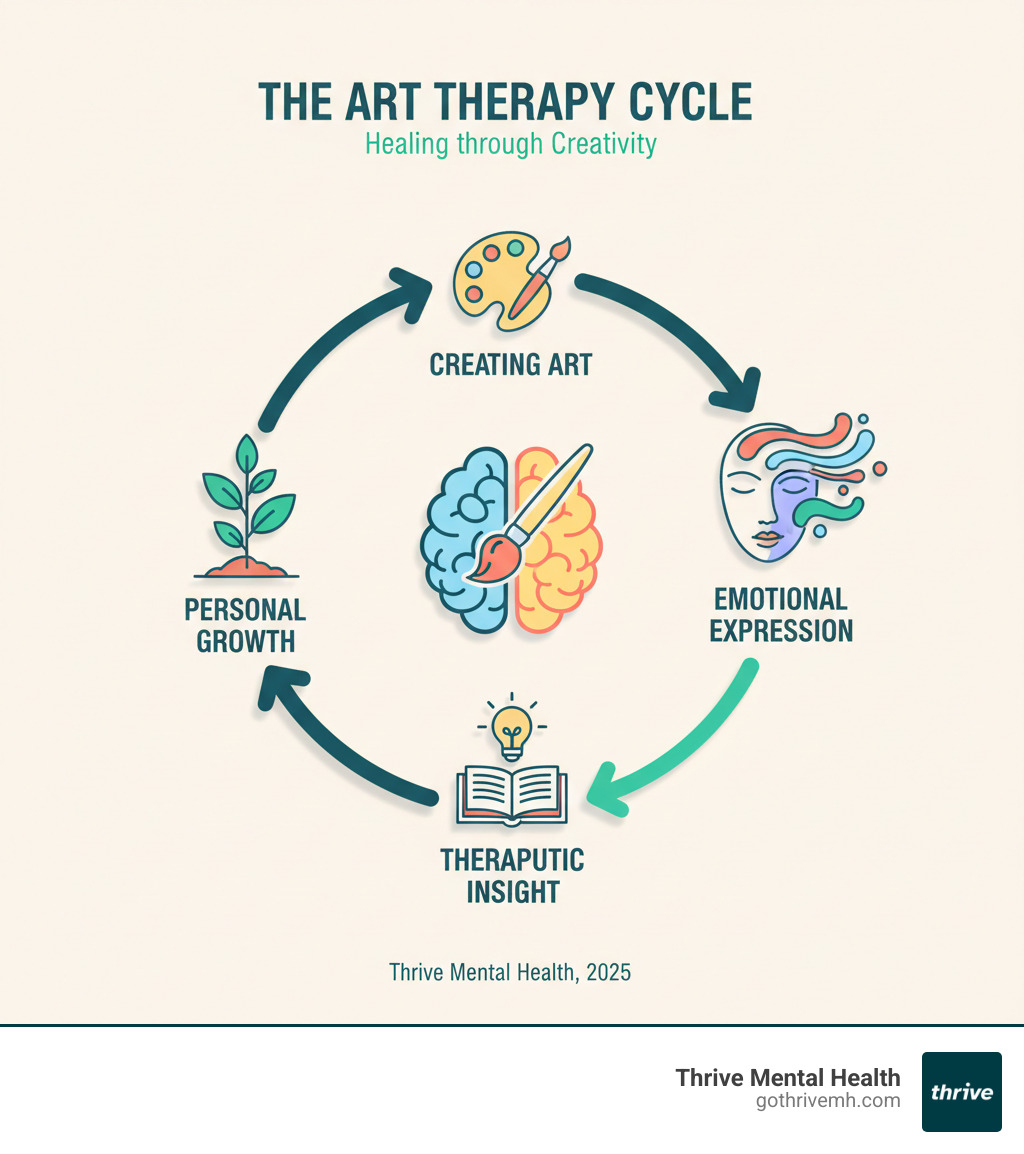
An art therapist, a clinician with a master’s degree and specialized training, guides you through creating art as part of your treatment. The goal isn’t to make something beautiful, but to use the creative process to explore emotions, work through trauma, and build resilience. The art becomes a bridge to your inner world, engaging your mind, body, and spirit through movement, sensation, and symbolism.
Research confirms its effectiveness, with studies showing that mindfulness-based art therapy interventions can significantly reduce anxiety and stress. To learn more, read The Healing Power of Art: How Art Therapy Can Transform Mental Health.

Core Principles of Art Therapy
Art therapy transforms art-making into a powerful therapeutic tool through several core principles:
- Kinesthetic Engagement: The physical act of creating, squeezing clay, moving a brush, helps release tension stored in the body.
- Sensory Experience: The smell of paint or texture of paper grounds you in the present, calming an anxious mind.
- Perceptual Shifts: Externalizing your feelings into a visual form allows you to see problems from a new perspective, leading to new insights.
- Symbolic Expression: You can use color, shape, and imagery to represent complex feelings without needing precise words.
- Bypassing Verbal Defenses: Art can access emotions that are blocked or intellectualized in talk therapy, allowing for breakthroughs.
- Fostering Self-Awareness: Creating and reflecting on art with a therapist helps you uncover hidden patterns and truths about yourself.
Art Therapy vs. Recreational Art: A Critical Distinction
While coloring books and art classes can be relaxing, they are not art therapy and counseling. The key difference lies in the presence of a credentialed therapist and clinical goals. The American Art Therapy Association is clear that such activities are valuable self-care tools but lack the therapeutic relationship, ethical framework, and professional guidance that define clinical art therapy.
| Feature | Art Therapy | Therapeutic Art Activities (e.g., coloring books) |
|---|---|---|
| Goal | Clinical assessment, diagnosis, treatment of mental health conditions, emotional processing, personal growth | Relaxation, stress relief, enjoyment, self-expression, hobby |
| Provider | Credentialed Art Therapist (Master’s degree, supervised training, ATCB certification/state licensure) | Self-directed, led by untrained facilitator, or part of general art class |
| Process | Guided exploration of artwork’s meaning, symbols, emotions; discussion and interpretation are central | Focus on the act of creation itself; discussion is optional and informal |
| Setting | Clinical settings (hospitals, private practice, schools), always within a therapeutic relationship | Home, community centers, informal groups; no clinical relationship |
| Emotional Safety | Therapist ensures safe space for deep emotional exploration and provides support for difficult feelings | Emotional experiences are self-managed; no professional support for intense responses |
| Outcome | Insight, behavioral change, trauma processing, improved coping skills, symptom reduction | Temporary stress reduction, enjoyment, improved focus, creative outlet |
Real art therapy happens within a therapeutic relationship, where a trained professional helps you process what emerges. This is why it can address serious mental health conditions in ways recreational art cannot.
The Professional Practice of Art Therapy and Counseling
Art therapy and counseling is a specialized mental health profession requiring rigorous training and clinical supervision. Art therapists are master’s-level clinicians grounded in both psychological theory and studio art practice. They hold national credentials like Board Certified Art Therapist (ATR-BC) and often state licenses such as Licensed Professional Counselor (LPC) or Licensed Creative Arts Therapist (LCAT), binding them to strict ethical standards.
The Role of the Professional in Art Therapy and Counseling
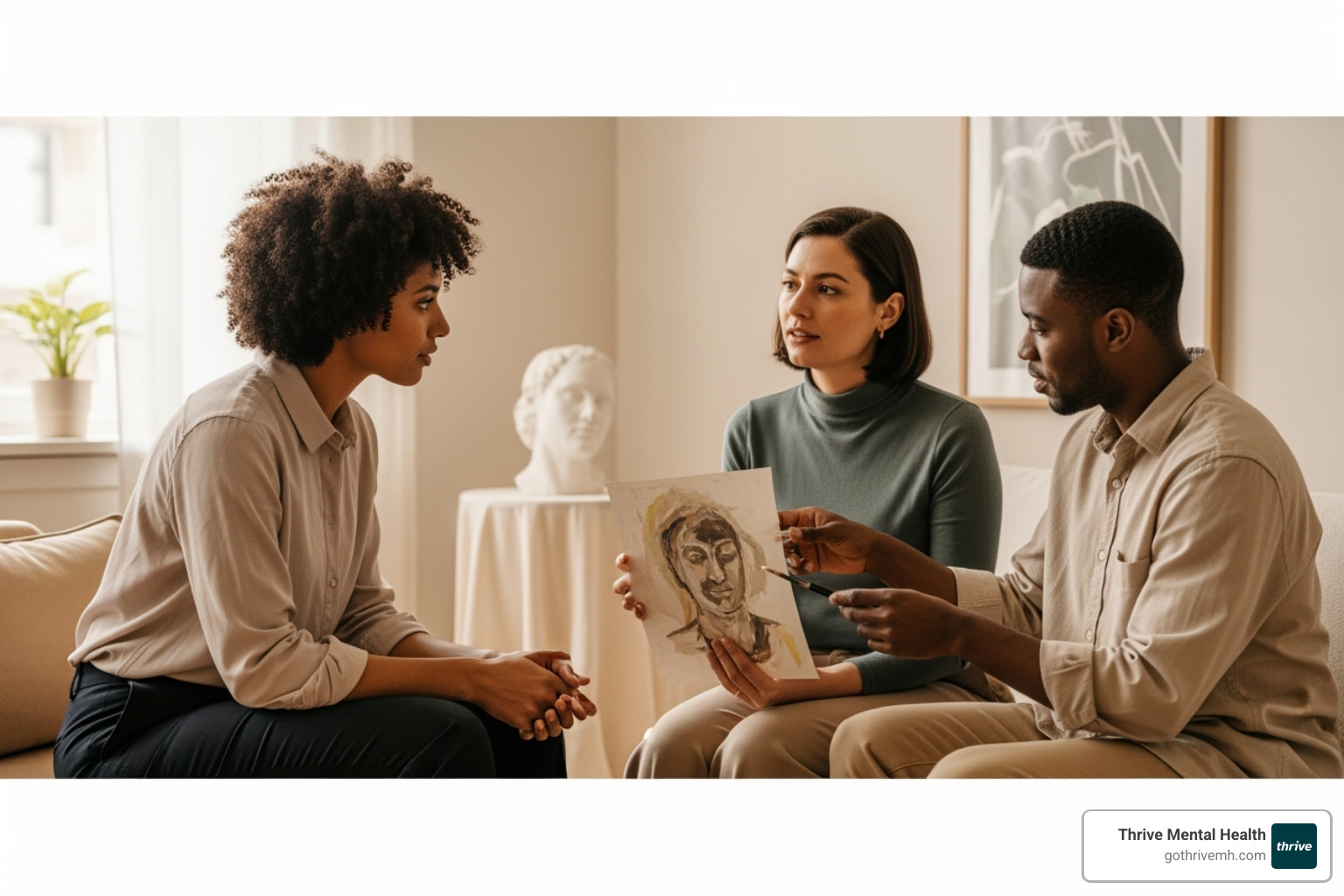
An art therapist is not an art teacher. They act as a facilitator, clinician, and guide. Their role is to create a safe, non-judgmental space for you to explore freely. They apply evidence-based psychological theories to your treatment plan and ask thoughtful questions to help you connect your art to your inner experiences. By fostering insight and upholding strict ethical standards, they help you make sense of what emerges on the canvas or in the clay. At Thrive Mental Health, our Florida-based art therapists are part of an integrated care team, providing holistic support. Learn more about our approach on our treatment modalities page.
Where Art Therapists Work
Art therapists work in a wide variety of settings, including:
- Hospitals and psychiatric wards
- Schools
- Private practices
- Community and veteran’s clinics
- Rehabilitation and crisis centers
- Senior communities and forensic institutions
- Virtual IOP programs, like ours at Thrive Mental Health, which offer accessible care for residents throughout Florida.
Verifying Credentials and Avoiding Misrepresentation
Not everyone who uses the term “art therapist” is qualified. To ensure you receive legitimate care, always verify credentials. A qualified professional will have a master’s degree in art therapy, completed 700+ hours of supervised clinical training, and be certified by the Art Therapy Credentials Board (ATCB). In Florida, art therapists are typically licensed as Licensed Mental Health Counselors (LMHCs), a key credential for clinical practice. A legitimate therapist will always be transparent about their qualifications.
Insurance Coverage for Art Therapy
Art therapy and counseling is often covered by insurance when delivered by a licensed and credentialed therapist. At Thrive Mental Health, we work with major providers like Cigna, Optum, Florida Blue, and Aetna. Coverage depends on your specific plan, but mental health parity laws often ensure it’s treated like any other medical service. We make it easy to verify your insurance benefits online with no obligation, helping you access care in Florida without financial stress.
The Transformative Benefits and Applications
Art therapy and counseling changes how you understand yourself and move through the world. It combines creative expression with clinical skill to help you heal, grow, and build resilience in ways talk therapy alone sometimes can’t. The benefits are tangible, research-backed shifts in how you manage stress, relate to others, and cope with life’s challenges.
Key benefits include:
- Stress Reduction: The focus required for art-making quiets mental noise and calms the nervous system.
- Emotional Resilience: By externalizing and processing difficult feelings in a safe space, you build the capacity to face future challenges.
- Improved Self-Esteem and Self-Awareness: Creating something that is uniquely yours affirms your experience and builds confidence.
- Conflict Resolution and Social Skills: Visualizing problems can lead to new solutions, and group therapy settings provide a space to practice empathy and communication.

How Art Therapy Helps Specific Populations
Art therapy and counseling is uniquely adaptable, offering a way to communicate when words fail.
 EMDR Therapy Explained: The 8 Phases + What to ExpectMental Health
- Trauma Processing: Art provides a non-verbal outlet to process memories and body sensations safely, without needing to narrate the traumatic event.
- Anxiety and Depression: The meditative quality of art-making can quiet racing thoughts, while the act of creation provides a sense of agency and accomplishment. Explore our guide on anxiety relief through art therapy.
- Autism Support: For autistic adults, art therapy offers a customizable, sensory-rich way to process complex thoughts and emotions without the pressure of verbal explanation.
- Grief and Loss: Creating art can help honor what’s been lost and give form to the complex emotions of grief. See our grief and loss guide for ideas.
- Teenagers: Art gives teens a non-judgmental outlet to explore their identity and manage stress. Learn more in our guide to art therapy for teenagers.
- Seniors and Memory Care: Reminiscence art projects can help preserve memories, maintain identity, and foster connection for older adults with dementia.
Art Therapy for Community and Societal Change
Beyond individual healing, art therapy can be a tool for collective change. Through community murals, social action projects, and advocacy, art gives a voice to marginalized groups and helps communities process shared trauma, build solidarity, and inspire action.
Becoming an Art Therapist: Education and Career Paths
Becoming an art therapist is a dedicated career path for those who want to combine creativity with clinical healing. It requires rigorous academic and clinical training, but the work is profoundly rewarding.
Education and Training Requirements
The journey begins with a master’s degree from a program accredited by the Commission on Accreditation of Allied Health Education Programs (CAAHEP). These programs blend mental health theory with hands-on art methods. Prerequisites typically include 12-15 credits in Psychology and 18-21 credits in Studio Art. For more details, the American Art Therapy Association offers an FAQ guide.
Training is intensive, requiring a minimum of 700 supervised clinical hours (a 100-hour practicum and a 600-hour internship). After graduation, further supervised practice is needed to earn national board certification (ATR-BC) and state licensure. In Florida, for example, this typically means becoming a Licensed Mental Health Counselor (LMHC), which is required for clinical practice.
Career Paths in Art Therapy and Counseling
A master’s degree in art therapy and counseling opens doors to diverse career paths. The Bureau of Labor Statistics projects 9% job growth for art therapists and 19% for mental health counselors, reflecting a growing demand for these services.
Art therapists work in:
- Private Practice: Offering specialized services to individuals and families.
- Agency Work: Collaborating with teams in hospitals, schools, and community mental health centers.
- Specialized Roles: Focusing on trauma, addiction, geriatrics, or working with veterans.
Pursuing dual licensure (e.g., as both an LPC and ATR-BC) can significantly broaden career opportunities and earning potential, especially in high-demand markets like Florida, where Thrive Mental Health operates.
Frequently Asked Questions about Art Therapy and Counseling
{
  "@context": "https://schema.org",
  "@type": "FAQPage",
  "mainEntity": [{
    "@type": "Question",
    "name": "Do you have to be good at art for art therapy?",
    "acceptedAnswer": {
      "@type": "Answer",
      "text": "No, absolutely not. Art therapy is not about artistic skill or creating a masterpiece. It focuses on the process of creating and using the artwork to explore your feelings, thoughts, and experiences. The therapist is interested in your personal expression, not your technical ability."
    }
  },{
    "@type": "Question",
    "name": "What happens to my art after a therapy session?",
    "acceptedAnswer": {
      "@type": "Answer",
      "text": "The handling of artwork is an important ethical consideration discussed between you and your therapist. Generally, the artwork is considered part of your clinical record and is stored securely by the therapist to maintain confidentiality. You and your therapist will decide together on the best plan for your artwork, whether it's kept at the office or you take it with you."
    }
  },{
    "@type": "Question",
    "name": "Is art therapy a recognized form of counseling?",
    "acceptedAnswer": {
      "@type": "Answer",
      "text": "Yes, art therapy is an established and recognized mental health profession. Practitioners are required to have a master's degree and complete extensive supervised clinical training. Many art therapists are also licensed professional counselors (LPCs) or hold other state-level licenses, and they are credentialed by the Art Therapy Credentials Board (ATCB)."
    }
  }]
}
Do you have to be good at art for art therapy?
No. Art therapy and counseling is about the creative process, not artistic skill. Your therapist is focused on helping you express yourself and explore your feelings through art, without any judgment about your technical ability.
What happens to my art after a therapy session?
This is a collaborative decision. Your artwork is part of your clinical record and is stored confidentially by the therapist. Together, you and your therapist will decide whether the art stays at the office for future sessions or if you take it home.
Is art therapy a recognized form of counseling?
Yes, it is a fully established mental health profession. Credentialed art therapists hold master’s degrees, complete over 700 hours of supervised clinical training, and are certified by the Art Therapy Credentials Board (ATCB). Many also hold state licenses, such as the LPC.
Conclusion
When words aren’t enough, art therapy and counseling offers a different way forward. It’s not about being an artist; it’s about finding a language beyond words to heal in a way that honors your unique experience. This clinical mental health profession combines creative expression with evidence-based treatment to help you build resilience and self-awareness.
Art therapy works because it engages your whole self, mind, body, and spirit, to bypass verbal defenses and tap into emotions that feel impossible to name. It provides profound benefits for trauma processing, anxiety relief, and supporting diverse populations from teens to seniors.
At Thrive Mental Health, we integrate art therapy and counseling into our flexible virtual intensive outpatient (IOP) program for residents across Florida. We offer evening sessions and work with major insurance providers like Cigna, Optum, Florida Blue, and Aetna to make expert-led care accessible.
You don’t have to steer this alone. Help is available.
Ready for support? Thrive Mental Health offers virtual IOP with evening options. Verify your insurance in 2 minutes (no obligation) → Start benefits check.
If you’re in crisis, call/text 988 right now. You are not alone.

This article is for informational purposes only and is not a substitute for individualized clinical advice or insurance verification.