
Intensive Care Showdown: PHP or IOP for Your Mental Health Journey?

PHP vs. IOP for Depression: Which Level of Care Is Right for You?
If you are in crisis, call or text 988 right now. You are not alone.
PHP vs IOP for depression is a choice you face when weekly therapy isn’t cutting it anymore. Here’s the core difference:
| Program | Time Commitment | Best For | Independence |
|---|---|---|---|
| PHP (Partial Hospitalization Program) | 5-7 days/week, 4-6 hours/day | Severe symptoms, recent crisis, need for stabilization | Low—highly structured, medical oversight |
| IOP (Intensive Outpatient Program) | 3-5 days/week, 2-4 hours/day | Moderate symptoms, stable home, maintaining work/school | High—flexible schedule, practice skills in real life |
When weekly therapy isn’t enough, you need a step up in care. Maybe you’ve been going for months without real progress. Maybe your depression has gotten worse despite medication changes. Or maybe you just left the hospital and need structure without living there.
Defining PHP and IOP: Both are intensive outpatient programs that give you more support than once-a-week sessions. PHP is the most intensive option short of inpatient care—it’s essentially a full-time commitment. IOP is a middle ground: more than weekly therapy, but designed to fit around your life.
This guide clarifies your choice by breaking down who needs what, when, and why. You’ll learn the real differences in time, structure, and goals—not just the textbook definitions. We’ll walk through what each program actually looks like day-to-day, who they work best for, and how to make the call with confidence.
I’m Nate Raine, CEO of Thrive Mental Health, and I’ve spent over a decade building tech-enabled behavioral health programs that bridge clinical care and real-world access. Throughout my career, I’ve worked directly with clinical teams and patients navigating the PHP vs IOP for depression decision across Florida, and I’ve seen how the right level of care transforms outcomes.
Common php vs iop for depression vocab:
- IOP for depression
- PHP mental health services
- Outpatient program for adults
- Virtual IOP program
- Verify your insurance
PHP vs. IOP: The Unfiltered Breakdown of Intensity and Time
When it comes to treating depression, the intensity and time commitment of a program are often the first factors we consider. This is where Partial Hospitalization Programs (PHPs) and Intensive Outpatient Programs (IOPs) diverge significantly, offering different levels of engagement to match varying needs.
Time Commitment
The most striking difference between a PHP and an IOP lies in the sheer volume of hours spent in treatment each week.
PHPs are designed for a higher level of care, demanding a substantial time commitment. Typically, a PHP involves attending treatment sessions five days a week for about six hours each day. Some programs might even extend to seven days a week. For instance, at some facilities, PHP can be six and a half hours a day, five days a week. This comprehensive schedule means participants are deeply immersed in therapeutic activities for a significant portion of their day.
In contrast, IOPs offer a more flexible schedule. While still intensive, they require a lower time commitment, usually involving several hours of therapy per week. Patients typically attend sessions a few times a week, often three to five days, for about two to four hours per day. For example, some IOPs may run for three hours a day, five days a week. This adaptability is key for individuals who need structured support but also need to balance treatment with other responsibilities.
Daily Structure
The daily structure of these programs reflects their intensity. PHPs are highly structured, mirroring the routine of an inpatient setting but without the overnight stay. This means a full day of back-to-back therapies, group sessions, and clinical oversight. The goal is to provide a consistent, therapeutic environment that minimizes external distractions and maximizes engagement with treatment.
IOPs, while structured, integrate more flexibility. The shorter daily sessions allow individuals to return to their homes, jobs, or academic pursuits. This enables them to apply the skills learned in therapy to their real-world environments on an ongoing basis, fostering a more direct integration of recovery into daily life.
PHP is a Full-Time Job
We often describe PHP as akin to a full-time job. With sessions spanning most of the day, five to seven days a week, it demands a significant dedication of time and energy. This level of commitment is crucial for individuals who need intensive stabilization, close monitoring, and a highly structured environment to manage severe depressive symptoms or to transition safely from inpatient care. It’s an all-in approach to healing.
IOP Fits Around Your Life
Conversely, an IOP is structured to fit around your life. Its adaptable schedule makes it an excellent option for those who cannot step away from their work, school, or family responsibilities entirely. The goal is to provide robust therapeutic support that complements, rather than completely disrupts, your daily routine. This flexibility is particularly beneficial for young professionals and adults who need to maintain their careers or education while actively engaging in their recovery journey.
Level of Independence
The level of independence expected from participants also differs. In a PHP, the high level of structure and constant clinical supervision means less independent time. This is often necessary for individuals who are not yet stable enough to manage significant periods on their own.
IOPs, however, intentionally build in time for independent skill practice. While clinicians provide support and guidance, a core aspect of IOP is empowering patients to apply learned coping mechanisms and strategies in their daily lives outside of structured sessions. This fosters self-sufficiency and prepares individuals for life post-treatment.
| Feature | Partial Hospitalization Program (PHP) | Intensive Outpatient Program (IOP) |
|---|---|---|
| Hours/Week | 20-30 hours (5-7 days/week, 4-6 hours/day) | 9-12 hours (3-5 days/week, 2-4 hours/day) |
| Daily Schedule | Highly structured, full-day sessions | Structured, but shorter daily sessions |
| Ideal Candidate | Severe symptoms, recent crisis, high need for stabilization, stepping down from inpatient | Moderate symptoms, stable home, maintaining work/school, stepping down from PHP |
| Level of Independence | Lower; high clinical oversight and structure | Higher; more flexible, focus on applying skills in daily life |
| Primary Goal | Stabilization, crisis intervention, intensive support, bridge to less intensive care | Continued recovery, relapse prevention, skill integration, long-term management |
Who Needs a PHP? [The All-In Approach to Stabilization]
When depression casts a long shadow over every aspect of life, making daily functioning feel impossible, a Partial Hospitalization Program (PHP) often becomes a guide of hope. This is the “all-in” approach, designed for individuals who need significant therapeutic intervention but don’t require 24/7 inpatient hospitalization.

Ideal Candidate for PHP
An ideal candidate for a PHP is someone struggling with moderate to severe mental health challenges, such as profound PHP vs IOP for depression. These individuals might be experiencing:
- Severe functional impairment: Their depression significantly interferes with their ability to work, attend school, maintain basic hygiene, or engage in relationships. They may struggle to eat, sleep, or manage daily tasks.
- Stepping down from inpatient care: Often, PHPs serve as a crucial transition for patients who have been discharged from an inpatient psychiatric facility. They still need a high level of structure and support to prevent relapse but are stable enough to return home at night.
- High need for structure: Individuals who benefit most from PHP thrive in a highly organized environment where their days are filled with therapeutic activities, minimizing unstructured time that could lead to negative coping mechanisms.
- Need for close medical/psychiatric supervision: While not requiring an overnight stay, PHP provides immediate access to medical professionals for monitoring and medication management, especially after a crisis.
Program Goals
The primary goals of a PHP are stabilization and intensive support. We aim to:
- Crisis stabilization: For those who have experienced a recent mental health crisis but are not an immediate danger to themselves or others. PHP offers the intensity needed to prevent hospitalization or re-hospitalization.
- Medication management: Many individuals in PHP require careful adjustment or monitoring of their psychiatric medications. The daily presence of psychiatrists and nurses ensures timely and effective medication management.
- Develop coping skills: Through various therapies, patients learn critical skills to manage their symptoms, regulate emotions, and improve their overall well-being.
- Bridge between care levels: PHP effectively bridges the gap between inpatient and less intensive outpatient care, providing a safe and structured environment for healing.
Advantages of PHP
- Comprehensive care: PHPs offer a robust treatment plan that includes individual, group, and family therapy, psychiatric evaluation, and medication management.
- Structured environment: The highly structured daily schedule provides a sense of routine and safety, which can be incredibly beneficial for individuals struggling with severe depression.
- Access to medical professionals: Immediate access to psychiatrists and nurses ensures that medical and psychiatric needs are addressed promptly.
- Cost-effective alternative: For many, PHP is a cost-effective option that provides a high level of care without the expenses associated with 24/7 inpatient stays.
Disadvantages of PHP
- Significant time commitment: The intensive daily schedule can be challenging to balance with work, school, or family obligations.
- Higher cost: While less expensive than inpatient care, PHP is generally more costly than IOP.
What a Typical Day in a PHP for Depression Looks Like
Imagine a full day dedicated to healing, typically running from morning until late afternoon. A typical day in a PHP for depression is packed with therapeutic activities designed to provide intensive support and skill-building:
- Group therapy: This is a cornerstone of PHP, offering multiple sessions throughout the day. Here, individuals share experiences, practice new coping strategies, and receive peer support. Topics often include cognitive behavioral therapy (CBT) techniques, dialectical behavior therapy (DBT) skills, emotional regulation, communication, and interpersonal effectiveness.
- Individual therapy: Each patient typically has daily or several individual sessions per week with a primary therapist. This provides a safe space for deeper exploration of personal issues, trauma, and specific treatment goals.
- Psychiatry check-ins: Regular meetings with a psychiatrist are crucial for medication management, symptom monitoring, and overall treatment planning. This high level of medical oversight ensures that any changes in condition are quickly addressed.
- Skills training (CBT/DBT): Dedicated sessions focus on teaching practical coping skills. For depression, this might involve identifying negative thought patterns and replacing them with healthier ones (CBT), or learning mindfulness, distress tolerance, and emotion regulation (DBT).
- Family sessions: Many PHPs include family therapy to address family dynamics, improve communication, and build a supportive home environment, recognizing the critical role family plays in recovery.
Is an IOP Your Best Fit? [Integrating Recovery into Real Life]
If you’re beyond the point where weekly therapy feels sufficient, but not experiencing the acute crisis that necessitates a PHP, an Intensive Outpatient Program (IOP) might be your sweet spot. IOPs are designed to integrate recovery into your daily life, offering robust support without requiring a full-time commitment.

Ideal Candidate for IOP
An IOP is often the ideal choice for individuals dealing with moderate depressive symptoms who:
- Are stepping down from PHP: Many patients transition from a PHP to an IOP as their symptoms stabilize and they require less intensive, but still structured, care. This provides a gradual return to full independence.
- Have a stable home environment: A supportive and safe home environment is crucial for IOP success, as patients return home after sessions.
- Need to maintain work or school: The flexible schedule of an IOP allows individuals to continue with their professional or academic responsibilities while actively engaging in treatment. This is a key advantage for adults and young professionals.
- Require more support than traditional outpatient therapy: If weekly therapy isn’t yielding enough progress, but you don’t need the extensive oversight of a PHP, IOP offers that essential middle ground.
- Are motivated to engage in treatment: While the structure is there, IOP requires a degree of self-motivation to apply learned skills and manage daily life alongside therapy.
Program Goals
The goals of an IOP extend beyond initial stabilization, focusing on sustainable recovery and real-world application of skills. We aim to:
- Relapse prevention: A significant focus is placed on identifying triggers, developing coping strategies, and building resilience to prevent future depressive episodes.
- Applying skills in real life: IOP emphasizes integrating therapeutic techniques into daily routines, helping individuals steer challenges and maintain well-being outside of the treatment setting.
- Build a strong support system: Group therapy and family sessions help foster connections and strengthen interpersonal relationships, crucial for long-term mental health.
- Improve overall functioning: Patients work on improving their social, occupational, and personal functioning, enabling them to lead fulfilling lives.
Advantages of IOP
- Flexibility: The ability to attend therapy sessions for fewer hours a day and fewer days a week means individuals can maintain their jobs, schooling, and family commitments.
- Supportive environment: IOP provides a balance of structured therapy and the opportunity to practice skills in your home environment, with built-in accountability and support.
- Less expensive: Generally, IOPs are more affordable than PHPs and inpatient programs, making intensive care more accessible.
- Peer support: Group sessions offer a sense of community, empathy, and validation, which can be incredibly powerful for motivation and recovery.
Disadvantages of IOP
- May not provide enough support for severe issues: For individuals with acute symptoms or who are unsafe at home, IOP may not offer sufficient clinical oversight.
- Increased risk of relapse: Returning to a potentially triggering home environment or dealing with daily stressors can pose a higher risk for relapse if not adequately prepared and supported.
How Virtual IOP for Depression Creates Access and Flexibility
Accessing quality mental healthcare can be a challenge. That’s where virtual Intensive Outpatient Programs (IOPs) step in, offering a flexible solution for individuals seeking treatment for php vs iop for depression. Our virtual programs, designed for adults and young professionals, combine clinical expertise with unparalleled convenience.
- Virtual programs: We deliver expert-led virtual IOPs, bringing comprehensive care directly to you. This means you can participate in therapy from the comfort and privacy of your own home, eliminating barriers like commute time, transportation, and geographical limitations.
- Evening options: Recognizing the demands of work and school, many of our virtual IOP sessions are offered in the evenings. This flexibility allows you to maintain your daily responsibilities without sacrificing your mental health journey.
- Access from anywhere in Florida: Our virtual IOPs ensure that you have access to high-quality care, regardless of your physical location within Florida. This is especially beneficial for those in rural areas or who have limited local treatment options. We serve communities across the state, including Tampa Bay, St. Petersburg, Miami, Orlando, Boca Raton, West Palm Beach, Jacksonville, Fort Lauderdale, Naples, and Sarasota.
- Custom to your needs: Virtual IOPs use the same evidence-based therapeutic modalities as in-person programs, including CBT, DBT skills, individual therapy, group therapy, and family sessions. This ensures you receive the comprehensive treatment necessary for managing your depression.
Learn more about our flexible and accessible Virtual IOP services.
Making the Final Call: A Guide to PHP vs IOP for Depression
Deciding between a PHP and an IOP for depression is a significant step in your mental health journey. It is not a one-size-fits-all decision, but rather a personalized choice that depends on a careful evaluation of your current situation and needs. We empower you to make an informed decision by considering several critical factors.
5 Factors to Weigh in Your PHP vs IOP for Depression Decision
To ensure you choose the program that offers the most effective support, we encourage you to consider these five key factors:
- Symptom severity: How severe are your depressive symptoms? Are you experiencing suicidal thoughts, pervasive hopelessness, or intense guilt? Is your depression significantly impairing your ability to function daily? If your symptoms are acute and severely impacting your life, a PHP’s higher intensity and structure might be necessary. If your symptoms are moderate and you have some capacity for daily functioning, an IOP might be appropriate.
- Home environment stability: Do you have a safe and supportive home environment? A stable and supportive home life is crucial for success in an IOP, as you will be returning home after sessions. If your home environment is unstable or a significant source of stress, the more contained and structured environment of a PHP might be more beneficial, at least initially.
- Work and school responsibilities: What are your current commitments to work or school? A PHP demands a full-time commitment, which can make it difficult to maintain employment or academic pursuits. An IOP, with its more flexible schedule and evening options, is designed to allow you to continue with these responsibilities while receiving intensive care.
- Personal motivation: How motivated are you to engage actively in your treatment and apply new skills independently? Both programs require dedication, but IOP places a greater emphasis on practicing skills outside of structured sessions. If you need more external motivation and supervision, a PHP might provide that initial push.
- Insurance coverage: What does your insurance plan cover? Most major insurance plans, including Cigna, Optum, and Florida Blue, cover PHP and IOP as medically necessary services. However, coverage details and out-of-pocket costs can vary. It is crucial to verify your insurance benefits to understand your financial responsibilities. You can verify your insurance with us in just a few minutes.
Why a Professional Assessment is Non-Negotiable for PHP vs IOP for Depression
While reflecting on the factors above is a great starting point, self-assessment alone is not enough to determine the right level of care. This is where a professional assessment becomes non-negotiable.
- The role of a clinical assessment: A qualified mental health professional, such as a psychiatrist, psychologist, or licensed therapist, can objectively evaluate your symptoms, challenges, and treatment history. They use standardized tools and clinical expertise to determine the medical necessity for a PHP or IOP.
- Determining medical necessity: This assessment is vital not only for ensuring you receive the most appropriate care but also for insurance purposes. Insurers typically require a diagnosis and a determination of medical necessity to cover the costs of these intensive programs.
- What to expect during an evaluation: A professional assessment usually involves a comprehensive interview about your mental health history, current symptoms, daily functioning, and any co-occurring conditions. They may also use psychological assessments or questionnaires.
- Why self-assessment is not enough: It is incredibly difficult to objectively assess your own level of need, especially when struggling with depression. A professional can identify underlying issues, assess risk factors, and recommend a treatment plan custom to your unique situation. Scientific research consistently points to the importance of expert guidance in treatment decisions for depression, as highlighted in comprehensive scientific research on depression treatment guidelines.
If you are unsure where to start, you can explore our IOP for depression and PHP mental health services pages, or request an assessment through our outpatient programs.
Beyond the Program: How PHP & IOP Fit in Your Long-Term Recovery
Choosing between PHP and IOP is not just about the immediate treatment; it is about understanding where these programs fit into your broader mental health journey. They are critical components of a comprehensive continuum of care.
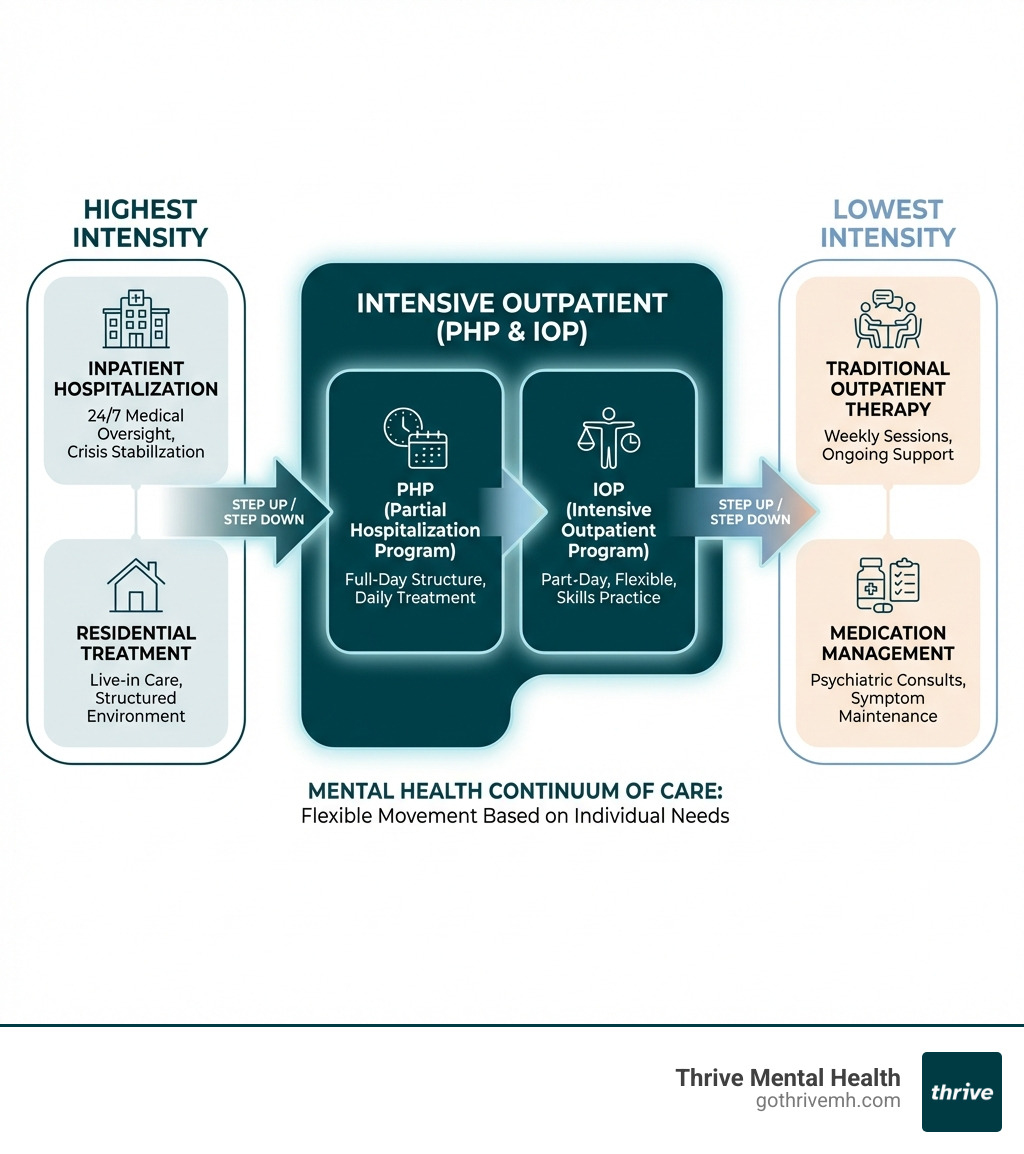
- Continuum of care: Mental health treatment is rarely a linear path. Instead, it is a spectrum of care levels, from inpatient hospitalization for acute crises, through residential treatment, PHP, IOP, and finally to traditional outpatient therapy and medication management. PHP and IOP bridge the gap between acute care and ongoing, less intensive support.
- Stepping up or stepping down: The strength of this continuum is the flexibility to move between levels of care as your needs evolve. You might start in an inpatient program, step down to a PHP, then transition to an IOP, and eventually move to weekly individual therapy. Conversely, if your symptoms worsen in a lower level of care, you can “step up” to a more intensive program. This adaptive approach ensures you always receive the right amount of support.
- Relapse prevention: Both PHP and IOP are instrumental in building a strong foundation for relapse prevention. They equip you with coping mechanisms, self-awareness, and a support network to steer future challenges. The skills learned are designed to be lifelong tools, not just temporary fixes.
- Building a foundation for long-term wellness: These programs help you develop sustainable habits, improve your relationships, and integrate healthy coping strategies into your life. This holistic approach is crucial for achieving long-term mental wellness, as detailed in research exploring a lifetime approach to major depressive disorder.
For a deeper dive into how higher levels of care fit into your journey, you can also read our related article on outpatient programs for adults.
Frequently Asked Questions about PHP and IOP
Can I still work or go to school during PHP or IOP?
IOP is designed with flexibility in mind, often offering evening sessions, which makes it much easier to continue with work or school responsibilities. PHP, however, is a full-time commitment, usually requiring attendance for several hours a day, five to seven days a week, making it very difficult to maintain concurrent work or academic schedules.
How long do these depression treatment programs last?
The duration of PHP and IOP programs varies depending on individual progress and needs, but they typically last several weeks. Your clinical team will regularly review your progress and adjust your treatment plan, including the length of your stay, to ensure it aligns with your recovery goals.
Does insurance cover PHP and IOP for depression?
Yes, most major insurance plans, including Cigna, Optum, and Florida Blue, recognize PHP and IOP as medically necessary services and provide coverage. However, coverage details, deductibles, and co-pays can vary significantly. We always recommend verifying your specific benefits with your insurance provider before starting treatment. You can also verify your insurance with Thrive in just a few minutes.
Is PHP or IOP better if I have suicidal thoughts?
If you are having active suicidal thoughts or feel unsafe, call or text 988 immediately. In general, PHP is better suited for people with recent crises or higher safety concerns because it provides more hours of care and closer monitoring. A professional assessment will determine whether PHP, IOP, or inpatient care is medically necessary.
How do I know if I should move from PHP down to IOP?
Most people step down from PHP to IOP when their symptoms are more stable, they are safer between sessions, and they can handle more time at home or work. Your treatment team will review your progress, safety, and support system with you and recommend when it is clinically appropriate to transition.
Your Path Forward Starts with a Clear Choice
Choosing the right level of care for PHP vs IOP for depression is a pivotal moment in your mental health journey. The right choice depends on your unique needs, the severity of your symptoms, your life circumstances, your insurance coverage, and your personal goals for recovery.
A professional assessment is the first step towards making this crucial decision with confidence. Our expert team at Thrive Mental Health is here to provide that assessment, guiding you toward the program that offers the most effective path to healing—whether that is PHP, IOP, or another outpatient option.
Both PHP and IOP are powerful tools for recovery, offering structured, evidence-based therapies designed to help you regain control over your life and build lasting well-being. In Florida, Thrive combines virtual access with trusted local presence so you can get intensive help without putting your life on hold.
Ready for support? Thrive offers virtual and hybrid IOP/PHP programs with evening options. Verify your insurance in 2 minutes (no obligation) → Start benefits check or call 561-203-6085. If you’re in crisis, call/text 988.