
Mentalization Therapy for Narcissism: When Self-Love Goes Too Far

Mentalization Based Therapy for Narcissistic Personality Disorder [2025]: Costs, Insurance, and Faster Relationship Repair
If you’re stuck in the cycle—blowups, shame, distance—here’s the fix that actually changes behavior fast and sticks. Mentalization based therapy for narcissistic personality disorder (MBT for NPD) helps you pause before reacting, read people more accurately, and build real connection—without shaming “gotcha” confrontations.
Quick answer: What you’ll get, how it works, and how to start
- What you’ll notice first (weeks 2–8): fewer fights, more self-control, clearer emotions; deeper shifts build over months.
- How it works: A collaborative, “not‑knowing” stance that moves you from me‑mode to we‑mode so you can see your mind—and others’—in real time.
- Who it helps: Grandiose and vulnerable narcissism; unstable self‑esteem; black‑and‑white thinking; emotional numbness or rage.
- Time + format: Long‑term therapy (months to years) with early wins in weeks; available via virtual and hybrid care.
- Cost + insurance: In‑network options with Cigna, Optum, Florida Blue, and more. Care available across Florida.
- Start here: Choose your level of care—Intensive Outpatient Program (IOP) or Partial Hospitalization Program (PHP)—or begin with secure Virtual Therapy. Verify benefits in 2 minutes → Verify Insurance. Explore care levels: IOP | PHP
Why act now vs. wait?
- If you ignore this: relationships keep detonating, shame hardens, and career/parenting take collateral damage.
- If you act now: you gain steady self‑respect, fewer ruptures, and a real way to repair—faster.
Telling someone with narcissistic traits to “just be more empathetic” fails because the issue isn’t a choice—it’s a mentalizing breakdown that starts early in life. MBT rebuilds that capacity.
Related read: Virtual IOP Programs [2025]: Costs, Insurance, and What to Expect → https://gothrivemh.com/blog/virtual-iop-programs-costs-insurance-what-to-expect/
The Root of the Problem: How Mentalizing Failures Create the Narcissistic Mindset
Narcissism isn’t a choice to be selfish; it’s a complex and often heartbreaking condition rooted in developmental failures.
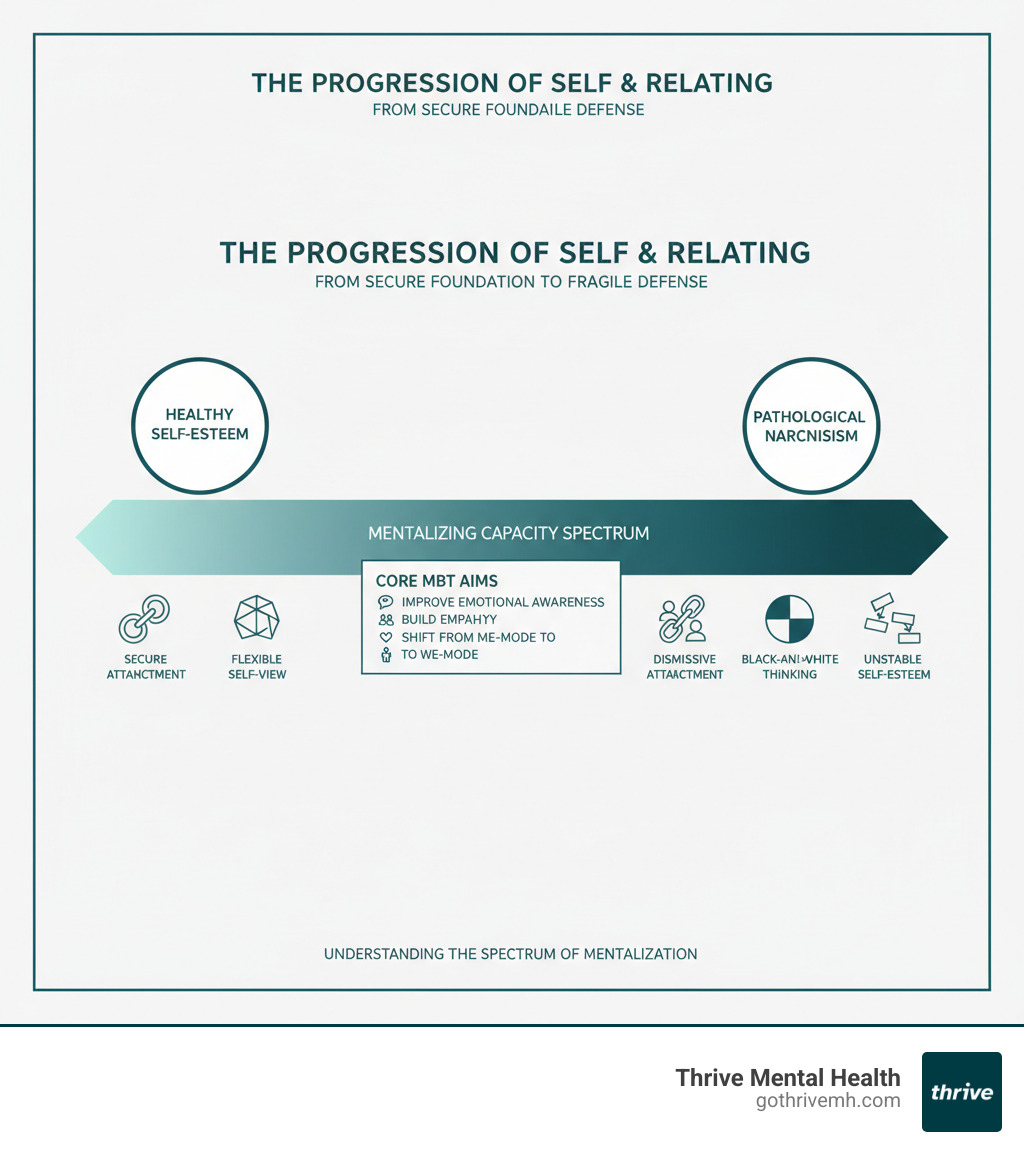
Mentalization is the ability to understand our own minds and the minds of others—to see the thoughts, feelings, and desires behind behavior. It’s how you “see yourself from the outside and others from the inside,” allowing for compassionate, rather than defensive, responses in relationships.
In people with pathological narcissism, this capacity is deeply impaired, often due to early life experiences. When a child’s emotions are ignored or invalidated by caregivers, they don’t learn to recognize their own internal states. This can lead to an “alien self”—a false identity built on external validation, disconnected from authentic feelings. This is why telling someone with NPD to “be more empathetic” is like telling someone with a broken leg to “walk normally.” The underlying capacity must be rebuilt.
Core mentalization impairments in NPD create a pattern of struggles:
- Impaired emotional awareness (alexithymia): Difficulty identifying or describing subtle emotions, often reporting feeling “nothing” or only extremes like rage.
- Black-and-white thinking: People and situations are seen as either all good or all bad, making it impossible to tolerate human complexity and flaws.
- Externalizing blame: Automatically pushing fault onto others to protect a fragile sense of self from the feeling of being defective.
- Limited emotional empathy: While they may have cognitive empathy (intellectually understanding another’s thoughts), they lack the ability to feel what another person is feeling, as shown in scientific research on empathy in NPD. This prevents genuine compassion.
- Overconfidence in perspective-taking: A paradoxical belief that they perfectly understand others, when in reality, they are often projecting their own anxieties and needs.
These impairments create a vicious cycle where misunderstanding others destabilizes relationships, which reinforces defensive patterns and blocks self-awareness. Mentalization based therapy for narcissistic personality disorder works to gently rebuild this core capacity.
At Thrive Mental Health, our virtual IOP and PHP programs across Florida address these root causes. We help individuals develop the emotional and relational skills missed in early development, with many insurance plans like Cigna, Optum, and Florida Blue covering our programs. Understanding the developmental roots of narcissism reveals a path forward that treats the underlying deficit, not just the symptoms.
How Mentalization Based Therapy for Narcissistic Personality Disorder Rebuilds the Self
Mentalization based therapy for narcissistic personality disorder rebuilds the self from the ground up by helping individuals understand their inner world and recognize that others have one, too. The therapy focuses on what you’re feeling (content), when mentalizing breaks down (context), and how these patterns appear in relationships (process).
At Thrive Mental Health, we weave these principles into our flexible IOP and PHP programs across Florida, with evening options available.

Key goals include:
- Structured emotional regulation: Expanding the emotional range beyond numbness or rage by identifying and tolerating vulnerable feelings like insecurity or fear.
- Empathy and perspective-taking: Cultivating curiosity about others’ minds (“What might they have been thinking?”) to recognize that multiple valid perspectives can coexist.
- ‘Reflect, not react’: Creating a pause between a trigger and a response to allow for more adaptive choices.
- Group psychotherapy: Providing real-world feedback and a safe space to practice new relational skills, which is invaluable for those who feel isolated.
Thrive Mental Health works with major insurance providers like Cigna, Optum, and Florida Blue to make care accessible.
Key Strategies: What Happens in an MBT Session for Narcissism?
An MBT session feels different from traditional therapy. The therapist adopts a ‘not-knowing’ stance—a genuine curiosity about your experience. This non-authoritarian approach reduces defensiveness and builds epistemic trust, the feeling that your therapist is a reliable source of understanding.
Core strategies include:
- Empathic validation: Acknowledging your subjective experience without judgment. If you feel disrespected, the therapist validates the feeling (“That sounds humiliating”) without endorsing a destructive reaction.
- Clarification techniques: Gently guiding you from vague generalities to concrete details (“Tell me more about that specific moment”) to anchor your experience in reality.
- Affect elaboration: Exploring the emotions beneath the surface. If you express anger, the therapist might ask, “What else might be there? Sometimes anger protects us from feeling small or afraid.”
These strategies address common challenges in treating NPD without triggering the defenses that keep people stuck. Learn more about our approach at our mentalization-based treatment page.
From “Me-Mode” to “We-Mode”: A Practical Guide to Mentalization Based Therapy for Narcissistic Personality Disorder
One of the most transformative shifts in mentalization based therapy for narcissistic personality disorder happens when someone moves from “me-mode” to “we-mode.”

- Me-mode: A self-protective focus where every interaction is filtered through how it affects you. Am I being admired or criticized?
- We-mode: A collaborative state where you recognize that others have their own valid experiences. This allows for genuine connection and mutual understanding.
The therapist fosters this shift not through confrontation but by first validating your experience in me-mode. Only then do they gently introduce joint attention with curious questions like, “I wonder what might have been going on for them?” This is especially crucial for those with dismissive attachment patterns, as it safely reactivates the ability to trust and depend on others. This gradual journey is transformative, as detailed in this mentalizing approach for NPD.
Addressing the Toughest Narcissistic Defenses with MBT
Narcissistic defenses are not a choice; they are protective walls built over years to shield a fragile self. Mentalization based therapy for narcissistic personality disorder doesn’t try to tear these walls down. Instead, it works with the defenses, understanding their purpose and gently helping patients build healthier ways to feel secure.

Common defenses include:
- Abstract discussions: Theorizing about feelings to avoid actually feeling them.
- Pretend Mode: Describing emotions with a script-like detachment, disconnected from genuine feeling.
- Psychic Equivalence: The belief that what one feels is absolute reality (“I feel criticized, therefore I was criticized”).
- Anger and rage: Using anger as a shield for more vulnerable feelings like shame, fear, or envy.
- Teleological Self-Esteem: Basing one’s entire self-worth on external achievements and validation.
This table breaks down how these defensive modes appear in therapy:
| Mode | Description | Manifestation in NPD |
|---|---|---|
| Pretend Mode | Thoughts and beliefs are disconnected from authentic subjective experience; intellectualizing or theorizing about experiences without genuine emotional involvement. | Patient discusses trauma or emotions in a detached, academic way; uses jargon; avoids direct emotional expression; “I know I should feel sad, but I don’t.” |
| Psychic Equivalence | Internal experiences and beliefs are equated with external reality; subjective emotions are perceived as objective truths; rigid, unshakeable beliefs. | “I feel you’re judging me, therefore you are judging me.” “My idea is perfect, anyone who disagrees is an idiot.” Devaluation of others based on internal feelings. |
| Teleological Mode | Mental reality is determined by the external world; focus on observable actions and qualities; self-worth contingent on external achievements and validation. | “I am worthless because I lost that job.” “My value comes from my accomplishments.” “If I’m not successful, I’m a failure.” Intense need for external admiration. |
Specific Interventions: A Toolkit for Mentalization Based Therapy for Narcissistic Personality Disorder
MBT uses curiosity and validation to work with these defenses, not attack them.
- For Pretend Mode: The therapist guides the patient from abstract to specific (“What did ‘upset’ feel like in your body?”) and points out disconnects (“You’re describing something painful, but your voice is flat. Is that how it feels?”).
- For Psychic Equivalence: The therapist first validates the feeling (“I can hear how convinced you are”) before gently introducing doubt (“I’m wondering… could there be even a 5% chance of another explanation?”).
- For Achievement-Based Self-Worth: The therapist validates the ambition, then explores the consequences (“What does it mean about you when you don’t hit a goal?”). This helps question if worth must be tied to performance.
Empathic validation is the key that disarms defenses. By validating the feeling underneath the contempt or rage, the therapist helps the person lower their guard. The focus is always on concrete examples over useless generalities, and the therapist will gently name the absence of expected emotions to invite exploration.
At Thrive Mental Health, our therapists in Florida are trained to use these interventions skillfully. We accept major insurance like Cigna, Optum, and Florida Blue because lasting change comes from building something better, not just breaking down defenses.
Is MBT the Right Choice? Strengths, Limitations, and What to Expect
Mentalization based therapy for narcissistic personality disorder offers significant hope, but it’s important to be realistic about its strengths and the current state of research.
Strengths of MBT for NPD:
- Accessible: Its principles are practical for clinicians to learn, making it more widely available, especially via telehealth. At Thrive Mental Health, we leverage this accessibility in our virtual IOP/PHP programs across Florida.
- Non-confrontational: The collaborative “not-knowing” stance sidesteps power struggles that often derail therapy with NPD, reducing defensiveness.
- Targets the root cause: It focuses on rebuilding the core capacity to mentalize, leading to more fundamental and lasting change than just managing symptoms.
- Proven for related conditions: MBT is a leading evidence-based therapy for Borderline Personality Disorder, another condition rooted in mentalizing failures.
Limitations and Research Status:
The research specifically on MBT for NPD is still developing.
- No randomized controlled trials (RCTs) yet: This is common for NPD treatment research, but it means we lack large-scale, controlled data.
- Evidence is mostly qualitative: The literature relies on theoretical papers and case studies rather than hard data on outcomes.
- More research is needed: Larger studies with control groups and long-term follow-up are required to fully validate the approach.
So, what does this mean for you? MBT for NPD is a clinically promising approach that aligns with decades of attachment research and has shown early success. While the formal evidence base is still growing, many are already benefiting from its principles.
At Thrive Mental Health, we offer MBT-informed treatment because we see real progress in our patients. We work with major insurance providers like Cigna, Optum, and Florida Blue to make this care accessible. Reaching out is the first step, even as the research continues to evolve.
Frequently Asked Questions about MBT for Narcissism
Is MBT effective for narcissistic personality disorder?
Yes. Evidence for personality disorders shows MBT improves reflective functioning, emotion regulation, and relationships. For NPD, the approach targets core deficits (mentalizing failures) without shaming confrontation.
How long does MBT take—and when will I notice change?
Expect months to years for deep change. Many notice early wins in the first 4–8 weeks: more pause before reacting, fewer escalations, clearer feelings.
Is MBT covered by insurance?
Often yes. Thrive works with Cigna, Optum, Florida Blue, and others. Check coverage in 2 minutes → Verify Insurance.
Do I need weekly therapy, IOP, or PHP?
If crises or blowups are frequent, start with structure: IOP or PHP. If stable, weekly Virtual Therapy can work. We help you choose.
How is MBT different from CBT or DBT?
MBT focuses on real‑time understanding of your mind and others’ (mentalizing). CBT targets thoughts/behaviors; DBT targets skills. Many patients benefit from combining them within our programs.
Take the First Step Toward Authentic Connection
Mentalization based therapy for narcissistic personality disorder helps you rebuild the capacity to understand your own and others’ minds—leading to steadier moods, fewer conflicts, and stronger relationships. It’s collaborative (not shaming), evidence‑informed, and available virtually across Florida with in‑network options like Cigna, Optum, and Florida Blue.
Ready for support? Thrive offers virtual and hybrid IOP/PHP programs with evening options. Verify your insurance in 2 minutes (no obligation) → Start benefits check or call 561-203-6085. If you’re in crisis, call/text 988.