
Obsessively Searching? How to Choose an OCD Therapist

Obsessively Searching? How to Finally Find the Right OCD Therapist
Finding an obsessive compulsive therapist who truly understands OCD is often the hardest stepbut it’s also the most important. Here’s what you need to know immediately:
Quick Answer: What to Look for in an OCD Therapist
- Specialized training in ERP (Exposure and Response Prevention)
- High percentage of OCD-focused practice (25%+ of their caseload)
- Willingness to conduct exposures outside the office
- Evidence-based approach, not just “talk therapy”
- Clear treatment plan with measurable goals
The search for the right therapist can feel like a compulsion in itselfendless, exhausting, and full of doubt. You may have clicked through dozens of profiles, checked provider lists for Cigna, Optum, Florida Blue, or other plans, and still feel stuck. You know you need help, but finding someone who truly gets Obsessive-Compulsive Disorder is overwhelming.
Here’s the truth: Not all therapists are trained to treat OCD effectively. In fact, many well-meaning professionals lack the specialized skills needed to deliver the gold-standard treatmentExposure and Response Prevention (ERP). Without the right approach, you could spend months or years in therapy with little to no improvement.
This isn’t about finding just any therapist. It’s about finding the right onesomeone who can help you break the cycle of obsessions and compulsions, not just manage symptoms on the surface.
Why the delay? Research shows it can take up to 14-17 years from symptom onset for someone to get appropriate OCD diagnosis and treatment. That’s a lifetime of suffering that doesn’t have to happen. The gap isn’t usually about accessit’s about knowing what to look for and asking the right questions.
OCD affects approximately 1 in 40 adults and 1 in 100 children in the United States. It’s a serious mental health condition that equally impacts men, women, and children of all backgrounds. Yet public awareness remains low, stigma runs high, and specialized training isn’t standard in most therapy programs.
I’m Nate Raine, CEO of Thrive Mental Health, where we’ve built evidence-based IOP and PHP programs specifically designed to deliver intensive, outcome-focused treatment for OCD and related disorders. Throughout my career in behavioral health and digital change, I’ve seen how the right obsessive compulsive therapistarmed with proven techniques like ERPcan change someone’s life in weeks, not years.
This guide cuts through the noise. You’ll learn exactly what to look for, the critical questions to ask, and how to find a therapist who can help you regain controlstarting now.
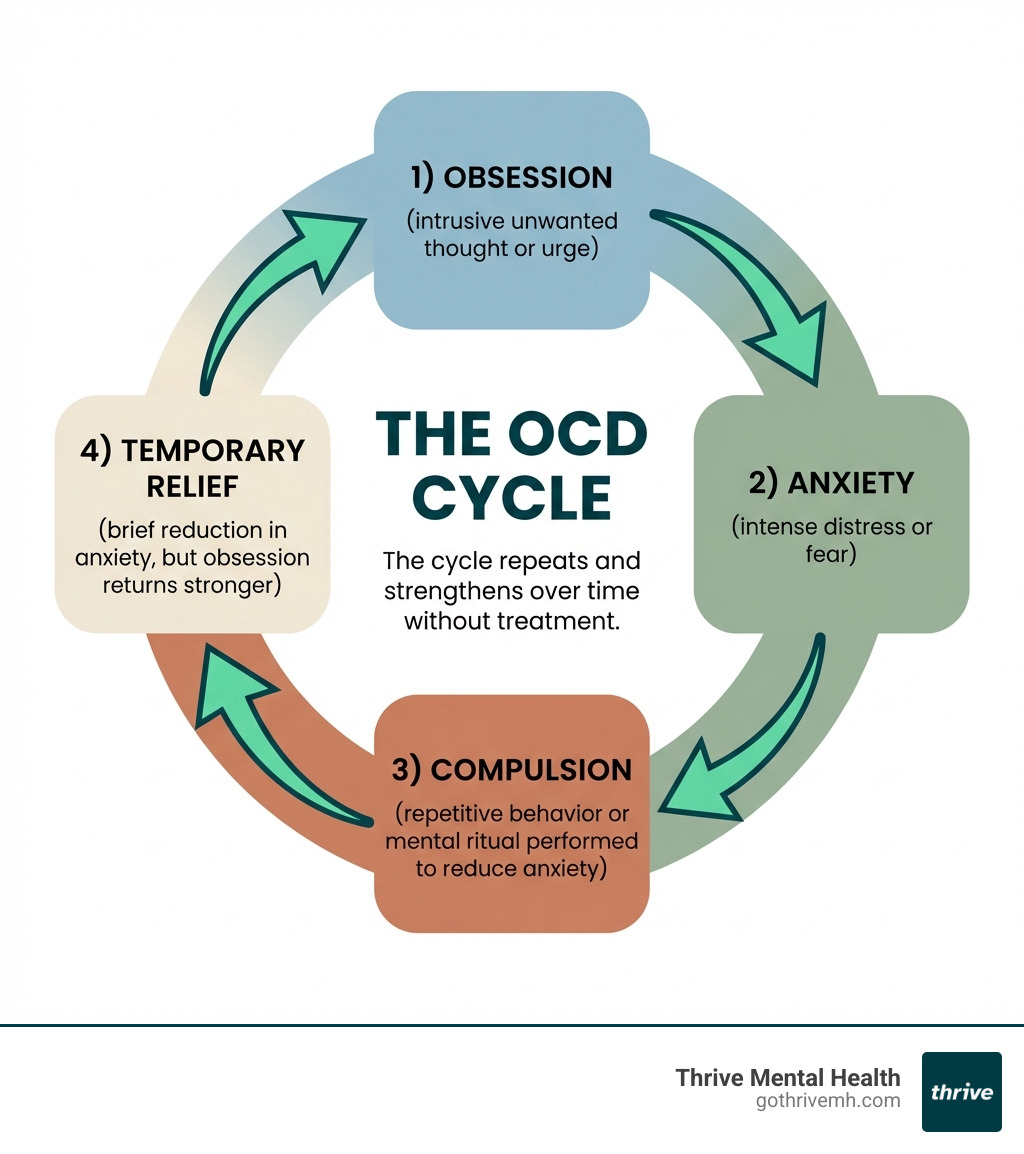
Summary: An experienced obsessive compulsive therapist uses ERP and a clear plan to help you step out of the OCD cycle instead of staying trapped in it.
Terms related to obsessive compulsive therapist:
- exposure and response prevention therapy
- ocd symptoms
- how to treat ocd
What is OCD? (And Why “Being a Little OCD” Isn’t a Thing)
Let’s be clear: Obsessive-Compulsive Disorder (OCD) is a serious mental health condition, not a quirky personality trait or a preference for neatness. When someone casually says, “I’m so OCD about my desk,” it trivializes the profound distress and impairment that true OCD causes. It’s a mental illness characterized by unwanted, intrusive thoughts and repetitive behaviors that significantly disrupt daily life.
OCD is a spectrum, and it’s commonly misunderstood. It forces individuals to fixate on aspects of life in an outsized way, often leaving them feeling like they’re staving off disaster by performing endless tasks. This is far from satisfying; it’s a deeply stressful experience.
The impact is significant: it’s estimated that about 1 in 100 children and 1 in 40 adults in the United States currently have OCD. This condition equally affects men, women, and children of all races, ethnicities, and backgrounds, often developing before age 25.
To receive an OCD diagnosis, an individual must experience obsessions and/or compulsions for at least one hour every day, causing significant distress or interference in their functioning. This isn’t about minor worries; it’s about debilitating patterns that control one’s life.
Obsessions vs. Compulsions: The Unwanted Thought and the Unstoppable Action
Understanding the difference between obsessions and compulsions is fundamental to grasping OCD. They are two sides of the same coin, forming the core of the disorder.
-
Obsessions Defined: These are persistent, recurring, unwanted thoughts, images, or urges that repeatedly enter your mind. They are intrusive and typically cause intense anxiety, disgust, or unease. Common themes include contamination fears, intrusive thoughts of harming others, sexual or religious obsessions (scrupulosity), or a need for symmetry and order. The crucial point is that these thoughts are unwanted and often go against a person’s true values.
-
Compulsions Defined: These are repetitive behaviors or mental acts that an individual feels driven to perform in response to an obsession. Their purpose is to temporarily reduce the distress caused by the obsession or to prevent a feared event. They are not performed for pleasure. Examples include excessive handwashing, checking, counting, arranging items, or repeating specific phrases mentally. While they provide temporary relief, they ultimately reinforce the obsessive cycle. For instance, a patient obsessing about germs on a doorknob may engage in a compulsive ritual to touch it. Without treatment, these rituals can escalate to the point where they prevent someone from leaving their house or going to work.
The Gold Standard: Why Exposure and Response Prevention (ERP) is Non-Negotiable
When it comes to treating OCD, not all therapies are created equal. While many forms of talk therapy can be helpful for various mental health conditions, the most effective and evidence-based approach for OCD is a specialized type of Cognitive Behavioral Therapy (CBT) called Exposure and Response Prevention (ERP). This is the gold standard for a reason: it directly targets the core mechanisms of OCD.

The 2013 APA Practice Guideline for the Treatment of Patients with Obsessive Compulsive Disorder recommends ERP as the first-line treatment, citing the strongest evidence supporting its use. ERP has been shown to dramatically reduce OCD symptoms, eliminating some entirely and bringing others down to manageable levels.
How ERP Works: Facing Your Fears to Reclaim Your Life
ERP is a powerful, active therapy that involves two key components:
-
Exposure: This involves gradually and systematically confronting the thoughts, images, objects, or situations that trigger your obsessions and anxiety. This is done in a controlled and safe environment with the guidance of a trained obsessive compulsive therapist. For example, someone with contamination fears might start by looking at pictures of dirt, then touching a clean object, eventually progressing to touching a “dirty” object.
-
Response Prevention: This is the crucial part. While you are exposed to your triggers, you are actively prevented from performing your usual compulsive rituals. The goal is to learn that your anxiety will naturally decrease over time without the compulsion, and that your feared outcome will likely not happen. You learn to tolerate the discomfort and anxiety, building confidence in your ability to manage it.
This process teaches your brain new associations. Instead of learning “anxiety -> compulsion -> relief,” you learn “anxiety -> no compulsion -> anxiety decreases naturally.” It’s about accepting the anxiety, building resilience, and developing healthier coping mechanisms when anxious thoughts or behaviors recur. While some people might mistakenly believe ERP is about forcing them into uncomfortable situations, it’s a careful and systematic process done in tandem with talk therapy, custom specifically to your needs.
Your Treatment Team: Who Diagnoses and Treats OCD?
Navigating the mental healthcare system can be daunting, but understanding the roles of different professionals is the first step in building your effective OCD treatment team. A collaborative approach often yields the best results.

Who Can Diagnose OCD?
A licensed and trained mental health provider is qualified to diagnose OCD. This typically includes:
- Psychologists: With doctoral degrees (PhD, PsyD), they are experts in psychological assessment and diagnosis.
- Psychiatrists: As medical doctors (MD, DO), they can diagnose mental health conditions and understand the interplay with physical health.
- Other Licensed Therapists: Depending on their training and licensure (e.g., Licensed Clinical Social Workers, Licensed Professional Counselors), they can also diagnose.
While primary care physicians or family doctors can assess for OCD symptoms and may make an initial diagnosis, they will almost always refer you to a mental health professional for further evaluation and specialized treatment. There’s no formal test for OCD; diagnosis relies on a comprehensive evaluation of your medical and mental health history, symptoms, feelings, fears, obsessions, and compulsions.
What is the Role of a Therapist in Treating OCD?
A therapist, particularly an obsessive compulsive therapist trained in ERP, is your primary guide through the behavioral and cognitive changes necessary for recovery. Their role includes:
- Delivering Psychotherapy: Primarily ERP and other CBT techniques. They help you identify obsessions and compulsions, challenge irrational thoughts, and guide you through exposure exercises.
- Teaching Coping Skills: Helping you develop strategies to manage anxiety and distress without resorting to compulsions.
- Providing Support and Accountability: Offering a safe space to process your experiences and staying accountable to your treatment plan.
- Family Involvement: Including family members in treatment to foster a supportive environment and prevent accommodation of OCD symptoms.
Role of a Psychiatrist: Medication Management
A psychiatrist’s primary role in OCD treatment is medication management. As medical doctors, they can:
- Prescribe Medication: Specifically, serotonin-reuptake inhibitors (SSRIs/SRIs) are often the first-line medication treatment for OCD. They can prescribe drugs like Fluoxetine (Prozac), Sertraline (Zoloft), Paroxetine (Paxil), Fluvoxamine (Luvox), and Clomipramine (Anafranil).
- Monitor Medication Effectiveness and Side Effects: Adjusting dosages and managing any adverse reactions.
- Assess for Comorbid Conditions: Diagnosing and treating other co-occurring mental health conditions that may impact OCD.
While some psychiatrists may offer psychotherapy, it’s common for them to work in conjunction with a therapist who specializes in ERP.
Role of a Psychologist: Comprehensive Assessment and Therapy
Psychologists often play a multifaceted role. Like other therapists, they deliver psychotherapy, especially CBT and ERP. Additionally, with their doctoral training, they can:
- Conduct Advanced Psychological Testing: Providing in-depth assessments to clarify diagnosis, understand cognitive functioning, and identify co-occurring disorders.
- Provide Specialized Therapy: Beyond ERP, they may also use Acceptance and Commitment Therapy (ACT) or other evidence-based approaches.
Therapist vs. Psychologist vs. Psychiatrist for OCD Treatment
| Professional Role | Credentials | Primary Focus in OCD Treatment | Can Prescribe Medication? | Typical Degree Level |
|---|---|---|---|---|
| Therapist | LCSW, LMFT, LPC, LMHC (Licensed Counselor) | Psychotherapy (e.g., ERP, CBT), coping skills, behavioral changes | No | Master’s |
| Psychologist | PhD, PsyD, EdD | Psychotherapy (e.g., ERP, CBT, ACT), psychological testing | No (in most states) | Doctoral |
| Psychiatrist | MD, DO (Medical Doctor) | Diagnosis, medication management (e.g., SSRIs), biological factors | Yes | Medical Doctor |
How to Find and Vet a Qualified Obsessive Compulsive Therapist
Finding the right obsessive compulsive therapist can feel like searching for a needle in a haystack, but with the right strategy, it’s entirely achievable. The goal is to find a specialist who understands the nuances of OCD and is proficient in evidence-based treatments like ERP. Learning how to treat OCD effectively starts with finding the right person.
Finding a Specialist
Many general therapists may not have the specialized training required for effective OCD treatment. Start your search by looking for professionals who explicitly state their expertise in OCD and ERP. Resources like the International OCD Foundation (IOCDF) provide directories of therapists who have specialized training, such as their Behavior Therapy Training Institute (BTTI) graduates.
If you live in Florida, you can often choose between in-person care near major cities (like Tampa, Miami, Orlando, and Jacksonville) and fully virtual options. Teletherapy has opened up access to OCD specialists across the state, allowing you to connect with an expert even if they’re not in your immediate vicinity.
When considering costs, specialized OCD treatment can be an investment. However, many insurance plans, including major providers like Cigna, Optum, Florida Blue, Aetna, and UnitedHealthcare, offer coverage for mental health services. At Thrive, we make it easy to check: you can verify your insurance benefits in about 2 minutes to understand your specific coverage for intensive programs or individual therapy.
If once-a-week outpatient therapy is not enough, you may benefit from structured programs like our OCD-focused Intensive Outpatient Program (IOP) or Partial Hospitalization Program (PHP), including our Virtual IOP for OCD.
What to Look for in an Obsessive Compulsive Therapist
Identifying a truly qualified obsessive compulsive therapist involves more than just checking their licensure. Here are key indicators of a therapist who can provide effective OCD treatment:
- Specialized Training in ERP: This is non-negotiable. Look for therapists who specifically mention ERP in their profiles. Even better, inquire if they are a BTTI Graduate (Behavior Therapy Training Institute), which signifies intensive training in OCD and related disorders.
- High Percentage of OCD Clients: An effective therapist will dedicate a significant portion of their practice to OCD. A good benchmark to aim for is over 25% of their caseload being OCD clients. This indicates deep experience and current knowledge.
- Willingness to Do Out-of-Office Exposures: ERP often requires confronting triggers in real-world settings. A therapist who is willing and able to conduct exposure work outside their office demonstrates a commitment to effective ERP delivery.
- Collaborative Approach: Look for a therapist who views treatment as a partnership. They should be open, friendly, knowledgeable, and responsive to your questions and concerns. Avoid anyone who is guarded or dismissive.
- Good Therapeutic Relationship: While expertise is paramount, feeling comfortable and trusting your therapist is also vital for progress. A strong therapeutic alliance improves treatment effectiveness.
For a deeper dive into choosing OCD treatment paths, you can also read our related guide: How to Treat OCD: What Actually Works.
7 Critical Questions to Ask a Potential Obsessive Compulsive Therapist
When you’re interviewing potential therapists, asking the right questions can save you invaluable time and ensure you find the best fit. Here are seven critical questions:
-
“What specific techniques do you use to treat OCD?”
What to look for: The answer must include “Exposure and Response Prevention (ERP).” Ideally, they’ll also mention Cognitive Behavioral Therapy (CBT) and possibly Acceptance and Commitment Therapy (ACT) as complementary approaches. If they offer only “talk therapy” or vague answers, it’s a red flag. -
“What is your training and background in treating OCD?”
What to look for: Inquire about specific certifications, specialized workshops, or supervised experience in ERP. Ask if they are a BTTI Graduate or have similar intensive training. -
“What percentage of your practice is focused on OCD?”
What to look for: A good answer is typically 25% or more. This indicates they specialize in OCD and are actively seeing a high volume of clients with the disorder, keeping their skills sharp. -
“Are you willing to do exposure exercises outside of the office?”
What to look for: A confident “yes” is a great sign. Effective ERP often involves real-world exposures, such as touching feared objects, leaving a door open uped, or going to a public place without performing rituals. -
“What is your approach to medication for OCD?”
What to look for: They should have a balanced view. A good therapist will acknowledge that medication (like SSRIs) can be a valuable adjunct to therapy for some individuals and should be managed by a psychiatrist, but also affirm that therapy alone can be highly effective. -
“How do you involve family members in treatment?”
What to look for: They should discuss strategies for educating family members about OCD and how to support the client without accommodating their compulsions. Family involvement can be crucial for long-term success. -
“Can therapy help manage OCD symptoms long-term, even if it’s a lifelong condition?”
What to look for: An affirmative answer acknowledging that while OCD may be lifelong, therapy provides tools for long-term management and significantly improves quality of life. The goal is to reduce symptoms to a manageable level, not necessarily to “cure” it.
If you’re not sure where to start or your symptoms are already disrupting work, school, or relationships, exploring a structured program like our Virtual IOP for OCD can be a faster path to relief than searching for an individual therapist on your own.
Beyond Weekly Therapy: When You Need More Support
For many individuals, particularly those with moderate to severe OCD, traditional once-a-week therapy simply isn’t enough to break the entrenched patterns of obsessions and compulsions. When OCD symptoms are significantly impacting daily functioning, work, relationships, or overall well-being, a higher level of care may be necessary. This is where more intensive programs come into play.
Medication Options
For some, medication can be a crucial component of an effective treatment plan, especially when combined with therapy. Psychiatrists often prescribe Selective Serotonin Reuptake Inhibitors (SSRIs) like Fluoxetine (Prozac), Sertraline (Zoloft), Paroxetine (Paxil), Fluvoxamine (Luvox), and Clomipramine (Anafranil). These medications help regulate serotonin levels in the brain, which are implicated in OCD symptoms. It can take up to 12 weeks to notice the effects of SSRI treatment for OCD, and often requires higher doses than for depression.
If you are using insurance, plans from Cigna, Optum, Florida Blue, Aetna, UnitedHealthcare, and other major carriers may cover both medication management and higher levels of care. At Thrive, you can quickly verify your insurance to see what OCD treatment options your plan will help pay for.
Intensive Outpatient Programs (IOP)
Intensive Outpatient Programs (IOPs) offer a structured treatment environment that provides more support and therapy hours than traditional outpatient therapy, without requiring overnight stays. At Thrive Mental Health, our IOPs for OCD are designed for individuals who need more than weekly sessions but less than inpatient care. They typically involve several hours of therapy per day, multiple days a week, focusing heavily on ERP and other evidence-based strategies.
- Benefits of IOPs:
- More Intensive Therapy: Increased exposure to therapeutic techniques accelerates progress.
- Structured Environment: Provides a consistent routine and support system.
- Group Therapy: Offers peer support and reduces feelings of isolation.
- Skill Building: Focuses on practical coping mechanisms and relapse prevention.
You can learn more about how our OCD-focused IOP works here: Intensive Outpatient Program (IOP).
Partial Hospitalization Programs (PHP)
Partial Hospitalization Programs (PHPs) represent an even higher level of care, offering comprehensive treatment that is comparable to inpatient hospitalization but allows patients to return home in the evenings. Our PHPs at Thrive Mental Health provide an immersive therapeutic experience, typically involving full days of treatment, five days a week. This intensive format is ideal for individuals with severe OCD symptoms who require significant supervision and support to manage their condition.
- Benefits of PHPs:
- Highest Level of Outpatient Care: Provides maximum therapeutic intensity and support.
- Rapid Progress: The concentrated nature of treatment often leads to quicker symptom reduction.
- Comprehensive Approach: Integrates individual, group, and family therapy, medication management, and psychoeducation.
- Real-World Application: Allows for immediate practice of learned skills in daily life.
Both IOPs and PHPs at Thrive Mental Health are built on the foundation of ERP and other proven modalities. We offer these programs both virtually and in-person across our locations in Florida, including major hubs like Tampa Bay, Miami, Orlando, and Jacksonville. Our virtual options provide flexible scheduling, including evening programs, making evidence-based treatment accessible from anywhere in Florida.
To see if a higher level of care is right for you and what your insurance will cover, you can start a quick benefits check, or explore our Virtual IOP for OCD.
Frequently Asked Questions about OCD Therapy
Can OCD be completely cured with therapy?
While there is no “cure” for OCD in the sense that it might disappear forever, therapyespecially ERPcan be incredibly effective. Many people reduce their symptoms to a point where they are highly manageable and no longer interfere with their daily life. The goal is management and recovery, achieving significant relief and reclaiming control, rather than total eradication.
How long does OCD therapy take to work?
The timeline varies depending on the severity of symptoms, individual commitment, and the intensity of the program. With a dedicated obsessive compulsive therapist utilizing ERP, many people start to see noticeable improvement within 12-20 sessions. Intensive programs like IOP or PHP can accelerate this progress, often yielding results in weeks. Consistency and commitment to doing the exposure work outside of sessions are key to faster and more lasting change.
Is OCD considered an anxiety disorder?
OCD was previously classified as an anxiety disorder, but in the DSM-5 (Diagnostic and Statistical Manual of Mental Disorders, 5th Edition), it was moved to its own category: “Obsessive-Compulsive and Related Disorders.” While intense anxiety is a core feature of OCD, its unique cycle of obsessions and compulsions sets it apart from other anxiety disorders. However, it’s still common for OCD to co-occur with anxiety disorders. You can read more about this distinction on our blog: Is OCD an Anxiety Disorder?
Do I need to live near a Thrive location to get OCD treatment?
No. Thrive offers virtual IOP and PHP programs for adults throughout Florida, so you can access specialized ERP-based OCD care from home, whether you’re in Tampa, Orlando, Miami, Jacksonville, or beyond. If you prefer in-person treatment, we also have trusted centers across the state.
Does insurance cover OCD therapy and intensive programs?
Often, yes. Many commercial plansincluding Cigna, Optum, Florida Blue, Aetna, UnitedHealthcare, and othersprovide coverage for OCD treatment, including higher levels of care like IOP and PHP when medically appropriate. The fastest way to know what your plan covers is to complete our secure Start benefits check; our team will review your benefits and explain your options in plain language.
Your Path to Recovery Starts with the Right Guide
Finding an obsessive compulsive therapist who specializes in ERP is the single most important step you can take toward recovery. It is not about finding just any therapist; it is about finding the right onesomeone who is expertly trained, experienced, and committed to using the most effective, evidence-based treatments. With targeted, intensive treatment, you can break the debilitating cycle of obsessions and compulsions and reclaim your life from OCD.
At Thrive Mental Health, we provide expert-led, intensive programs designed to deliver these results. Our virtual and in-person IOP and PHP programs offer the structure, clinical expertise, and measurable outcomes you need to make significant progress. Whether you are in Tampa, Miami, or anywhere else in Florida, our Virtual IOP for OCD makes specialized ERP treatment accessible from home.
Ready for support? Thrive offers virtual and hybrid IOP/PHP programs with evening options. Verify your insurance in 2 minutes (no obligation) Start benefits check or call 561-203-6085. If youre in crisis, call/text 988.