
Your Path to Wellness: Understanding Outpatient Mental Health Options

Outpatient Mental Health: 2024’s Fast Recovery
Why Outpatient Mental Health Is the Bridge Between Weekly Therapy and Hospitalization
Outpatient mental health care is structured treatment you receive while living at home. It’s designed for people who need more than weekly therapy but don’t require 24/7 hospital supervision. Programs range from a few hours a week to over 20, treating conditions like depression, anxiety, trauma, and substance use with a mix of individual and group therapy, medication management, and peer support.
If you’re thinking about harming yourself or someone else, call or text 988 immediately. You are not alone.
For the 1 in 4 American adults with depression or anxiety, weekly therapy doesn’t always cut it. Outpatient mental health programs offer the intensity needed to make progress without pausing your life. Whether you’re stepping down from inpatient care or hitting a wall with traditional therapy, this model provides expert support that fits your schedule. You stay at home, keep working, and apply coping skills in the real world.
Most major insurance plans, including Medicare Part B, Cigna, Aetna, and Optum, cover these services. At Thrive Mental Health, we’ve built our virtual and in-person IOP and PHP programs across Florida to deliver measurable results. Our goal is to give you the structure you need without putting your life on hold.
Easy outpatient mental health glossary:
Outpatient vs. Inpatient: Which Gets You Back on Track Faster?
Choosing the right level of care isn’t about which is “better”—it’s about what matches your needs right now.
Outpatient mental health care delivers structured support while you live at home. You attend treatment sessions but continue with work, school, and family life, applying new skills in your actual environment. It’s built for people who need serious help without pausing their lives.
Inpatient care involves checking into a hospital for 24/7 medical and psychiatric supervision. It’s the highest level of care, designed for acute crises where immediate stabilization and safety are the top priorities.
Here’s how they differ:
- Living Arrangements: With outpatient, you go home after each session. Inpatient care removes you from your daily environment to live at a facility.
- Intensity & Autonomy: Inpatient care is constant supervision with limited autonomy. Outpatient programs like Intensive Outpatient Programs (IOP) (9-12 hrs/week) or Partial Hospitalization Programs (PHP) (20+ hrs/week) offer intensive treatment while giving you the freedom to test coping skills in real time.
- Who It’s For: Inpatient is for severe psychiatric crises or immediate safety risks. Outpatient is for those who are stable but struggling, or for anyone stepping down from inpatient care needing a bridge back to daily life.
Outpatient vs. Inpatient: The Numbers You Need to Know
This breakdown makes the choice clearer:
| Feature | Outpatient (IOP/PHP) | Inpatient (Hospital) |
|---|---|---|
| Location | Home | Facility |
| Duration | Weeks/Months | Days/Weeks |
| Intensity | 3–20 hrs/week | 24/7 supervision |
| Cost | Lower | Higher |
| Best For | Stable but struggling | Acute crisis/safety risk |
The bottom line: Inpatient care saves lives in a crisis. Outpatient mental health builds lives after the crisis—or prevents one from happening.
Is Outpatient Mental Health Right for You? [7 Signs You Need More Than Weekly Therapy]
If weekly therapy isn’t delivering the breakthrough you need, it might be time for a higher level of care. Outpatient mental health programs like IOP and PHP fill the gap between once-a-week sessions and hospitalization, offering intensive support while you live your life.
This approach is effective for conditions like depression, anxiety, PTSD, substance use, eating disorders, and mood disorders. If your current treatment has stalled, consider if you’re seeing these signs.

7 Warning Signs You Need Outpatient Mental Health Now
- Your weekly therapy isn’t cutting it. You talk, but nothing changes. You’re stuck in a cycle. This is a clear sign you need more frequent, structured support. Our Intensive Outpatient Programs provide 9-12 hours of treatment weekly to create real momentum.
- Your symptoms are disrupting your daily life. You’re missing work, straining relationships, or struggling with school. When mental health interferes with what matters, it’s time for a higher level of care.
- You need structure and accountability. You know what you should do, but can’t make it stick. Outpatient programs provide an external framework for consistent therapeutic engagement.
- You just left inpatient care and fear relapse. Transitioning back to daily life is risky. An IOP serves as a critical “step-down,” offering support as you reintegrate and dramatically reducing relapse risk.
- You feel completely isolated. Mental health struggles are isolating. Group therapy connects you with peers who understand, providing support that often becomes a turning point in recovery.
- You need results now but can’t pause your life. You have a job, family, or school. Outpatient programs are designed for this, with virtual and evening options available across Florida.
- You want practical tools, not just talk. You need skills to manage anxiety at 2 AM or fight depressive thoughts. Our programs focus on evidence-based techniques like CBT and DBT that you can use immediately.
When to Get Help—Right Now
If you’re thinking about harming yourself or someone else, call or text 988 immediately.
The 988 Suicide & Crisis Lifeline is available 24/7, offering free and confidential support. They provide crisis intervention, safety planning, and connection to local resources. Whether you’re at risk of suicide, overdose, or just in desperate need of someone to talk to, trained counselors are ready to help.
If you’re in crisis, call/text 988 right now. You are not alone.
Outpatient Mental Health Programs: What Works, What Doesn’t, and Why
Effective outpatient mental health care isn’t just more therapy; it’s a structured, multi-faceted approach. The programs that get results combine evidence-based therapies, peer connection, and expert oversight into a flexible schedule that works with your life.

Core Outpatient Treatment Options That Deliver Results
- Individual Psychotherapy: One-on-one sessions using CBT, DBT, and trauma-focused approaches to create a personalized treatment plan.
- Group Therapy: A space to practice new skills, gain accountability, and connect with peers who understand what you’re going through.
- Family Counseling: Sessions designed to rebuild trust, improve communication, and set healthy boundaries.
- Medication Management: Expert psychiatric oversight to ensure your prescriptions are effective and adjusted as your needs change.
- Peer Support: Connection with mentors and group members who have been there, accelerating healing by reducing isolation and judgment.
Outpatient Levels of Care: Find Your Fit
Outpatient mental health care meets you where you are.
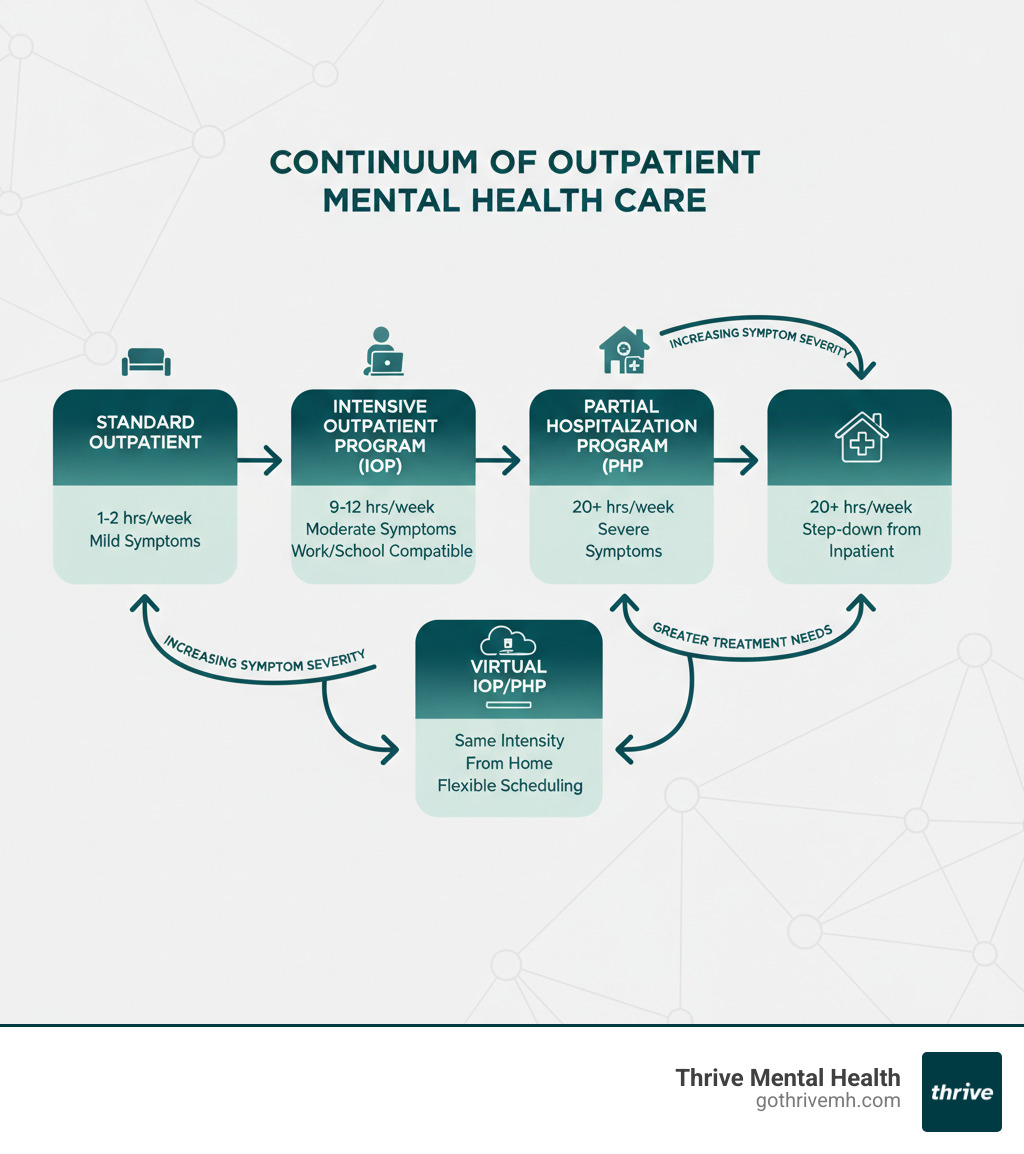
- Standard Outpatient: 1–2 hours per week, ideal for mild symptoms or as a step-down from more intensive care.
- Intensive Outpatient Program (IOP): 9–12 hours of structured treatment weekly. It’s designed for those who need serious support but can’t pause work or school. We offer day, evening, and virtual options across Florida.
- Partial Hospitalization Program (PHP): 20+ hours of care per week. This is the highest level of outpatient support, often used as a step-down from inpatient care.
- Virtual IOP/PHP: Delivers the same clinical intensity and expert-led care from the comfort of your home, with 24/7 crisis support.
- Specialized Tracks: We match you with therapists and peer groups focused on your specific challenges, such as trauma, mood disorders, or substance use.
How to Get Outpatient Mental Health Care—And What It Really Costs
The biggest questions are often about cost and access. The good news is that most outpatient mental health programs, including IOP and PHP, are covered by insurance. The cost of not getting help is almost always higher than the cost of treatment.

How to Choose the Right Outpatient Program
- Ask your doctor or therapist for a referral. They know your history and can recommend a program that fits.
- Use SAMHSA’s National Helpline (1-800-662-HELP). It’s a free, 24/7 resource for finding local treatment options.
- Contact us directly. Thrive’s admissions team can walk you through the process, verify your insurance, and see if our programs are a good fit, with no pressure.
- Check community mental health centers in Florida for local services.
Before committing, ask about staff credentials, accepted insurance, therapeutic approaches (look for CBT/DBT), treatment outcomes, and scheduling flexibility.
Insurance & Payment: What’s Covered, What’s Not
Most major insurance plans cover outpatient mental health services. We partner with Cigna, Aetna, Florida Blue, Optum, Medicare, and Medicaid (in applicable states).
The easiest way to know your costs is to verify your insurance in 2 minutes. Our team will explain your coverage, co-pays, and any out-of-pocket costs upfront. We work to stay in-network with providers across Florida to keep care affordable.
Medicare Part B covers most outpatient services, including IOP and PHP. After your deductible, you typically pay 20% of the approved amount. Medicaid coverage varies by state, and our team can help you steer the specifics. Don’t let confusion about cost keep you from getting help.
What to Expect: Your First Week in Outpatient Mental Health
Starting outpatient mental health treatment is a structured process designed to get you the right support quickly. Here’s what your first week looks like.
Your journey begins with a comprehensive intake and assessment. In this free clinical screening, you’ll talk with a licensed clinician about your history, current challenges, and goals. This helps us match you with the right level of care and therapeutic team.
Next, you’ll get a personalized treatment plan. This isn’t a generic template; it’s a roadmap built around your specific goals, with clear steps and a realistic timeline. A typical week in our Florida Intensive Outpatient Program (IOP) involves 9-12 hours of treatment, including:
- Group therapy sessions to build skills and connect with peers.
- Individual therapy to work on personal challenges.
- Family therapy to improve communication and rebuild trust.
- Psychiatry and medication management as needed.
Every session focuses on building practical skills—like CBT, mindfulness, and stress management—that you can use immediately. For maximum flexibility, our virtual IOP and PHP programs deliver the same expert-led treatment through a secure platform, complete with 24/7 crisis support.
How Family & Friends Can Help—Without Making Things Worse
If a loved one is starting treatment, you can be a powerful ally.
- Learn: Understand what outpatient care involves to offer informed support.
- Help Practically: Offer rides, help with meals, or send appointment reminders. Small gestures reduce stress.
- Listen Without Judging: You don’t need to have the answers. Just hold space for their feelings.
- Participate: If invited to family therapy, go. It’s an opportunity to learn and heal together.
- Respect Privacy & Celebrate Wins: Let them decide what to share, and acknowledge their progress, no matter how small.
Outpatient Mental Health FAQs [2024]
We hear these questions every day from people just like you—smart, motivated individuals who are tired of struggling and ready for real answers. Here’s what you need to know about outpatient mental health care.
What is outpatient mental health care?
Outpatient mental health care is structured therapy and support you get while living at home—no hospital stay required. You receive professional treatment for conditions like depression, anxiety, trauma, or substance use disorders in a clinic, office, or virtual setting, allowing you to maintain your daily routines. Unlike inpatient care, you sleep in your own bed, go to work or school, and practice your new coping skills in real-world situations. It’s expert care on your schedule.
How long does IOP last?
Most Intensive Outpatient Programs run 9–12 weeks, but the exact duration depends on your individual needs, progress, and insurance coverage. Some people graduate sooner; others benefit from a bit more time. Your primary therapist will work with you to determine the best discharge date for your recovery journey. The goal isn’t to rush you through—it’s to give you the skills and support you need to thrive long after the program ends.
Can I work or go to school during outpatient treatment?
Absolutely. Intensive Outpatient Programs (IOPs) and Partial Hospitalization Programs (PHPs) are built for real life. Many programs, including our Florida programs at Thrive, offer evening and virtual options specifically designed to accommodate work, school, and family responsibilities. You don’t have to put your life on hold to get better. That’s the whole point.
Does insurance cover outpatient mental health?
Most major plans cover outpatient mental health services, including IOP and PHP. This includes Cigna, Aetna, Florida Blue, Optum, Medicare, and Medicaid (in states where IOP is covered). At Thrive, we partner with over 300 major insurance providers across Florida. That said, every plan is different. Always verify your specific benefits first to understand your coverage, co-pays, and deductibles. We make this easy—you can verify your insurance in about two minutes, with no obligation.
What’s the difference between IOP and PHP?
IOP (Intensive Outpatient Program) typically involves 9–12 hours of structured treatment per week, while PHP (Partial Hospitalization Program) is more intensive, requiring 20+ hours per week. Think of PHP as a step-down from inpatient care—it provides a higher level of support than IOP, often for individuals who need more structure but don’t require 24/7 supervision. Both programs offer individual therapy, group sessions, medication management, and peer support. The right fit depends on your symptom severity, daily functioning, and clinical needs.
Summary: Outpatient Mental Health Gets You Back to Life—Faster
Outpatient mental health care offers a powerful path to wellness, providing the structured, intensive support you need without putting your life on hold. Whether through our Intensive Outpatient Programs (IOP), Partial Hospitalization Programs (PHP), or flexible virtual options, you receive expert support, proven therapies, and a schedule that adapts to your life. Most insurance plans cover these vital services, making effective treatment accessible. Don’t wait—every week you delay is a week you could be feeling better, building lasting coping skills, and reconnecting with your best self.
Ready for support? Thrive offers virtual and hybrid IOP/PHP programs across Florida, with evening options. Verify your insurance in 2 minutes (no obligation) → Start benefits check or call 561-203-6085. If you’re in crisis, call/text 988.
If you’re in crisis, call/text 988 right now. You are not alone.
Related reading: How Virtual IOPs Cut Recovery Time by 50%