





Outpatient Mental Health Insurance in Florida [2025]: What’s Covered, Costs, and How to Get Care
If you’re in crisis, call or text 988 now. You are not alone.
Summary: Outpatient mental health insurance in Florida covers therapy, psychiatry, IOP, and PHP. This guide shows what’s covered, what you’ll pay, and how to use your benefits to start care faster, without surprise bills.
Outpatient mental health insurance pays for therapy, counseling, and other services you receive while living at home. But figuring out what’s covered can be confusing, especially when you need help fast. The last thing you want when struggling with anxiety or depression is to deal with surprise bills or long hold times with your insurer.
The reality is that even with insurance, access isn’t guaranteed. While 60.2% of people with a diagnosed mental disorder get outpatient treatment, that means nearly 40% go without help, often due to cost, provider shortages, or confusing rules.
Here’s what you need to know:
- Most plans must cover outpatient mental health services thanks to the Affordable Care Act (ACA) and the Mental Health Parity and Addiction Equity Act (MHPAEA).
- Your coverage depends on your insurance type: Private insurance, Medicare, and Medicaid offer vastly different access and costs.
- Key services typically covered include: individual and group therapy, psychiatry, medication management, Intensive Outpatient Programs (IOP), and Partial Hospitalization Programs (PHP).
- Common barriers include: high deductibles, limited provider networks, inaccurate directories, and disparities in access.
The COVID-19 pandemic expanded telehealth options, but it also widened gaps in care, with treatment access varying significantly by insurance type. I’m Anna Green, LMHC, LPC, Chief Clinical Officer at Thrive Mental Health. I’ve seen how insurance barriers prevent people from getting well, especially here in Florida. This guide breaks down what you need to know to steer your outpatient mental health insurance and access the care you deserve.
Quick outpatient mental health insurance terms:
- how to read mental health insurance benefits
- do insurance plans have to offer mental health benefits
- medicaid covered therapy
- verify your insurance in minutes
What Is Outpatient Mental Health Care and What Does Insurance Cover?
Outpatient mental health insurance covers treatment you receive while living at home and maintaining your daily routines. Unlike inpatient care, where you stay overnight, outpatient services fit into your life through scheduled appointments at clinics, doctor’s offices, or virtually. This flexibility is valuable for managing anxiety, depression, or other challenges while juggling work, family, and other responsibilities.
So what exactly does outpatient mental health care include? It’s a spectrum of services designed for different levels of support:
- Individual therapy (psychotherapy) involves one-on-one sessions with a licensed therapist, typically for 45-60 minutes. It’s effective for everything from relationship stress to trauma recovery.
- Group therapy brings together a small number of people with similar challenges, led by a therapist. The shared experience can be incredibly validating and helps you realize you’re not alone.
- Intensive Outpatient Programs (IOP) offer a higher level of support, with several hours of treatment multiple days a week (usually 9-12 hours total). Our virtual IOP programs at Thrive Mental Health provide this comprehensive care with the flexibility of attending from home. You can learn more about how virtual IOP insurance typically works, or explore our IOP program page.
- Partial Hospitalization Programs (PHP) provide the most intensive outpatient care, sometimes called “day treatment.” You attend structured programming for several hours each day, five days a week, but return home each evening. This level of care is for those who need significant support but not 24/7 supervision. Our PHP guide explains how this level of care treats serious mental health challenges.
- Medication management involves regular appointments with a psychiatrist or other prescribing provider to monitor medications, adjust dosages, and manage side effects.
Your care team may include psychiatrists, psychologists, and licensed therapists (like clinical social workers or licensed professional counselors). Many also access care through community mental health centers, which offer a range of services, including therapy and crisis support. Prefer virtual sessions? See our Virtual Therapy options.
The good news is that federal legislation has dramatically improved outpatient mental health insurance coverage. The Affordable Care Act (ACA) made mental health and substance use disorder services one of the “ten essential health benefits” that most insurance plans must cover. The ACA also ended the practice of denying coverage based on pre-existing conditions like a mental health diagnosis. You can find more information about mental health & substance abuse coverage under the ACA.
Key Legislation: Your Rights to Coverage
Two federal laws fundamentally changed how outpatient mental health insurance works, and understanding them means understanding your rights.
The Affordable Care Act (ACA), passed in 2010, mandated that most health insurance plans cover mental health and substance use disorder services as “essential health benefits.” This applies to Marketplace plans and most Medicaid expansion programs. Crucially, the ACA also made it illegal for insurers to deny you coverage or charge higher premiums for a pre-existing mental health condition.
The Mental Health Parity and Addiction Equity Act (MHPAEA) of 2008 ensures that mental health benefits are equal to medical benefits. Before MHPAEA, insurers could impose stricter limits on mental health care, such as capping therapy sessions. MHPAEA requires that financial requirements (deductibles, copayments) and treatment limitations (visit caps, prior authorization) for mental health care cannot be more restrictive than those for medical and surgical care. This principle of equal coverage is known as parity. For example, if your plan doesn’t limit visits to a cardiologist, it generally can’t impose an arbitrary cap on your therapy sessions. You can learn more about your rights under The Mental Health Parity and Addiction Equity Act (MHPAEA).
How Insurance Type Dictates Your Access and Costs
The type of outpatient mental health insurance you have dramatically shapes your access to care, out-of-pocket costs, and even the number of therapy sessions you can receive. Whether you have private insurance, Medicare, Medicaid, or no insurance, your experience will be fundamentally different.

Research from the Mental Disorder Prevalence Study (MDPS) reveals stark disparities. While 60.2% of people with a diagnosed mental disorder received outpatient treatment, this figure hides significant gaps based on insurance. For more details, you can review the key findings from the Mental Disorder Prevalence Study (MDPS).
The numbers show that people without insurance have 63% lower odds of receiving any mental health treatment than those with private insurance. Conversely, people with Medicare have over four times higher odds of getting treatment, likely reflecting more severe or chronic conditions requiring ongoing care. Among those who do get care, Medicaid enrollees average 63% more outpatient visits than those with private insurance, often due to the complexity of their conditions.
Let’s break down what this looks like in practical terms:
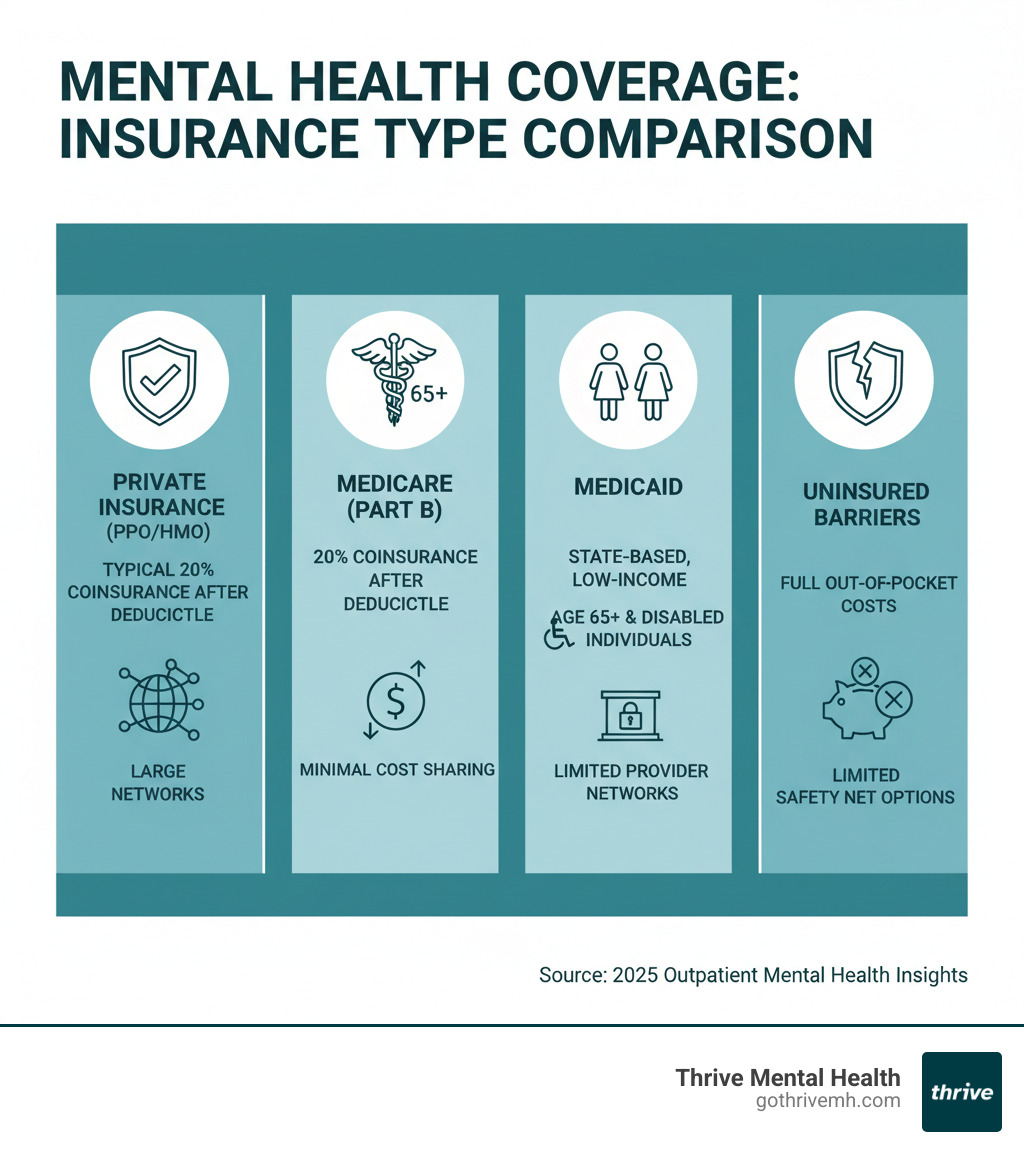
| Insurance Type | Typical Cost-Sharing (after deductible) | Provider Network Size | Average Number of Visits (among those with at least one visit) | Key Challenges |
|---|---|---|---|---|
| Private Insurance | 20% coinsurance or copay ($20-$50) | Large networks, but accuracy varies | Baseline comparison | High deductibles, “ghost networks,” varying coverage by plan |
| Medicare | 20% coinsurance after Part B deductible | Moderate; specific provider types covered | Higher treatment engagement (AOR = 4.25) | Fixed coinsurance can add up; fewer providers accept Medicare |
| Medicaid | Minimal to no cost-sharing | Limited due to low reimbursement rates | 63% more visits than private insurance | Provider shortages, long wait times, state-by-state variations |
| Uninsured | Full out-of-pocket costs | Safety-net clinics, sliding scale options | Significantly lower odds of any treatment (AOR = 0.37) | Cost barriers, limited options, reliance on community resources |
Understanding these differences is crucial when choosing a plan. If you’re researching health insurance with mental health coverage, knowing what to expect can help you make better choices.
Private Insurance (Employer-Sponsored, Marketplace)
Most working-age adults rely on private insurance for outpatient mental health insurance. These plans often appear comprehensive, but navigating them can be tricky. The key is understanding in-network vs. out-of-network care. In-network providers have contracts with your insurer, meaning you pay a lower copayment or coinsurance after meeting your deductible. Out-of-network care costs significantly more.
Deductibles, the amount you pay before insurance kicks in, can be a major barrier, with some high-deductible plans requiring you to pay thousands out of pocket first. This can prevent people from seeking care early.
Finding an available in-network provider is another challenge. Insurer provider directories are often inaccurate, a problem known as “ghost networks.” You might call dozens of listed therapists only to find they don’t accept your insurance or aren’t taking new patients. This issue affects coverage across major insurers in Florida, including Florida Blue (BCBS), Aetna, Cigna (Evernorth), and Optum (United/UBH). For specific guidance on major Florida plans, our comprehensive guide to Aetna, Florida Blue, and Evernorth plans can be helpful.
At Thrive Mental Health, we work with most major private insurance carriers in Florida. You can verify your insurance in minutes to see what your plan covers for our virtual IOP program, which is accessible throughout Florida.
Medicare’s Role in Outpatient Mental Health Insurance
Medicare Part B offers comprehensive outpatient mental health coverage for older adults and people with disabilities. It covers services from a wide range of providers, including psychiatrists, psychologists, clinical social workers, and licensed mental health counselors.
The standard cost is a 20% coinsurance after you meet the annual Part B deductible. While the deductible is modest, the 20% coinsurance can add up, especially for intensive services like IOP or PHP. A persistent challenge is that fewer providers accept Medicare due to lower reimbursement rates, which can lead to longer wait times and fewer choices, particularly in rural areas of Florida.
 18 DBT Group Activities for Adults: A Clinician’s Field GuideMental Health
For Florida residents, telehealth has significantly expanded access. Thrive does not accept Medicare or Medicaid.
Medicaid and Its Impact on Treatment
Medicaid is the primary outpatient mental health insurance for millions of low-income Americans. With minimal or no cost-sharing, it removes major financial barriers to care. Data shows that once Medicaid enrollees access care, they engage more intensively, averaging 63% more visits than those with private insurance.
The main challenge is finding a provider who accepts Medicaid. Low provider reimbursement rates lead to significant provider shortages and long wait times. In Florida, the Medicaid program provides coverage, but finding an available provider can still be a challenge. Community mental health centers are crucial access points for this population. Our guide to Medicaid covered therapy offers more information on navigating these benefits.
The Uninsured: Facing the Greatest Barriers
Without insurance, the odds of receiving mental health treatment are 63% lower than for those with private insurance. The primary barrier is the high out-of-pocket cost. A single therapy session can cost $100-$250, and more intensive programs cost thousands.
Options do exist, however. Community health centers often operate on a sliding scale based on income. Some private therapists also offer a limited number of reduced-fee spots. The challenge is that these resources are often overwhelmed, leading to long wait lists.
If you’re uninsured, exploring Marketplace plans during open enrollment is a good step. Our article on health insurance with mental health coverage can help you understand what to look for. Thanks to the ACA, all Marketplace plans must cover mental health, and you may qualify for subsidies to make it affordable.
Florida: Coverage Snapshot
Navigating outpatient mental health insurance in Florida involves understanding the major players and how to access care. Thrive Mental Health is in-network with many of the state’s largest insurance plans.
- Major Florida Plans: Common private plans include Florida Blue (BCBS of Florida), Aetna, Cigna (Evernorth), and Optum/UnitedHealthcare. Our comprehensive guide to Aetna, Florida Blue, and Evernorth plans offers more detail on their mental health benefits.
- Medicare & Medicaid: We do not accept Medicare or Medicaid, including Florida Medicaid plans. Community mental health centers are a key resource for Medicaid recipients.
- Accessing Care with Thrive: Thrive’s virtual IOP program is available to residents throughout Florida, helping you bypass long waitlists. You can verify your insurance to confirm your benefits for our services.
Prefer virtual sessions for speed and convenience? Explore Virtual Therapy and then check your benefits.
How Insurance Type Dictates Your Access and Costs
Your insurance type isn’t just a detail on a card; it’s a major determinant of your access to outpatient mental health insurance benefits and the costs you’ll incur. The landscape of mental health care in the U.S. is heavily influenced by whether you have private insurance, Medicare, Medicaid, or no insurance at all. Each pathway presents its own set of opportunities and challenges.
Recent studies, like the Mental Disorder Prevalence Study (MDPS), shed light on these disparities. The MDPS found that 60.2% of participants with a mental disorder received outpatient treatment in the past year. However, this average masks significant differences based on insurance status. For instance, participants with no insurance had significantly lower odds of receiving any mental health treatment (Adjusted Odds Ratio (AOR) = 0.37 [0.16, 0.89]) compared to those with private insurance. Conversely, participants with Medicare had significantly higher odds of past-year mental health treatment (AOR = 4.25 [1.59, 11.36]) compared to those with private insurance, suggesting that those with Medicare may have more severe or chronic conditions requiring consistent care.
Among individuals who did receive at least one outpatient mental health visit, Medicaid enrollees had 63% more visits on average than those with private insurance (Relative Risk (RR) = 1.63, 95% C.I: 1.11-2.38). This highlights that while Medicaid helps people access care, the pattern of utilization often differs.
Let’s break down how different insurance types shape your experience with outpatient mental health insurance:
| Insurance Type | Typical Cost-Sharing (after deductible) | Provider Network Size | Average Number of Visits (MDPS, among those with at least one visit) | Key Challenges |
|---|
FAQs: Outpatient Mental Health Insurance
-
Is outpatient mental health therapy covered by insurance?
Yes, most Marketplace, employer plans, Medicare, and Medicaid must cover outpatient mental health under the ACA and MHPAEA. Coverage details vary by plan. Check your deductible, copay/coinsurance, visit limits, and any prior authorization. You can verify your insurance in minutes. -
How many therapy sessions will insurance cover?
Parity rules mean plans generally cannot impose stricter limits on therapy than on comparable medical care. While some plans review medical necessity, arbitrary session caps are not allowed. If you hit roadblocks, ask for a parity review. -
What’s the difference between weekly therapy, IOP, and PHP, and are they covered?
Weekly therapy is 45-60 minutes once a week. IOP is 9-12 hours/week across multiple days. PHP is daytime care 5 days/week. Most plans cover all three levels when medically necessary. Learn about our IOP program. -
How much will I pay out of pocket?
Private plans often charge a $20, $50 copay or ~20% coinsurance after the deductible. Medicare is 20% after the Part B deductible. Medicaid cost-sharing is usually minimal. In-network care is almost always cheaper than out-of-network. -
How do I find an in-network therapist fast?
Use your insurer portal, then confirm directly with the provider. Consider telehealth to expand options. Thrive can help you schedule quickly, see Virtual Therapy or start a benefits check.
Suggested FAQ Schema (JSON-LD)
Ready for support? Thrive offers virtual IOP with evening options. Verify your insurance in 2 minutes (no obligation) → Start benefits check or call 561-203-6085. If you’re in crisis, call/text 988.

This article is for informational purposes only and is not a substitute for individualized clinical advice or insurance verification.