
Depression Treatment Without the Overnight Stay: Outpatient Programs Explained

Outpatient programs for depression: 24/7 Fast Help
Outpatient Programs for Depression [2025]: Fast Relief—No Hospital Stay, Covered by Insurance
If you’re in crisis, call or text the 988 Suicide & Crisis Lifeline now. You are not alone. Help is available 24/7.
Outpatient programs for depression offer structured, evidence-based care without requiring you to leave home overnight. Here’s what you need to know:
Quick Answer: What Are Outpatient Programs for Depression?
- Structured therapy you attend while living at home
- Flexible scheduling that fits work, school, and family life
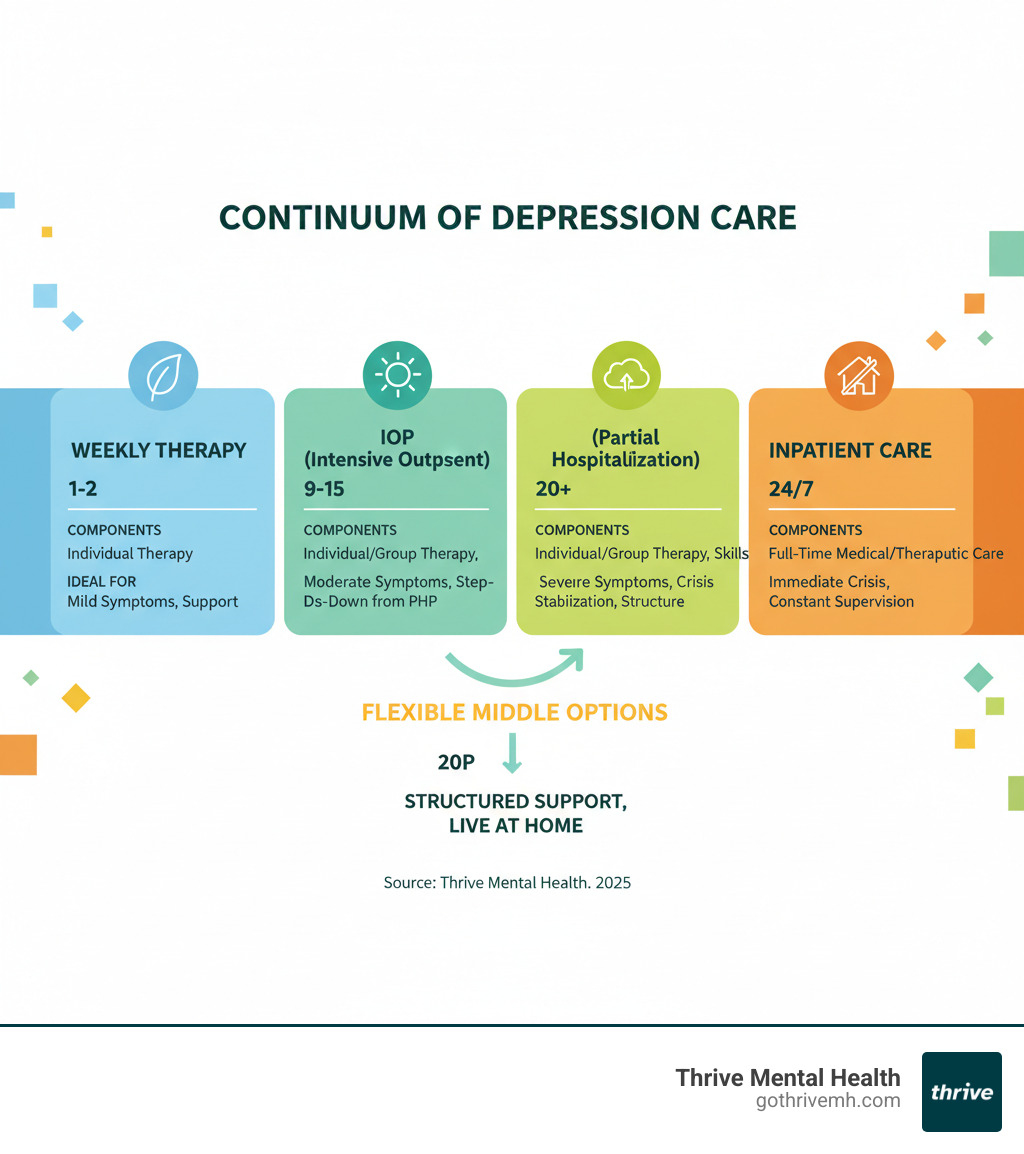
- Multiple levels of care: Intensive Outpatient (IOP) at 9-15 hours/week or Partial Hospitalization (PHP) at 20+ hours/week
- Evidence-based treatment including CBT, DBT, and medication management
- Covered by most insurance including Cigna, Optum, and Florida Blue
- Virtual options available for treatment from home
Depression affects millions of people, but you don’t need to check into a hospital to get effective help. Outpatient programs bridge the gap between weekly therapy and inpatient care, offering intensive support while you continue with daily life. You can keep your job, stay connected to family, and sleep in your own bed.
If weekly therapy isn’t enough but you’re not in crisis, outpatient programs provide the structure and intensity you need. Based on talk therapy—a first-line treatment for depression—programs like IOP and PHP combine individual and group therapy, skill-building, and medication management into a comprehensive plan.
This guide explains your options, how they work, what they cost, and how to get started.
About the Author
I’m Anna Green, LMHC, LPC, Chief Clinical Officer and founder of Thrive Mental Health. With a career spent designing and leading outpatient programs for depression across major healthcare settings, I’ve focused on making high-quality care accessible. At Thrive, we pioneered one of the nation’s first Joint Commission-accredited telehealth IOPs and PHPs to make evidence-based treatment easier to access and afford.
What’s next: Let’s break down the types of outpatient programs, who they’re for, and how to find the right fit for your needs.
Outpatient programs for depression word roundup:
What Are Outpatient Programs for Depression?
Outpatient programs for depression provide intensive, structured therapy while you live at home. You attend sessions at a clinic or online but sleep in your own bed, maintain your job, and stay connected to your support system.
This approach allows you to practice new coping skills in your real-world environment, facing triggers like work stress or family dynamics with new tools. At Thrive Mental Health, our programs are designed to fit your life, not pause it.
We offer a bridge between weekly therapy, which may not be enough, and a full hospital stay, which may not be necessary. It’s structured, evidence-based support for those who are stable but need more than a single weekly session.
Inpatient vs. Outpatient: Which Is Right for You?
The difference comes down to support level and safety. Inpatient care means 24/7 supervision in a facility, ideal for those in crisis or at immediate risk of self-harm. Outpatient programs are for those who are struggling but not in acute danger. You can manage daily life with the right structure, which is where PHP and IOP come in.
| Feature | Inpatient Treatment | Partial Hospitalization Program (PHP) | Intensive Outpatient Program (IOP) |
|---|---|---|---|
| Location | Live at facility 24/7 | Live at home, attend facility/virtual daily | Live at home, attend facility/virtual several times/week |
| Time | Days to weeks, constant supervision | 5-8 hours/day, 5 days/week | 3-4 hours/day, 3-5 days/week |
| Intensity | Highest: medical stabilization, crisis management | High: structured therapy, medical monitoring | Moderate: structured therapy, skill-building |
| Ideal for | Acute crisis, severe symptoms, safety risk | Step-down from inpatient, or step-up from IOP | Moderate symptoms, stable home life, need more than weekly therapy |
| Cost | Highest (room & board, 24/7 care) | Moderate-High (no room & board, but intensive care) | Moderate (fewer hours than PHP) |
PHP is the most intensive outpatient option, offering full-day programming five days a week. It’s often a step-down from inpatient care or a step-up from IOP. IOP offers more flexibility with sessions a few times a week for several hours, making it ideal for those balancing work, school, or family life.
Both are more affordable and less disruptive than inpatient care, giving you the chance to practice recovery skills in your daily life. For a deeper look at how outpatient programs work across different conditions, check out our guide to outpatient mental health programs.
Types of Outpatient Programs: Find the Right Level for Your Needs
When you’re looking for support for depression, it’s good to know you have options. Outpatient programs for depression come in different levels of intensity, allowing you to step up care when things are tough or step down as you feel stronger. Your treatment can grow and change right along with you.
Intensive Outpatient Programs (IOP)
An Intensive Outpatient Program (IOP) is a great fit if weekly therapy isn’t enough but you don’t need 24/7 care. You’ll spend 9 to 15 hours per week in therapy while living at home. IOPs typically include a mix of group therapy, where you connect with peers who understand; individual therapy for personalized work on your goals; and sometimes family therapy to improve home relationships. You’ll learn practical skills for managing emotions and preventing relapse. It’s ideal for moderate depression while allowing you to maintain your job, school, or family commitments. Learn more about our Thrive IOP program details.
Partial Hospitalization Programs (PHP)
Partial Hospitalization Programs (PHPs) are the most intensive outpatient option, providing a high level of daily clinical support without an overnight stay. A PHP involves 20 or more hours of treatment per week, often five days a week. This intensity is ideal if you’re stepping down from inpatient care, need to step up from an IOP, or want to avoid a hospital stay altogether. PHPs offer more group and individual sessions than IOPs and often include medication management with a psychiatrist, providing a structured environment to stabilize and heal. Explore our Thrive PHP program details.
Virtual Outpatient Programs for Depression
Virtual outpatient programs for depression use secure, HIPAA-compliant technology to bring structured treatment to you. At Thrive Mental Health, our virtual IOPs and PHPs offer the same expert-led, evidence-based care as our in-person programs with added benefits:

- Flexibility: Evening and daytime schedules fit around your life, perfect for busy professionals or students across Florida, from Tampa to Orlando.
- Accessibility: Get support from the comfort and privacy of your home, removing barriers like transportation or distance from a clinic.
Research shows virtual care is just as effective as in-person treatment, allowing you to apply new coping skills in your daily life immediately. Learn more about our Thrive Virtual IOP info.
Who’s a Good Fit for Outpatient Depression Treatment?
Wondering if an outpatient program for depression is right for you? These programs are a lifeline for many, offering robust support without an overnight stay. They are designed for individuals who need more than weekly therapy but are not in a crisis requiring 24/7 supervision.

You might be a perfect fit for an outpatient program if you:
- Experience mild to moderate depression symptoms that impact daily life but don’t prevent you from functioning.
- Are not an immediate danger to yourself or others and do not have active suicidal thoughts with a plan.
- Have a stable, supportive home environment to return to after treatment sessions.
- Are motivated to participate actively in therapy and complete assignments.
- Can manage daily responsibilities like personal hygiene and attending appointments.
- Need a step-down from inpatient care to transition back into your community.
When Inpatient Care Is Necessary
While outpatient programs offer incredible flexibility, they aren’t right for every situation. A higher level of care like inpatient treatment is necessary for immediate safety and well-being.
Crisis Support Callout:
If you or someone you know is in crisis or thinking of suicide, call/text 988 now. You are not alone. Help is available 24/7.
It’s crucial to seek inpatient care if you are experiencing suicidal thoughts with a plan and have the means to act. In this case, 24/7 care is critical for your safety. Another indicator is being unable to care for yourself due to severe symptoms like an inability to eat, maintain hygiene, or psychosis. Finally, an unsafe living situation may require the protective environment of an inpatient facility. If you’re unsure, a professional assessment can guide you to the right level of care.
What to Expect in an Outpatient Depression Program
Starting an outpatient program for depression is a personalized journey. At Thrive Mental Health, we know a one-size-fits-all approach doesn’t work. Your treatment plan should be as unique as your story.
Your journey starts with a thorough initial assessment where we learn about your mental health history, current life situation, and treatment goals. This helps us determine the right level of care (IOP, PHP, etc.). Next, we collaborate on a custom treatment plan, setting realistic goals and identifying the best therapeutic approaches for you.
The core of the program involves regular therapy sessions, including a mix of group, individual, and family therapy. Group therapy provides powerful peer support, while individual sessions allow for deeper personal work. Throughout the program, you’ll build practical skills for challenging negative thoughts, regulating emotions, and communicating effectively. Finally, aftercare planning is a crucial step. We help you create a plan for what comes next, whether it’s transitioning to weekly therapy or finding community resources, to ensure your long-term success.
For a more detailed look at the day-to-day experience, see what to expect in an Intensive Outpatient Program.
Common Therapies for Depression
The backbone of effective outpatient programs for depression is evidence-based therapy. Talk therapy is a first-line treatment, and we tailor multiple proven methods to your needs.
- Cognitive Behavioral Therapy (CBT) helps you identify, challenge, and change the negative thought patterns and behaviors that fuel depression. Our CBT Virtual IOP helps you break free from destructive thinking.
- Dialectical Behavior Therapy (DBT) teaches skills in mindfulness, distress tolerance, emotion regulation, and interpersonal effectiveness, which is especially helpful for overwhelming emotions. Our DBT Virtual IOP can help you manage intense feelings.
- Eye Movement Desensitization and Reprocessing (EMDR) is a trauma-focused therapy that helps your brain reprocess painful memories so they lose their emotional charge. We offer an EMDR Virtual IOP for this specialized work.
- Family Therapy involves your loved ones to improve communication, repair relationships, and build a stronger support network at home. Our Family Therapy and Coaching Virtual IOP can help strengthen family bonds.
- Medication Management is an optional component where a psychiatrist can evaluate if medication could help, prescribe appropriate options, and monitor your response.
- Mindfulness and Somatic Therapies help you reconnect with your body and the present moment, teaching you to observe thoughts without judgment and release physical tension. Our Mindfulness Meditation Virtual IOP fosters calm and self-awareness.
Sample IOP Weekly Schedule
Wondering what a week in our IOP looks like? While schedules are personalized, this sample provides a general idea:
| Time | Monday | Tuesday | Wednesday | Thursday | Friday |
|---|---|---|---|---|---|
| 9-10 AM | Group Therapy: CBT Skills for Depression | Individual Therapy Session | Group Therapy: DBT Emotion Regulation | Group Therapy: CBT Skills for Depression | Group Therapy: Mindfulness & Stress Reduction |
| 10-11 AM | Group Therapy: Process Group | Psychoeducation: Understanding Depression | Group Therapy: Process Group | Group Therapy: Process Group | Family Therapy Session (as needed) |
| 11-12 PM | Life Skills/Activity Group | Medication Management (optional) | Life Skills/Activity Group | Life Skills/Activity Group | Wrap-up & Weekend Planning |
Most people attend 3 to 4 days per week for about 3 hours each day. This structure provides consistent support while allowing you to manage work, family, and other responsibilities. The mix of group, individual, and educational sessions ensures a comprehensive approach to healing. Our virtual format means you can participate from anywhere with an internet connection. Learn more about how Virtual IOP works at Thrive.
How to Find a Program & Understand Costs
Finding the right outpatient program for depression is a key step toward healing. It’s about matching a program to your needs, preferences, and financial situation.
How to Find Quality Outpatient Programs for Depression
Start by asking your doctor or therapist for referrals or using your insurance provider’s online directory. You can also search online with specific terms like “virtual IOP in Tampa” or “PHP programs in Miami.” At Thrive, we proudly serve clients throughout Florida, offering accessible care in major areas like Tampa Bay, St. Petersburg, Miami, and Orlando. Reading reviews and testimonials can also provide valuable insight. For more guidance, see our guide on finding quality IOP programs near me.
Does Insurance Cover Outpatient Depression Treatment?
Yes, most health insurance plans are required by law (MHPAEA) to cover mental health services comparably to medical services. At Thrive Mental Health, we accept most major insurance providers, including Cigna, Aetna, Optum, United Healthcare, Florida Blue, and others. It’s important to understand your specific plan’s details, such as deductibles, co-pays, and in-network vs. out-of-network coverage. To simplify this, use our free online tool to verify your insurance in 2 minutes.
Local Options: Serving All of Florida
For residents across Florida, including those in Tampa, St. Petersburg, Miami, and Orlando, Thrive Mental Health offers both virtual and hybrid IOP and PHP programs. This allows you to access our expert-led outpatient programs for depression from the comfort of your home, with flexible scheduling and evening options to fit your life.
Frequently Asked Questions about Outpatient Depression Treatment
It’s completely normal to have questions when you’re exploring options for your mental health. Here are some of the most common questions we hear about outpatient programs for depression, answered to help you feel more informed and confident in your choices.
How effective are outpatient programs for depression?
Yes, they are highly effective for many people, especially for moderate depression with a stable home environment. Because you apply new coping skills in your real-world setting, the learning is reinforced daily. Evidence-based approaches like Cognitive Behavioral Therapy (CBT), a cornerstone of these programs, are proven to significantly reduce depression symptoms.
What’s the difference between IOP and PHP?
The main difference is time commitment and intensity. A Partial Hospitalization Program (PHP) is more intensive, involving 20+ hours of therapy per week (e.g., 5–8 hours/day, 5 days/week). An Intensive Outpatient Program (IOP) is more flexible, typically requiring 9–15 hours per week (e.g., 3–4 hours/day, 3–5 days/week). PHP is often a step-down from inpatient care, while IOP is ideal for balancing treatment with work or school. Learn more in our guide on IOP vs. PHP.
How long do outpatient programs last?
Duration varies based on individual needs and progress. Generally, an IOP lasts about 8–12 weeks, while a more intensive PHP is often shorter, around 4–6 weeks. Your treatment team will collaborate with you to determine the right length of stay based on your goals and progress.
Can I do outpatient depression treatment virtually?
Absolutely. Thrive Mental Health offers virtual IOP and PHP programs, providing high-quality, structured care from the comfort of your home. Virtual treatment offers great flexibility, making it accessible for those with busy schedules or transportation challenges across Florida and beyond. Explore our Virtual IOP to see how it works.
Does insurance cover outpatient depression programs?
Yes, most major health insurance plans cover outpatient programs for depression, as required by mental health parity laws. Thrive Mental Health is in-network with many providers, including Cigna, Optum, Florida Blue, Aetna, and United Healthcare. To understand your specific benefits, like your deductible and co-pays, use our quick online tool to check your insurance benefits – it only takes a couple of minutes and there’s no obligation!
<script type="application/ld+json">
{
  "@context": "https://schema.org",
  "@type": "FAQPage",
  "mainEntity": [
    {
      "@type": "Question",
      "name": "How effective are outpatient programs for depression?",
      "acceptedAnswer": {
        "@type": "Answer",
        "text": "Outpatient programs are highly effective for many people with moderate depression and a stable home. Evidence-based care like CBT can significantly reduce symptoms."
      }
    },
    {
      "@type": "Question",
      "name": "What’s the difference between IOP and PHP?",
      "acceptedAnswer": {
        "@type": "Answer",
        "text": "PHP is more intensive (20+ hours/week, often 5–8 hours/day). IOP is part-time (9–15 hours/week). PHP is a step-down from inpatient; IOP offers more flexibility."
      }
    },
    {
      "@type": "Question",
      "name": "How long do outpatient programs last?",
      "acceptedAnswer": {
        "@type": "Answer",
        "text": "IOP typically runs 8–12 weeks; PHP often lasts 4–6 weeks. Your team adjusts length based on goals and progress."
      }
    },
    {
      "@type": "Question",
      "name": "Can I do outpatient depression treatment virtually?",
      "acceptedAnswer": {
        "@type": "Answer",
        "text": "Yes. Virtual IOP/PHP provides structured, evidence-based care from home and is comparable in effectiveness to in-person treatment."
      }
    },
    {
      "@type": "Question",
      "name": "Does insurance cover outpatient depression programs?",
      "acceptedAnswer": {
        "@type": "Answer",
        "text": "Most major plans (e.g., Cigna, Optum, Florida Blue, Aetna, United Healthcare) cover outpatient depression treatment. Verify your benefits to see costs."
      }
    }
  ]
}
</script>
Summary: Outpatient Programs for Depression Offer Real Relief—Without Disrupting Your Life
Outpatient programs for depression represent a powerful, flexible, and evidence-based pathway to healing. They provide the intensive support you need to overcome depression, all while allowing you to live at home, maintain your daily responsibilities, and practice new skills in real-world settings. From the structured care of IOPs to the higher intensity of PHPs, and the convenience of virtual options, there’s a program designed to meet you where you are. We’ve seen how these programs empower individuals to regain control, build resilience, and refind hope.
Ready for Support?
Feeling ready to take that brave next step toward a brighter, healthier future? We at Thrive Mental Health are here, ready to walk alongside you. We understand that finding expert care needs to be easy and fit your life. That’s why we offer virtual and hybrid Intensive Outpatient (IOP) and Partial Hospitalization (PHP) programs, even with convenient evening options. Our goal is to make high-quality, evidence-based care accessible and convenient for you.
Curious about how it works with your insurance? You can quickly verify your benefits in just 2 minutes – with absolutely no obligation. It’s a simple way to get clear answers and understand your coverage for outpatient programs for depression. Just click here to Start your benefits check or give us a friendly call at 561-203-6085. We’re happy to help guide you through the process.
Please remember, if you or someone you know is in immediate crisis, don’t hesitate. Reach out for help right away by calling or texting 988. You are not alone, and support is always available.