
The DSM-5: A Clinician’s Compass for Mental Disorders

What Is the DSM-5 and Why Does It Matter for Your Care?
The DSM V (officially styled as DSM-5) is the Diagnostic and Statistical Manual of Mental Disorders, Fifth Edition—the authoritative guide mental health professionals use to diagnose, classify, and understand mental health conditions. Published by the American Psychiatric Association (APA), it’s the standard reference clinicians rely on when evaluating symptoms like persistent anxiety, depression, trauma responses, or burnout.
Quick Answer: What You Need to Know About the DSM-5
- What it is: A comprehensive manual that defines over 300 mental disorders with specific diagnostic criteria
- Who uses it: Psychiatrists, psychologists, therapists, and other mental health professionals across the United States
- Why it matters: It ensures you get an accurate diagnosis, which leads to the right treatment plan and insurance coverage
- Latest version: DSM-5-TR (Text Revision), published in 2022, includes updated criteria based on the most current research
- Key change from DSM-IV: Removed the outdated five-axis system in favor of a more flexible, dimensional approach to diagnosis
Why this matters for you: If you’re seeking mental health treatment—whether through intensive outpatient programs, therapy, or medication management—your clinician will use the DSM-5 to give your experience a clinical name. That diagnosis becomes the foundation for your treatment plan, determines what your insurance will cover, and helps your care team track your progress.
The DSM-5 isn’t just a book of labels. It’s a common language that allows your therapist, psychiatrist, and researchers throughout Florida to all understand exactly what you’re experiencing. It translates your struggles into criteria that can be measured, treated, and—most importantly—resolved.
I’m Nate Raine, CEO of Thrive Mental Health. With over a decade in behavioral health, I’ve seen how precise frameworks like the DSM V lead to measurable outcomes. At Thrive, we use DSM-5-aligned assessments to match you with the right level of care—from our virtual IOP to individual therapy—ensuring you get exactly what works.
Essential dsm v terms:
The Purpose of the DSM-5 in Diagnosing Mental Health Conditions
The DSM V acts as a vital compass for mental health professionals. Its primary purpose is to provide clear, standardized definitions for mental health conditions, which is crucial for:
- Reliable Diagnoses: The DSM-5’s specific criteria ensure consistent diagnoses for patients with similar symptoms, whether in Miami, Orlando, or anywhere else in Florida. This consistency is fundamental for effective treatment.
- Guiding Treatment: An accurate diagnosis is the critical first step in creating an effective treatment plan. It helps clinicians select appropriate evidence-based therapies, like the Dialectical Behavior Therapy (DBT) used in Thrive Mental Health’s virtual IOP and PHP programs.
- Clinical Assessment: The manual helps professionals differentiate between conditions with overlapping symptoms, such as clarifying the distinction between Major Depressive Disorder and Persistent Depressive Disorder.
- Standardized Communication: The DSM-5 creates a common language for mental health professionals, researchers, and insurance providers, facilitating seamless communication and collaborative care for our clients throughout Florida.
The Role of the DSM-5 in Clinical Practice, Research, and Insurance
The influence of the DSM V extends far beyond the diagnostic interview. In clinical practice, it’s indispensable for treatment planning and monitoring progress. A diagnosis of Borderline Personality Disorder (BPD), for instance, might lead to a specialized DBT program like our virtual IOP.
In research, the DSM-5 provides standardized criteria for studies, allowing for meaningful comparisons and the development of new treatments. This is foundational for the scientific research on diagnostic classification that advances mental health.
For insurance and billing, the dsm v is non-negotiable. Health insurance companies like Cigna, Optum, and Florida Blue require a valid DSM-5 diagnosis and its corresponding ICD-10 code to process claims and justify the level of care, ensuring patients in Florida can access vital services like intensive outpatient programs.
How the DSM-5 Changed Mental Health Diagnosis
The journey of the DSM is one of continuous evolution, reflecting our growing understanding of the human mind. The DSM V marked a significant departure from its predecessors, introducing changes that aimed to improve clinical utility and scientific validity.

Key Differences Between the DSM-V and DSM-IV
A profound change in the DSM V was eliminating the DSM-IV’s multi-axial system. Previously, diagnoses were coded across five axes addressing different aspects of a person’s functioning. The DSM-5 streamlined this by integrating information into a single diagnostic statement.
| Feature | DSM-IV (Multi-Axial System) | DSM-5 (Non-Axial System) |
|---|---|---|
| Axis I | Clinical Disorders (e.g., Depression, Anxiety) | Integrated into the main diagnostic categories |
| Axis II | Personality Disorders, Intellectual Disability | Integrated into the main diagnostic categories |
| Axis III | General Medical Conditions | Noted within the diagnostic formulation |
| Axis IV | Psychosocial and Environmental Problems | V-codes (or Z-codes in ICD-10) for other conditions that may be a focus of clinical attention |
| Axis V | Global Assessment of Functioning (GAF) Scale | Replaced by WHODAS 2.0 (World Health Organization Disability Assessment Schedule 2.0) or clinical judgment |
| Numerals | Roman numerals (e.g., DSM-IV) | Arabic numerals (DSM-5) |
| Revision Style | Discrete editions | “Living document” concept with text revisions (e.g., DSM-5-TR) |
| Approach | Primarily categorical | More dimensional approach, particularly for certain disorders |
The move from Roman to Arabic numerals (from DSM-IV to DSM-5) signaled a shift towards a “living document” model, allowing for more frequent and flexible updates. This allows for timely incorporation of new scientific findings, ensuring that clinicians in our Florida centers are working with the most current information.
Major Structural and Organizational Changes
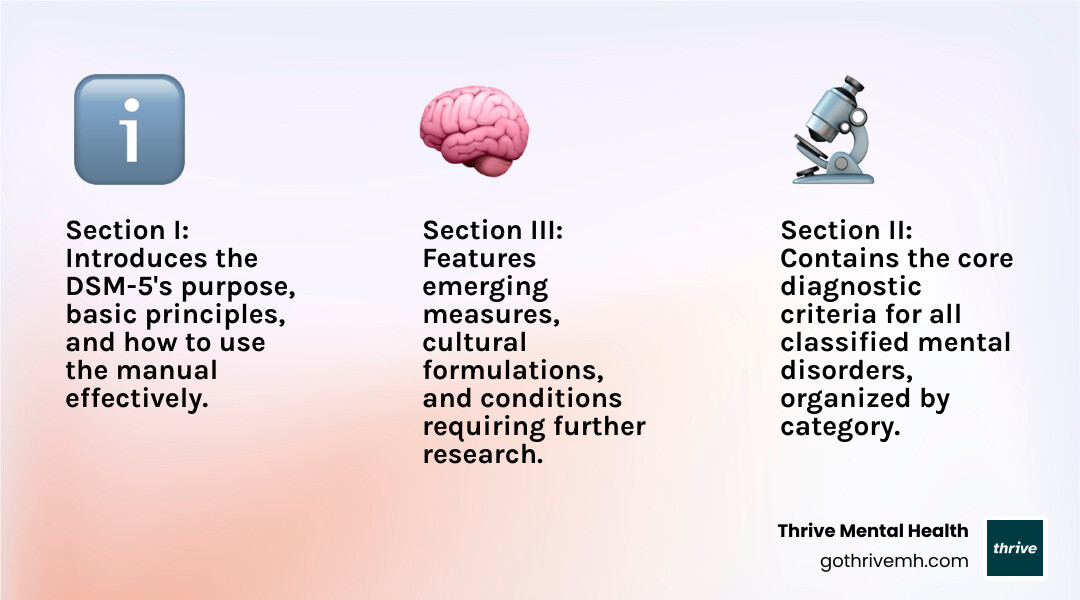
The DSM V is organized into three sections with a new structure based on a developmental lifespan approach:
- Section I: DSM-5 Basics
This introductory section provides guidance on the manual’s use, definition of a mental disorder, and an overview of the development process. It emphasizes the importance of clinical judgment and cultural context in diagnosis. - Section II: Diagnostic Criteria and Codes
This is the largest section, containing the specific diagnostic criteria for all recognized mental disorders. Disorders are grouped by their underlying vulnerabilities and symptom patterns, often reflecting a developmental lifespan approach. This section also includes the numerical diagnostic codes used for billing by insurance providers like Optum and Cigna. - Section III: Emerging Measures and Models
This forward-looking section includes assessment measures, cultural formulation interviews, and conditions that warrant further research before official inclusion. An example is Attenuated Psychosis Syndrome, listed here for further study. This section highlights the dynamic nature of psychiatric diagnosis.
The emphasis on cultural considerations throughout the DSM-5 is a significant advancement, encouraging clinicians to understand how cultural factors might influence symptom presentation and treatment response, ensuring more equitable care for Florida’s diverse populations.
Significant New Diagnoses and Revisions in the DSM-5
The DSM V introduced numerous changes to existing disorders and added several new diagnoses. Some of the most notable include:
- Autism Spectrum Disorder (ASD): The DSM-5 combined Autistic Disorder, Asperger’s Disorder, and others into a single Autism Spectrum Disorder (ASD). This reflects the continuum of symptoms and improves diagnostic consistency, an approach we use in our Florida programs.
- Disruptive Mood Dysregulation Disorder (DMDD): Introduced to address over-diagnosis of bipolar disorder in children, DMDD characterizes children with persistent irritability and frequent, severe temper outbursts.
- Binge Eating Disorder: Now a formal diagnosis, this recognizes recurrent binge eating episodes accompanied by distress and a lack of control, without the compensatory behaviors of bulimia nervosa.
- Hoarding Disorder: This new diagnosis recognizes the persistent difficulty discarding possessions, regardless of their actual value, leading to significant clutter and impairment.
- Removal of Bereavement Exclusion: The DSM V removed the bereavement exclusion for Major Depressive Disorder. This change recognizes that major depression can co-occur with grief and may warrant clinical attention, while clarifying that grief itself is not depression.
- Somatic Symptom Disorder: This revised category replaces several somatoform disorders. It focuses on distressing physical symptoms accompanied by abnormal thoughts, feelings, or behaviors in response to them.
- Gender Dysphoria: The term “Gender Identity Disorder” was replaced with “Gender Dysphoria” to better reflect the distress associated with the incongruence between one’s experienced gender and assigned gender, rather than pathologizing the identity itself.
These changes underscore the dynamic nature of psychiatric diagnosis. For a comprehensive overview, the Highlights of Changes from DSM-IV-TR to DSM-5 provides valuable details.
The Latest Updates: Understanding the DSM-5-TR
The DSM V is considered a “living document,” meaning it undergoes periodic updates to reflect the latest scientific advancements. This commitment to currency led to the publication of the DSM-5-TR, or Text Revision, in 2022.
What is the DSM-5-TR and Why Was It Published?
The DSM-5-TR is a text revision of the original DSM-5, published nearly a decade after its 2013 predecessor. It’s not a completely new edition, but rather an updated version that incorporates critical refinements based on new scientific literature and clinical experience. The process involved contributions from more than 200 subject matter experts, including psychiatrists, psychologists, and other mental healthcare professionals from around the world. These experts carefully reviewed and updated existing descriptive text, diagnostic criteria, and associated codes.
The publication of the DSM-5-TR ensures that mental health professionals, including our clinicians throughout Florida, are equipped with the most current and accurate information available. It reflects the American Psychiatric Association’s dedication to providing the most reliable diagnostic framework possible. You can find more detailed information through the DSM-5-TR Fact Sheets from the APA.
What’s New in the Text Revision?
The DSM-5-TR brought several important changes and clarifications:
- Prolonged Grief Disorder: This is a significant new diagnosis included in the DSM-5-TR. It addresses a distinct pattern of grief that is intense, debilitating, and extends beyond what is considered typical for a prolonged period, causing significant impairment in functioning.
- Updated Language for Gender Dysphoria: The text for gender dysphoria was revised to reflect more current and inclusive language, aligning with evolving societal and clinical understanding of gender identity. This ensures that our approach to care is sensitive and affirming.
- Inclusion of Codes for Suicidal Behavior and Nonsuicidal Self-Injury: The DSM-5-TR added ICD-10-CM symptom codes for suicidal behavior and nonsuicidal self-injury. This allows for better tracking and clinical attention to these critical public health concerns, improving our ability to identify and support individuals at risk within our programs.
- Revisions to Autism Spectrum Disorder Criteria: While the core diagnostic criteria for ASD remained largely the same, the descriptive text was updated to improve clarity and provide more nuanced guidance for diagnosis.
- Comprehensive Review of Racism and Discrimination: A crucial addition to the DSM-5-TR is a comprehensive review of the impact of racism and discrimination on the diagnosis and manifestations of mental disorders. This reflects a growing awareness of social determinants of mental health and helps clinicians consider systemic factors in their assessments.
- Clarifying Modifications: Over 70 disorders received clarifying modifications to their criteria sets, ensuring greater precision and reducing ambiguity in diagnosis.
- Attenuated Psychosis Syndrome: This condition remains in Section III, “Conditions for Further Study,” indicating continued research interest in early-onset, subthreshold psychotic symptoms.
These updates reinforce the dsm v‘s role as a dynamic and responsive tool, continuously striving for greater accuracy and clinical utility.
If you’re in crisis, call/text 988 right now. You are not alone.
Criticisms of the DSM V and the Future of Diagnosis
Despite its widespread acceptance and utility, the DSM V, like all scientific endeavors, has faced its share of criticism. These critiques are vital for driving ongoing improvements and fostering a more nuanced understanding of mental health.
Who Developed the DSM-5 and What Was the Process?
The development of the DSM V was an extensive and ambitious undertaking led by the American Psychiatric Association (APA). The process began in 1999, involving more than 160 mental healthcare professionals from around the world, including psychiatrists, psychologists, and experts from many other professional fields. These individuals formed a central Task Force and numerous work groups dedicated to specific disorder categories.
The development process was designed to be rigorous and transparent, involving:
- Work Groups: Experts reviewed scientific literature, identified areas needing revision, and drafted proposed changes.
- Public Comment Periods: Draft criteria were posted online, allowing for feedback from mental health professionals, patient advocates, and the general public. This extensive public engagement was a key part of the process, with millions of comments submitted.
- Field Trials: Proposed diagnostic criteria underwent field trials in various clinical settings across the United States and Canada to test their reliability and validity. These trials involved thousands of patients and clinicians.
- Expert Review: The final proposed changes were rigorously reviewed by scientific and clinical experts.
The APA’s commitment to continuous improvement is evident in the ongoing revision process, including the DSM-5-TR. You can learn more about this detailed process by exploring the development details.
Controversies and Potential Biases
While the DSM-5’s development was comprehensive, it wasn’t without significant controversy:
- Pharmaceutical Industry Ties: A frequently cited concern involves the financial ties between task force members and the pharmaceutical industry. Statistics indicate that about 68% of DSM-5 task-force members and 56% of panel members reported having ties to the pharmaceutical industry. More recently, a study of the DSM-5-TR found that 60% of the American physicians contributing to the revised edition received payments from industry. Critics argue that such ties could potentially influence diagnostic decisions, leading to the “medicalization” of normal experiences and increased reliance on medication.
- Medicalizing Normal Behavior: Some critics argue that the DSM V lowers diagnostic thresholds for certain conditions, potentially pathologizing normal human responses to life’s challenges. The removal of the “bereavement exclusion” for Major Depressive Disorder, for example, sparked debate about whether normal grief might be mislabeled as a mental illness.
- Lack of Biological Markers: A significant criticism, particularly from the National Institute of Mental Health (NIMH), is that the DSM-5 diagnoses are largely symptom-based, lacking objective biological markers. This raises questions about the underlying validity of some diagnostic categories.
- Cultural Bias Concerns: While the DSM-5 made strides in addressing cultural considerations, some critics still point to potential cultural biases in diagnostic criteria, suggesting that what is considered “normal” or “pathological” can vary significantly across cultures.
- Transparency and Secrecy: Early in its development, the APA faced criticism for requiring task force members to sign non-disclosure agreements, which some argued hindered open scientific debate and transparency.
These criticisms highlight the ongoing tension between the need for a standardized diagnostic system and the complexities of human experience, urging continuous dialogue and refinement in the field of mental health.
How the DSM-5 Works with Other Systems like the ICD and RDoC
The DSM V does not exist in a vacuum; it interacts with other crucial systems for classifying health conditions and guiding research.
- International Classification of Diseases (ICD): The ICD, maintained by the World Health Organization (WHO), is the global standard for reporting diseases and health conditions. In the United States, the DSM-5’s diagnostic codes are designed to harmonize with the ICD-10-CM (Clinical Modification) codes. This alignment is critical for billing, public health statistics, and international research collaboration. The ICD-11 is currently being rolled out globally, and future revisions of the DSM will continue to work towards greater congruence with this international standard. For our practice in Florida, this means seamless integration of diagnostic and billing practices, ensuring our clients can effectively use their insurance for care.
- Research Domain Criteria (RDoC): Initiated by the National Institute of Mental Health (NIMH), RDoC is a research framework designed to classify mental disorders based on observable behaviors and neurobiological measures, rather than just symptoms. Unlike the DSM-5, which is a clinical diagnostic manual, RDoC is intended to guide research into the underlying causes of mental illness. While the DSM-5 is symptom-focused, RDoC takes a more biological/neurological approach, examining domains like negative valence systems, cognitive systems, and social processes. The NIMH has been critical of the DSM-5’s lack of biological grounding, proposing RDoC as a complementary, research-focused framework. The goal is that RDoC may eventually inform future diagnostic systems by providing a deeper, biologically validated understanding of mental disorders. You can explore the differences and shared interests in comparing DSM-5, ICD-11, and RDoC.
Frequently Asked Questions about the DSM-5
We understand that the DSM V can seem complex. Here are some common questions we hear:
Can a non-professional use the DSM-5 to diagnose themselves or others?
No, absolutely not. The DSM V is a highly technical, complex manual intended exclusively for trained mental health professionals. While it is available to the public for purchase in bookstores and online, and many public and university libraries have copies, it is not designed for self-diagnosis or diagnosing others. Trying to diagnose yourself or a loved one using the DSM-5 can be unreliable, misleading, and potentially harmful.
Here’s why:
- Clinical Judgment is Essential: A diagnosis isn’t just a checklist. It requires extensive clinical training, experience, and the ability to conduct a comprehensive assessment, including interviews, observation, and consideration of an individual’s unique history, context, and cultural background.
- Nuance and Differential Diagnosis: Many mental health conditions share overlapping symptoms. A professional is trained to differentiate between these, ruling out other medical conditions or substance use that might mimic psychiatric symptoms. This process, called differential diagnosis, is crucial for an accurate outcome.
- Potential for Misinterpretation: Without proper training, it’s easy to misinterpret criteria, over-pathologize normal experiences, or incorrectly label oneself or others, which can lead to unnecessary anxiety or inappropriate treatment.
If you are concerned about your mental health or that of a loved one, the most important step is to consult a qualified mental health professional. We offer virtual therapy services across Florida, providing accessible and professional assessments to residents throughout the state.
How is the DSM-5 made available to the public?
The American Psychiatric Association makes the DSM V available through several channels:
- Purchase: The manual can be purchased in physical and digital formats from major bookstores and online retailers.
- Libraries: Many public libraries, as well as university and medical libraries, hold copies of the DSM-5 and DSM-5-TR for reference.
- APA Resources: The American Psychiatric Association’s website (psychiatry.org) offers various educational resources, including fact sheets and informational articles about the DSM-5 and its updates, designed to inform the public and professionals.
While accessible, simply having the manual does not equip one with the expertise needed for accurate diagnosis.
What is the difference between a diagnosis in the DSM-5 and a mental illness?
A diagnosis in the DSM V is a clinical construct—a tool—while a mental illness is the lived experience of an individual.
- Diagnosis (DSM-5): A diagnosis is a label applied by a trained professional based on a set of defined criteria. It’s a shorthand, a way for clinicians to categorize and communicate about patterns of symptoms, severity, duration, and functional impairment. It guides treatment, facilitates research, and helps with insurance billing. It helps us understand what someone is experiencing from a clinical perspective.
- Mental Illness: This refers to the actual, often deeply personal, experience of psychological distress, impaired functioning, and suffering. It encompasses the subjective feelings, thoughts, and behaviors that impact a person’s daily life, relationships, and well-being.
Think of it this way: a map (the DSM-5 diagnosis) helps you steer a city (the mental illness). The map is a representation, a tool, but it is not the city itself. The city is vibrant, complex, and filled with unique experiences. A diagnosis is a starting point for understanding and addressing a person’s struggles, but it never fully captures the individual’s unique journey or identity. We always treat the person, not just the diagnosis.
Your Path to a Clear Diagnosis and Effective Treatment
The DSM V serves as an indispensable tool, a clinician’s compass that guides us in understanding and addressing mental health conditions. It brings clarity to complex symptom presentations, facilitates effective treatment planning, and ensures that care is standardized and accessible.
At Thrive Mental Health, we leverage the precision of DSM V criteria in our evidence-based programs for clients throughout Florida. Our goal is to provide accurate diagnoses that lead to measurable results and real recovery. We know that a clear diagnosis is the first step on your path to healing and empowerment, offering hope and a roadmap for regaining control of your life.
Ready for support? Thrive offers virtual and hybrid IOP/PHP programs with evening options. Verify your insurance in 2 minutes (no obligation) → Start benefits check or call 561-203-6085. If you’re in crisis, call/text 988.
If you’re in crisis, call/text 988 right now. You are not alone.