





The Vaping Withdrawal Timeline (and What to Expect When You Quit): #1 Guide
Why Understanding the Vaping Withdrawal Timeline Matters When You’re Ready to Quit
The Vaping Withdrawal Timeline (and What to Expect When You Quit) is crucial information for anyone preparing to break free from nicotine dependence. Whether you’ve been vaping for months or years, knowing what lies ahead can make the difference between success and relapse.
Quick Overview: What to Expect When You Quit Vaping
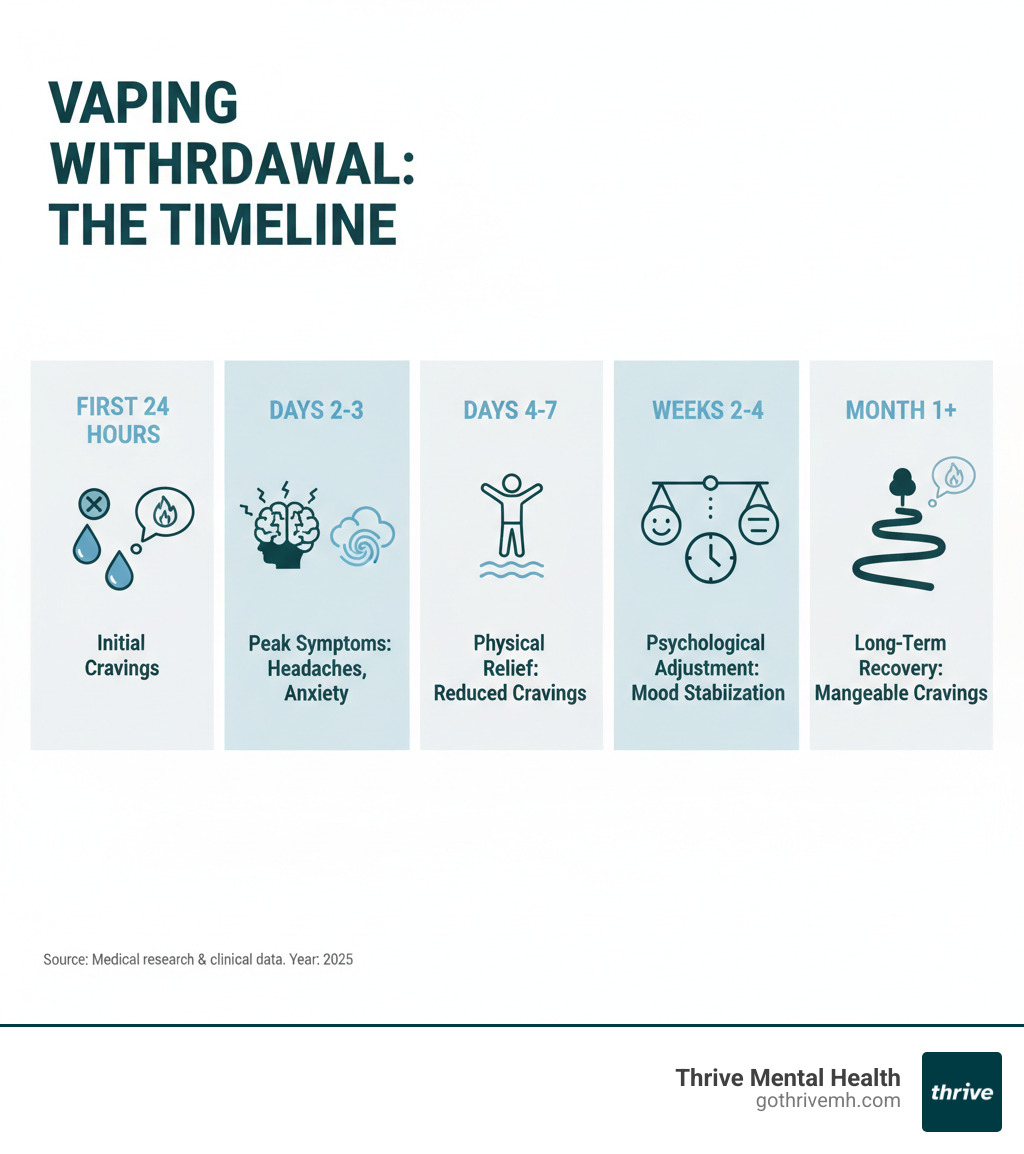
| Timeframe | What Happens | Key Symptoms |
|---|---|---|
| First 4-24 Hours | Nicotine leaves your bloodstream | Initial cravings, irritability, restlessness |
| Days 2-3 | Symptoms peak in intensity | Intense headaches, strongest cravings, anxiety, mood swings |
| Days 4-7 | Physical symptoms begin to ease | Reduced craving intensity, improving energy, appetite changes |
| Weeks 2-4 | Psychological challenges persist | Mood swings, habitual triggers, lingering irritability |
| 1 Month+ | New normal established | Occasional cravings, long-term health improvements begin |
Let’s be honest: quitting vaping isn’t easy. Nicotine is highly addictive, it alters your brain chemistry by disrupting dopamine levels and creating both physical and psychological dependence. When you stop using nicotine, your body and brain need time to recalibrate. This adjustment period brings withdrawal symptoms that can feel overwhelming, especially during the first week.
The good news? Most symptoms return to baseline within 10 days, and the acute phase typically resolves within 2-4 weeks. Physical symptoms like headaches and fatigue fade first, while psychological symptoms like cravings and mood swings take a bit longer to settle.
Understanding this timeline helps you prepare mentally and practically. You’ll know when symptoms will be most intense (days 2-3), when you’re most vulnerable to relapse (the first two weeks), and what strategies work best at each stage. This knowledge transforms a chaotic, scary process into a manageable journey with a clear endpoint.
I’m Anna Green, LMHC, LPC, Chief Clinical Officer at Thrive Mental Health, and I’ve guided countless individuals through the challenges of substance use recovery, including navigating The Vaping Withdrawal Timeline (and What to Expect When You Quit). Through evidence-based treatment and compassionate support, I’ve seen how understanding the withdrawal process empowers people to achieve lasting freedom from nicotine.
In this guide, we’ll walk through each stage of withdrawal, explain why symptoms happen, and share proven strategies to manage cravings, physical discomfort, and emotional challenges. You’ll also learn when professional support can make the difference, and how to access it.
Know your The Vaping Withdrawal Timeline (and What to Expect When You Quit) terms:
- evidence based therapy online
- online therapy
- remote mental health support
Understanding Vaping Withdrawal: Symptoms and Causes
When you stop vaping, your body and mind go through a challenging adjustment period called withdrawal. This isn’t a sign of weakness, it’s actually proof that your body is healing and breaking free from nicotine’s grip.
Why does withdrawal happen? The answer lies in your brain chemistry. Nicotine is one of the most addictive substances known to science. When you inhale it, nicotine rushes to your brain within seconds, binding to specific receptors and triggering a flood of dopamine, the “feel-good” neurotransmitter that creates feelings of pleasure and reward.
Your brain loves this dopamine surge. Over time, it starts to expect it. It even changes its structure and function to accommodate the regular nicotine supply, a process called neuro-adaptation. Your brain essentially rewires itself around nicotine use, adjusting its natural dopamine production and receptor sensitivity.
When you suddenly stop vaping, your brain doesn’t have enough time to readjust immediately. The dopamine levels drop, your receptors are still expecting nicotine, and your entire reward system is thrown off balance. This disruption is what causes the uncomfortable symptoms of The Vaping Withdrawal Timeline (and What to Expect When You Quit).
The good news? These symptoms are temporary. They’re your body’s way of healing and returning to its natural state. Understanding what’s happening inside your brain can make the experience less scary and more manageable. Scientific research on the biology of addiction shows that with time and proper support, your brain can and will recover.
Physical Symptoms
Your body has gotten used to nicotine’s effects, and when you take it away, you’ll feel the difference. These physical symptoms are uncomfortable, but they’re also signs that your body is starting to repair itself.
Headaches are one of the most common complaints during withdrawal. While scientists aren’t entirely sure why they happen, it likely relates to changes in blood flow to the brain. Nicotine constricts blood vessels, and when you quit, those vessels start opening up again. Over-the-counter pain relievers can help you manage the discomfort.
You might notice increased sweating as your body’s temperature regulation system recalibrates. This usually improves within a few days.
Increased appetite and weight gain catch many people off guard. Nicotine suppresses your appetite and speeds up your metabolism slightly. Without it, your natural hunger signals return, often with a vengeance. You might find yourself craving carbohydrates and sweets in particular. Many people gain 5 to 10 pounds in the first few weeks, but this typically levels off as your body adjusts.
Fatigue is incredibly common. Nicotine is a stimulant, so your body needs time to learn how to maintain energy levels without that artificial boost. Be patient with yourself and rest when you need to.
Some people experience dizziness, especially in the first few days. This happens as your circulation improves and your blood pressure normalizes. It typically passes quickly.
Here’s an ironic one: coughing and sore throat often get worse after you quit vaping. This is actually a positive sign. Your lungs are beginning to heal, and the tiny hairs (cilia) that line your airways are starting to work again, pushing out mucus and toxins.
Constipation can happen because nicotine affects your digestive system. Drinking plenty of water and eating fiber-rich foods can help your body adjust.
Psychological and Emotional Symptoms
The mental and emotional side of withdrawal can be even tougher than the physical symptoms. Nicotine doesn’t just affect your body, it fundamentally changes how your brain processes emotions, stress, and pleasure.
Intense cravings are often the most persistent challenge. These are powerful, sometimes overwhelming urges to vape. The good news? Most cravings only last 5 to 10 minutes. They feel urgent and all-consuming, but they pass. Learning to ride them out without giving in is one of the most important skills you’ll develop.
Irritability and anger can surprise you with their intensity. You might snap at people you care about or feel frustrated by small things that normally wouldn’t bother you. This happens because your brain’s emotional regulation system is recalibrating. Your patience will return as your brain chemistry stabilizes.
Anxiety is extremely common during withdrawal. You might feel nervous, jumpy, or worried without any obvious reason. Some people who vaped to manage anxiety find that their symptoms temporarily worsen when they quit. This doesn’t mean vaping was actually helping, nicotine often masks anxiety rather than treating it. As withdrawal progresses, your natural anxiety levels typically improve.
Depression and mood swings can hit hard, especially in the first few weeks. You might feel sad, hopeless, or just generally “flat.” This happens because dopamine and serotonin, two key neurotransmitters that regulate mood, are disrupted during withdrawal. Depressive symptoms can appear as early as day one and may persist for a few weeks, but they typically fade within a month as your brain chemistry rebalances.
Restlessness makes it hard to sit still or relax. You might feel like you need to constantly move or do something with your hands. This is your brain missing both the nicotine and the physical ritual of vaping.
Difficulty concentrating and brain fog can make work or school more challenging. Nicotine temporarily improves focus and memory, so when you quit, mental tasks might feel harder. You might forget things more easily or find it difficult to complete tasks that usually come naturally. Don’t worry, your concentration will return to normal, usually within a few weeks.
Understanding these symptoms helps you recognize them for what they are: temporary side effects of your brain healing. When you’re experiencing The Vaping Withdrawal Timeline (and What to Expect When You Quit), every uncomfortable moment is bringing you closer to freedom from nicotine dependence. And you don’t have to face these symptoms alone, remote mental health support can provide the tools and guidance you need to manage withdrawal successfully.
The Vaping Withdrawal Timeline (and What to Expect When You Quit)
Understanding The Vaping Withdrawal Timeline (and What to Expect When You Quit) gives you a roadmap for the journey ahead. While everyone’s experience is different, influenced by how much you vaped, how long you’ve been using, and the nicotine concentration in your products, there’s a predictable pattern that most people follow.
Think of it this way: your body is incredibly smart. It knows how to heal itself once you remove the thing that’s been disrupting its natural balance. The withdrawal symptoms you’ll experience aren’t a sign that something’s wrong, they’re actually proof that your body is working hard to return to its healthy baseline.
First 4-24 Hours: The Initial Adjustment
This is day one of your new life. Within the first 4 to 24 hours after your last puff, nicotine levels in your bloodstream drop significantly, triggering the start of withdrawal. Some people notice changes as quickly as 30 minutes after their last use, while others might not feel much until several hours have passed.
First cravings appear during this window, and they can catch you off guard with their intensity. You might feel irritability beginning to creep in, suddenly that minor annoyance feels major, or you snap at someone you care about. Restlessness and feeling on edge are common too. You might find yourself fidgeting, pacing, or just feeling like you can’t get comfortable. Some initial physical discomfort like mild headaches or fatigue might show up, but these are usually subtle at this stage.
The good news? Within 24 hours, there won’t be any nicotine left in your system. Your body is already starting to heal.
Days 2-3: The Peak Challenge
I won’t sugarcoat this: days 2 and 3 are typically the hardest part of The Vaping Withdrawal Timeline (and What to Expect When You Quit). This is when symptoms hit their peak intensity, both physical and psychological. Your body’s adjustment to life without nicotine is at its most dramatic during this period.
Intense headaches can feel relentless. The strongest cravings you’ll experience will likely happen now, they’ll be frequent and powerful, sometimes feeling almost unbearable. Heightened anxiety and mood swings can make you feel like you’re on an emotional roller coaster. One minute you’re okay, the next you’re irritable or sad, and you might not even know why. This happens because your brain is working overtime to recalibrate its chemistry.
Sleep disturbances and insomnia often peak during this time too. You might have trouble falling asleep, wake up frequently, or experience vivid, unusual dreams. Your brain is processing a lot right now.
Here’s an important fact: nicotine withdrawal symptoms peak on the second or third day of being nicotine-free. Knowing this helps because you can remind yourself that if you’re on day 2 and feeling terrible, you’re actually at the worst point, and it only gets better from here. This is also when most relapses happen, so having support and coping strategies in place is crucial.
Days 4-7: Physical Symptoms Begin to Ease
By day 4, something shifts. Your body starts to adjust to life without nicotine, and many people notice that the worst is behind them. The physical discomfort that felt overwhelming just a day or two ago begins to ease.
Cravings become less intense, they still show up, but they’re not as powerful or as frequent. You might find that energy levels start to improve. That crushing fatigue lifts a bit, and you feel more like yourself. Appetite changes continue, and you might still be hungrier than usual, but managing it becomes more doable.
The first week is often the worst, and after that, the intensity of symptoms tends to drop significantly over the next month. But stay alert: most relapses happen within the first 2 weeks of quitting. This is when people think they’re past the hardest part (which is true) and let their guard down (which is risky). Keep using your coping strategies and leaning on your support system.
Weeks 2-4: Navigating the Psychological Problems of The Vaping Withdrawal Timeline
Welcome to a new phase. By week 2, most physical symptoms have faded, the headaches are gone, the dizziness has passed, and your body feels more normal. But here’s where the journey gets psychological.
Mental and emotional challenges persist during this stage. You might still experience moodiness, occasional anxiety, or difficulty concentrating. About one in six people still deal with lingering constipation during this period. These symptoms are milder than the acute phase, but they can be frustrating because you thought you’d be “done” by now.
This is when habitual triggers become your biggest challenge. You’ll notice situations, times of day, or emotions that make you think about vaping. Maybe it’s your morning coffee, a break at work, or feeling stressed. These are the moments when your brain says, “This is when we used to vape.” You’re not physically dependent anymore, this is about emotional reliance and breaking old patterns.
Symptoms of nicotine withdrawal typically fade over three to four weeks. While the acute phase passes, occasional cravings can linger much longer. This is normal and doesn’t mean you’re failing, it means you’re learning to steer life without your old coping mechanism.
1 Month and Beyond: Establishing a New Normal
Congratulations, reaching the one-month mark is a huge achievement. Most of the acute withdrawal symptoms have resolved, and you’re settling into a vape-free normal.
You might still experience occasional cravings, especially when faced with strong psychological triggers or stressful situations. These are typically less intense and easier to manage than early cravings. They might last just a few seconds or minutes, and they’ll continue to decrease over time.
This is when the long-term health benefits begin to emerge. Your circulation improves, making it easier to be active. Your lung function gets better, you might notice you can breathe more deeply or climb stairs without getting winded. Your blood pressure lowers, and your senses of taste and smell sharpen.
Here’s what the research tells us: most symptoms of vaping withdrawal return to baseline within 10 days of quitting. However, some studies show that withdrawal symptoms can last for several weeks or even months. For most people, nicotine withdrawal symptoms resolve after about a month. Some people feel back to normal in just 2 weeks, while others experience symptoms that come and go for a couple of months.
The variation is normal. Your timeline is your own, and wherever you are in the process, you’re making progress. Every day without vaping is a day your body is healing and your brain is rewiring itself for long-term freedom.
Proven Strategies to Manage Withdrawal Symptoms

Getting through The Vaping Withdrawal Timeline (and What to Expect When You Quit) doesn’t mean suffering in silence. The truth is, you have options, real, proven strategies that can make this journey significantly more manageable. Whether it’s medical support, lifestyle changes, or building a strong support network, combining these approaches gives you the best shot at success.
Nicotine Replacement Therapy (NRT) and Medications
Think of Nicotine Replacement Therapy as a bridge. Instead of jumping cold turkey from full nicotine use to zero, NRT lets you walk across gradually. These products deliver controlled amounts of nicotine without the harmful chemicals in vape products, which means your body can adjust without the shock.
NRT comes in several forms, patches you wear on your skin, gum you chew, lozenges that dissolve in your mouth, inhalers, and nasal sprays. Each works slightly differently, so you can choose what fits your lifestyle. The patches provide steady nicotine throughout the day, while gum or lozenges give you control when cravings hit.
Here’s the thing about NRT: it can make withdrawal symptoms much milder by preventing that sudden drop in nicotine levels. Your body gets time to adjust. However, it does extend the overall timeline since you’re tapering down gradually rather than stopping all at once. That’s not necessarily bad, it just means you’re choosing a gentler path.
 In-Depth Guide to Effective Anxiety Treatments for AdultsMental Health
Before starting NRT, talk with your doctor about timing (some people start before they quit, others right after), how long you’ll use it, and your weaning plan. This conversation matters because everyone’s nicotine dependence is different.
Prescription medications offer another route. Bupropion (Wellbutrin) is an antidepressant that reduces cravings and withdrawal symptoms, it’s often started a week or two before you actually quit. Varenicline (Chantix) works differently by changing how nicotine affects your brain, making vaping less enjoyable while easing withdrawal discomfort. You can find more information on Nicotine Replacement Therapy to understand which option might work best for you.
Lifestyle Adjustments: Diet, Exercise, and Sleep
Your daily habits can either support your recovery or make it harder. The good news? Simple lifestyle changes pack a powerful punch when you’re navigating withdrawal.
Exercise is your secret weapon. When you quit vaping, your brain is missing that dopamine boost it got from nicotine. Physical activity naturally releases feel-good hormones like serotonin and dopamine, exactly what you need. Even a 15-minute walk can reduce cravings, lift your mood, and help with the insomnia that often comes with withdrawal. Research on physical activity and withdrawal shows that moderate exercise significantly improves depression symptoms and reduces cravings. You don’t need to run a marathon, just move your body regularly.
What you eat matters too. Since nicotine suppresses appetite, you’ll likely feel hungrier when you quit. That’s completely normal. Focus on nutritious, balanced meals to manage that increased appetite without gaining unwanted weight. Drink plenty of water, it helps flush toxins from your system and can ease symptoms like dry mouth and headaches. Keep your blood sugar stable by not skipping meals, which helps prevent mood swings and energy crashes.
Sleep hygiene becomes crucial because insomnia is a common withdrawal symptom, and poor sleep makes everything worse. Create a consistent routine: go to bed and wake up at the same time every day, even on weekends. Make your bedroom a sleep sanctuary, dark, quiet, and cool. Put away screens at least an hour before bed, and avoid caffeine and alcohol in the late afternoon or evening. Your brain needs quality rest to heal and recalibrate.
Psychological Coping and Support Systems
The mental and emotional side of quitting vaping can be just as challenging as the physical symptoms, sometimes more so. This is where psychological tools and human connection become invaluable.
Mindfulness techniques like deep breathing and meditation help you ride out cravings without giving in. When a craving hits, try this: take five slow, deep breaths, paying attention only to the sensation of air moving in and out. This simple act can interrupt the craving cycle and calm your anxious mind. Mindfulness isn’t about making thoughts disappear, it’s about observing them without letting them control you.
Identifying your triggers is detective work worth doing. Pay attention to when you most want to vape. Is it after meals? During your commute? When you’re stressed or bored? Once you know your patterns, you can create new routines to replace the old habit. If you always vaped with morning coffee, swap it for tea and a short walk. If stress triggered you, try deep breathing or calling a friend instead.
You need people in your corner. Share your quit journey with friends and family who will encourage you, not judge you. Tell them specifically how they can help, whether that’s checking in daily, distracting you when cravings hit, or just listening when you need to vent.
For many people, professional support makes the difference between relapse and lasting success. At Thrive Mental Health, our Intensive Outpatient Programs combine evidence-based treatments like Cognitive Behavioral Therapy (CBT) with complementary approaches such as yoga and art therapy. We address both the physical and emotional challenges of quitting, giving you tools that work in real life. Our virtual and hybrid programs offer evening options, so you can get expert support without disrupting your work or family commitments. Learn more info about Intensive Outpatient Programs (IOP) to see if this level of support could help you succeed.
Vaping vs. Cigarette Withdrawal: What’s Different?
While both vaping and smoking traditional cigarettes deliver nicotine and lead to similar withdrawal symptoms, the experience of quitting each can feel quite different. Understanding these distinctions helps you prepare more effectively for The Vaping Withdrawal Timeline (and What to Expect When You Quit).
| Feature | Vaping Withdrawal | Cigarette Withdrawal |
|---|---|---|
| Nicotine Delivery | Often higher nicotine concentrations (especially with nicotine salts); faster absorption. | Variable nicotine levels; slower absorption. |
| Behavioral Habits | Constant accessibility (no need to go outside); discreet use; hand-to-mouth action. | Ritualized breaks; strong association with social settings. |
| Chemical Exposure | Primarily nicotine, flavorings, propylene glycol, vegetable glycerin. | Nicotine + thousands of other chemicals and carcinogens. |
| Intensity | Can be more intense due to higher nicotine concentrations and constant use patterns. | Intense due to nicotine + additional chemical withdrawal. |
| Psychological Link | Strong link to device itself, flavors, and technology. | Strong link to the act of smoking, smell, and social cues. |
The first major difference is nicotine concentration. Many modern vape products, especially those popular pod systems, pack a serious punch. They often contain very high concentrations of nicotine, frequently in the form of nicotine salts. This formulation allows for faster absorption into your bloodstream and enables higher overall nicotine intake compared to traditional cigarettes. The result? You might be more physically dependent on nicotine than you realize, which can translate to more intense initial withdrawal symptoms when you quit.
Behavioral habits also differ significantly between vaping and smoking. Vaping involves an almost constant hand-to-mouth action and can be done practically anywhere, in your car, at your desk, even in bed. There’s no need to step outside or wait for a designated break. This constant accessibility and discreet use creates a deeply ingrained behavior pattern that’s harder to break than the more ritualized smoking breaks associated with cigarettes. When you’re vaping dozens of times throughout the day without even thinking about it, breaking that automatic behavior becomes a significant psychological challenge during withdrawal.
The absence of other tobacco chemicals in vapes is worth noting, though it doesn’t make quitting easier necessarily. Traditional cigarettes contain thousands of chemicals and carcinogens beyond nicotine. When someone quits smoking, they’re withdrawing from nicotine and all those other substances their body has grown accustomed to. While vaping isn’t harmless, it still exposes you to nicotine, flavorings, propylene glycol, and vegetable glycerin, the chemical profile is simpler. This might lead to a slightly different physical symptom experience, though nicotine remains the primary driver of your discomfort either way.
There’s also the psychological link to consider. Vapers often develop strong attachments to their specific device, favorite flavors, and even the technology aspect of vaping. The ritual might involve checking battery levels, changing coils, or trying new flavor combinations. Smokers, on the other hand, typically have stronger associations with the physical act of smoking, the smell of tobacco, and specific social settings where smoking occurs. Both create powerful psychological triggers, just in different ways.
The bottom line? Whether you’re quitting vaping or cigarettes, you’re facing a real challenge. The core experience, breaking free from nicotine addiction, is fundamentally similar. But understanding how vaping’s unique characteristics might intensify certain aspects of withdrawal helps you prepare the right coping strategies for your specific situation.
When to Seek Professional Help for Vaping Withdrawal
If you’re in crisis, call or text 988 right now. You are not alone.
Most people navigating The Vaping Withdrawal Timeline (and What to Expect When You Quit) will experience uncomfortable but manageable symptoms. However, there are times when withdrawal becomes more than you can handle alone, and recognizing those moments is a sign of strength, not weakness.
Professional help isn’t just for people who are “really struggling.” It’s for anyone who wants better odds of success, who’s tried before without lasting results, or who simply wants expert guidance through a challenging process.
You should seriously consider reaching out for professional support if you notice any of these warning signs:
Severe anxiety or persistent depression that goes beyond typical moodiness. If you’re experiencing overwhelming panic, constant worry that interferes with daily activities, or feelings of hopelessness that last more than a few days, these are signals your brain needs additional support. Nicotine withdrawal can intensify underlying mental health conditions, and trying to white-knuckle through severe symptoms can be both dangerous and unnecessary.
Unmanageable cravings that don’t ease up even after the first week or two. If you’re constantly thinking about vaping, if the urges feel physically painful, or if you’ve relapsed multiple times because the cravings are too intense, professional intervention can provide medications and therapeutic techniques that genuinely help.
Multiple failed quit attempts don’t mean you’re weak or that quitting is impossible for you. They usually mean you need a different strategy or more structured support. Each attempt teaches you something, but working with professionals who specialize in addiction can help you identify what’s been holding you back and create a plan that actually works for your life.
Daily life disruption is another clear indicator. If withdrawal symptoms are affecting your job performance, damaging your relationships, preventing you from sleeping for days on end, or making it impossible to function normally, you need more than willpower, you need professional tools and support.
Treatment Options
At Thrive Mental Health, we understand that quitting vaping isn’t just about nicotine, it’s about the habits, emotions, and triggers woven into your daily life. Our Intensive Outpatient Programs (IOP) offer comprehensive, evidence-based treatment that addresses both the physical addiction and the psychological patterns keeping you stuck.
Cognitive Behavioral Therapy (CBT) forms the foundation of our approach. This proven therapy helps you identify the thoughts and situations that trigger your vaping urges, then teaches you practical skills to respond differently. Instead of reaching for your vape when you’re stressed, anxious, or bored, you’ll learn healthier coping mechanisms that actually serve you. CBT isn’t just talk therapy, it’s skill-building that changes how your brain responds to cravings and triggers.
We also offer medication management when appropriate. Prescription medications like Bupropion (Wellbutrin) or Varenicline (Chantix) can significantly reduce both cravings and withdrawal symptoms, making the physical aspects of quitting much more manageable. Our medical team will assess whether these options make sense for your situation and monitor your progress throughout treatment.
Individual and group counseling provides the emotional support many people need but don’t have access to in their personal lives. In individual sessions, you’ll work one-on-one with a therapist who understands addiction and can help you process the deeper reasons behind your vaping habit. Group sessions connect you with others going through similar struggles, and there’s real power in realizing you’re not alone, in hearing how others cope, and in celebrating wins together.
Our programs are designed for real life. We offer remote mental health support through virtual sessions, so you can access expert care from home without adding commute time to your already busy schedule. We also offer hybrid options and evening sessions for young professionals who can’t take time off work.
Insurance coverage is available through major providers including Cigna, Optum, and Florida Blue, and we serve clients in Indiana, California, and beyond. You can verify your benefits in about two minutes with no obligation, we handle the insurance paperwork so you can focus on recovery.
The bottom line? You don’t have to suffer through withdrawal alone, and you don’t have to keep trying the same approach that hasn’t worked. Professional support gives you better tools, accountability, and expert guidance through every stage of The Vaping Withdrawal Timeline (and What to Expect When You Quit). Sometimes the bravest thing you can do is ask for help.
Ready for support? Thrive offers virtual IOP with evening options. Verify your insurance in 2 minutes (no obligation) → Start benefits check or call 561-203-6085. If you’re in crisis, call/text 988.
Frequently Asked Questions about The Vaping Withdrawal Timeline
It is recommended to implement JSON-LD FAQ schema markup for this section.
How long do vape withdrawal symptoms last?
Acute physical symptoms typically peak within 2-3 days and significantly improve over 2-4 weeks. Psychological symptoms like irritability and occasional cravings can linger for a few weeks to months but will decrease in intensity over time. For most people, withdrawal symptoms resolve after about a month, though some may experience them for longer or on and off for a couple of months.
Is it better to quit vaping cold turkey or gradually?
Both methods can be effective, and the best choice depends on your level of dependency, personality, and past experiences. Quitting cold turkey may result in more intense initial withdrawal symptoms but a shorter overall duration. A gradual approach, often using Nicotine Replacement Therapy (NRT), may ease the transition but prolongs the process. Consulting a healthcare professional can help you decide which approach is most appropriate for your specific situation.
What helps with vape cravings instantly?
To manage intense, short-lived cravings, try the “5 Ds”: Delay for 10-15 minutes (cravings typically last 5-10 minutes), take deep breaths, drink a glass of water slowly, distract yourself with a new activity (like a quick walk or a puzzle), and discuss your feelings with a supportive friend or family member. Keeping your hands busy with a fidget toy or sugar-free gum can also help.
Can vaping withdrawal cause anxiety?
Yes, anxiety is one of the most common psychological symptoms of nicotine withdrawal. As your brain chemistry adjusts to the absence of nicotine, it’s normal to feel more anxious, jumpy, or restless. These feelings are temporary and typically subside within a few weeks as your brain recalibrates. Practicing relaxation techniques, exercise, and seeking support can help manage anxiety during this period.
Your Path to a Vape-Free Life
You’ve made it through this guide, and that alone shows you’re serious about quitting. Understanding The Vaping Withdrawal Timeline (and What to Expect When You Quit) isn’t just about knowing what’s coming, it’s about reclaiming control over your life and health.
Here’s the truth: quitting vaping is challenging. There will be moments when cravings hit hard, when irritability feels overwhelming, or when you wonder if it’s worth it. But here’s what I want you to remember: withdrawal is temporary, but the benefits last a lifetime. Every uncomfortable symptom you experience is actually a sign that your body is healing, that your brain is recalibrating, and that you’re breaking free from nicotine’s grip.
The rewards waiting for you are real and significant. Within weeks, your lung function improves. Your circulation gets better, meaning more oxygen reaches your brain and muscles. Your blood pressure drops to healthier levels. Your senses of taste and smell sharpen, food actually tastes better. You’ll sleep more soundly, feel less anxious over time, and experience a profound sense of accomplishment and self-control.
But you don’t have to white-knuckle your way through this alone. Professional support can be the difference between struggling through multiple failed attempts and achieving lasting success. Whether it’s evidence-based therapy like Cognitive Behavioral Therapy (CBT), medication management to ease cravings, or comprehensive programs that address both the physical and psychological aspects of addiction, having expert guidance and accountability changes everything.
At Thrive Mental Health, we’ve walked alongside countless individuals through their recovery journeys. We understand that quitting nicotine isn’t just about willpower, it’s about addressing the underlying patterns, triggers, and mental health factors that keep you reaching for your vape. Our remote mental health support programs combine proven clinical methods with flexible, accessible care that fits your life.
You deserve support that meets you where you are, whether that’s managing intense cravings at 2 PM or processing the anxiety that surfaces when you’re stressed. Recovery isn’t a straight line, and having professionals who understand that can make all the difference.
Ready for support? Thrive offers virtual IOP with evening options. Verify your insurance in 2 minutes (no obligation) → Start benefits check or call 561-203-6085. If you’re in crisis, call/text 988.

This article is for informational purposes only and is not a substitute for individualized clinical advice or insurance verification.