
Healing for Him: Understanding Trauma Therapy for Men

Introduction: Men’s Trauma Is Real—And Ignoring It Costs You Everything
Trauma therapy for men is specialized treatment helping men process traumatic experiences, end destructive coping patterns, and rebuild their lives using evidence-based methods like Cognitive Behavioral Therapy (CBT), Eye Movement Desensitization and Reprocessing (EMDR), and group support.
Quick Answer: What You Need to Know
| What It Is | Specialized therapy addressing trauma’s impact on men—anger, substance use, isolation, and relationship problems |
| Who It’s For | Men struggling with PTSD, childhood trauma, racial trauma, combat trauma, or unrecognized emotional wounds |
| What Works | CBT, EMDR, Cognitive Processing Therapy (CPT), men’s trauma groups, and trauma-informed care |
| How Long | 8-18 sessions for single-event trauma; longer for complex trauma. Intensive programs (IOP/PHP) speed recovery |
| Does Insurance Cover It? | Yes—most plans (Cigna, Optum, Florida Blue) cover trauma therapy, IOP, and PHP programs |
Men face trauma. Most never talk about it. Society tells you to “man up,” but ignoring trauma doesn’t make you tough—it destroys your life.
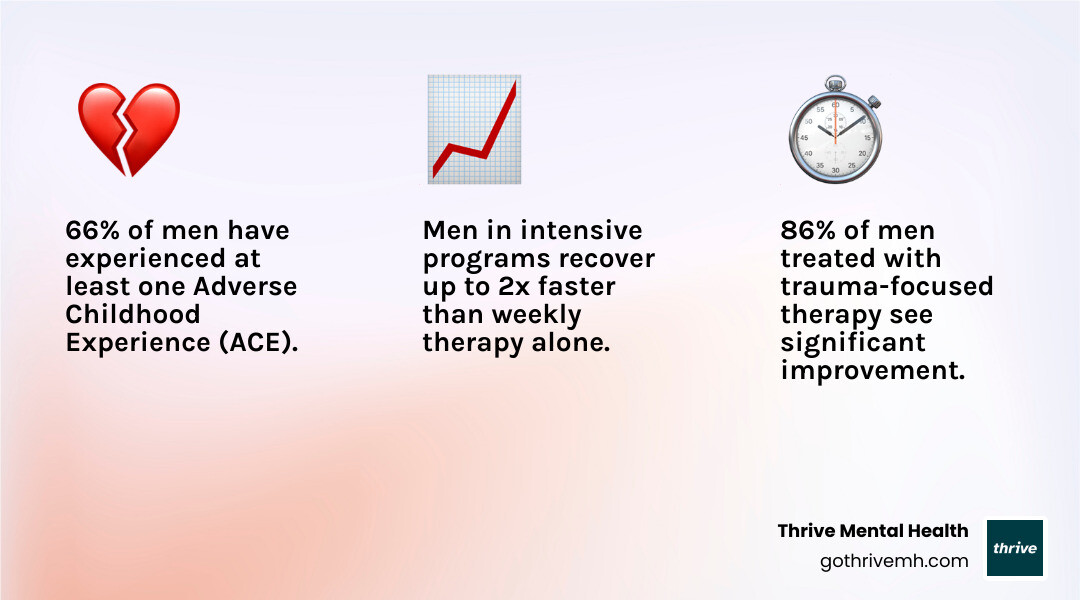
Almost two-thirds of men have at least one adverse childhood experience (ACE). More than 20% have three or more. A high ACE score increases your risk for addiction, depression, heart disease, and early death.
Trauma hits men hard, from combat and violence to racial discrimination and sudden loss. But the “man rules”—don’t be weak, don’t ask for help, don’t show emotion—keep you trapped and silent.
The cost is steep: broken relationships, lost jobs, addiction, and years wasted feeling angry, numb, or out of control.
It doesn’t have to be this way. Trauma therapy for men works. Evidence-based treatments like CBT and EMDR help men take back control—fast. Studies show 86% of men see significant improvement with trauma-focused therapy, and intensive programs can speed recovery up to 2x faster than weekly therapy alone.
This guide shows you how to recognize hidden trauma, find the best therapies, and start healing now.
I’m Nate Raine, CEO of Thrive Mental Health. We’ve helped men across Florida access effective trauma therapy through our Intensive Outpatient Programs (IOP) and Partial Hospitalization Programs (PHP). We’ve seen how structured, compassionate care transforms lives faster than traditional therapy. You’re not weak for needing help. You’re smart for seeking it.
Let’s get started.
Trauma therapy for men glossary:
- PTSD
- post traumatic stress disorder treatment
- 5 Signs You’re Experiencing Bilateral Stimulation Fatigue
Why “Man Up” Is Killing Men: The Truth About Trauma and Masculinity
“Don’t be weak.” “Don’t ask for help.” These unwritten rules destroy men by keeping them stuck, angry, and alone. Here’s how to break the cycle.
Society teaches men to be strong, stoic, and self-reliant—to suppress emotions and never show vulnerability. This outdated playbook, known as “The Man Rules®,” creates a dangerous environment where trauma festers in silence. Men are conditioned not to acknowledge trauma or seek help. This repression doesn’t make us stronger; it makes us sicker. Public figures like Kevin Love and Prince Harry have shown that real strength lies in facing these challenges, giving other men permission to seek help.
The “Man Rules” That Keep You Trapped
These unwritten rules dictate how men are “supposed” to behave:
- Don’t be weak: Vulnerability is seen as a flaw.
- Don’t ask for help: Self-reliance is paramount.
- Don’t cry: Tears are a sign of weakness.
- Don’t show emotion: Stoicism is the ideal.
- Be brave: Fear is not an option.
These rules force men to build protective shields, leading to emotional repression and isolation. This directly fuels problematic behaviors. When sadness or fear are suppressed, they often emerge as anger or irritability. Instead of seeking support, men may turn to workaholism, addiction, or risky behaviors to numb the pain.
Trauma leaves unhealed psychological injuries. When compounded by a societal expectation to “just get over it,” the result is a deeper experience of isolation and shame. This cycle can lead to significant difficulties in relationships, as discussed in our article, How Abandonment Trauma Influences Your Relationships. Breaking these rules is about reclaiming your full humanity.
How to Beat Stigma and Judgment—For Good
Fear of judgment is a huge barrier. Men worry therapy makes them look weak or that their struggles will be dismissed, a fear rooted in cultural expectations of self-reliance. For men in marginalized communities, mistrust of healthcare systems adds another layer of hesitation.
However, the tide is turning. Effective trauma therapy for men prioritizes safety and stabilization, creating an environment where vulnerability is encouraged. Finding a safe, confidential space is crucial. Specialized programs, including men’s-only trauma therapy groups, are incredibly powerful. In these settings, men find a brotherhood where shared experiences reduce shame and build trust.
At Thrive Mental Health, we are committed to providing confidential mental health support. Our approach ensures that men can explore their trauma without fear. For more information, refer to our Confidential Mental Health Support Guide.
The Hidden Wounds: Is Unseen Trauma Wrecking Your Life?

Most men don’t realize trauma is the root of their anger, substance use, or relationship issues. Here’s how to spot the signs before it’s too late.
For men, trauma often manifests in subtle, destructive ways mistaken for personality traits. Many men don’t recognize their struggles as Post-Traumatic Stress Disorder (PTSD), blaming stress or just “how they are.” But a traumatic event can rewire your brain, impacting your entire life.
7 Signs You’re Living With Unrecognized Trauma
Look for these common signs if you suspect past experiences are silently shaping your present:
- Explosive anger or irritability: Lashing out or being easily frustrated can be a mask for unprocessed sadness or fear.
- Substance use or addiction: Using alcohol, drugs, or other behaviors to numb emotional pain is a common coping mechanism.
- Risky or impulsive choices: Reckless behavior can be a way to feel something when you’re emotionally numb or a form of self-sabotage.
- Feeling numb or disconnected: Shutting down emotionally to avoid pain can leave you feeling empty and detached from life.
- Relationship problems: Trauma can cause trust issues, fear of intimacy, and communication problems that damage relationships.
- Chronic pain or health issues: Unresolved trauma often manifests physically as headaches, digestive issues, chronic pain, or sleep problems.
- Hypervigilance: Feeling constantly on edge, anxious, or easily startled is a classic trauma symptom that leads to exhaustion.
These symptoms are distress signals. Understanding them is the first step toward healing. For a deeper dive, our guide on Understanding the Symptoms Associated with PTSD provides valuable insights.
How Childhood Trauma Still Controls You (And How to Break Free)
Childhood experiences have a massive impact. The landmark Adverse Childhood Experiences (ACEs) study found that nearly two-thirds of people (including men) have at least one ACE, like abuse, neglect, or household dysfunction. Over 20% have three or more.
A higher ACE score is directly linked to higher risks for:
- Addiction and substance use
- Depression and anxiety
- Heart disease and other chronic health issues
Unresolved childhood trauma can wreck a man’s health and relationships. Your current struggles may be rooted in your past. Ignoring it allows it to control your present. Breaking free starts with acknowledging this connection and seeking support. Our article on Overcoming Childhood Trauma: Healing Into Adulthood offers guidance on this journey.
The Best Trauma Therapy for Men: What Actually Works (And What Doesn’t)
| Therapy Type | Approach | Who It’s For | Session Focus | Results for Men |
|---|---|---|---|---|
| CBT | Challenges negative thought patterns and behaviors related to trauma. | Men who ruminate, have distorted beliefs, or engage in avoidance. | Psychoeducation, cognitive restructuring, behavioral experiments. | Significant symptom reduction, improved coping, better mood. |
| EMDR | Uses bilateral stimulation to reprocess traumatic memories. | Men with vivid flashbacks, nightmares, or intense emotional distress. | Recalling trauma while engaging in eye movements or other bilateral stimulation. | Rapid decrease in distress, resolution of traumatic memories, changed negative beliefs. |
| CPT | Focuses on how trauma changes thoughts and beliefs. | Men who blame themselves, others, or feel unsafe after trauma. | Identifying “stuck points,” challenging distorted cognitions, writing impact statements. | Reduced PTSD symptoms, improved emotional regulation, clearer perspective. |
For trauma, “just talking” isn’t enough. Effective trauma therapy for men uses structured, evidence-based approaches to process memories, challenge distorted beliefs, and build coping skills. At Thrive Mental Health, our Intensive Outpatient (IOP) and Partial Hospitalization (PHP) programs deliver these proven treatments in a structured format that accelerates healing. Our programs offer more support than weekly therapy with the flexibility of outpatient care. Explore our Virtual Intensive Outpatient Programs (IOP) and Partial Hospitalization Programs (PHP) to learn more.
Cognitive Behavioral Therapy (CBT): Rewire Your Brain, Fast
Cognitive Behavioral Therapy (CBT) is a powerful tool in trauma therapy for men that targets the negative thought patterns trauma creates, such as “I’m not good enough” or “The world isn’t safe.” CBT helps you identify and challenge these “stuck points.”
Key components include:
- Psychoeducation: Understanding trauma’s effect on your brain and body.
- Cognitive Restructuring: Identifying and replacing negative thoughts with balanced ones.
- Behavioral Experiments: Gradually facing feared situations to reduce avoidance.
Studies show that after Cognitive Processing Therapy (CPT), a type of CBT for trauma, 30% to 97% of participants no longer meet PTSD criteria. CBT provides practical tools to manage anxiety and anger, improving daily life and relationships. Learn more in our article on How Cognitive Behavioral Therapy Can Transform Your Life.
EMDR: The Fast-Track to Healing PTSD
Eye Movement Desensitization and Reprocessing (EMDR) is a specialized trauma therapy for men that helps the brain process traumatic memories. It uses bilateral stimulation (like guided eye movements) while you recall a distressing memory, reducing its emotional charge.
Many men prefer EMDR because it requires less verbal processing than talk therapy. It helps men:
- Learn coping skills: Use bilateral stimulation to calm the nervous system.
- Change negative beliefs: Replace self-blame or feelings of inadequacy with healthier beliefs.
- Decrease distress: Significantly reduce the emotional pain of traumatic memories.
EMDR is efficient, often providing relief for a single traumatic memory in just 1-3 sessions, making it a powerful option for rapid change. Learn more in our articles What is EMDR and How Does It Work? and EMDR vs CBT for PTSD.
Medication: When You Need It—And When You Don’t
Medication can be a crucial part of trauma therapy for men, especially when severe PTSD symptoms interfere with daily life or therapy itself. However, it’s rarely a standalone solution.
- What helps: SSRIs and SNRIs (common antidepressants) can manage PTSD-related depression, anxiety, and irritability, making it easier to engage in therapy.
- What doesn’t: Medication alone doesn’t resolve trauma; it only manages symptoms. Some medications, like benzodiazepines, are strongly recommended against for PTSD treatment.
- Best results: Combining psychotherapy with medication often yields the best outcomes. Meds can stabilize you enough to do the deeper work in therapy. This integrated approach is central to our Psychiatry Medication Management services.
Beyond Talk: Real Support for Men’s Trauma Recovery
Healing from trauma is a relational journey. Alongside individual therapy, peer support is indispensable for trauma therapy for men. Group settings dismantle the isolating “Man Rules” by creating connection through shared experience.
At Thrive Mental Health, our IOP and PHP programs in Florida—including Tampa Bay, St. Petersburg, Miami, Orlando, Boca Raton, West Palm Beach, Jacksonville, Fort Lauderdale, Naples, and Sarasota—integrate men’s groups to foster trust and real change. Learn more in our Evidence-Based Group Therapy Guide.
The Power of Men’s Trauma Groups: How Brotherhood Heals
Men’s trauma groups provide a unique space for healing. Here’s why they work:
- What to expect: Structured group programs involve weekly sessions with 8-10 men and trained facilitators. You’ll learn about trauma, develop coping skills, and connect past experiences to current challenges through discussion and exercises.
- How peer support crushes isolation: Men’s groups break the “suffer in silence” rule. Hearing other men share similar struggles validates your experience, reduces shame, and builds a powerful sense of brotherhood. You realize you’re not alone.
- Why men recover faster together: Witnessing other men’s courage creates a ripple effect of support and accountability. This collective journey helps men build practical tools for connection, leading to deeper, more lasting recovery than individual therapy alone.
Racial Trauma: Why Culturally Competent Care Matters
For men of color, trauma is often compounded by racial trauma—the psychological harm from racism, discrimination, and systemic oppression. This can include everything from microaggressions to generational trauma.
The impact is profound, leading to chronic stress, anxiety, and depression. Many men of color hesitate to seek therapy, fearing a lack of understanding. This is why culturally competent care is essential. A culturally competent therapist understands the context of racial trauma and how it intersects with a man’s identity.
At Thrive Mental Health, we connect you with therapists who specialize in trauma therapy for men and possess the cultural competence to honor your full experience. For further reading, explore how Racial trauma can lead to stress and other health problems.
How to Start Trauma Therapy for Men—Step by Step
Starting trauma therapy for men is a powerful step. Here’s a clear, actionable guide:
- Admit you need help: Recognize that your struggles might be symptoms of unprocessed trauma. This is the first and strongest step.
- Find a specialist: Look for therapists specializing in men’s trauma and PTSD who understand the “Man Rules.”
- Check your insurance: Most major plans (Cigna, Optum, Florida Blue, and others) cover trauma therapy, including IOP and PHP programs. Don’t let cost be a barrier.
- Book a consultation: Use a free consult to see if the therapist is a good fit. Thrive Mental Health offers these.
- Confirm their approach: Ensure they use trauma-informed care, prioritizing safety and trust to avoid re-traumatization.
- Choose your format: Decide between virtual or in-person therapy. Virtual options offer great flexibility across Florida.
When vetting a therapist, ask about their experience with male clients and specific trauma therapies (CBT, EMDR). Insurance makes quality care accessible. For more tips, see our Guide to Finding a Therapist and explore Virtual Therapy.
Using Insurance for Trauma Therapy: What Men Need to Know
Navigating insurance is a critical step in making trauma therapy for men affordable.
- Verify benefits in 2 minutes: Use Thrive Mental Health’s free online tool to check your coverage with providers like Cigna, Optum, and Florida Blue with no obligation.
- Major insurance accepted: We work with a wide range of insurers to cover our IOP and PHP programs. Mental health benefits are often more robust than people think.
- In-network vs. out-of-network: We can help you clarify your costs based on your provider’s network status during a consultation.
- IOP/PHP coverage: Intensive programs like IOP and PHP are often covered by insurance as medically necessary for conditions like PTSD, accelerating recovery.
Don’t let finances stop you. Check your benefits today. Learn more about Insurance for Mental Health and Verify Your Insurance Now.
FAQs: Trauma Therapy for Men—What Guys Really Ask
How do I know if I need trauma therapy?
If anger, substance use, relationship problems, chronic stress, or emotional numbness are persistently impacting your life after a tough event, or if you suspect past experiences are holding you back, you need a professional assessment. Don’t wait—early intervention means faster recovery and prevents symptoms from worsening.
What’s the fastest way to recover from trauma?
The fastest path to recovery typically involves evidence-based, trauma-focused therapies like CBT, EMDR, or CPT, combined with robust group support and, if appropriate, medication management. Thrive’s virtual IOP/PHP programs offer this intensive, integrated approach, helping men recover up to 2x faster than traditional weekly therapy alone.
Will therapy make me look weak?
No. Asking for help is the strongest move you can make. It takes immense courage to confront your past and commit to healing. Real men get help, get better, and build stronger lives and relationships. The outdated “Man Rules” are what keep men stuck; seeking therapy is how you break free.
Does insurance cover trauma therapy for men?
Yes. Most comprehensive health insurance plans (including Cigna, Optum, Florida Blue, and many others) cover trauma therapy for men, including specialized IOP and PHP programs. Thrive Mental Health can verify your benefits in 2 minutes, with no obligation, to help you understand your coverage.
Summary: Trauma Therapy for Men—Act Now or Lose More Time
Ignoring trauma costs you years, health, and relationships. The right trauma therapy for men—utilizing evidence-based approaches like CBT, EMDR, and robust group support—can change your life fast. We understand the unique challenges men face, and our programs are designed to help you break free from the “Man Rules” and heal your hidden wounds.
Thrive Mental Health offers virtual and hybrid Intensive Outpatient (IOP) and Partial Hospitalization (PHP) programs specifically for men across Florida, including cities like Tampa Bay, St. Petersburg, Miami, Orlando, Boca Raton, West Palm Beach, Jacksonville, Fort Lauderdale, Naples, and Sarasota. Our expert-led programs combine clinical excellence, flexible scheduling, and measurable results, providing more than weekly therapy but less than inpatient care. Insurance is accepted, including major providers like Cigna, Optum, and Florida Blue.
Ready for support? Thrive offers virtual and hybrid IOP/PHP programs with evening options. Verify your insurance in 2 minutes (no obligation) → Start benefits check or call 561-203-6085. If you’re in crisis, call/text 988.
If you’re in crisis, call/text 988 right now. You are not alone.