

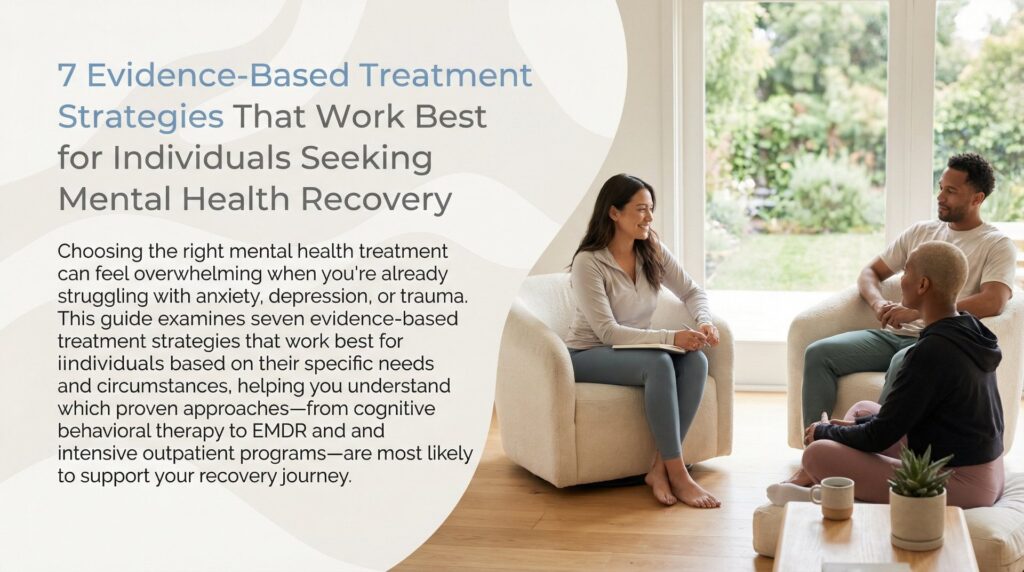
You’ve decided to seek mental health treatment, and that decision alone takes courage. But now you’re facing another challenge: figuring out which treatment approach will actually help you feel better.
Maybe you’ve heard about cognitive behavioral therapy from your doctor. A friend swears by EMDR. Your insurance covers intensive outpatient programs, but you’re not sure what that even means. Meanwhile, you’re still struggling with anxiety that makes it hard to focus at work, or depression that’s stealing your energy, or trauma that keeps replaying in your mind.
Here’s what matters: effective mental health treatment isn’t about finding the single “best” approach that works for everyone. It’s about understanding which evidence-based strategies match your specific needs, circumstances, and goals.
This guide breaks down seven proven treatment strategies that consistently help individuals achieve meaningful recovery. For each approach, we’ll explore what it actually involves, which conditions it addresses most effectively, and how to determine if it might be right for your journey.
1. Cognitive Behavioral Therapy (CBT): Rewiring Thought Patterns That Drive Distress
The Challenge It Solves
You notice the same destructive thoughts running through your mind on repeat. “I’m going to fail.” “Everyone thinks I’m incompetent.” “Something terrible is about to happen.” These thoughts feel automatic and true, and they fuel anxiety, depression, and behaviors that keep you stuck. You want to break this cycle, but you don’t know how to change patterns that feel hardwired into your brain.
The Strategy Explained
Cognitive Behavioral Therapy helps you identify the specific thoughts, beliefs, and behaviors that contribute to your mental health challenges, then systematically change them. The American Psychological Association recognizes CBT as an evidence-based treatment for depression, anxiety disorders, and OCD.
Think of CBT as learning a new mental skill set. Your therapist helps you notice when distorted thinking patterns emerge (like catastrophizing or all-or-nothing thinking), examine the evidence for and against these thoughts, and develop more balanced perspectives. You’ll also work on changing behaviors that reinforce negative patterns, gradually facing situations you’ve been avoiding.
CBT is structured and goal-oriented, typically involving homework between sessions. You might track your thoughts in specific situations, practice new coping skills, or gradually expose yourself to feared scenarios in a controlled way.
Implementation Steps
1. Work with your therapist to identify your most problematic thought patterns and the situations that trigger them, creating a clear picture of what you’re working to change.
2. Learn to recognize cognitive distortions as they happen in real-time, using techniques like thought records to document the situation, your automatic thought, your emotional response, and evidence for or against the thought.
3. Practice behavioral experiments and exposure exercises between sessions, starting small and gradually building your confidence in handling challenging situations.
Pro Tips
CBT works best when you actively engage with homework assignments between sessions, the real change happens when you practice new skills in your daily life. If traditional CBT feels too structured, ask about variations like Acceptance and Commitment Therapy (ACT) or Dialectical Behavior Therapy (DBT) that incorporate additional elements while maintaining the cognitive-behavioral foundation.
2. EMDR Therapy: Processing Trauma Without Reliving Every Detail
The Challenge It Solves
Traumatic memories feel stuck in your nervous system. Maybe you experienced abuse, witnessed violence, survived an accident, or endured a medical crisis. Even though the event is over, your body and mind react as if you’re still in danger. Flashbacks intrude without warning. Certain sounds, smells, or situations trigger intense emotional responses. Traditional talk therapy feels overwhelming because describing the trauma in detail retraumatizes you.
The Strategy Explained
Eye Movement Desensitization and Reprocessing (EMDR) helps your brain reprocess traumatic memories so they lose their emotional intensity. The World Health Organization and the Department of Veterans Affairs list EMDR as an effective trauma treatment.
During EMDR sessions, you briefly focus on the traumatic memory while simultaneously experiencing bilateral stimulation, typically following your therapist’s hand movements with your eyes, though some therapists use tapping or audio tones instead. This dual attention seems to help your brain process the memory more adaptively, similar to what happens during REM sleep.
What makes EMDR different is that you don’t need to describe the trauma in extensive detail. You’re not analyzing why it happened or talking through every aspect. Instead, you’re allowing your brain’s natural healing process to work more effectively.
Implementation Steps
1. Complete the preparation phase with your therapist, learning grounding techniques and establishing a safe mental space you can return to if processing becomes overwhelming.
2. Identify the specific traumatic memory to target, along with the negative belief about yourself connected to that memory (like “I’m not safe” or “I’m powerless”).
3. Process the memory through multiple sets of bilateral stimulation, allowing whatever thoughts, feelings, or images emerge without forcing anything, trusting your brain’s natural ability to move toward resolution.
Pro Tips
EMDR often works more quickly than traditional talk therapy for trauma, but it’s not a one-session solution. Complex trauma typically requires working through multiple memories over several months. Schedule sessions when you have time afterward to rest, processing can continue after the session ends, and you may feel emotionally tired.
3. Intensive Outpatient Programs (IOP): Comprehensive Support While Maintaining Your Life
The Challenge It Solves
Your mental health symptoms have become severe enough that weekly therapy isn’t providing sufficient support, but you’re not in crisis requiring hospitalization. You need more intensive treatment, but you also need to keep working, caring for family, or maintaining other essential responsibilities. You’re caught between needing more help and needing to function in daily life.
The Strategy Explained
Intensive Outpatient Programs provide structured, comprehensive treatment multiple times per week while allowing you to live at home and maintain daily responsibilities. SAMHSA (Substance Abuse and Mental Health Services Administration) recognizes IOP as an appropriate level of care for individuals who need more support than traditional outpatient therapy.
A typical IOP involves attending treatment sessions three to five times per week for several hours each day. You’ll participate in group therapy, individual counseling, skills training, and specialized therapies addressing your specific conditions. The program creates structure and accountability while providing intensive therapeutic support during a critical period of recovery.
Think of IOP as immersive treatment that fits around your life. You might attend sessions in the morning and work in the afternoon, or work during the day and attend evening sessions. Many programs now offer virtual options, expanding access for those with transportation challenges or living in rural areas.
Implementation Steps
1. Complete a clinical assessment to determine if IOP is the appropriate level of care for your needs, discussing your symptoms, functioning level, and support system with a mental health professional.
2. Arrange your schedule to accommodate the program commitment, having conversations with your employer about taking FMLA leave if needed, or adjusting work hours to attend sessions.
3. Engage fully with all program components, group therapy, individual sessions, skills practice, and any homework assignments, recognizing that the comprehensive approach creates synergy between different treatment elements.
Pro Tips
The group therapy component of IOP often surprises people with how powerful it becomes. Connecting with others facing similar challenges reduces isolation and provides perspective you can’t get from individual therapy alone. If you’re considering Intensive Outpatient Programs, look for programs that offer both virtual and in-person options so you can choose the format that best supports your recovery.
4. Mindfulness-Based Approaches: Calming the Mental Storm Through Present-Moment Awareness
The Challenge It Solves
Your mind constantly races with worries about the future or regrets about the past. Anxiety keeps you trapped in “what if” scenarios. You feel disconnected from your body and emotions, or alternatively, overwhelmed by them. You’ve tried to “just relax” or “stop overthinking,” but these instructions feel impossible to follow. You need concrete practices that actually quiet the mental noise.
The Strategy Explained
Mindfulness-based approaches teach you to anchor attention in the present moment with curiosity and without judgment. Rather than trying to eliminate difficult thoughts or feelings, you learn to observe them without getting swept away.
Mindfulness-Based Cognitive Therapy (MBCT) is specifically recommended by NICE guidelines for preventing depression relapse. These approaches combine meditation practices with psychoeducation about how your mind works, helping you recognize early warning signs of distress and respond skillfully rather than reactively.
In practice, this might involve sitting meditation where you focus on your breath, body scan exercises that build awareness of physical sensations, or informal mindfulness practices like eating or walking with full attention. The goal isn’t to achieve a perfectly calm mind, it’s to change your relationship with your thoughts and feelings.
Implementation Steps
1. Start with brief, guided practices of just five to ten minutes daily, using apps or recordings rather than trying to figure out meditation on your own, building consistency before increasing duration.
2. Practice noticing when your mind has wandered into rumination or worry, gently redirecting attention back to present-moment sensory experience without criticizing yourself for getting distracted.
3. Apply mindfulness skills during challenging moments in daily life, taking three conscious breaths before responding to a stressful email or noticing the physical sensations of anxiety without immediately trying to make them go away.
Pro Tips
Many people give up on mindfulness because they think they’re “doing it wrong” when their mind wanders. Mind-wandering is completely normal, the practice is noticing when it happens and returning to the present moment. That noticing and returning is the practice. Consider joining a structured Mindfulness-Based Stress Reduction (MBSR) or MBCT course rather than trying to learn from apps alone, as the group support and expert guidance significantly enhance learning.
5. Trauma-Focused Therapies: Healing From What Happened Through Phased Treatment
The Challenge It Solves
Past traumatic experiences continue affecting your present life in ways you can’t always predict or control. You might struggle with trust in relationships, experience intense emotional reactions to seemingly minor triggers, feel disconnected from your body, or engage in behaviors that once protected you but now cause problems. You know the trauma is affecting you, but you’re not sure how to heal from something that happened years ago.
 Buyer’s Guide: Best Betrayal Trauma Therapists in CAMental Health
The Strategy Explained
Trauma-focused therapies use specialized approaches designed to safely address and heal from traumatic experiences. These treatments follow phased models endorsed by the International Society for Traumatic Stress Studies, recognizing that trauma healing requires more than just talking about what happened.
The phased approach typically begins with stabilization, developing coping skills, building safety, and addressing current symptoms. Only after you have a foundation of stability do you move to processing traumatic memories. The final phase focuses on integration and reconnection, helping you build a life defined by more than your trauma history.
Different trauma-focused therapies use different techniques. Beyond EMDR, options include Prolonged Exposure (gradually confronting trauma-related memories and situations), Cognitive Processing Therapy (examining how trauma changed your beliefs), and Trauma-Focused CBT (combining cognitive-behavioral techniques with trauma-specific interventions).
Implementation Steps
1. Work with a trauma-specialized therapist to assess your current stability and determine which phase of treatment is appropriate, resisting pressure to process traumatic memories before you’ve developed adequate coping skills.
2. Build your window of tolerance through stabilization techniques, learning to recognize when you’re becoming overwhelmed (hyperaroused) or shutting down (hypoaroused) and developing skills to return to a regulated state.
3. Process traumatic memories only when you and your therapist agree you’re ready, trusting that healing doesn’t require you to remember every detail or experience overwhelming distress during sessions.
Pro Tips
Trauma therapy isn’t about forcing yourself to confront what happened before you’re ready. A skilled trauma therapist will help you move at a pace that challenges you without overwhelming your nervous system. If you have complex trauma from childhood or multiple traumatic experiences, expect treatment to take longer than if you’re addressing a single traumatic event. Dissociative disorders often develop as a response to severe trauma and require specialized treatment approaches within the trauma-focused framework.
6. Dual-Diagnosis Treatment: Addressing Mental Health and Substance Use Together
The Challenge It Solves
You’re struggling with both mental health symptoms and substance use, and they’re tangled together in ways that make it hard to know which came first or which to address. Maybe you started using substances to cope with anxiety or depression. Or substance use triggered mental health problems that persist even when you’re not using. You’ve tried treating one issue while ignoring the other, but that approach hasn’t worked. You need treatment that addresses both conditions simultaneously.
The Strategy Explained
Dual-diagnosis treatment provides integrated care that addresses co-occurring mental health and substance use conditions at the same time. SAMHSA’s integrated treatment model emphasizes treating both conditions simultaneously rather than sequentially, recognizing that each condition affects the other.
In integrated treatment, you work with a team that understands the complex relationship between mental health and substance use. Your treatment plan addresses both conditions together, managing withdrawal and cravings while also treating underlying anxiety, depression, trauma, or other mental health conditions.
This approach recognizes that sustainable recovery requires addressing root causes, not just symptoms. If you’re using substances to manage untreated PTSD, stopping substance use without addressing the trauma leaves you without your coping mechanism and vulnerable to relapse.
Implementation Steps
1. Seek assessment from a provider experienced in dual-diagnosis treatment who can evaluate both your mental health symptoms and substance use patterns, identifying how each condition influences the other.
2. Participate in treatment that addresses both conditions simultaneously, which might include medication management for mental health symptoms, substance use counseling, therapy for underlying trauma or mood disorders, and skills training for managing both cravings and emotional distress.
3. Build a recovery support system that understands both conditions, connecting with peer support groups, involving family members in education about dual-diagnosis, and creating a relapse prevention plan that addresses triggers for both substance use and mental health symptoms.
Pro Tips
Be honest with your treatment team about both your mental health symptoms and substance use. Withholding information about either condition prevents your team from developing an effective treatment plan. If you’re considering dual-diagnosis treatment, look for programs that offer integrated care rather than separate tracks for mental health and substance use, the integration is what makes this approach effective.
7. Creative and Expressive Therapies: Accessing Healing Beyond Words
The Challenge It Solves
Sometimes words aren’t enough. You feel emotions you can’t articulate. Traumatic memories exist more as physical sensations or images than as coherent narratives. Traditional talk therapy feels intellectually engaging but doesn’t create the emotional release or shift you need. You need ways to access and express what’s happening inside that don’t rely solely on verbal processing.
The Strategy Explained
Creative and expressive therapies use art, music, movement, and other non-verbal modalities to facilitate emotional expression and healing. The American Art Therapy Association recognizes these approaches as beneficial for emotional expression and processing, particularly when traditional talk therapy feels limiting.
Art therapy might involve creating images that represent your feelings, making a collage about your recovery journey, or using clay to externalize difficult emotions. Music therapy could include listening to specific pieces that evoke emotions you’re working to process, creating songs about your experiences, or using rhythm and sound to regulate your nervous system. Movement therapy helps you reconnect with your body and release trauma stored physically.
These approaches work because they engage different parts of your brain than talk therapy. They can bypass intellectual defenses and access emotions and memories that aren’t easily verbalized, particularly for trauma that occurred before you had language or that overwhelmed your ability to make sense of what was happening.
Implementation Steps
1. Work with a credentialed creative arts therapist (art therapist, music therapist, or dance/movement therapist) rather than simply doing creative activities on your own, as the therapeutic relationship and the therapist’s training in using these modalities for healing make the crucial difference.
2. Release any expectations about creating “good” art or being talented, the therapeutic value comes from the process of creation and expression, not the aesthetic quality of what you produce.
3. Notice what emerges during creative expression without immediately trying to analyze or explain it, allowing images, sounds, or movements to communicate what words cannot.
Pro Tips
Creative therapies work particularly well in combination with traditional talk therapy. You might use art therapy to access and express difficult emotions, then process what emerged with your talk therapist. These approaches can be especially valuable for children and adolescents who lack the developmental capacity for insight-oriented talk therapy, but they’re equally powerful for adults who feel stuck in intellectual understanding without emotional breakthrough.
Putting It All Together: Matching Strategy to Your Unique Needs
You’ve now explored seven evidence-based treatment strategies, each addressing different aspects of mental health recovery. So how do you choose?
Start by considering your specific conditions. If you’re dealing with trauma, EMDR or trauma-focused therapy should be on your list. Struggling with anxiety or depression? CBT has strong evidence for these conditions. If you have co-occurring substance use and mental health challenges, integrated dual-diagnosis treatment is essential.
Think about the severity and intensity of your symptoms. If weekly therapy isn’t providing enough support, an Intensive Outpatient Program might be the right level of care. If you’re functioning reasonably well but want to build specific skills, weekly individual therapy using one of these approaches might be sufficient.
Consider your personal preferences and learning style. Do you like structured, skill-based approaches? CBT might resonate. Do you need something less verbal? Explore creative therapies. Are you drawn to practices that calm your nervous system? Mindfulness-based approaches could be a good fit.
Here’s what many people discover: the most effective treatment often combines multiple strategies. You might participate in an IOP that incorporates CBT, mindfulness practices, and group therapy. Or you might do individual EMDR therapy while also practicing mindfulness techniques between sessions.
The key is finding the right combination for your unique situation, and that starts with a comprehensive assessment by mental health professionals who can help you navigate these options.
At Thrive Mental Health, we offer personalized treatment programs that integrate multiple evidence-based approaches, with both virtual and in-person options available across California, Florida, Indiana, Arizona, and South Carolina. Our Joint Commission accredited programs, including Intensive Outpatient and Partial Hospitalization options, are designed to meet you where you are and support your unique path to recovery.
Your mental health recovery doesn’t have to follow someone else’s path. It should be built around your specific needs, circumstances, and goals.

This article is for informational purposes only and is not a substitute for individualized clinical advice or insurance verification.