



Stepping down from inpatient psychiatric care means moving from 24-hour hospital treatment to a lower level of care that still gives you structure, usually a partial hospitalization program (PHP) or an intensive outpatient program (IOP), before you return to weekly therapy. For most Florida adults the step-down should be arranged before discharge and start within days, not weeks. The hospital stabilizes a crisis. The step-down is where recovery is actually built.
This guide explains the levels of care between the hospital and a weekly appointment, what a solid discharge plan contains, how Florida’s Baker Act fits in, and how a virtual IOP works as a step-down. It is written by a clinical team that runs virtual intensive outpatient treatment for Florida adults. It is general information, not a substitute for your treatment team’s advice.
Why the first weeks after discharge need a plan
Leaving the hospital is a relief, and it is also the point where support drops the fastest. On the unit you had staff around the clock, a fixed schedule, and medication handed to you. At home you have none of that on day one, and the problems that led to the admission are usually still there.
The research is consistent on this. A JAMA Psychiatry meta-analysis of 100 studies found that the risk of suicide is highest within the first three months after discharge from a psychiatric facility, and stays elevated for years. The authors concluded that people in those first months should be a particular focus of care.
A second finding matters just as much. A national study of more than 770,000 adults discharged with a mental health diagnosis found short-term risk was higher for people with no outpatient care in the six months before admission. In plain terms: being connected to care is protective, and being on your own is not.
None of this is meant to frighten you. It is the reason hospitals, insurers, and clinicians all push for a fast, structured next step. A step-down program is how that early period gets covered.
The levels of care between the hospital and weekly therapy
Mental health treatment comes in levels, and the goal is to match the level to what you need right now. Stepping down means moving one level at a time instead of going from everything to almost nothing.
| Level of care | Time in treatment | Where you sleep | Who it fits |
|---|---|---|---|
| Inpatient hospital | 24 hours a day | On the unit | Immediate safety risk or severe symptoms that need round-the-clock care |
| Partial hospitalization (PHP) | Most of the day, about five days a week | At home | Stable enough to go home at night, still needing daily structure |
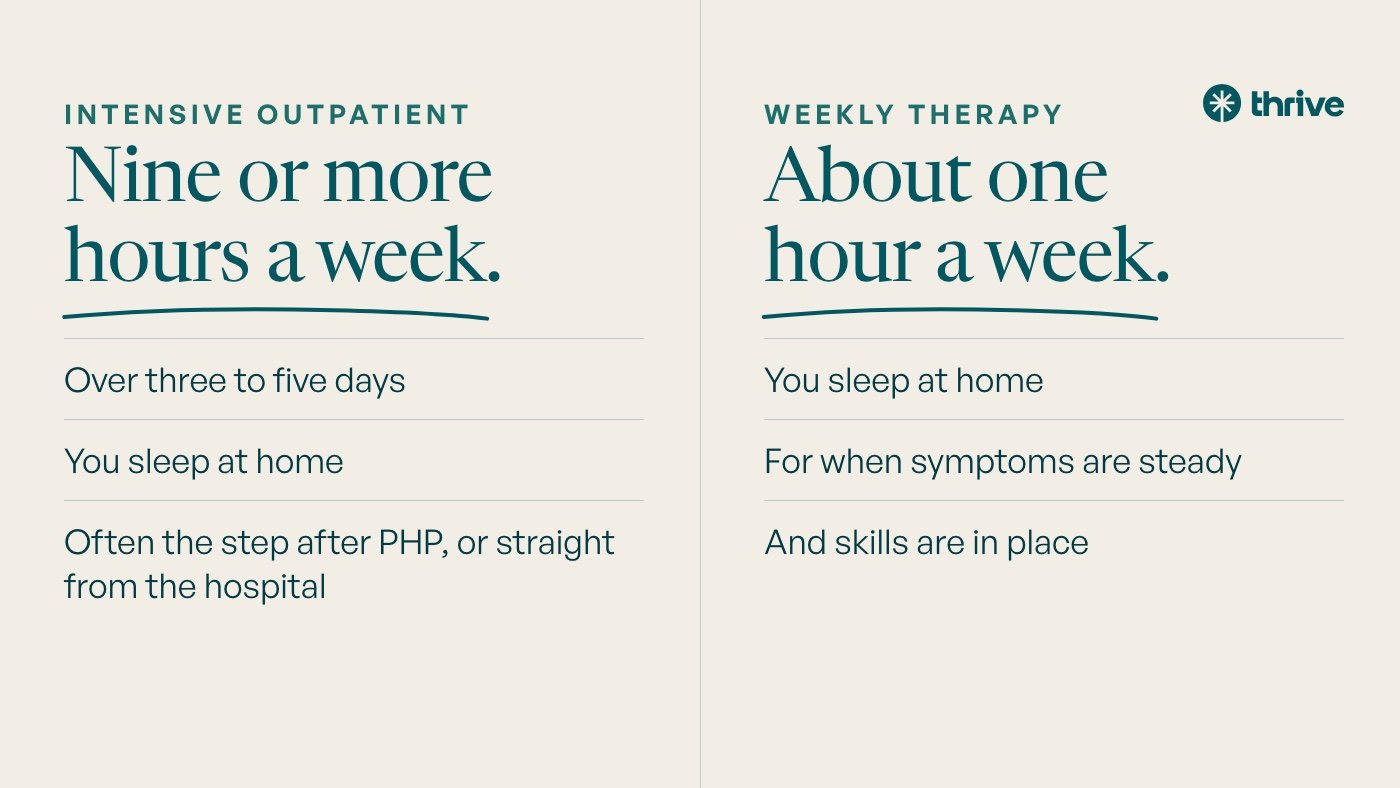
| Intensive outpatient (IOP) | Nine or more hours a week, over three to five days | At home | Able to manage daily life with strong support; often the step after PHP, or straight from the hospital |
| Weekly outpatient therapy | About one hour a week | At home | Symptoms are steady and skills are in place |
Federal treatment guidance describes intensive outpatient treatment as structured programming of at least nine hours a week, built around group therapy with individual sessions alongside. That is roughly nine times the contact of a weekly appointment, which is why it works as a bridge. Our overview of what an intensive outpatient program is covers the model in more detail.
Which level comes first is a clinical decision, not a preference. Your inpatient team will recommend PHP or IOP based on safety, symptoms, and what is waiting for you at home. If they recommend PHP and you were hoping for IOP, ask what would need to be true for IOP to be safe. It is a fair question and a good team will answer it.
What a good discharge plan includes before you leave
The best time to arrange your step-down is while you are still in the hospital. A systematic review in the British Journal of Psychiatry looked at what actually reduces early readmission. The approaches that worked shared a short list of parts:
- Education before and after discharge about your condition, your medication, and warning signs
- A structured look at your needs: housing, transport, work, childcare, money
- A medication check so the list you leave with matches what you will actually take
- One named person who manages the handoff
- Direct contact between the hospital team and the next provider
Turn that into questions you can ask your social worker or case manager. You should not leave without answers to these:
- What level of care are you recommending next, and why?
- Which program is it, and what is the date and time of my first appointment?
- Has the program confirmed it takes my insurance?
- Do I have enough medication to last until I see a prescriber, and who is that prescriber?
- What is my written safety plan, and who has a copy?
- Have I signed a release so the hospital can send my records to the next program?
- Who do I call if the plan falls through in the first week?
Florida specifics: the Baker Act and what happens after
Many Florida adults enter the hospital through the Baker Act, the state law that allows an involuntary mental health examination. Under Florida Statute 394.463, a person can be held at a receiving facility for examination for up to 72 hours. The Florida Department of Children and Families publishes a plain overview of how the Baker Act works.
When that period ends, one of a few things happens:
- You are released, with or without a referral for outpatient care
- You agree to stay voluntarily for further treatment
- The facility asks a court to order a longer involuntary stay
The end of a 72-hour hold is a legal deadline, not a sign that the crisis is over. People are often released quickly, late in the day, with a list of phone numbers and no appointment. If that is you or someone you love, treat the first business day after release as the day to book a step-down assessment. You do not need the hospital’s permission or a referral to call a program yourself.
Whether your stay was voluntary or not has no bearing on your right to choose your next provider. You can ask for your records to be sent to any licensed program you pick.
How virtual IOP works as a step-down
A virtual IOP delivers the same structure as an in-person program over secure video, from home. For someone just out of the hospital, that removes the two things that most often break a step-down plan: the drive and the wait.
The evidence supports the format. A study in the Journal of Psychiatric Research compared 1,192 adults treated in person with 1,192 treated by telehealth in intensive programs. It found no significant difference in how much depression symptoms improved, and quality of life rose in both groups.
At Thrive, a step-down week looks like this:
- Group therapy several days a week, in small adult-only groups with cameras on
- An individual session every week with a licensed clinician
- Psychiatric consultation when it is needed
- Symptom measures on a schedule, so you and your clinician can see whether you are improving
- Morning and evening groups, so treatment can sit beside work or family life
Our guide to what to expect from virtual IOP in Florida walks through the first week in detail. If you are wondering how this differs from going back to your old weekly appointment, see virtual IOP vs weekly therapy.
When virtual IOP is not the right step-down
An honest program will tell you when you need more than it offers. Virtual IOP is not the right next step if:
 Navigating Your Journey: What to Expect from a Virtual Intensive Outpatient ProgramIntensive Outpatient Program
- You cannot keep yourself safe between sessions
- You need medical detox or daily medical monitoring
- You have no private, stable place to join sessions from
- Your inpatient team has recommended PHP or residential care and nothing has changed since
In those cases the safer step is a higher level of care first, then IOP. Stepping down in two moves is not a setback. It is the plan working.
Your first two weeks home: a practical plan
Keep the first two weeks small and structured. The aim is not to get your old life back at once. It is to stay connected to care while ordinary routines return.
- Day 1 to 2: fill prescriptions, put your safety plan where you can see it, and confirm your first program appointment by phone.
- Day 2 to 5: complete your step-down assessment and attend your first sessions. Tell the program exactly what happened in the hospital, including medication changes.
- Week 1: sleep and meals at regular times. Skip alcohol. Keep big decisions for later.
- Week 2: add one normal activity back, such as a short work day or a walk with a friend. Tell your group how it went.
- Any day: if warning signs from your safety plan show up, call your program the same day. If you are in danger, call or text 988 or go to an emergency room.
If work is the worry, you may have more protection than you think. Our guide to FMLA and virtual IOP explains job-protected time for treatment.
For family members: how to help without hovering
Families often swing between watching every move and saying nothing. Neither helps. What does help is practical and specific:
- Ask to see the safety plan, and ask what your part in it is
- Help with the logistics of the first week: pharmacy, a quiet room for sessions, childcare during group
- Agree on a simple daily check-in instead of constant questions
- Remove or lock up anything the safety plan names as a risk
- Get your own support. The SAMHSA National Helpline (1-800-662-4357) is free, confidential, and open all day, every day
Common questions about stepping down from inpatient care in Florida
How soon after discharge should step-down treatment start?
As soon as possible, ideally within a few days. The first three months after discharge carry the highest risk, and the first weeks most of all. Ask for a confirmed appointment before you leave the hospital.
Do I need a referral from the hospital to start an IOP?
No. You can call a program directly and ask for an assessment. A referral and your discharge paperwork help the program understand your care, and you can sign a release so records are sent.
Will insurance cover PHP or IOP after a hospital stay?
Most commercial plans cover both when they are medically necessary, and many require approval in advance. Ask the program to check your benefits before your first session so the cost is known up front.
Can I go straight from the hospital to a virtual IOP?
Often, yes. It depends on safety, symptoms, and your home setting. If your inpatient team recommends PHP first, follow that and step down to IOP afterward.
How long does a step-down program last?
Most intensive outpatient programs run six to twelve weeks. The length is set by progress, not by a calendar, and the plan usually ends with a handoff to weekly therapy.
Next steps
If you or someone you love is leaving a Florida hospital soon, the most useful thing you can do today is get the next appointment on the calendar. Thrive Mental Health is a Joint Commission accredited provider of virtual IOP for adults in Florida.
Start with a free, confidential benefits check. Most members receive a summary within 24 hours, and many begin the same week. Prefer to talk first? Call (561) 203-6085.

This article is for informational purposes only and is not a substitute for individualized clinical advice or insurance verification.