
In-Depth Guide to Mental Health Treatments for Startup Founders

Why Founder Mental Health Isn’t Optional—It’s Your Most Critical Asset
What are the best mental health treatment approaches for startup founders? The answer is clear: evidence-based therapies like Cognitive Behavioral Therapy (CBT), Acceptance and Commitment Therapy (ACT), and Interpersonal Therapy (IPT)—often delivered through structured programs like Intensive Outpatient Programs (IOP) or Partial Hospitalization Programs (PHP) when weekly therapy isn’t enough.
Quick Answer: Best Mental Health Treatments for Founders
| Treatment Approach | What It Does | Best For |
|---|---|---|
| Cognitive Behavioral Therapy (CBT) | Rewires negative thought patterns and builds stress management skills | Anxiety, depression, burnout |
| Acceptance and Commitment Therapy (ACT) | Builds psychological flexibility to steer uncertainty | High-pressure decision-making, chronic stress |
| Interpersonal Therapy (IPT) | Improves relationships with co-founders, employees, and investors | Isolation, conflict resolution |
| Intensive Outpatient Program (IOP) | Structured group and individual therapy 3+ days/week | When weekly therapy isn’t enough |
| Partial Hospitalization Program (PHP) | Daily treatment while living at home | Crisis stabilization, severe symptoms |
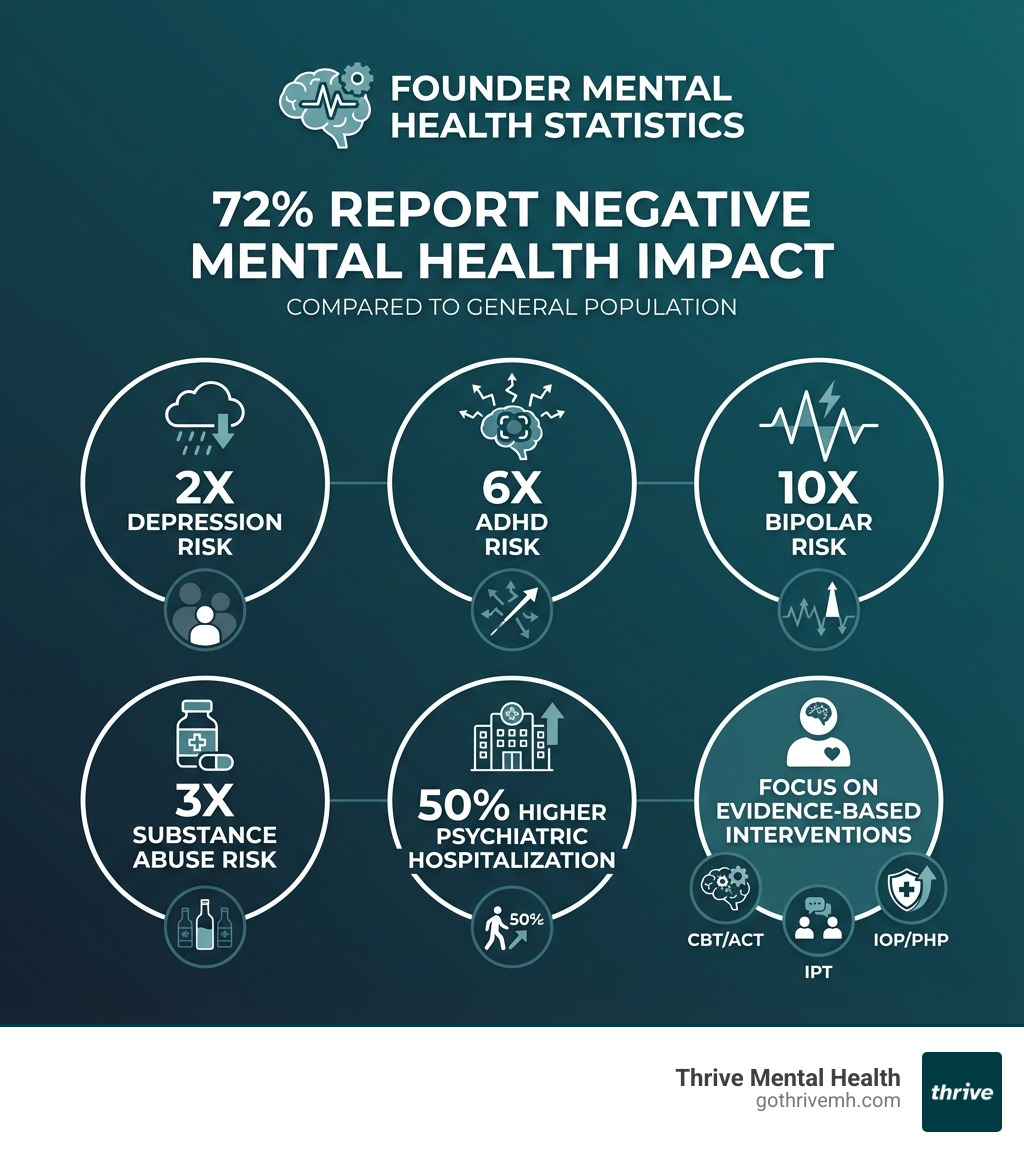
Here’s the reality: 72% of startup founders say entrepreneurship has negatively affected their mental health. You’re not just stressed—you’re statistically at extreme risk. Founders are 2X more likely to suffer from depression, 6X more likely to have ADHD, and 10X more likely to experience bipolar disorder compared to the general population.
This isn’t about “self-care tips” or generic wellness advice. This is about clinically proven interventions that work when the stakes are highest—when your business, your team, and your health are all on the line.
If you’re in crisis right now, call or text 988. You are not alone.
I’m Nate Raine, CEO of Thrive Mental Health, and I’ve spent over a decade at the intersection of behavioral health, data science, and leadership development. I’ve seen what are the best mental health treatment approaches for startup founders—and I’ve built Thrive to deliver them through flexible, evidence-based IOP and PHP programs designed for high-performers who can’t afford to slow down but need real support now.
Basic What are the best mental health treatment approaches for startup founders? vocab:
The Founder’s Paradox: Why High-Achievers Are at Extreme Risk

Being a startup founder is often glamorized, but behind the headlines and funding rounds lies a reality of immense pressure, relentless uncertainty, and profound personal sacrifice. We understand this isn’t just “stress”; it’s a unique crucible that can push even the most resilient individuals to their breaking point. The unique challenges founders face—from the constant financial pressure of making payroll to the gnawing self-doubt of imposter syndrome and the profound isolation of carrying an entire company on your shoulders—create a perfect storm for mental health struggles.
The common culture within a startup often prioritizes personal achievement above all else, setting impossibly high expectations and fostering a fast pace that actively discourages time off and mental wellness. This “hustle culture” can lead directly to burnout, a state of emotional, physical, and mental exhaustion caused by prolonged or excessive stress. When your identity is intrinsically tied to your company’s success, the high rate of startup failure can feel like a personal catastrophe, further exacerbating mental health conditions.
The Shocking Statistics on Founder Mental Health
We’re not guessing about the mental health toll on founders; the data is stark. According to a report from Startup Snapshot, 72% of startup founders and CEOs say their entrepreneurship has affected their mental health. This isn’t a minor impact; it’s a significant, pervasive issue across the industry.
Founders are far more vulnerable to mental health issues than the general population. A worrying study by Michael Freeman found that founders and entrepreneurs are 50% more likely to suffer from mental health conditions overall. To be more specific, the numbers paint a stark picture:
- Founders are 2X more likely to suffer from depression.
- Founders are 6X more likely to suffer from ADHD.
- Founders are 3X more likely to suffer from substance abuse.
- Founders are 10X more likely to suffer from bipolar disorder.
- Founders are 2X more likely to be hospitalized for psychiatric reasons.
These aren’t just abstract figures; they represent real people, real struggles, and a clear call for proactive, effective mental health support.
How “Hustle Culture” Destroys Mental Well-being
The relentless pursuit of growth, often glorified as “hustle culture,” actively contributes to these alarming statistics. This culture fosters constant pressure, encouraging founders to work endless hours, sacrifice sleep, and ignore personal well-being in the name of success. The implicit message is clear: if you’re not “hustling,” you’re not trying hard enough.
This glorification of burnout leads to a severe lack of boundaries between work and personal life. Founders often find themselves unable to disconnect, with their phones becoming extensions of their companies. Sleep deprivation becomes the norm, severely impacting cognitive function, emotional regulation, and overall physical health. A study by Forbes even found that startup employees have some of the highest levels of job-related stress.
This isn’t sustainable. A founder’s mental health directly impacts their team’s performance and the overall business success. When leaders are burned out, stressed, or struggling with untreated mental health conditions, it affects their decision-making, their ability to lead effectively, and the morale of their entire team. The emotional strength of a leader is, in fact, a startup’s most critical resource.
What are the best mental health treatment approaches for startup founders?

Now that we understand the profound challenges, let’s turn to the solutions. When considering what are the best mental health treatment approaches for startup founders, we focus on evidence-based therapies that are highly effective, action-oriented, and designed to build long-term resilience. These aren’t just coping mechanisms; they are tools for rewiring your brain, building psychological flexibility, and mastering the complex relationships that define your entrepreneurial journey.
Cognitive Behavioral Therapy (CBT): Rewire Your Brain for Success
Cognitive Behavioral Therapy (CBT) is an evidence-based, structured, goal-oriented, time-limited intervention for psychological disorders. It’s particularly effective for founders because it’s highly practical and focuses on actionable change.
CBT Explained: The core idea behind CBT is that our thoughts, feelings, and behaviors are interconnected. Often, negative or distorted thought patterns can lead to unhelpful emotions and behaviors. CBT helps you identify these negative patterns—like catastrophizing about market trends or ruminating on a failed pitch—and challenge them.
How it helps founders:
- Identifying Negative Patterns: A founder might consistently blame themselves for every setback, leading to intense self-criticism. CBT helps identify this pattern.
- Challenging Distorted Thoughts: Instead of accepting a thought like “This failure means I’m a bad leader,” CBT teaches you to question its validity and consider alternative, more balanced perspectives.
- Behavioral Activation: CBT can also involve behavioral strategies, such as gradually re-engaging in activities that bring a sense of accomplishment or pleasure, which can be crucial for combating founder burnout and depression.
- Scientific Backing: Scientific research on CBT for stress shows its effectiveness in helping individuals eliminate avoidant behaviors that prevent self-correction of faulty beliefs, facilitating stress management to reduce stress-related disorders and improve mental health. It’s a proven approach for anxiety management and depression treatment, two conditions highly prevalent among founders.
Acceptance and Commitment Therapy (ACT): Build Psychological Flexibility
For founders navigating the inherent uncertainty and unpredictability of the startup world, Acceptance and Commitment Therapy (ACT) offers a powerful framework.
ACT Explained: Unlike CBT, which often focuses on changing thoughts, ACT emphasizes accepting difficult feelings and thoughts rather than fighting them. It then guides you to commit to actions that align with your core values, even in the presence of discomfort. It helps founders develop what’s called psychological flexibility.
How it helps founders:
- Accepting Difficult Feelings: The anxiety of a looming deadline or the frustration of a technical glitch are inevitable. ACT teaches founders to acknowledge these feelings without letting them take over.
- Values-Based Action: Instead of being paralyzed by fear, ACT helps founders clarify their deep-seated values (e.g., innovation, impact, team well-being) and take committed action towards them, regardless of internal struggles.
- Mindfulness: ACT integrates mindfulness practices, helping founders stay present and observe their thoughts and feelings without judgment, which is invaluable for navigating the constant churn of a startup environment.
- Defusion from Thoughts: It provides techniques to “defuse” from unhelpful thoughts, seeing them as just words rather than absolute truths. This allows founders to make decisions based on what truly matters, not just what their anxious mind is telling them.
Interpersonal Therapy (IPT): Master the Relationships That Drive Your Business
Startup success is rarely a solo endeavor; it’s built on relationships. Interpersonal Therapy (IPT) is an excellent approach for founders struggling with the interpersonal dynamics that can make or break a venture.
IPT Explained: IPT focuses on improving the quality of a person’s interpersonal relationships and social functioning to alleviate psychological distress. It recognizes that many mental health issues, particularly depression, are intertwined with relationship problems.
How it helps founders:
- Social Support Networks: Founders often experience profound isolation. IPT can help them identify and strengthen their existing support networks or build new ones.
- Role Transitions: Launching a startup involves constant role transitions—from individual contributor to CEO, from peer to manager, from innovator to fundraiser. IPT helps founders steer these shifts gracefully.
- Resolving Interpersonal Disputes: Conflicts with co-founders, employees, or investors are common. IPT equips founders with better communication and conflict-resolution skills, changing potential breakdowns into opportunities for stronger relationships.
- Combating Founder Isolation: By focusing on connection and communication, IPT directly addresses the loneliness that many founders experience, fostering healthier connections essential for both personal well-being and business stability.
Beyond Weekly Therapy: When You Need More Intensive Support [IOP & PHP]
While individual therapy sessions can be incredibly beneficial, sometimes the demands of startup life—or the intensity of the mental health challenges—require a more structured and comprehensive approach. This is where a “stepped-care model” comes into play, offering more intensive support when needed. For founders who need more than once-a-week therapy but less than inpatient care, Intensive Outpatient Programs (IOP) and Partial Hospitalization Programs (PHP) are designed to provide robust clinical care without requiring you to step away from your life or business entirely.
The benefits of seeking therapy for startup founders extend far beyond symptom reduction. It can lead to improved decision-making, improved leadership skills, and better emotional regulation—all critical assets for a thriving business. Our IOP and PHP programs are specifically designed for high-performing individuals like founders, ensuring that you receive the highest level of care while maintaining your professional commitments.
What is an Intensive Outpatient Program (IOP) and How Does It Fit a Founder’s Schedule?
An Intensive Outpatient Program (IOP) offers a structured level of care that bridges the gap between traditional weekly therapy and more intensive inpatient treatment. It’s ideal for founders who are struggling but can still function in their daily lives, including running their companies.
IOP Definition: An IOP provides a comprehensive treatment plan that typically involves several hours of therapy per day, three to five days a week. This includes a mix of group therapy, individual counseling, and family therapy. The focus is on developing coping skills, processing emotions, and addressing underlying issues in a supportive, structured environment. You can learn more info about IOP programs on our site.
How it fits a founder’s schedule: We understand that a founder’s schedule is anything but 9-to-5. That’s why our IOP programs, especially our Virtual Intensive Outpatient Program (VIOP) in Florida, are designed with flexible scheduling, including evening and morning options. This allows founders across Florida to engage in intensive treatment without completely disrupting their business operations. You get the deep clinical work you need, along with the flexibility to manage critical business tasks.
What is a Partial Hospitalization Program (PHP) for Crisis Stabilization?
For founders experiencing more severe mental health symptoms or who are at risk of crisis, a Partial Hospitalization Program (PHP) offers a higher level of care than an IOP, but still allows you to live at home.
PHP Definition: A PHP provides a daily treatment structure, similar to inpatient care, but without the overnight stay. Participants typically attend several hours of therapy, five days a week, focusing on crisis stabilization, intensive skill-building, and symptom management. It’s often used as a step-down from inpatient hospitalization or as a preventative measure for those at high risk of needing inpatient care. You can find more info about PHP programs and what a PHP Program Mental Health entails on our website.
How it helps founders: For founders facing acute distress, a PHP can provide the intensive support needed to stabilize symptoms, prevent further escalation, and develop robust coping strategies. It offers a safe and structured environment to address severe anxiety, depression, or other mental health crises while still allowing for a degree of personal autonomy and connection to one’s home environment. Our PHP programs are available to clients throughout Florida.
Your Tactical Toolkit: Daily Strategies & Resources for Founder Well-Being
Beyond formal therapy, what are the best mental health treatment approaches for startup founders to integrate into their daily lives? Proactive mental health management involves building a tactical toolkit of daily strategies and resources. These aren’t just “nice-to-haves”; they are essential for sustainable well-being and long-term success.
How to Recognize the Warning Signs Before You Burn Out
The first step in proactive mental health is recognizing the signs that you’re heading towards burnout or a deeper mental health struggle. Founders, with their tendency to push through, often miss these critical signals. We encourage all founders to be attuned to these mental health warning signs, which can include:
- Persistent Fatigue: Feeling constantly drained, even after rest.
- Irritability: Short temper, quick to anger, or easily frustrated.
- Loss of Motivation: Apathy towards work you once loved, difficulty starting tasks.
- Changes in Sleep: Insomnia, sleeping too much, or disturbed sleep patterns.
- Social Withdrawal: Isolating yourself from friends, family, or even your team.
- Decreased Performance: Noticeable drop in productivity, focus, or decision-making ability.
Recognizing these early warning signs and symptoms is crucial for timely intervention.
What are the best mental health treatment approaches for startup founders to implement daily?
Integrating mental health practices into your daily routine can significantly bolster your resilience. These are practical, actionable steps:
- Mindfulness and Meditation: Even 5-10 minutes a day can make a difference. Apps can guide you, helping you to calm your mind and gain perspective. Mindfulness helps you stay present and grounded.
- Physical Exercise: Regular physical activity is a powerful antidepressant and stress reducer. It doesn’t have to be intense; a daily walk can be profoundly beneficial.
- Time Blocking: Intentionally scheduling your day, including “focus time,” “break time,” and “personal time,” can create much-needed structure and boundaries.
- Setting Firm Boundaries: This means truly disconnecting. Establish “do-not-disturb” hours and communicate them clearly. Prioritize relentlessly, learning to say “no” to commitments that don’t align with your core goals.
- Digital Detox: Regularly unplugging from screens and work notifications. This can be an hour before bed, a full evening, or even a weekend day.
- Journaling: Writing down your thoughts and feelings can help process emotions, identify patterns, and gain clarity.
- Social Support: Avoid social isolation. Confide in a trusted loved one or maintain a network of professionals who understand your journey.
- Virtual Therapy Options: For ongoing support that fits your schedule, explore virtual therapy options in Florida that offer flexibility and accessibility from anywhere in the state.
How to Build a Mentally Healthy Startup Culture
Your well-being isn’t just personal; it’s foundational to your company’s health. Founders have a unique opportunity to shape a mentally healthy workplace culture.
- Leading by Example: Your actions speak volumes. When you prioritize your mental health, set boundaries, and talk openly (where appropriate) about the challenges, you normalize these behaviors for your team.
- Open Communication: Foster an environment where employees feel safe discussing their mental health without fear of stigma. Encourage feedback from employees through regular check-ins or anonymous surveys.
- Mental Health Benefits: Offer and maintain health insurance coverage for employees that explicitly includes mental health services. This is a tangible commitment to their well-being.
- Creating a workplace wellness plan: Implement initiatives like personal days for mental health, partnerships with counseling services, and regular check-ins. Companies like Afrocenchix set a great example with such programs.
- Encouraging Time Off: Actively promote and model taking vacations and breaks. A culture that stigmatizes time off is detrimental to long-term productivity and happiness.
How to Find the Right Mental Health Support [For Founders]
Overcoming the stigma associated with seeking mental health support is a critical hurdle for many founders. The narrative of the “invincible entrepreneur” often makes admitting vulnerability feel like a weakness. We believe that seeking help is a profound act of strength and a smart business decision. Just as you’d hire an expert for your finances or legal matters, investing in your mental health is investing in your most valuable asset.
What are the best mental health treatment approaches for startup founders when choosing a therapist?
Choosing the right mental health professional is a highly personal decision, but for founders, there are specific considerations:
- Experience with Entrepreneurs: Look for a therapist who understands the unique pressures of startup life—the 24/7 demands, financial stakes, investor relations, and team management. This specialized understanding means less time explaining your world and more time focusing on solutions.
- Understanding of Startup Pressures: A therapist familiar with the startup ecosystem can provide more relevant strategies for managing burnout, imposter syndrome, and the emotional roller coaster of fundraising or product launches.
- Therapy Modality Fit: Consider what resonates with you. Is it the structured, actionable nature of CBT, the values-driven approach of ACT, or the relationship focus of IPT? Discuss these options during an initial consultation.
- Building Trust: The therapeutic relationship is paramount. Choose someone with whom you feel a strong sense of trust and rapport.
- Virtual vs. In-Person: For many founders in Florida, the flexibility of virtual therapy is a game-changer, allowing access to expert care from anywhere in the state without adding commute time to an already packed schedule. We offer comprehensive virtual programs designed to integrate seamlessly into your life. For more insights, refer to our guide on key considerations in choosing a mental healthcare provider.
Navigating Insurance for IOP/PHP in Florida, California, and Other States
Understanding the financial aspect of mental health treatment, especially for more intensive programs like IOP and PHP, is essential. We believe that high-quality mental health care should be accessible, not a luxury.
Many major insurance providers offer coverage for IOP and PHP programs. At Thrive Mental Health, we work with a wide range of insurance companies to help make our services affordable. This includes plans from:
- Cigna
- Optum
- Florida Blue
- Aetna
We understand that navigating insurance benefits can be complex. That’s why we offer a simple, no-obligation process to verify your benefits. For founders located in Florida, we can help you understand your coverage for our virtual and in-person programs. Don’t let uncertainty about costs prevent you from getting the support you need. Start your insurance benefits check today—it only takes 2 minutes.
Frequently Asked Questions about Founder Mental Health Treatment
How much does therapy for a startup founder cost?
Costs for therapy can vary widely based on the type of therapy, the therapist’s qualifications, your geographic location, and whether you use insurance. Individual therapy sessions can range significantly, while more intensive programs like IOP and PHP are structured differently. The good news is that many IOP/PHP programs, especially those offered by Thrive Mental Health for Florida residents, are often covered by major insurance plans, which can significantly reduce your out-of-pocket expenses. We encourage you to verify your specific benefits with us to get an accurate understanding of costs.
Can I do an IOP program while running my company?
Absolutely. We specifically design our Intensive Outpatient Programs (IOPs) with working professionals and founders in mind. Many IOPs, particularly virtual programs like those offered by Thrive Mental Health, provide flexible evening or morning schedules. This allows you to participate in structured group therapy, individual counseling, and skill-building sessions without having to step away from your business completely. Our goal is to provide intensive support that integrates into your life, not disrupt it, helping you gain the tools you need to thrive both personally and professionally.
What’s the first step to getting mental health help as a founder?
The first and most courageous step is acknowledging that you need support. From there, you have several options. You can speak with your primary care doctor for a referral, contact a mental health therapy provider directly, or use a confidential online tool to verify your insurance benefits and explore treatment options. At Thrive Mental Health, we make it easy to start your journey by offering a quick and discreet insurance benefits check, allowing you to understand your coverage without any obligation.
Conclusion
The journey of a startup founder is inherently challenging, filled with highs and lows that can deeply impact mental well-being. But prioritizing your mental health isn’t a luxury; it’s a non-negotiable strategy for building resilience, fostering sustainable success, and ultimately leading a thriving business. Understanding what are the best mental health treatment approaches for startup founders—from evidence-based therapies like CBT, ACT, and IPT to more intensive programs like IOP and PHP—equips you with the tools to steer this demanding landscape.
At Thrive Mental Health, we are committed to providing flexible, evidence-based IOP and PHP programs designed for high-achieving professionals like you. With virtual and in-person options available for founders across Florida, we offer the comprehensive support you need to not just survive, but truly thrive.
Ready for support? Thrive offers virtual and hybrid IOP/PHP programs with evening options. Verify your insurance in 2 minutes (no obligation) → Start benefits check or call 561-203-6085. If you’re in crisis, call/text 988.