


What Is Reactive Abuse? 1 Vital Clarity
Are You the Abuser? [The Truth About Reactive Abuse]
What Is Reactive Abuse? Reactive abuse occurs when someone who has been subjected to ongoing emotional, psychological, or physical abuse eventually lashes out at their abuser. Despite the term, reactive abuse is not actually abuse, it’s a self-defense response to prolonged harm. The person reacting is not trying to control or dominate their partner. Instead, they’ve reached a breaking point after enduring manipulation, gaslighting, and provocation.
Quick Answer:
- What it is: A victim’s aggressive response (yelling, hitting back, insults) after sustained abuse
- Why it happens: The abuser intentionally provokes a reaction to shift blame and portray themselves as the victim
- Key difference: Abuse seeks power and control; reactive behavior is a desperate attempt to defend oneself or stop the harm
- The trap: The abuser uses your reaction as “proof” that you’re the problem, making you feel guilty, confused, and ashamed
If you’ve ever snapped at someone after months of criticism, only to be told you’re the abusive one, you’re not alone. Approximately 27% of women have experienced intimate partner violence in their lifetimes, and many victims are blamed for their own reactions to that abuse. The abuser’s goal is simple: provoke you, then claim victimhood. This tactic keeps you trapped in a cycle of guilt and confusion, questioning whether you’re the real problem.
I’m Anna Green, LMHC, LPC, Chief Clinical Officer at Thrive Mental Health, with over a decade of experience treating complex trauma, including helping clients understand What Is Reactive Abuse and break free from its painful cycle. My work centers on helping people reclaim their sense of reality and rebuild their confidence after psychological abuse.
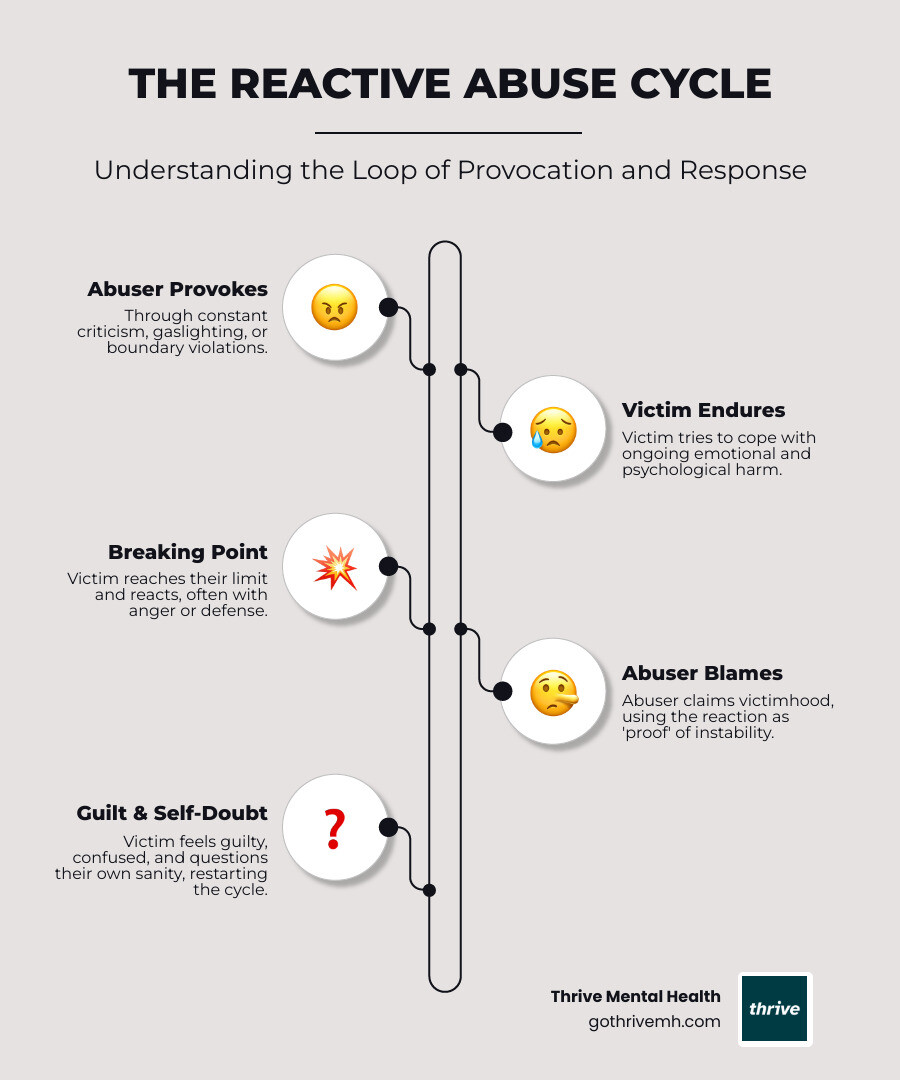
What Is Reactive Abuse? definitions:
What Is Reactive Abuse? The Cycle of Provocation and Reaction
If you’re in crisis, call/text 988 right now. You are not alone.
What Is Reactive Abuse? It’s when someone who’s been enduring ongoing abuse finally hits their breaking point and lashes out at their abuser. You might yell, insult them back, or even push or hit them. But here’s what’s crucial to understand: this isn’t actually abuse. It’s a self-defense response to prolonged harm.
As Alexa Connors, LMSW, a senior therapist, explains, reactive abuse occurs when someone who has been abused begins to defend themselves by responding with physical and verbal attacks. It’s always rooted in retaliation toward a previously received action, a desperate reaction to continuous emotional, psychological, or physical torment.
The difference between abuse and reactive behavior comes down to power and control. An abuser deliberately behaves in cruel, violent, demeaning, or invasive ways to create and maintain an imbalance of power. When you react, you’re not trying to gain power or control over them. You’re trying to protect yourself, to make it stop, to counter the damage being done to you. This crucial distinction is what separates your reaction from true abuse.
You can find a more scientific definition of reactive abuse in academic literature if you want to dig deeper. And because abuse profoundly affects how we process and remember events, it helps to learn more info about trauma and memory.
The Role of Provocation
The cycle doesn’t start with your reaction. It starts with deliberate, calculated provocation from your abuser. This isn’t accidental, it’s a tactic specifically designed to push you past your limits.
Intentional baiting might look like asking triggering questions they know will upset you, making inflammatory statements at just the wrong moment, or deliberately violating boundaries you’ve clearly set. Maybe they post something on social media designed to hurt you, or they “forget” to do something important, again and again, until you’re ready to scream.
Gaslighting makes you doubt your own mind. They’ll tell you conversations never happened, that you’re remembering things wrong, that you’re too sensitive or imagining things. This constant twisting of reality creates immense psychological distress that eventually pushes you to your breaking point.
Stonewalling, refusing to communicate or engage during crucial conversations, can feel like emotional torture. You’re trying desperately to resolve something important, and they just… shut down. Or leave. Or stare at their phone. This silent treatment drives you to increasingly desperate attempts to get any response.
They might also create no-win situations where you’re destined to fail or be blamed no matter what you do. And through it all, there’s the constant drip of emotional abuse: criticism, belittling, humiliation, threats that erode your self-worth bit by bit.
The abuser’s goal in all of this? To elicit a reaction. Once you finally snap, they have their “proof” that you’re the crazy one, the unstable one, the abusive one. They’ve successfully shifted all blame and avoided any accountability for their own behavior.
An Example of Reactive Abuse
Let’s say you’re with someone who constantly tears you down. Every day brings verbal attacks, belittling comments, and gaslighting. You’re told you’re worthless, oversensitive, imagining things. You try everything, communicating calmly, ignoring it, trying to appease them. Nothing works. The abuse continues, slowly destroying your mental and emotional well-being.
One evening, after yet another barrage of insults and a dismissive wave of the hand, you finally snap. You yell back. Maybe you throw a pillow across the room. Maybe you say something hurtful in return, fueled by months or years of pent-up frustration, fear, and pain.
And in that moment, your abuser calmly looks at you and says, “See? You’re the abusive one. You’re the one with anger issues. I’ve been trying to stay calm, but you always have to escalate things.”
This is reactive abuse in action. Your outburst, while aggressive, was a direct, involuntary reaction to prolonged torment, not an attempt to control or harm. Yet your abuser skillfully uses this single reaction to rewrite the entire narrative, portraying themselves as the long-suffering victim and you as the problem.
If you’ve experienced this dynamic, you’re not alone. And understanding what’s really happening is the first step toward breaking free. Online counseling for trauma can help you process these experiences and reclaim your sense of reality.
Signs You’re Experiencing Reactive Abuse (Not Initiating It)

When you’re caught in the cycle of reactive abuse, distinguishing your reactions from genuine abusive behavior can feel nearly impossible. The manipulation runs so deep that you start questioning your own sanity. In my practice, clients often describe feeling confused, guilty, scared, and angry all at once after these interactions, and that’s exactly what the abuser wants.
One of the most telling signs you’re experiencing reactive abuse is the overwhelming guilt and shame that follows your outburst. You genuinely regret what happened. You replay it over and over, wishing you’d handled it differently. True abusers rarely feel this remorse, they believe their actions are justified.
Another red flag is that your reactions feel completely out of character. You find yourself yelling, throwing things, or saying cruel words that don’t sound like you. You might think, “I’ve never been this person before.” That’s because you’re not, you’ve been pushed beyond your limits by someone who knows exactly which buttons to press. People who aren’t naturally violent or aggressive often find themselves driven to these behaviors as a desperate last resort.
The abuser’s response to your reaction is equally revealing. They immediately flip into victim mode, claiming you’re the one abusing them. They might record your outburst on their phone (conveniently leaving out the twenty minutes of provocation beforehand) or provoke you in public so others witness only your breaking point. This is a textbook example of DARVO, Deny, Attack, Reverse Victim and Offender. They deny their own abuse, attack your character, and claim they’re the real victim.
You’ll also notice that your reactions connect to specific triggers. You can trace them back to particular words, actions, or patterns from the abuser. Maybe it’s a certain dismissive tone, a specific insult they know wounds you deeply, or the way they “forget” important things just to frustrate you. These aren’t random explosions, they’re responses to calculated provocations.
The constant self-doubt is perhaps the most painful sign. The abuser’s gaslighting makes you question everything: your perceptions, your memories, even your sanity. Victims of narcissistic abuse often appear uncertain of themselves, constantly seeking clarification about basic facts. “Did that really happen?” “Am I remembering this wrong?” These questions become your internal soundtrack. Understanding the fawning trauma response can help you recognize other ways you might be coping with this abuse.
There’s also a profound sense of powerlessness and being trapped. Your reactive behaviors stem from helplessness, from a desperate need to make the abuse stop or to reclaim even a tiny bit of control. When you try to communicate calmly and rationally, the abuser escalates the conflict or dismisses your concerns entirely, backing you into a corner where reacting feels like the only option left.
If you have a history of abuse, whether in past relationships or during childhood, you may be more vulnerable to these dynamics. The patterns can feel familiar, and abusers often target people who’ve already been conditioned to accept mistreatment.
How Abusers Use Your Reaction to Manipulate
Once they’ve provoked you into reacting, abusers weaponize that moment with surgical precision. The reaction becomes their “get out of jail free” card, their proof that they’re innocent.
Shifting blame is their first move. “See what you make me do?” or “You’re the one who started this” become their mantras. Your reaction, no matter how justified, suddenly becomes the focal point, while their months or years of abuse fade into the background. They’ll claim they’re the ones being abused, holding up your single outburst as evidence.
Next comes portraying you as unstable. Your emotional outbursts or defensive actions become proof of your mental health issues. They’ll tell friends you’re “crazy,” “bipolar,” or “losing it.” This tactic is devastatingly effective at isolating you because people who haven’t witnessed the full context might actually believe them.
The abuser then gains sympathy from others by selectively sharing stories. They’ll recount your worst moments to friends, family, coworkers, or even therapists, conveniently leaving out the part where they spent three hours criticizing you or intentionally violated a boundary you’d clearly set. They paint themselves as the long-suffering partner trying their best with someone “impossible,” securing external validation while further isolating you.
Perhaps most importantly, focusing on your reaction allows them to avoid accountability entirely. As long as everyone’s talking about your behavior, no one’s examining theirs. The cycle continues uninterrupted, and they never have to face the consequences of their actions.
What is Reactive Abuse in the Context of Narcissism?
What Is Reactive Abuse? becomes an even more complex question when narcissistic personality traits enter the picture. Individuals with narcissistic tendencies have an insatiable need for narcissistic supply, attention, admiration, or even negative reactions that fuel their fragile egos.

Narcissists engineer situations specifically to provoke reactions from their partners. They use gaslighting, relentless criticism, and intentional boundary violations as tools. The profound lack of empathy means they don’t care about the pain they cause, in fact, they need it. Your distress becomes their validation.
When you finally react, the narcissist seizes the opportunity to confirm their victimhood. Your outburst becomes “proof” that they’re the victim of your “unstable” or “abusive” behavior. This reinforces their distorted self-image and gives them ammunition to use against you indefinitely. “Remember when you threw that glass?” can become a weapon they wield for years, regardless of what led to that moment.
This dynamic also allows them to maintain absolute control over the relationship narrative and your emotional state. By constantly destabilizing your reality and making you doubt yourself, they keep you off-balance and dependent on their version of events.
Narcissists rarely engage in self-reflection. Your reaction provides the perfect scapegoat, diverting any need for them to look inward. If you’re recognizing these patterns, learning about narcissistic family dynamics can help you understand how these behaviors often have deep roots.
This dynamic leaves victims feeling confused, ashamed, and genuinely questioning their own sanity. But understanding that your reactions are responses to calculated abuse, not evidence that you’re abusive, is the first step toward breaking free.
Reactive Abuse vs. Mutual Abuse vs. Self-Defense: Key Differences
If you’ve ever questioned whether your reactions make you “just as bad” as the person hurting you, you’re not alone. This confusion is exactly what abusers count on. Understanding the critical differences between reactive abuse, self-defense, and the myth of “mutual abuse” can help you see your situation more clearly.
The distinction comes down to three key factors: motivation, power dynamics, and the overall pattern of behavior. True abuse is always about establishing and maintaining power and control over another person. When you react to ongoing abuse, you’re not seeking power, you’re trying to survive, defend yourself, or make the pain stop.
Let’s break down these differences:
Reactive abuse happens when you’ve been pushed past your breaking point by sustained emotional, psychological, or physical torment. Your motivation isn’t to control or dominate; it’s a desperate attempt to defend yourself or end the abuse. You’re reacting to someone else’s pattern of harmful behavior. The power dynamic is clear: the abuser holds the power, and you’re trying to counter their control. Your behavior might look aggressive, yelling, saying hurtful things, even physical actions, but it’s always in response to prolonged provocation.
Self-defense is your immediate response to a threat of harm happening right now. If someone is physically attacking you and you push them away or fight back to protect yourself, that’s self-defense. The motivation is simple: protect yourself from imminent danger. You’re responding to an immediate threat, not a long pattern of psychological warfare. Self-defense is about stopping harm in the moment, while reactive abuse is a breaking point after enduring months or years of manipulation and torment.
“Mutual abuse” is a term you might hear, but here’s the truth: experts agree that mutual abuse is a myth. This concept is often used to confuse victims and absolve abusers of responsibility. Abuse requires a consistent pattern of power and control. One person establishes and maintains dominance in the relationship. Yes, both partners in a relationship can behave badly or have unhealthy communication patterns, but that’s not the same as abuse.
Think of it this way: if two people are equally matched in power, equally able to leave, and equally responsible for conflict, that might be an unhealthy relationship, but it’s not abuse. Abuse always involves a primary aggressor who sets the tone, controls the dynamic, and uses various tactics to maintain power. The other person’s reactions, no matter how aggressive they might seem, don’t change who holds the power.
Why “Mutual Abuse” Isn’t Real
The concept of mutual abuse is dangerous because it suggests both people are equally responsible for the harm. This simply isn’t how abuse works. Abuse is fundamentally about a consistent pattern of power and control, not isolated incidents of bad behavior.
When both partners exhibit unhealthy behaviors, like yelling, name-calling, or stonewalling, that might indicate a toxic or dysfunctional relationship. But dysfunction and abuse are different. In abuse, one person systematically uses fear, intimidation, manipulation, and control tactics to dominate the other. The primary aggressor establishes the dynamic and maintains it over time.
The victim’s reactions to that abuse, even violent or aggressive reactions, don’t make the situation “mutual.” They’re responding to an environment of fear and control that the abuser created and maintains. When professionals incorrectly label a situation as mutual abuse, they often miss the forest for the trees, focusing on individual incidents rather than the overall pattern and power imbalance.
Reactive Abuse vs. Self-Defense
While both involve defending yourself, What Is Reactive Abuse and self-defense are distinct concepts, though they can overlap.
Self-defense is your immediate response to a threat of harm happening in real time. If someone raises their fist to hit you and you block them or hit back, that’s self-defense. You’re protecting yourself from imminent physical danger. The threat is clear, present, and immediate.
Reactive abuse, on the other hand, is a breaking point reaction to a long pattern of psychological or emotional torment. You might not be in immediate physical danger when you finally snap. Instead, you’ve endured weeks, months, or years of gaslighting, manipulation, criticism, and emotional abuse. One day, you reach your limit and react aggressively, yelling, throwing something, or saying cruel things. That reaction isn’t about an immediate physical threat; it’s about the accumulated weight of sustained psychological harm.
Both are understandable responses to abuse, but they’re triggered by different circumstances. Self-defense happens in the moment of physical threat, while reactive abuse is the culmination of prolonged emotional and psychological torture. Neither makes you an abuser, they make you someone who was pushed beyond what any person should have to endure.
If you’re struggling to understand your own reactions and whether they’re normal responses to abuse, talking to a trauma-informed professional can provide much-needed clarity. Programs like Intensive Outpatient Programs (IOP) offer structured support to help you process these complex dynamics and begin healing.
Finding Support in Florida with Insurance
Navigating the path to healing is easier with the right support. For residents of Florida, Thrive Mental Health offers specialized programs tailored to trauma recovery. We are in-network with most major insurance providers, including Cigna, Optum, and Florida Blue, to make care more accessible. You can verify your insurance online in just a few minutes to see what your plan covers for services like our Intensive Outpatient and Partial Hospitalization Programs.
Frequently Asked Questions About Reactive Abuse
What is an example of reactive abuse?
Imagine being constantly criticized and belittled by your partner for months. You try to talk calmly, but they dismiss you. One day, after another barrage of insults, you snap and yell back, “Just leave me alone!” Your partner then says, “See? You’re the one who’s always yelling. You’re the abusive one.” Your reaction, born from prolonged distress, is an example of reactive abuse.
How do you know if it’s reactive abuse or mutual abuse?
The key difference is the power dynamic. “Mutual abuse” is a myth because abuse is about a consistent pattern of one person using power and control over another. Reactive abuse is a response to that control. If one person is the primary aggressor who instigates, manipulates, and controls the relationship, and the other person’s aggressive actions are defensive reactions, it is not mutual abuse.
Can you be arrested for reactive abuse?
Yes. While reactive abuse is a psychological concept explaining a victim’s response, any physical act of violence can have legal consequences, regardless of the context. An abuser may even try to use the legal system against you by reporting your reaction to the police. This is why it’s crucial to create a safety plan and seek help from domestic violence resources or a trauma-informed therapist.
How do you stop reactive abuse?
Stopping reactive abuse involves addressing the source: the abuser’s behavior. The first step is recognizing the pattern. Healing often requires setting firm boundaries, creating a safety plan to reduce contact or leave the relationship, and seeking professional support. Therapy can help you process the trauma, rebuild your self-worth, and learn strategies to protect yourself without being pushed to a breaking point.
Ready for support? Thrive offers virtual IOP with evening options. Verify your insurance in 2 minutes (no obligation) → Start benefits check or call 561-203-6085. If you’re in crisis, call/text 988.

This article is for informational purposes only and is not a substitute for individualized clinical advice or insurance verification.