






Why Your Creative Brain Needs a Different Kind of Mental Health Support
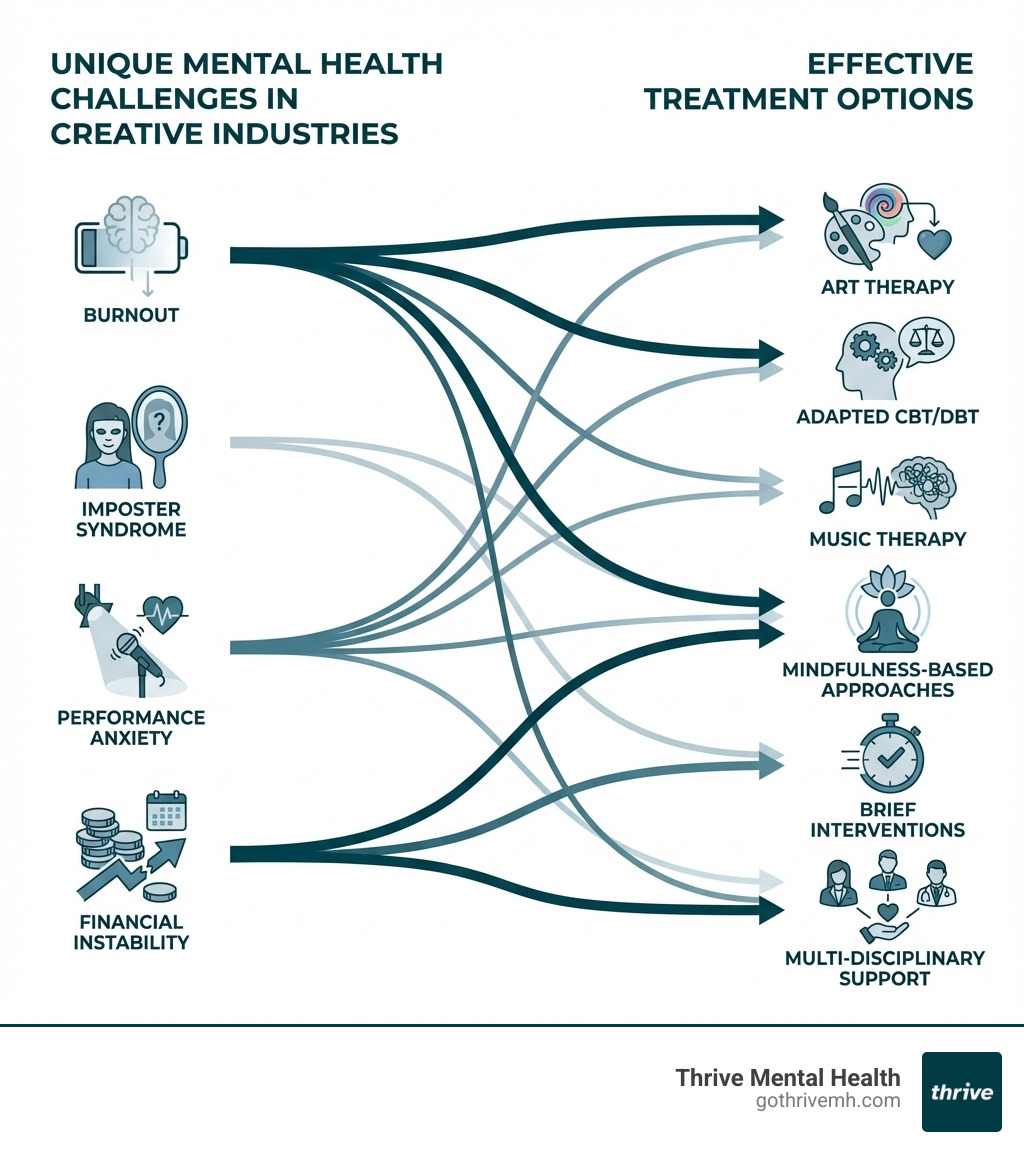
What mental health treatment options work best for creative industries? Creative professionals thrive when they have access to adapted talk therapy (like CBT and DBT with creativity-literate therapists), arts-based therapies (art therapy, music therapy, dance/movement therapy), brief interventions for mild-to-moderate issues, mindfulness-based approaches (MBSR, ACT), and multi-disciplinary support for complex needs. The most effective treatments acknowledge the unique pressures of creative work, burnout, imposter syndrome, performance anxiety, financial instability, and integrate creative expression as a therapeutic tool.
Quick Reference: Top Treatment Options for Creatives
| Treatment Type | Best For | Key Benefit |
|---|---|---|
| Art Therapy | Processing trauma, anxiety without words | Non-verbal expression; reduces cortisol |
| Adapted CBT/DBT | Reframing inner critic, emotional regulation | Builds resilience using creative metaphors |
| Music Therapy | Mood regulation, focus | Engages the creative mind directly |
| Mindfulness (MBSR/ACT) | Stress reduction, self-doubt | Grounding practices for high-pressure work |
| Brief Interventions (6-12 sessions) | Mild-to-moderate needs | Fast, targeted support (50% need no further care) |
| Multi-disciplinary Teams | Complex or enduring conditions | Comprehensive, coordinated care |
The truth is, creative professionals face mental health challenges at rates far higher than the general population. Research shows that 46% of Americans use creative activities to relieve stress, but when your creativity is your career, that coping mechanism becomes entangled with the very pressures causing distress. Financial instability, lack of work, and career uncertainty are the top three contributors to poor mental health among creatives, with suicide rates well above the national average in fields like performing arts.
Generic therapy often misses the mark because it doesn’t account for how your brain works. Your mind thinks in stories, images, and rhythms. Your identity is woven into your work. Your income depends on your next project. And your inner critic? It’s louder and more relentless than most people can imagine.
You need a different kind of support, one that respects the way you process the world and addresses the unique stressors of creative careers. That’s where specialized approaches like arts-based therapies, creativity-literate talk therapy, and flexible outpatient programs come in.
I’m Nate Raine, CEO of Thrive Mental Health, and over the past decade, I’ve worked at the intersection of behavioral health, data science, and digital innovation to build systems that deliver personalized, evidence-based care. At Thrive, we’ve designed programs specifically for high-performing professionals, including creatives, who need more than weekly therapy, integrating what mental health treatment options work best for creative industries into flexible, outcome-focused treatment plans. This guide will walk you through exactly what works, why it works, and how to access it, whether you’re navigating burnout, battling imposter syndrome, or just trying to keep your mental health on track while building something meaningful.
Related content about What mental health treatment options work best for creative industries?:
- Are there any programs that use art and mental health techniques for young professionals?
- exploring mental health through art
- Show me mental health centers that use therapy with art for adults.
The Double-Edged Sword: Unique Mental Health Risks in Creative Careers
Creative minds, whether they’re artists, designers, musicians, writers, or entrepreneurs in a creative field, face a unique set of challenges that can significantly impact their mental well-being. The very passion that drives them can also become a source of immense pressure and distress.
The Pressure Cooker: Burnout, Imposter Syndrome, and the Inner Critic
The romanticized image of the “tortured artist” often masks a harsh reality. Creative professionals are constantly pushing boundaries, innovating, and putting their work out for public consumption, and often, public judgment. This environment is a breeding ground for specific mental health struggles:
- Burnout from constant output: The demand for continuous creativity and output can lead to exhaustion, cynicism, and a reduced sense of accomplishment. The pressure to always be “on” and producing can be relentless.
- Imposter syndrome despite success: Even highly successful creatives often struggle with feeling like a fraud, attributing their achievements to luck rather than skill. This self-doubt can be crippling.
- A relentless inner critic: Creatives are often their own harshest critics. This internal voice, while sometimes driving improvement, can become destructive, leading to perfectionism and self-sabotage.
- Performance anxiety: For performing artists, the fear of failure or negative judgment in front of an audience can be paralyzing. Even visual artists or writers can experience performance anxiety when presenting their work.
- The emotional toll of rejection: Rejection is an inherent part of creative industries, whether it’s an audition, a pitch, or a grant application. Constantly facing rejection can take a significant emotional toll.
- Financial instability and gig work: Many creative careers involve freelance work, project-based contracts, and unpredictable income. This financial insecurity is a major contributor to poor mental health, leading to chronic stress and anxiety. Studies indicate that financial issues, lack of work, and career uncertainty are primary drivers of mental health problems among performing artists.
The Isolation Trap: Blurred Boundaries and Unstable Work-Life Balance
While creativity can be a deeply personal and solitary pursuit, it can also lead to isolation and an unhealthy blurring of personal and professional boundaries.
- Working in isolation: Many creative roles, especially for writers, visual artists, or remote designers, involve long hours spent alone. This can lead to feelings of loneliness and detachment.
- Projects demanding total immersion: Creative projects often require intense focus and immersion, making it difficult to maintain social connections or engage in other aspects of life.
- Difficulty “switching off”: The creative process doesn’t always adhere to a 9-to-5 schedule. Ideas can strike at any time, leading to constant mental engagement and difficulty disengaging from work. This constant mental load contributes to stress.
- Identity tied to creative output: For many creatives, their work is deeply intertwined with their identity and self-worth. Negative feedback or professional setbacks can feel like personal attacks, leading to significant emotional distress.
- The impact on personal relationships: Long hours, unpredictable schedules, and the emotional intensity of creative work can strain personal relationships. Balancing creative demands with family and friends often becomes a significant challenge.
Recognizing these unique stressors is the first step toward finding effective mental health support. As a systematic review on Creative Arts Interventions for Stress Management and Prevention highlighted, stress is a global health problem with serious consequences, and creative approaches can be innovative ways to manage it. You can explore more about stress management in our comprehensive guide to online therapy for stress.
Beyond the Couch: Therapies That Actually Work for the Creative Mind
Traditional talk therapy is undoubtedly a powerful tool for mental health, but for a mind that thinks in colors, melodies, and stories, it often needs a creative upgrade. We believe therapy should work with your creative brain, not against it, to open up deeper healing and growth.
Supercharging Talk Therapy: How to Make CBT and DBT Work for You
Cognitive Behavioral Therapy (CBT) and Dialectical Behavior Therapy (DBT) are evidence-based treatments that can be incredibly effective for creatives when custom to their unique needs.
- Cognitive Behavioral Therapy (CBT) to reframe the inner critic: CBT helps identify and challenge negative thought patterns. For creatives, this means tackling the relentless inner critic, changing self-doubt into constructive feedback, and developing a more balanced self-perception. We can help you implement CBT for professionals in your daily life.
- Dialectical Behavior Therapy (DBT) for emotional regulation: DBT equips individuals with skills in mindfulness, emotional regulation, distress tolerance, and interpersonal effectiveness. These skills are invaluable for navigating the emotional highs and lows of creative work, managing intense reactions to criticism or rejection, and improving professional relationships. Our online DBT complete guide offers further insights.
- Finding a “creativity-literate” therapist: The key is finding a therapist who understands the nuances of creative industries, someone who “gets” the pressure of deadlines, the vulnerability of sharing your work, and the unique link between your identity and your craft. They can adapt traditional techniques to resonate with your creative worldview.
- Using metaphors and storytelling in sessions: A therapist who can engage with your creative language, using metaphors, imagery, and storytelling, can help you process emotions and insights more effectively. This approach leverages your inherent strengths rather than forcing a purely verbal, logical framework.
At Thrive Mental Health, our intensive outpatient programs (IOP) often integrate these adapted talk therapies. We design our programs for professionals, including creatives, who need more structured support than weekly therapy but less than inpatient care. You can find more info about our intensive outpatient programs (IOP) and find how we blend clinical expertise with flexible scheduling.
Building an Unshakeable Core: Therapies for Resilience and Self-Doubt
The creative journey is not for the faint of heart. It requires immense resilience to bounce back from setbacks and a strong sense of self to manage persistent self-doubt. Certain therapeutic approaches are particularly adept at building this inner strength.
- Mindfulness-Based Stress Reduction (MBSR): MBSR teaches techniques to cultivate present-moment awareness, helping creatives manage stress, reduce rumination, and improve focus. This can be crucial for staying grounded amidst chaotic project demands or external pressures. Our mindfulness resources offer a great starting point.
- Acceptance and Commitment Therapy (ACT): ACT helps individuals accept difficult thoughts and feelings while committing to actions aligned with their values. For creatives, this means embracing the discomfort of uncertainty or self-doubt, rather than letting it derail their creative process, and staying true to their artistic vision.
- Building emotional intelligence to steer feedback: Therapy can help you develop the emotional intelligence to process criticism objectively, separating personal attacks from constructive feedback, and protecting your emotional well-being.
- Resilience training for handling rejection: Learning to view rejection not as a personal failing but as an inherent part of the creative path is vital. Resilience training helps build coping mechanisms and a growth mindset to persevere.
- Taming self-doubt and perfectionism: These are common demons for creatives. Therapy can provide strategies to challenge perfectionistic tendencies, accept imperfection, and quiet the self-critical voice that stifles innovation and progress.
Arts-Based Therapies: A Core Treatment for Creative Professionals
For many creatives, the most powerful healing tool is one they already know intimately: creation itself. Arts-based therapies leverage this inherent connection to expression, offering unique pathways to healing where words alone may fall short. These modalities are clinically proven and increasingly recognized for their effectiveness.
Art Therapy: Processing Trauma and Anxiety Without Saying a Word

Art therapy uses creative processes like painting, drawing, sculpture, and collage to help clients explore their emotions, improve self-esteem, manage addictions, reduce stress, and alleviate anxiety. It’s not about artistic skill; it’s about the therapeutic process.
- Non-verbal expression: For those who struggle to articulate complex feelings or past traumas verbally, art provides a powerful alternative. As one individual shared, “It helps when I struggle to find the words, when I’m too angry, despairing or confused to know what I think. It gives me a voice.”
- Externalizing difficult feelings: Creating art allows individuals to externalize their inner world, giving tangible form to emotions, fears, or anxieties that might otherwise feel overwhelming. This can bring repressed emotions and memories to the surface in a safe, contained way.
- Reducing cortisol and physical stress symptoms: Engaging in art-making has been shown to reduce physiological markers of stress. Studies indicate that active art-making can significantly reduce cortisol levels. This directly addresses the physical toll of chronic stress common in creative industries.
- Effectiveness: Art therapy has been reported as a highly helpful group modality, with one survey showing 45.65% positive feedback. It can be particularly beneficial as an adjunct therapy alongside cognitive-behavioral therapy or psychotherapy for conditions like depression, grief, anxiety, and even more complex conditions like Alzheimer’s, autism, and schizophrenia. Recent research, including a study on online art therapy’s effectiveness, suggests that even virtual art therapy can be a relevant and welcomed intervention, offering a judgment-free zone for self-expression.
We incorporate art therapy activities for adults into our programs, recognizing its profound impact on emotional healing and growth.

Music, Drama, and Dance: Embodied Healing for Mind and Body
Beyond visual arts, other creative therapies offer unique benefits, engaging the mind and body in therapeutic ways.
- Music Therapy for mood regulation and focus: Music has a direct line to our emotions and cognitive functions. Music therapy can help regulate mood, reduce anxiety, and improve focus. For musicians, it offers a way to reconnect with their craft on a therapeutic level, untangling thoughts and re-establishing order. Studies show music interventions can significantly reduce depressive symptoms and improve quality of life.
- Dramatherapy for exploring new perspectives: Dramatherapy uses drama and theater processes to help individuals explore difficult feelings, practice new behaviors, and gain insight into their lives. It can be particularly effective for creatives dealing with identity issues, self-expression, or navigating complex interpersonal dynamics. It allows for playful exploration of imagination in a safe space.
- Dance/Movement Therapy for releasing stored physical tension: The body often holds onto stress and trauma. Dance/movement therapy helps individuals connect with their bodies, express emotions non-verbally through movement, and release physical tension. It can help address body image issues and improve overall physical and psychological well-being. The British Association of Art Therapists (BAAT) and other professional bodies for music, drama, and dance therapists offer more resources on these powerful modalities.
Turning Your Craft into a Therapeutic Tool
The very act of creation, when approached with intention and without the pressure of commercial outcomes, can be profoundly therapeutic. For creatives, understanding this distinction is key to preventing burnout and fostering well-being.
- The “flow state” as a mental reset: The “flow state”, that immersive, energized focus when fully engaged in an activity, is a natural mental reset. It reduces self-consciousness, improves mood, and improves performance. Intentionally seeking this state through personal creative pursuits can provide immense relief from work-related stress.
- Using personal projects for meaning-making: Engaging in personal creative projects, separate from professional obligations, allows for pure expression and meaning-making. This can help re-establish a sense of purpose and joy in creation, independent of external validation.
- The difference between creative work and creative play: For a creative professional, their craft is often their livelihood, bringing with it deadlines, client demands, and financial pressures. Creative play, however, is about exploration, experimentation, and joy without judgment or expectation. Nurturing this distinction is crucial for mental health.
- How hobbies protect against professional burnout: Engaging in creative hobbies outside of one’s professional creative field can act as a buffer against burnout. It provides a different outlet for creative energy, reduces performance pressure, and offers a sense of accomplishment purely for personal satisfaction. Indeed, statistics reveal that Americans who rate their mental health as very good or excellent tend to engage in creative activities more frequently than those who rate their mental health as fair or poor.
How to Find the Right Support and Build a Mentally Healthy Workplace
Finding the right mental health support is crucial for creatives, and it’s equally important for employers in creative industries to foster environments that champion well-being.
Finding Your Ally: A Practical Guide to Accessing the Right Therapist

Navigating the mental health landscape can be daunting, but finding a therapist who truly understands your world can make all the difference.
- Using therapist directories: Online directories are excellent starting points. Look for therapists who list specializations in “artists,” “creatives,” “performance anxiety,” or “burnout.” Many virtual therapy platforms, including ours, offer specialized therapists.
- Verifying credentials: Always ensure your therapist is licensed and registered with relevant professional bodies. For arts therapists, this might include the Health and Care Professions Council (HCPC) or the Art Therapy Credentials Board (ATCB). For psychiatrists, you can use tools like the American Psychiatric Association’s Find a Psychiatrist tool.
- Questions to ask a potential therapist: Don’t hesitate to interview potential therapists. Ask about their experience working with creatives, their understanding of industry-specific stressors, and how they integrate creative approaches into their practice.
- The importance of cultural and industry competence: A therapist who understands your industry’s culture, its demands, its language, its unique anxieties, can provide more relevant and effective support.
- Flexible and accessible options: For creatives with demanding or irregular schedules, virtual therapy and online programs are invaluable. We offer virtual Intensive Outpatient (IOP) programs throughout Florida, providing evidence-based care that fits your life. Whether you’re in Miami, Orlando, Tampa, or Jacksonville, our flexible programs are designed to support your career and well-being.
For Employers: How to Create a Culture That Fosters Well-being
Employers in creative industries have a significant role to play in supporting the mental health of their teams. A healthy, supportive environment not only benefits individuals but also boosts creativity, productivity, and retention.
- Destigmatizing mental health conversations: Leaders should openly discuss mental health, creating a safe space where employees feel comfortable seeking help without fear of professional repercussions.
- Implementing flexible deadlines and “no-meeting” days: Recognizing the non-linear nature of creative work, flexible schedules and dedicated focus time can reduce stress and improve creative output.
- Providing robust mental health benefits: Ensure health insurance plans, like those from Cigna, Optum, and Florida Blue, offer comprehensive mental health coverage, including access to specialized therapies. We work with many major insurance providers to make our programs accessible.
- Encouraging paid time off and creative sabbaticals: Regular breaks are essential for preventing burnout. Encouraging and supporting paid time off, and even offering creative sabbaticals, can lead to renewed energy and inspiration. The Center for Workplace Mental Health provides excellent resources for employers looking to build supportive environments.
Frequently Asked Questions about Mental Health for Creatives
Is art therapy only for visual artists?
No. Art therapy is for everyone, regardless of artistic skill. It’s not about creating a masterpiece; it’s about using the creative process, whether with paint, clay, or collage, to explore feelings and thoughts that are hard to put into words. The focus is on the process, not the final product.
How can I get mental health support that fits my freelance schedule?
Flexible and virtual programs are key. Many providers now offer virtual Intensive Outpatient (IOP) programs with evening and weekend options. This allows you to get structured support without sacrificing your work commitments. Learn about our flexible Virtual IOP options.
Will my insurance cover specialized therapies like art or music therapy?
Coverage varies, but many insurance plans, including those from major providers like Cigna, Optum, and Florida Blue, are increasingly covering arts-based therapies as part of a comprehensive mental health treatment plan, especially within IOP or PHP programs. It’s always best to verify your benefits directly with the provider.
Take the First Step: Get Support That Understands the Creative Mind
Your creativity is your greatest asset, it deserves to be nurtured. The unique pressures of creative industries demand more than a one-size-fits-all approach to mental health. By exploring custom options like adapted talk therapy, arts-based interventions, and structured outpatient programs, you can build resilience, silence your inner critic, and get back to creating from a place of strength and clarity.
Thrive Mental Health offers specialized virtual and in-person programs across Florida, designed for professionals who need more than weekly therapy. Our services are available to residents in Tampa Bay, St. Petersburg, Miami, Orlando, Boca Raton, West Palm Beach, Jacksonville, Fort Lauderdale, Naples, and Sarasota. Our approach integrates evidence-based treatments that respect the needs of a creative life.
Ready for support? Thrive offers virtual IOP programs with evening options. Verify your insurance in 2 minutes (no obligation) → Start benefits check or call 561-203-6085. If you’re in crisis, call/text 988.

This article is for informational purposes only and is not a substitute for individualized clinical advice or insurance verification.