






CBT Worksheets [2025]: 9 Tools That Cut Anxiety and Depression Faster (Free PDFs + How-To)
Summary: CBT worksheets make change concrete. In this guide, youll use 9 proven CBT worksheets to spot triggers, challenge thoughts, and build better habits in 10 minutes a dayoften with noticeable relief in 24 weeks. Includes free downloads, step-by-step use, and information on insurance-friendly CBT programs available across Florida.
If worry, low mood, or burnout wont let up, talking isnt enough. Doing is what changes your brain. CBT worksheets are the fastest way to turn insight into actionon paper, on purpose.
What you risk if you skip this: more spirals, more avoidance, the same week on repeat. What you gain if you start today: clarity, calmer days, better sleep, and traction you can measure.
CBT worksheets help you identify, challenge, and change unhelpful thought patterns and behaviors:
- Thought Records Catch and challenge negative automatic thoughts
- Behavioral Activation Schedule mood-lifting, mastery-building actions
- Exposure Hierarchies Face fears step-by-step (no white-knuckling)
- Cognitive Distortions Spot thinking traps and reframe fast
- ABC Model Map triggers Beliefs Consequences to break cycles
- Goal Setting Turn overwhelm into a clear plan
CBT is doing therapy. Writing it down makes patterns visible and changeable. Decades of research back these tools for anxiety, depression, OCD, and trauma.
At Thrive Mental Health, weve helped thousands use CBT worksheets inside virtual IOP programs to get faster, lasting results. In this guide, youll get 9 worksheets that work, exactly how to use them, plus free, therapist-approved resources. For principles behind these tools, see our guides on how cognitive behavioral therapy works, its application for mood disorders, and its place within psychotherapy.
What Are CBT Worksheets? (And Why They Actually Work)
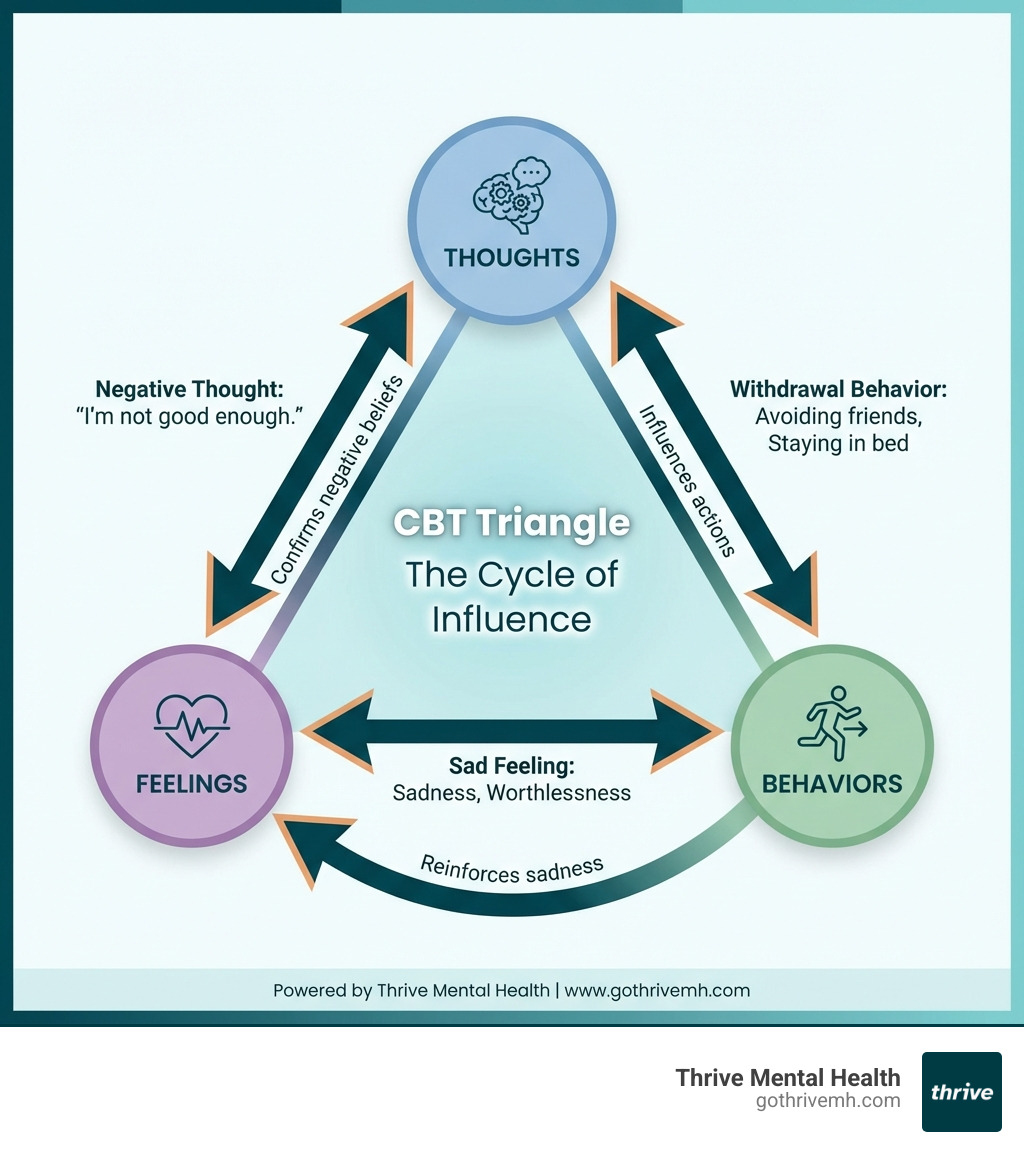
Cognitive Behavioral Therapy (CBT) is an evidence-based form of psychological therapy that helps us understand the intricate connection between our thoughts, feelings, and behaviors. It’s not just about talking; it’s about actively “doing” the work to change unhelpful patterns. CBT worksheets are the practical, structured forms that make this “doing” possible.
These aren’t just blank pages; they’re carefully designed tools that help us gather data, examine our thoughts, and look for patterns. Whether we’re exploring automatic thoughts, tracking activities, or formulating a case, these worksheets provide a tangible way to externalize our experiences. This externalization is crucial because it makes our internal world less prone to bias, allowing us to objectively assess and challenge what’s going on inside our heads.
For instance, when we experience anxiety, a condition that affected 301 million adults, children, and adolescents worldwide in 2023, according to the World Health Organization, our thoughts can become a tangled mess. CBT worksheets help solve that mess, allowing us to see how our thoughts directly influence our feelings and actions. They empower us to challenge unhelpful cognitive patterns, replacing them with more rational and constructive ways of thinking. This process is fundamental to the cognitive model of CBT, which posits that our thoughts, not external events, largely determine our emotional responses.
The Science of Rewiring Your Brain
At the heart of CBT lies the concept of cognitive restructuring, the process of reevaluating and reframing our thought processes to promote a more constructive and adaptive mindset. This isn’t just a mental exercise; it taps into our brain’s incredible capacity for neuroplasticity, the ability to form new neural pathways. When we consistently use CBT worksheets to identify and challenge our “Automatic Negative Thoughts” (ANTs), those rapid, ingrained cognitive responses that significantly impact our mood, we’re literally creating new ways for our brains to respond.
These worksheets help us take abstract, often overwhelming, thoughts and make them concrete and manageable. By writing them down, we can scrutinize them, question their validity, and explore alternative perspectives. This systematic approach helps chip away at deeply held core beliefs that might be fueling distress, allowing us to build healthier, more realistic foundations for our thinking. It’s like giving our brain a new operating system, designed for resilience and positive growth.
The Difference Between Worksheets, Exercises, and Handouts
While often used interchangeably, there are distinct differences between CBT worksheets, exercises, and information handouts, each serving a unique purpose in the therapeutic process:
| Type | Purpose | Usage | Example |
|---|---|---|---|
| Worksheets | Forms designed to be filled in, to gather data, examine thoughts, and look for patterns. | Often used as homework, or completed collaboratively in-session, or started in-session and completed outside. | Thought Record, Activity Log, Core Beliefs Worksheet. |
| Exercises | Therapeutic interventions designed to introduce a new way of thinking, acting, or feeling. | Typically guided by a therapist in-session, but can also be practiced independently. | Mindfulness meditation, role-playing, behavioral experiments. |
| Handouts | Informational sheets that provide psychoeducation on a specific topic. | Given to clients to read and reference between sessions. | A list of cognitive distortions, an explanation of the fight-or-flight response. |
9 Powerful CBT Worksheets to Rewire Your Brain
These CBT worksheets are designed to help you tackle common challenges like anxiety, depression, and stress management. They’re practical, actionable, and can be used as a standalone self-help tool or in conjunction with professional therapy, such as the specialized programs offered at our Florida locations.
1. The Thought Record: Stop Negative Spirals in Their Tracks
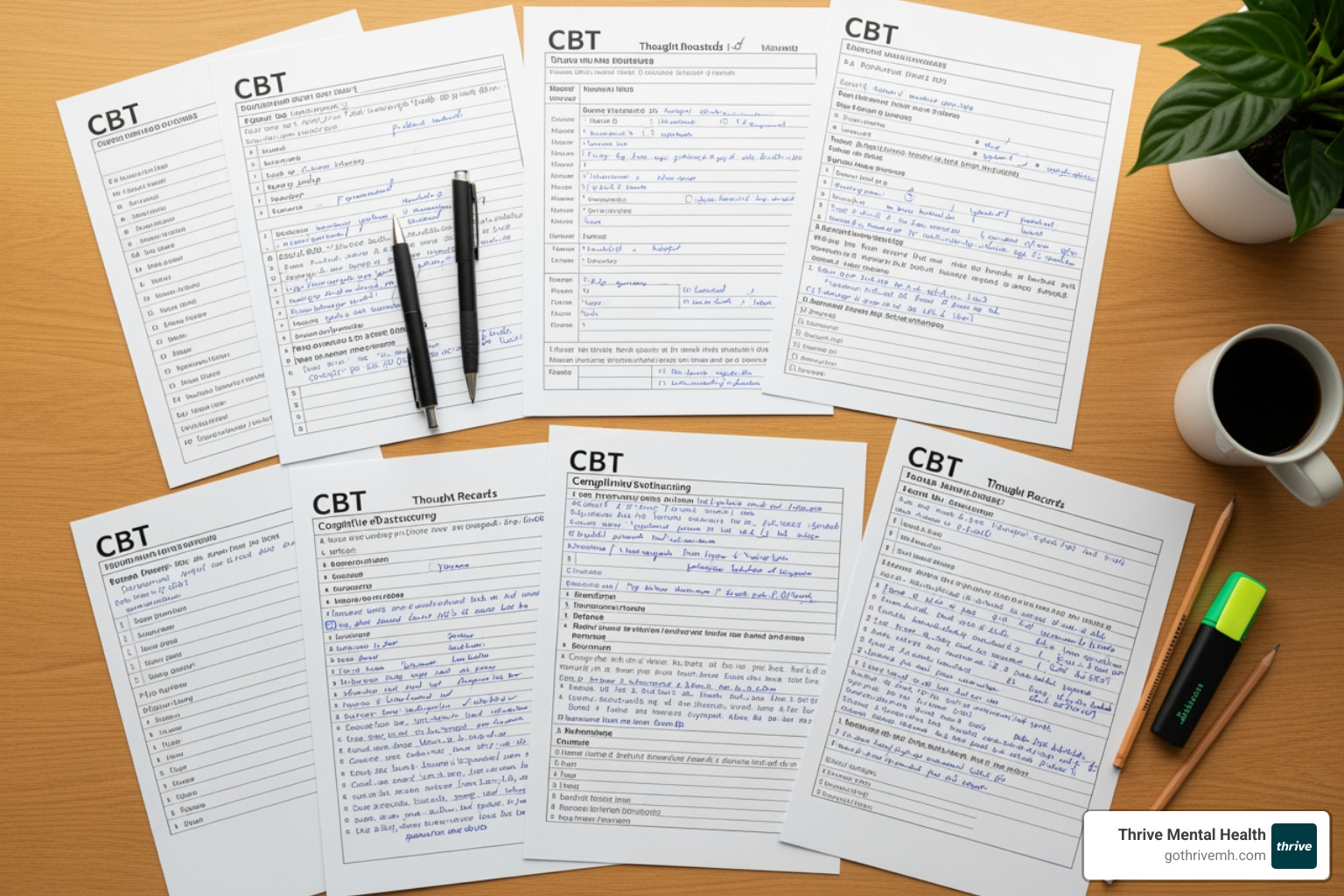
The Thought Record is arguably one of the most foundational and effective CBT worksheets. Its purpose is to help you identify, evaluate, and respond to your automatic negative thoughts (ANTs). These are the rapid, ingrained thoughts that pop into our heads and often trigger strong emotional reactions.
Here’s how it generally works:
- Situation: Briefly describe the event or situation that led to the unpleasant emotion.
- Emotion(s): List the feelings you experienced (e.g., anxiety, sadness, anger) and rate their intensity.
- Automatic Thought(s): Write down the exact thoughts that went through your mind.
- Evidence For/Against: Crucially, list evidence that supports your thought and evidence that contradicts it. This is where we challenge the thought’s validity.
- Alternative/Balanced Thought: Based on the evidence, formulate a more realistic, balanced, and helpful thought.
- Outcome: Rerate your emotions after considering the alternative thought.
By systematically filling out a thought record, we gain perspective, challenge cognitive distortions, and ultimately, create a more balanced and realistic view of ourselves and the world. This worksheet is particularly powerful for conditions like anxiety and depression. For more on how this works, read our article: Cognitive Behavioral Therapy: A Deep Dive into How it Battles Anxiety and Depression.
2. Behavioral Activation: Break Free From Depression’s Grip
When depression takes hold, it often leads to withdrawal and a lack of motivation. We stop doing things we once enjoyed, which only perpetuates the cycle of low mood. Behavioral activation is a powerful CBT exercise that directly counters this. It operates on the premise that engaging in meaningful and rewarding activities can alleviate depressive symptoms and improve mood.
This worksheet typically involves:
- Logging Activities: Tracking your current activities and how they make you feel.
- Categorizing: Identifying activities that are energy-giving vs. energy-draining, or those that provide pleasure vs. a sense of mastery.
- Scheduling: Intentionally planning and engaging in activities that bring pleasure or a sense of accomplishment, even if you don’t initially “feel like it.”
By systematically identifying and participating in these activities, we counteract the inertia and withdrawal associated with depression. This approach recognizes the bidirectional relationship between behavior and mood, proving that taking action can lead to positive emotional shifts. This is a cornerstone of CBT for Mood Disorders and a key component of the structured support we provide for depression in our Florida-based IOP programs.
3. Exposure Hierarchy: Conquer Anxiety and Phobias Step-by-Step
For those struggling with anxiety, panic disorder, or phobias, avoidance can become a powerful, yet ultimately self-defeating, coping mechanism. The Exposure Hierarchy worksheet, often referred to as a “fear ladder,” helps us systematically and gradually confront feared situations.
Here’s the process:
- Identify Feared Situations: List all situations, objects, or thoughts that trigger anxiety.
- Rate Fear/Avoidance: Assign a subjective unit of distress (SUD) score (e.g., 0-100) to each item.
- Create a Hierarchy: Arrange these items from least to most anxiety-provoking.
- Gradual Exposure: Starting with the least anxiety-provoking item, we systematically expose ourselves to it until our anxiety naturally decreases (habituation). We then move to the next step.
This graded exposure process helps us build tolerance, reduce our fear response over time, and challenge the catastrophic predictions often associated with anxiety. It’s a crucial element in treating conditions like panic disorder and OCD, often guided by a therapist for safety and effectiveness. For a deeper dive into how this helps, see our resource on Cognitive Behavioral Therapy for Panic Disorder. Our Florida-based therapists specialize in this approach within our virtual therapy and higher-level care programs.
4. Cognitive Distortions Worksheet: Identify Your Brain’s Biased Filters
Cognitive distortions are irrational or biased ways of thinking that can lead to unhealthy emotions and behaviors. Research indicates that individuals with anxiety disorders often experience more cognitive distortions than those without mental illnesses. These “filters” can twist reality, making us feel worse than the situation warrants.
Common cognitive distortions include:
- All-or-Nothing Thinking: Seeing things in black and white, with no middle ground.
- Catastrophizing: Expecting the worst possible outcome.
- Mind-Reading: Assuming you know what others are thinking without evidence.
- Overgeneralization: Drawing broad, sweeping conclusions based on a single event.
- Emotional Reasoning: Believing something is true because you feel it so strongly.
A CBT worksheet for cognitive distortions helps us:
- Identify: Recognize which distortions we commonly use.
- Challenge: Question the validity and helpfulness of these distorted thoughts.
- Reframe: Develop more balanced and realistic interpretations.
Becoming aware of these patterns is the first step toward breaking free from their grip. For more evidence on how cognitive distortions impact anxiety, you can explore this research: Evidence on cognitive distortions in anxiety.
5. The ABC Model: Pinpoint Your Triggers and Reactions
The ABC Model is a fundamental tool in CBT that helps us understand how our beliefs mediate our reactions to events. It breaks down an experience into three key components:
- A, Activating Event: The objective situation or trigger that occurs.
- B, Beliefs: Our interpretation or thoughts about the activating event. This is where cognitive distortions often reside.
- C, Consequences: The emotional and behavioral reactions that follow from our beliefs.
This CBT worksheet guides us to:
- Identify the “A”: What happened?
- Uncover the “B”: What thoughts or beliefs did I have about it?
- Observe the “C”: What feelings and behaviors resulted?
The power of the ABC model lies in its ability to show us that it’s often not the activating event (A) itself that causes our distress (C), but rather our beliefs (B) about the event. Once we pinpoint these beliefs, we can then work on disputing irrational beliefs and developing more effective, rational ones, leading to healthier emotional and behavioral consequences.
6. Core Beliefs Worksheet: Uncover Your Deepest “Rules for Living”
Beyond automatic thoughts, we all hold deeper, more fundamental assumptions about ourselves, others, and the world, these are our core beliefs. Often formed in childhood, they act as “rules for living” and can be positive (“I am competent”) or negative (“I am unlovable”). Negative core beliefs often underlie and fuel our automatic negative thoughts and cognitive distortions.
A Core Beliefs CBT worksheet helps us:
- Identify: Uncover these deeply held beliefs, which might not always be conscious.
- Explore Origins: Understand where these beliefs came from.
- Gather Evidence: Systematically look for evidence in our lives that supports and contradicts these beliefs. We often find that there’s ample evidence against negative core beliefs once we start looking.
- Formulate New Beliefs: Work towards developing more balanced, flexible, and empowering core beliefs.
Challenging and modifying core beliefs is a profound process that can lead to lasting change, as it addresses the root of many psychological difficulties.
 Intervene Like You Mean It: Understanding Crisis Intervention Mental Health ServicesMental Health
7. Mindfulness & Acceptance Worksheets: Find Calm in the Chaos
Mindfulness, the practice of being fully present and engaged in the current moment without judgment, integrates beautifully with CBT to improve emotional regulation and reduce distress. Research indicates that activities such as mindfulness, guided meditation, and deep breathing can effectively reduce negative thoughts and other mental health symptoms.
Mindfulness and acceptance CBT worksheets can guide us through exercises such as:
- ‘Leaves on a Stream’: Imagining thoughts as leaves floating down a stream, observing them without judgment or attachment.
- Body Scan: Systematically bringing attention to different parts of the body, noticing sensations without trying to change them.
- Mindful Breathing: Focusing on the breath as an anchor to the present moment.
These practices help us cultivate a non-judgmental awareness of our internal experiences, allowing us to accept difficult thoughts and feelings rather than fighting them. This can significantly reduce the distress caused by anxiety and rumination, helping us find calm even amidst chaos.
8. The Responsibility Pie: Stop Unfair Self-Blame
When things go wrong, it’s common to fall into the trap of self-blame, taking on 100% of the responsibility for outcomes that are often influenced by many factors. The Responsibility Pie is a visual CBT worksheet designed to challenge this tendency.
Using this worksheet, we:
- Identify a Situation: Choose a situation where you feel overly responsible or guilty.
- List Contributing Factors: Brainstorm all the different factors that contributed to the outcome, including your actions, others’ actions, external circumstances, chance, etc.
- Assign Percentages: Draw a pie chart and assign a realistic percentage of responsibility to each factor.
This exercise often reveals that our share of responsibility is much smaller than we initially believed, helping to alleviate self-blame, guilt, and shame. It promotes a more balanced and realistic understanding of complex situations.
9. Goal Setting & Problem-Solving: Create Your Roadmap to Change
A core component of CBT is its practical, solution-focused approach. CBT worksheets for goal setting and problem-solving help us translate therapeutic insights into actionable steps, building self-efficacy and momentum.
These worksheets typically involve:
- Problem Identification: Clearly defining the problem we want to address.
- Brainstorming Solutions: Generating a wide range of possible solutions.
- Evaluating Options: Weighing the pros and cons of each solution.
- Setting SMART Goals: Crafting goals that are Specific, Measurable, Achievable, Relevant, and Time-bound.
- Action Planning: Breaking down larger goals into smaller, manageable steps.
- Anticipating Obstacles: Identifying potential barriers and planning how to overcome them.
This systematic approach helps us tackle overwhelming problems, reduce procrastination, and feel more in control of our lives. It’s about creating a clear roadmap to the changes we want to see.
How to Use CBT Worksheets for Real Change (For You or Your Clients)

CBT worksheets work best with consistency and feedback. Use them daily, review weekly, and adjust based on what the data shows.
For Self-Care: Make it a 10-minute habit
- Set a time: 10 minutes after dinner or before bed.
- One page, one goal: complete a Thought Record or Activity Log daily.
- Review weekly: circle biggest triggers and wins. Keep what works, cut what doesnt.
- Stuck, severe, or complex symptoms? Pair worksheets with professional care. If you’re in Florida, Thrive offers accessible Virtual Therapy and insurance-friendly programs to provide more structure.
For Professionals: Structure, homework, outcomes
- Assign targeted worksheets as homework to generalize skills.
- Complete first drafts in-session; finish between sessions.
- Track intensity ratings over time to show progress and guide next steps.
- Use case tools (e.g., cognitive conceptualization) to link core beliefs to current patterns.
Need more support than weekly therapy? Our virtual and hybrid programs are available across Florida, with day and evening options to fit your schedule:
- Intensive Outpatient Program (IOP)
- Partial Hospitalization Program (PHP)
- Quick coverage check: Verify insurance
When worksheets meet structured care, people move faster and relapse less.
Where to Find Free, Therapist-Approved CBT Resources
Access to reliable, evidence-based CBT worksheets is crucial. Fortunately, several reputable organizations and mental health institutes offer free and high-quality resources for both individuals and professionals.
Here are some excellent places to start:
- The Beck Institute: As a leading authority in CBT, the Beck Institute offers a range of online and downloadable resources, including their updated CBT Worksheet Packet, which includes traditional and strength-based Cognitive Conceptualization Diagrams.
- Academic and Health Institutions: Many universities and national health organizations (like the NHS in the UK or NIMH in the US) provide free, evidence-based mental health resources, including CBT worksheets.
- Therapist-Curated Websites: Some licensed therapists and mental health professionals share free, high-quality worksheets and tools on their websites as a public service.
When choosing resources, prioritize those that are clearly presented, easy to understand, and come from organizations known for their commitment to evidence-based practice. Many resources are available as printable PDFs, while others offer interactive or dynamic versions that can be completed on digital devices, catering to different preferences.
Frequently Asked Questions about CBT Worksheets
Do CBT worksheets actually work without a therapist?
Yesfor mild to moderate symptoms, daily use can help. For severe or stuck patterns, pair worksheets with therapy or an IOP/PHP for faster, safer results. Our programs in Florida are designed to provide this structured support.
How fast will I feel better using CBT worksheets?
Many people notice small wins in 24 weeks with 10 minutes a day. Core belief shifts usually take a few months.
Where can I get free, printable CBT worksheets?
See the Beck Institutes CBT Worksheet Packet and resources from major health systems. We also outline 9 worksheets in this guide.
Do insurance plans cover CBT-based programs?
Often yes. In Florida, Thrive accepts most major insurance plans, including Cigna, Aetna, Optum, and Florida Blue. You can check your benefits in 2 minutes on our site: Verify insurance.
Are online CBT worksheets as effective as in-person?
For many anxiety and depression cases, online CBT tools perform as well as in-person when used consistently and supported by a clinician if needed.
Take Control of Your Mental Health Today
CBT worksheets turn insight into action. If you’re in Florida and want faster relief with stronger follow-through, combine these tools with expert support. Thrive offers virtual IOP programs across the state. We accept most major insurance plans, including Cigna, Aetna, Optum, and Florida Blue.
- Learn more: Intensive Outpatient Program (IOP) | Partial Hospitalization Program (PHP) | Virtual Therapy
- Quick coverage check: Verify your insurance
Ready for support in Florida? Thrive offers virtual IOP programs with evening options. Verify your insurance in 2 minutes (no obligation) Start benefits check or call 561-203-6085. If youre in crisis, call/text 988.

This article is for informational purposes only and is not a substitute for individualized clinical advice or insurance verification.