





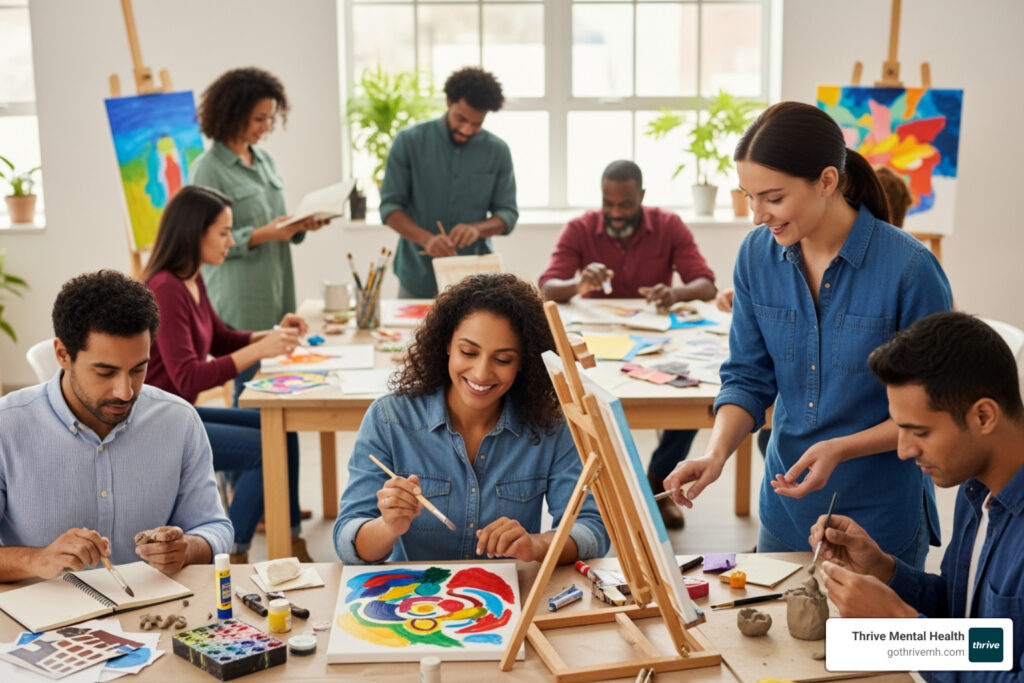
Why Group Art Activities Transform Mental Health Treatment
Art activities for mental health groups offer a powerful, non-verbal way to process emotions, build connection, and heal together. Whether you’re searching for practical exercises to use in therapy sessions or curious about how creative expression supports recovery, here are proven activities that work:
Top Art Activities for Mental Health Groups:
- Collaborative Mural, Build community through shared creation
- Mandala Drawing, Reduce stress and anxiety through focused patterns
- Inside-Outside Bags, Explore public vs. private self
- Clay Sculpting, Ground yourself through tactile expression
- Story Stones, Develop narratives and find your voice
- Mask Making, Uncover hidden emotions and identity
- Gratitude Banner, Shift focus to positive connections
- Collage Creation, Express values through images and words
- Painting to Music, Release emotions through spontaneous art
- Emotions Wheel, Map and communicate complex feelings
When words fail, art speaks. That’s not poetic fluff, it’s backed by decades of clinical research showing that creative expression activates different brain pathways than verbal therapy alone.
For people dealing with trauma, anxiety, or depression, talking about feelings can feel impossible. Art therapy bypasses that barrier. It gives you a way to externalize what’s stuck inside, to make the invisible visible, and to do it alongside others who understand.
In a group setting, the benefits multiply. You’re not just creating, you’re witnessing others create. You’re seeing that you’re not alone in your struggle. You’re building trust through shared vulnerability, not forced conversation.
Art therapy has been shown to reduce cortisol (your stress hormone), improve emotional regulation, and foster genuine connection in ways traditional talk therapy sometimes can’t. And the best part? You don’t need talent. You need willingness.
Whether you’re in an Intensive Outpatient Program (IOP), a Partial Hospitalization Program (PHP), or a community support group, these activities are designed to work in real-world settings, including virtual sessions. They’re accessible, adaptable, and backed by evidence.
I’m Nate Raine, CEO of Thrive Mental Health, and over the past decade I’ve helped build behavioral health programs that integrate evidence-based modalities like art activities for mental health groups into IOP treatment, with a special focus on our communities in Florida. At Thrive, we’ve seen how creative expression accelerates healing when combined with compassionate, outcome-focused care.
Art activities for mental health groups helpful reading:
- exploring mental health through art
- mental health awareness art projects
- mental health art activities for kids
Your First Step to Healing: What is Group Art Therapy?
Art therapy has become an increasingly popular approach for enhancing mental health and emotional well-being, especially within group settings. But what exactly is it, and how does it differ from other creative approaches?
The term “art therapy” was coined by British artist Adrian Hill in 1942, who is considered the founder of the practice. Simply put, art therapy combines the creative process of making art with techniques used in traditional therapy. In a formal environment, a licensed art therapist helps individuals of all ages and backgrounds heal. It’s a vital tool in mental health treatment, providing a unique avenue for expression when words alone may not suffice. By engaging in various artistic activities, participants often develop a deeper understanding of their emotional states and unconscious thoughts.
Expressive arts therapy, on the other hand, involves a multimodal integration of varied elements of the creative arts therapies into psychotherapy and counseling. While creative arts therapies include distinct practices like art therapy, dance therapy, music therapy, drama therapy, and writing therapy, expressive arts therapy integrates multiple forms. Creative arts therapists are typically experts in one specific art form with additional training in that therapy type. Expressive arts therapists are proficient in using expressive arts as an integrative intervention, blending different mediums to facilitate healing.
The core benefits of using art therapy for mental health and emotional well-being are profound and well-documented:
- Reduces Symptoms: Art therapy has been acknowledged for its efficacy in reducing symptoms of anxiety, depression, and trauma-related conditions, complementing traditional therapy methods.
- Fosters Self-Findy: Engaging in artistic activities helps individuals develop a deeper understanding of their emotional states and unconscious thoughts, empowering them on a journey toward self-findy and personal growth.
- Builds Trust and Communication: In a professional setting, mental health therapists use art therapy to build trust, encourage communication, and develop custom treatment plans.
- Improves Resilience: The collaborative process of art-making has the capacity to foster resilience and improve well-being, reflecting its significant role in comprehensive mental health care.
- Lowers Stress Hormones: Research shows that engaging in creative activities can lower levels of cortisol, the hormone that helps the body respond to stress.
- Accessible to All: You don’t need to be an “artist” to benefit. The focus is on the process of creation and self-expression, not the aesthetic outcome, making it accessible to everyone.
At Thrive Mental Health, we integrate these evidence-based art therapy techniques into our virtual Intensive Outpatient (IOP) programs across Florida. These programs are often covered by major insurance plans, including Cigna, Optum, and Aetna, making high-quality care more accessible for Floridians. We’ve seen how powerful these creative outlets can be in helping our clients heal and thrive.
Why Art Opens Up What Words Can’t: The Science of Group Healing
When we engage in art activities for mental health groups, we’re tapping into a deeply human way of understanding and expressing ourselves. Art therapy provides a safe space where non-verbal communication can flourish, building trust and fostering a shared experience among participants. This communal aspect is crucial; a 2021 study highlighted how group craftwork encourages the sharing of ideas and perspectives, strengthening our sense of connection to the community.
For individuals wrestling with anxiety, depression, or trauma, finding the right words can feel like an impossible task. Art bypasses this verbal hurdle, offering a direct conduit to emotions that are often too complex or painful to articulate. As a vital tool in mental health treatment, art provides a unique avenue for expression when words alone may not suffice.
The role of a therapist in these sessions is to create a compassionate and personalized approach. They guide the process, helping to build trust, encourage communication, and develop treatment plans custom to each individual’s needs within the group context. In our Florida-based virtual IOP programs, our expert therapists skillfully integrate art to facilitate profound healing.
What’s the difference between art therapy and an art class?
This is a common question, and the distinction is important. An art class typically focuses on skill-building, teaching techniques, and achieving an aesthetically pleasing final product. The goal is often to improve artistic talent.
Art therapy, conversely, is a therapeutic modality. While art is the medium, the focus is on emotional processing, self-findy, and healing. The “art” itself is a tool for communication and insight, not an end goal. There’s no judgment on artistic skill, and the process of creation is far more valuable than the final piece. A licensed art therapist facilitates these sessions, guiding participants to explore psychological and emotional challenges.
How does art help people who struggle to talk about their feelings?
For many, especially those who have experienced trauma or struggle with conditions like anxiety and depression, verbalizing emotions can be intimidating or even re-traumatizing. Art offers a powerful alternative:
- Symbolic Expression: Art allows us to use symbols, colors, and shapes to represent feelings that might otherwise remain abstract or overwhelming. A dark color might represent sadness, or a jagged line might symbolize anger.
- Metaphor: We can create metaphors through art, a tangled knot of yarn could represent confusion, or a crumbling clay figure might symbolize a sense of brokenness. This allows for indirect expression, which can feel safer.
- Externalizing Emotions: By putting emotions onto paper or into a sculpture, we externalize them. They become something outside of us that we can observe, discuss, and process, rather than something overwhelming inside. This reduces the pressure of direct confrontation.
- Accessing Unconscious Thoughts: The creative process can tap into unconscious thoughts and feelings, bringing them to the surface in a gentle, non-threatening way. This can lead to profound insights without the need for intense verbal interrogation.
Art therapy serves as a bridge, allowing individuals to communicate and process their inner world, even when words are out of reach.
10 Powerful Art Activities for Mental Health Groups [That Actually Work]
Here are some highly effective art activities for mental health groups that we recommend, drawing from proven therapeutic techniques and the collective experience of our therapists. These activities are designed to foster connection, promote self-expression, and support healing.
1. The Collaborative Mural: Building Something Bigger Together
This activity is fantastic for community building and fostering a sense of shared purpose. Engaging in a collaborative mural can foster a sense of community and shared experience, encouraging participants to work together toward a common goal. This promotes communication and empathy while highlighting the strength found in collective effort. It’s a powerful way to see individual contributions come together to create something beautiful and meaningful as a group.
- Materials: A large canvas or roll of paper, various paints (acrylic, tempera), paintbrushes, markers, pencils.
2. Mandala Creation: A Path to Mindfulness and Calm
Mandala drawing has the power to reduce negative emotions in its creators. Creating mandalas can promote relaxation and mindfulness by encouraging focused attention and introspection. Participants draw or color circular designs, serving as a meditative process to reduce stress and anxiety. The repetitive nature of creating patterns within a circle can be incredibly grounding.
- Materials: Paper, compass or circular plates (for outlines), fine-line markers, colored pencils.
3. “Inside-Outside” Bags: Exploring Your Public and Private Self
This activity encourages deep self-reflection and sharing within a safe group environment. Participants decorate a bag or box with images and words on the outside to represent the qualities they show to the world, their public persona. Then, they decorate the inside of the bag or box with images and words that represent their inner, hidden qualities. It’s a visual metaphor for the different parts of ourselves, fostering authenticity and understanding.
- Materials: Paper bags (or small boxes), magazines, newspapers, glue, scissors, markers, colored pencils.
4. Group Clay Sculpting: A hands-on art activity for mental health groups
Working with clay offers a tactile experience that can be both soothing and grounding. This process allows individuals to express feelings through the manipulation of materials, providing insight into their struggles and triumphs. Clay sculpting can become a powerful metaphor for personal growth and development, as participants mold and shape the material to represent emotions, challenges, or even aspects of their identity. The physical act of working with clay can be incredibly therapeutic for releasing tension.
- Materials: Air-dry clay, basic sculpting tools (optional), wet wipes for cleanup.
5. Story Stones: Weaving Narratives, Finding Your Voice
Story stones therapy involves painting or drawing images on smooth stones and then using them to create and tell stories. This activity helps participants explore narratives and themes that are meaningful to them, fostering imagination and communication. In a group, participants can collaborate on a story, each adding a stone, or use their stones to tell personal narratives, which can be particularly helpful for processing experiences in a gentle, metaphorical way.

- Materials: Smooth, flat stones (collected or purchased), acrylic paint pens (or acrylic paints and fine brushes), clear sealant.
6. Mask Making: Uncovering the Faces of Emotion
Mask making offers many possibilities for exploring identity, social roles, and hidden feelings. Participants create a mask that represents different emotions or aspects of their personality. A common tactic is painting how you think others see you on the exterior, while on the interior, you depict how you truly feel or see yourself. This can be a profound way to explore authenticity and self-perception within a supportive group.
- Materials: Plain masks (paper mache or plastic), various paints, feathers, beads, collage materials, glue, glitter.
7. The Gratitude Banner: Focusing on What Lifts You Up
This activity taps into positive psychology, helping groups shift their perspective towards appreciation. Creating a gratitude banner can serve as a daily reminder of the things you’re grateful for. Each group member can contribute by drawing or writing what they appreciate on a section of the banner, fostering a collective sense of positivity and hope. It’s a visual celebration of the good things in life, strengthening group bonds and individual well-being.
- Materials: Large roll of fabric or paper, markers, fabric paints (if using fabric), glue, various decorative elements.
8. “Words to Live By” Collage: A powerful art activity for mental health groups
The “Words to Live By” activity helps individuals visualize their core values, inspirations, and motivations through creative collage. Participants select words, phrases, and images from magazines or newspapers that resonate with their personal beliefs and aspirations. Arranging these elements into a collage helps clarify self-identity and provides a visual reminder of what guides them. Sharing these collages within the group can spark meaningful discussions and foster mutual understanding.
- Materials: Poster board, old magazines, newspapers, picture books, scissors, glue sticks, markers.
9. Painting to Music: Let Sound Guide Your Brush
This expressive art activity encourages emotional release and spontaneity. Painting to music is a fun and expressive art therapy project that allows participants to listen to the rhythm and melody of their favorite songs and create a visual representation of the emotions the music evokes. There are no rules or expectations for the final product, only the freedom to let sound guide the brush, helping individuals let go of control and express themselves intuitively.
- Materials: Paper or small canvases, various paints (tempera, acrylic), paintbrushes, music player with diverse genres.
10. The Emotions Wheel: Mapping Your Inner World
Creating an emotions wheel can be a meaningful way to represent your feelings in a creative manner. This activity helps individuals develop emotional literacy and self-awareness by mapping out their inner world. Participants can color-code different emotions, draw symbols, or write words within sections of a circular diagram to illustrate the complexity of their feelings. Sharing these wheels in a group can improve communication and empathy, as members gain insight into each other’s emotional landscapes.
- Materials: Paper plate or pre-drawn circle on paper, colored pencils, markers.
How to Create a Space That Fosters Healing and Connection
The environment in which art activities for mental health groups take place is just as important as the activities themselves. We strive to create a safe, supportive, and non-judgmental space where everyone feels comfortable to explore and express.
Choosing a quiet, comfortable environment where participants can focus without distractions is key. Natural light, comfortable seating, and perhaps some calming music can improve the therapeutic atmosphere. The goal is to encourage creativity and self-expression, not to intimidate.
Essential Materials for Your Group
Having a good selection of accessible materials is crucial. You don’t need expensive art supplies; often, simple items are the most effective. Here’s a basic list:
- Paper (various sizes and textures)
- Canvas (small, inexpensive options)
- Paints (tempera, acrylic, watercolors)
- Brushes (various sizes)
- Clay (air-dry clay is easy to use)
- Markers (fine-tip, broad-tip, various colors)
- Colored pencils, crayons, pastels
- Magazines, newspapers, old books (for collage)
- Scissors (safety scissors for some groups)
- Glue (sticks, liquid glue)
- Found objects (leaves, twigs, fabric scraps, buttons, encourage participants to bring their own too!)
Adapting Activities for All Abilities
One of the beautiful aspects of art therapy is its adaptability. We can modify activities to suit individuals with different needs or abilities:
- Simplify Steps: Break down complex instructions into smaller, manageable steps.
- Offer Choices: Provide a variety of materials and options for expression, allowing participants to choose what feels most comfortable.
- Focus on Sensory Experience: For some, the tactile sensation of clay or the vibrant colors of paint are more important than the final image.
- Use Adaptive Tools: Larger brushes, specialized grips, or even digital art tools can make activities accessible.
- Provide Verbal Prompts: Gentle questions and prompts can guide participants who may struggle to initiate their creative process.
- Virtual Adaptation: Many of these art activities for mental health groups can be done in virtual settings, which is essential for our virtual IOP programs. Participants can use materials they have at home, and our therapists guide them through the process online, fostering connection even across distances.
Our art therapy programs, like those offered through Thrive Mental Health’s virtual IOP programs in Florida, are designed to be inclusive and effective for all. You can learn more about how we integrate creative approaches into our comprehensive treatment plans by visiting our Art Therapy program page.
Frequently Asked Questions about Art Activities for Mental Health Groups
Do you need to be “good at art” to benefit from art therapy?
Absolutely not! This is one of the biggest misconceptions. The core principle of art therapy is that the process of creating is far more important than the final product. It’s not about artistic skill or talent; it’s about self-expression, exploration, and healing. We use art as a tool to understand ourselves and connect with others, not as a medium for critique.
What’s the difference between expressive arts therapy and art therapy?
While closely related, there’s a key distinction. Art therapy typically focuses on visual art mediums like drawing, painting, and sculpting. Expressive arts therapy, on the other hand, is a broader, multimodal approach that integrates various creative arts therapies, including visual art, dance/movement, music, drama, and writing. Both aim for therapeutic goals, but expressive arts therapy offers a wider palette of creative modalities.
Can these art activities be done in a virtual group?
Yes, absolutely! Many of these art activities for mental health groups are highly adaptable for virtual settings. Activities like drawing, painting, collage, and even some forms of creative writing can be seamlessly integrated into virtual IOP/PHP sessions. Participants can use readily available materials at home, and our experienced therapists can guide the process effectively through online platforms, fostering connection and healing regardless of physical location. This flexibility is a cornerstone of Thrive Mental Health’s accessible virtual programs, available to residents throughout Florida.
Ready for Support? Find Your Connection Through Creative Expression.
Art therapy is a powerful tool for healing, especially within a supportive group. It provides a unique path to understanding yourself and connecting with others when words fall short. In our Florida-based programs, Thrive Mental Health integrates these evidence-based methods to help you build resilience and find your voice.
Ready for support? Thrive offers virtual IOP programs with evening options. Verify your insurance in 2 minutes (no obligation) → Start benefits check or call 561-203-6085. If you’re in crisis, call/text 988.

This article is for informational purposes only and is not a substitute for individualized clinical advice or insurance verification.