
ADHD & CBT: A Powerful Partnership for Better Living

ADHD & CBT: Sick of Distraction Wrecking Your Life? Here’s the Fastest Way Out
Cognitive behavioral therapy for ADHD is a proven, skills-based treatment that helps you break the cycle of distraction, procrastination, and emotional chaos-fast.
Here’s what you need to know:
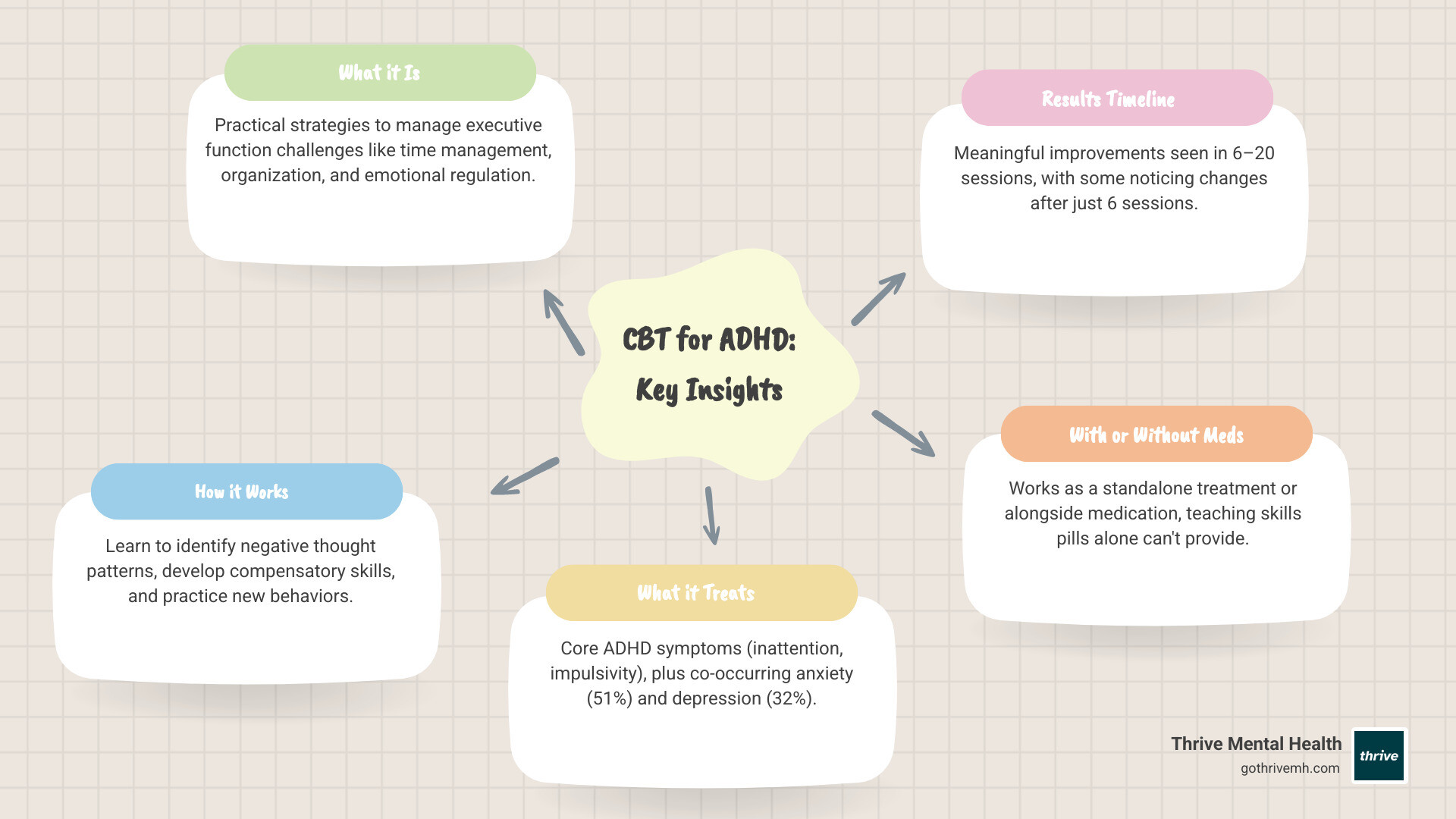
- What it is: CBT for ADHD teaches practical strategies to manage executive function challenges like time management, organization, and emotional regulation
- How it works: You learn to identify negative thought patterns, develop compensatory skills, and practice new behaviors through structured sessions and homework
- What it treats: Core ADHD symptoms (inattention, impulsivity), plus common co-occurring conditions like anxiety (51% of adults with ADHD) and depression (32%)
- Results timeline: Most people see meaningful improvements in 6-20 sessions, with some noticing changes after just 6 sessions
- With or without meds: CBT works as a standalone treatment or alongside medication-it teaches skills that pills alone can’t provide
You’re stuck in a loop: missed deadlines, forgotten appointments, emotional blowups, endless frustration. You know you’re smart and capable, but ADHD keeps sabotaging your success. Traditional therapy feels too slow. Medication helps with focus but doesn’t teach you how to organize your life or manage the shame spiral when you mess up again.
CBT for ADHD is different. It’s action-focused, not just talk. You learn specific techniques-like breaking tasks into manageable steps, using “distractibility delay” to handle interruptions, and reframing the harsh inner voice that says “I’m failing at everything.” These aren’t vague self-help tips. They’re evidence-based strategies that target the specific executive function deficits that make ADHD so exhausting.
Research backs this up. A 2023 review found that CBT improved core ADHD symptoms, reduced emotional difficulties, and increased self-esteem and quality of life. A 2024 study showed that even a short, 6-session CBT program led to meaningful improvements in ADHD symptoms, anxiety, and depression. And here’s the best part: improvements from CBT often last long after therapy ends.
As Nate Raine, CEO of Thrive Mental Health, I’ve seen how cognitive behavioral therapy for ADHD transforms lives by giving people the tools to manage symptoms and build lasting, healthy habits. At Thrive, we integrate CBT into our IOP and PHP programs, helping adults across Florida finally break free from the ADHD chaos through expert-led virtual care and trusted in-person centers.
Explore more about cognitive behavioral therapy for adhd:
- how cognitive behavioral therapy works
- cognitive behavioral therapy for general anxiety disorder
- cbt worksheets
- virtual therapy and IOP for ADHD
What Is Cognitive Behavioral Therapy for ADHD? [And Why It Works When Nothing Else Does]
Cognitive behavioral therapy (CBT) is a structured type of talk therapy that actually changes how your brain responds to stress, distraction, and self-criticism. It is not endless talking about your past; it is a results-driven method where you and a mental health professional target the patterns that are wrecking your day right now.
The journey of CBT began by melding cognitive therapy, pioneered by figures like Aaron Beck and Albert Ellis in the 1960s, with behavior therapy from researchers like B.F. Skinner and Joseph Volpe. Beck emphasized identifying and challenging distorted thoughts, while Ellis focused on irrational beliefs that lead to emotional distress. This powerful combination forms the foundation of modern CBT.
For adults with ADHD, this approach isn’t just generic therapy-it’s a targeted intervention. While medication effectively controls core ADHD symptoms like distractibility and impulsivity, it doesn’t teach the vital life skills needed to truly thrive. That’s where cognitive behavioral therapy for ADHD steps in. It’s specifically adapted to help adults develop skills for executive self-management, emotional regulation, and interpersonal relationships.
Learn more about Thrive’s Virtual Therapy for ADHD
Research consistently supports CBT’s effectiveness for ADHD. A comprehensive 2023 review highlighted that both individual and group CBT significantly improved core ADHD symptoms, reduced emotional difficulties, and boosted self-esteem and overall quality of life. These improvements often last long after therapy ends.
Research: CBT’s proven results for ADHD
The Core Truth: Your Thoughts Aren’t Facts-And You Can Change Them
At the heart of CBT lies a profound truth: your thoughts shape your feelings and actions. For individuals with ADHD, this connection can often be a source of significant distress. Many people fall prey to “automatic negative thoughts” and “cognitive distortions” that aren’t based in reality but feel incredibly real.
Imagine this: you miss a deadline, and your mind immediately jumps to “I’m a failure, I can’t do anything right.” This is an automatic negative thought. If left unchallenged, it can spiral into cognitive distortions like “all-or-nothing thinking” or “catastrophizing.” These distortions fuel negative emotions like shame, anxiety, or depression, leading to counterproductive behaviors like avoidance or further procrastination.
This cycle is particularly challenging for individuals with ADHD, who often experience emotional dysregulation and rejection sensitivity, where perceived criticism can feel devastating.
In cognitive behavioral therapy for ADHD, you work with your therapist to untangle this web. Structured techniques like thought logs help you spot these negative automatic thoughts in real time. Through guided discussion and home exercises, you learn to challenge these irrational beliefs and replace them with more balanced, realistic thinking.
How CBT for ADHD Is Different (and Better)
Unlike traditional psychoanalytic therapy, which might explore past childhood experiences for years, CBT for ADHD is remarkably action-focused and present-oriented:
- Action-Focused, Not Just Talk: You and your therapist set clear, measurable goals and work on practical steps to achieve them.
- Skill-Building Every Session: Each session equips you with concrete skills for managing ADHD symptoms.
- Short-Term, Measurable Results: CBT typically ranges from 6 to 20 sessions with meaningful improvements in a relatively short period.
- Structured, Practical Approach: Sessions follow a clear agenda, focusing on real-world solutions you can immediately apply.
- Targets Planning, Organization, and Emotional Control: Specifically addresses core executive function deficits like time management and impulse control.
- Handles Anxiety and Depression Too: 51% of adults with ADHD suffer from co-morbid anxiety and 32% from co-morbid depression. CBT effectively treats these conditions, often indirectly improving ADHD management.
This comprehensive approach empowers you to build a life of greater control and accomplishment-whether you are in Tampa, Jacksonville, Miami, Orlando, or joining virtually from anywhere in Florida.
ADHD Life Hacks: CBT Strategies That Actually Work (Even If You’ve Tried Everything)
Living with ADHD means facing unique challenges: the constant battle against procrastination, the struggle with distractibility, the frustration of “time blindness,” and the intensity of emotional storms. But with cognitive behavioral therapy for ADHD, you can use targeted, evidence-based strategies to finally get traction instead of spinning your wheels.

Stop Procrastination and Overwhelm-Today
Procrastination and feeling overwhelmed are hallmarks of ADHD. CBT offers concrete strategies to break free:
- Break Tasks Down (Chunking): Large tasks trigger task paralysis. CBT teaches you to “chunk” them into smaller steps. Instead of “Clean the whole house,” aim for “Empty the trash,” then “Run the dishwasher.”
- The 5-Minute Rule: Commit to working on a dreaded task for just five minutes. Often, momentum carries you forward.
- Time-Blocking: Schedule specific blocks of time for certain tasks. For those with “time blindness,” this provides visual structure.
- Prioritization Matrix: Categorize tasks by urgency and importance to focus energy on what truly matters.
- Problem-Solving Steps: When overwhelmed, articulate the problem clearly, brainstorm solutions, rate them, and pick the best one.
5 ADHD-Friendly Organization Hacks:
- “One Home” for Everything: Assign a specific place for keys, wallet, phone, glasses.
- Visual Reminders: Use clear containers and open shelving so you can see what you have.
- “Launchpad” Station: Create a dedicated area near your exit for daily items.
- Digital Declutter: Regularly clear desktop icons and organize files.
- The “Done for Now” Box: Use a designated box for ongoing projects to prevent clutter.
Master Focus and Crush Distraction
Distractibility is a core ADHD challenge, but CBT helps you build strategies to protect your focus:
- Mindfulness for ADHD: Notice your thoughts without judgment. Focus on your breath to ground yourself and redirect attention.
- Control Your Environment: Create distraction-free workspaces by minimizing clutter and using visual cues.
- Silence Notifications: Turn off unnecessary alerts and create dedicated “focus times.”
- Self-Monitoring: Use time tracking logs and check-ins to identify distraction patterns.
- Distractibility Delay: Jot down distracting thoughts to address after completing your current task.
For additional practical ideas, explore this guide on how to manage adult ADHD symptoms.
Regulate Emotions Before They Hijack Your Day
Emotional dysregulation can be one of the most painful aspects of ADHD. Cognitive behavioral therapy for ADHD provides tools to steer these internal storms:
- Spot Emotional Triggers: Identify specific situations that provoke strong emotional responses.
- Distress Tolerance Skills: Use techniques like radical acceptance or self-soothing to ride out emotional waves.
- Reframe Rejection: Challenge automatic negative thoughts associated with rejection sensitive dysphoria.
- Manage Frustration: Use CBT problem-solving skills instead of getting stuck in anger loops.
- Tackle Anxiety and Depression: Given high comorbidity rates (51% anxiety, 32% depression), CBT addresses these conditions simultaneously.
If symptoms are severe, Thrive’s structured IOP and PHP use CBT-based groups and individual sessions to help adults in Florida make faster progress.
CBT vs. Other ADHD Support: What’s the Fastest Path to Results?
When it comes to managing ADHD, you’ll encounter various approaches. While each has its place, cognitive behavioral therapy for ADHD offers a uniquely powerful path to lasting change. It’s not just about symptom management; it’s about equipping you with skills that medication or general coaching cannot provide on their own.

At Thrive Mental Health, we understand that effective treatment for ADHD often requires a multi-faceted approach. That’s why our Intensive Outpatient (IOP) and Partial Hospitalization (PHP) programs integrate CBT with comprehensive psychosocial support and skills training, recognizing that a holistic approach leads to the most measurable results. We focus on therapy and skills, not just pills, because we know true change comes from building new habits, not just managing symptoms.
ADHD Support Options Compared
| Support Type | Focus | Who Benefits Most | How It Works | Typical Duration |
|---|---|---|---|---|
| CBT Therapy | Skills, emotions, thought patterns | Adults, teens, kids with ADHD and/or comorbidities | Weekly sessions, structured exercises, homework | 6-20 sessions |
| Skills Training | Organization, focus, time management, executive functions | Motivated adults/teens seeking practical tools | 1:1 or group sessions, hands-on practice | Varies, often short-term modules |
| Medication | Core ADHD symptoms (inattention, impulsivity, hyperactivity) | Individuals needing quick symptom reduction | Daily prescription, monitored by physician | Ongoing |
| ADHD Coaching | Goal-setting, accountability, practical routines | Individuals seeking structure and support for specific goals | Regular check-ins, action planning | Varies, often short-to-medium term |
| Psychosocial Support | Community, empathy, shared experience, general coping | All ages, especially those feeling isolated | Group therapy, peer support, educational workshops | Ongoing |
Why CBT + Therapy Wins Long-Term
Cognitive behavioral therapy for ADHD isn’t a quick fix; it’s an investment in yourself that yields enduring returns. Here’s why it’s often the fastest path to sustainable results:
- Builds Life Skills for Lasting Results: Unlike medication, which manages symptoms while it’s active, CBT teaches you practical, transferable skills that you can use for the rest of your life. These skills become ingrained habits, offering sustained improvement long after therapy concludes.
- Reduces Anxiety and Depression: ADHD frequently co-occurs with anxiety and depression. CBT is a highly effective treatment for these conditions. By addressing the cognitive and behavioral patterns contributing to anxiety and depression, CBT helps alleviate the emotional burden that often aggravates ADHD symptoms.
- Measurable Impact: A 2024 study on combined treatment highlights the power of integrated approaches. It found that a combined treatment strategy, which often includes CBT, leads to superior outcomes in managing ADHD symptoms and related emotional distress.
- Fits Into Real Life: Thrive’s CBT-based IOP and PHP are designed for adults and young professionals who need more than a weekly session but less than inpatient care. Virtual options let you join from anywhere in Florida, and many clients use in-network benefits with plans like Cigna, Optum, and Florida Blue.
When you learn to identify and challenge unhelpful thought patterns and adopt effective behavioral strategies through CBT, you’re not just coping-you’re actively reshaping your brain and building resilience. To see how this fits into a higher level of care, explore our IOP and PHP services.
What Happens in a CBT Session for ADHD? [And How to Get Results Fast]
Starting cognitive behavioral therapy for ADHD means starting on a structured, collaborative journey designed for real-world impact. The approach at Thrive Mental Health is rooted in a partnership between you and your therapist, focused on clear goals and measurable progress you can actually feel in your schedule, your relationships, and your mood.
During your CBT sessions, you can expect to:
- Collaborate with Your Therapist: This is a team effort. Your therapist is an expert guide, but you are the expert on your own experience. Together, you’ll identify challenges, set goals, and choose strategies.
- Engage in Structured Sessions: Each session typically lasts 45 minutes to an hour and follows a clear agenda. This structure helps maintain focus, which is particularly beneficial for individuals with ADHD. You might start by reviewing homework, discussing a specific challenge, learning a new technique, and then planning for practice.
- Receive Homework for Real-World Change: The real work of CBT happens between sessions. You’ll be given “homework” assignments-practical exercises to apply the skills you learn in your daily life. This consistent practice is crucial for turning new strategies into ingrained habits.
- Track Measurable Progress: You and your therapist regularly check in on your progress toward your goals, celebrate your wins, and adjust strategies as needed so the work stays relevant and effective.
At Thrive Mental Health, we integrate these CBT principles into our comprehensive programs. We offer Virtual IOP (Intensive Outpatient) and in-person PHP (Partial Hospitalization) options, designed for adults and young professionals who need more than once-a-week therapy but less than inpatient care. We accept various insurance plans, including Cigna, Optum, and Florida Blue, across our Florida locations, making evidence-based treatment accessible whether you are in Miami, Jacksonville, Orlando, or joining fully online from anywhere in the state.
Thrive IOP/PHP Programs
Your First Session: What to Expect
Your initial session, or intake, is a crucial step in tailoring your CBT experience. Here’s what you can typically expect:
- Comprehensive Assessment: Your clinician will conduct a thorough assessment to understand your unique ADHD symptoms, their impact on your life, and any co-occurring conditions like anxiety or depression.
- Pinpointing Your Biggest Pain Points: You work together to identify the specific challenges you want to address-whether it’s chronic procrastination, emotional outbursts, disorganization, or negative self-talk.
- Setting SMART Goals: You and your therapist establish Specific, Measurable, Achievable, Relevant, and Time-bound (SMART) goals for your therapy. This ensures clarity and a roadmap for your progress.
- Building Trust: This first meeting is also an opportunity to build rapport with your therapist. A strong, trusting relationship is foundational to effective therapy.
- Typical Program Duration: While some individuals may see meaningful improvements in as few as 6 sessions, many find significant, lasting change occurs over a program of 12 to 20 sessions. In IOP and PHP, you get more contact hours per week, which can speed up skill-building and habit change.
How to Get the Most from CBT for ADHD
To truly harness the power of cognitive behavioral therapy for ADHD, your active engagement is key:
- Show Up, Speak Up, Do the Homework: Consistency is paramount. Attend all your sessions, be open and honest about your struggles and successes, and commit to completing your homework assignments. The practice between sessions is where real change happens.
- Try New Strategies: CBT for ADHD will introduce you to new ways of thinking and behaving. Be willing to experiment, even if they feel awkward or unnatural at first.
- Find the Right Therapist and Level of Care: Look for a therapist who specializes in ADHD and has extensive experience with CBT. If weekly therapy is not enough, consider structured support like Thrive’s IOP or PHP to accelerate progress.
- Know the Limits-CBT Isn’t Magic, But It Works If You Work It: CBT is highly effective, but it requires effort and dedication. It’s a powerful tool, but like any tool, its effectiveness depends on how you use it.
You can also quickly see what your insurance covers by using Thrive’s online verify insurance form, which typically takes about two minutes and does not obligate you to enroll.
FAQs: Cognitive Behavioral Therapy for ADHD [2024]
Does CBT really work for ADHD?
Yes. Extensive research, including a 2023 review and recent 2024 studies, consistently shows that CBT is effective for adults with ADHD. It helps improve core symptoms like inattention and impulsivity, strengthens organizational skills, and significantly boosts emotional regulation and self-esteem. Often, these improvements last long after therapy ends.
Can CBT replace ADHD medication?
CBT teaches essential life skills that medication alone cannot provide, such as organizational strategies, emotional regulation, and cognitive restructuring. While some individuals find CBT effective as a standalone treatment, many experience the best results when combining CBT with medication. This integrated approach addresses both the neurological and behavioral aspects of ADHD.
How long does CBT take for ADHD?
While some individuals may begin to see improvements in just a few sessions, many clients at Thrive Mental Health experience significant, lasting changes within 6 to 20 sessions. In higher levels of care like IOP and PHP, you are practicing CBT skills several days per week, which can speed up progress.
Is virtual CBT for ADHD effective?
Yes. Virtual CBT for ADHD is proven to be highly effective. Studies, including a 2024 investigation into a CBT-based mobile app, have shown significant improvements in ADHD symptoms and daily functioning through digital and online interventions. This format offers flexibility and accessibility, making it an excellent option for individuals in Florida who may struggle with in-person appointments.
Does insurance cover CBT for ADHD at Thrive?
Many Thrive clients use in-network or out-of-network benefits through plans like Cigna, Optum, Florida Blue, and other major insurers to help pay for CBT-based IOP and PHP. Coverage varies by plan, so the fastest way to check is to use our online verify insurance tool.
Summary: Why Cognitive Behavioral Therapy for ADHD Is Your Fastest Path to Real Change
If you’re tired of ADHD dictating your life, cognitive behavioral therapy for ADHD offers a powerful, practical way out. It is a proven, time-efficient approach that goes beyond symptom management to equip you with lasting life skills: task initiation, time management, emotional regulation, and more.
At Thrive Mental Health, we integrate these evidence-based CBT strategies into our virtual and in-person IOP and PHP programs, helping adults across Florida build a future where they can thrive, not just survive. Whether you are in Miami, Orlando, Tampa Bay, Jacksonville, or elsewhere in the state, our expert-led virtual care and trusted in-person centers make high-quality support accessible.
Ready for support? Thrive offers virtual and hybrid IOP/PHP programs with evening options. Verify your insurance in 2 minutes (no obligation) → Start benefits check or call 561-203-6085. If you’re in crisis, call/text 988.