






When Your Teens Struggles Take Over the Whole Family
Family Therapy for Teens: 5 Proven Benefits, What It Treats, and How to Start This Week
Family therapy for teens is a specialized form of counseling that brings parents, siblings, and the adolescent together to improve communication, resolve conflicts, and strengthen relationships. Unlike individual therapy, which focuses solely on the teen, family therapy treats the family as a system, addressing patterns that affect everyone’s well-being.
Quick Answer: What is Family Therapy for Teens?
| What It Is | How It Helps | Who Attends |
|---|---|---|
| Counseling that involves the whole family | Improves communication, reduces conflict, supports teen mental health | Teen, parents, siblings (sometimes) |
| Focuses on family patterns, not blame | Builds empathy, sets healthy boundaries, addresses root causes | Typically weekly, 820 sessions |
| Evidence-based approaches (Structural, Strategic, DBT-informed) | Treats anxiety, depression, defiance, substance use | Led by licensed family therapist (LMFT, LCSW, etc.) |
If you’re a parent watching your teenager pull away, shut down, or spiral into anxiety or defiance, you know this truth: when your teen struggles, the whole family feels it. Constant tension, slammed doors, and walking on eggshells can become the new normal.
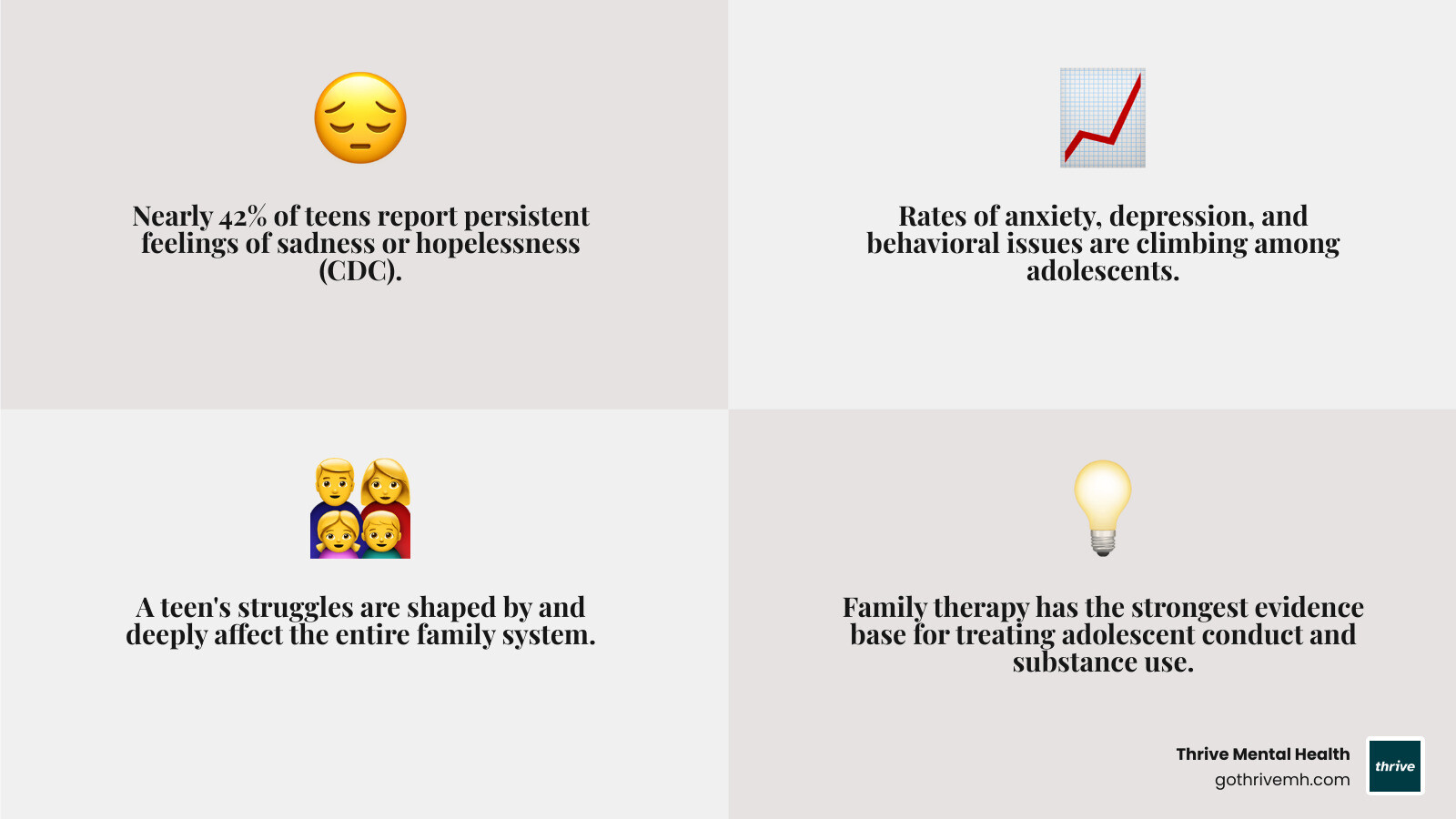
You’re not alone. According to the CDC, nearly half of teens (42%) report persistent feelings of sadness or hopelessness. But your teen’s struggles aren’t happening in a vacuum; they’re shaped byand deeply affectthe family system.
That’s where family therapy comes in. It doesn’t assign blame. Instead, it helps everyone understand how their actions impact each other in a safe, neutral space. Research shows that family therapy has the strongest evidence base for treating many adolescent behavioral issues, producing larger effect sizes than individual or group treatments. When families work together, teens thrive.
“I’ve seen how powerful it is when families stop fighting against each other and start healing together. Family therapy provides the tools to make that happen.” Anna Green, LMHC, LPC, Chief Clinical Officer at Thrive Mental Health
If youre in crisis, call/text 988 right now. You are not alone.
What Is Family Therapy for Teens? How It’s Different from Individual Counseling
When a teen is struggling, their anxiety or defiance is woven into the fabric of your family’s daily interactions and unspoken rules. Family therapy for teens treats the family as a single system, not just the teen as “the problem.”
Based on family systems theory, this approach recognizes that an individual’s struggles can’t be resolved without looking at the whole family dynamic. Unlike individual therapy’s private, one-on-one sessions, family therapy brings everyone to the table to understand how you can all work together to create lasting change.
Family Therapy vs. Individual Teen Therapy
| Aspect | Family Therapy | Individual Teen Therapy |
|---|---|---|
| Who’s involved | Teen, parents, sometimes siblings | Teen and therapist only |
| Focus | Family patterns, communication, relationships | Teen’s personal thoughts, feelings, behaviors |
| Goals | Improve family dynamics, reduce conflict, build support system | Help teen develop coping skills, process emotions, build resilience |
| Best for | Systemic issues, family conflict, behavioral problems | Personal struggles, trauma, identity issues, severe anxiety |
| Outcomes | Stronger family bonds, healthier communication, collaborative problem-solving | Individual growth, emotional regulation, self-awareness |
Why Family Therapy Works for Teen Issues
Family therapy is effective because it gets to the root of recurring conflicts. Your family has unspoken rules and roles, perhaps one parent is the “bad cop,” or your teen has learned that shutting down is safer than speaking up. A family therapist creates a neutral, safe space to uncover these hidden dynamics and interrupt negative cycles.
Research confirms this approach. Manualized family therapy models consistently produce the largest effect sizes in treating adolescent behavioral problems, outperforming individual and group treatments in meta-analyses. When families work together, real change happens for everyone.
When to Choose Family vs. Individual Therapy
Deciding between family and individual therapy depends on your situation.
Family therapy makes the most sense when issues affect everyone. If your home feels like a war zone, communication has broken down, or your teen’s defiance is tearing the family apart, a family-wide approach is best. It’s also ideal for navigating major life transitions like divorce or a family loss.
Individual therapy might be a better starting point for deeply personal struggles like trauma, intense anxiety, or identity questions. Some teens need a private space before they’re ready to talk with family. If your teen is strongly resistant, individual sessions can build trust that opens the door to family work later.
Often, a combination approach is most effective. Teens can process personal issues individually while working on family dynamics together. Our personalized therapy for teens at Thrive helps determine the right mix for your family’s unique needs.
5 Big Benefits of Family Therapy for Teens

When families commit to the process, they don’t just address a teen’s anxiety or defiance; they rebuild the foundation of how they relate to each other. This creates lasting change that supports everyone’s well-being.
The key benefits include:
- Stronger relationships: Trust is rebuilt and connections deepen as you learn to navigate stressful situations together.
- Less conflict and drama: Healthier communication patterns replace the same old fights, lifting the constant tension.
- More support for your teen: When a teen feels seen and heard, not judged, their mental well-being improves dramatically.
- Increased empathy and understanding: Hearing each other’s perspectives in a safe space shifts the dynamic from “me vs. you” to “us.”
- A healthier, calmer home: The environment becomes more stable, predictable, and nurturing for everyone.
How Family Therapy Rebuilds Communication & Solves Conflict
Poor communication is at the heart of most family struggles. In therapy, you’ll learn practical strategies to transform interactions:
- Active Listening: Therapists teach techniques like paraphrasing (“So what I’m hearing is…”) to ensure everyone feels understood.
- Expressing Needs Calmly: Using “I” statements (“I feel hurt when…”) instead of accusations (“You never…”) reduces defensiveness.
- De-escalation and Boundaries: You’ll learn to identify triggers and take breaks before arguments spiral, sometimes using a family “timeout” signal.
- Breaking Negative Cycles: A therapist helps you see and change repetitive, unhelpful patterns, like every conversation about grades turning into a shouting match.
- Negotiating New Rules: Therapy provides a neutral space to collaboratively agree on updated rules for independence, responsibilities, and privileges.
Boosting Your Teen’s Self-Esteem and Resilience
Family therapy helps teens develop a stronger sense of self. Validating your teen’s experience, acknowledging their feelings with statements like “That sounds really tough”, is fundamental. It teaches them their emotions aren’t wrong.
As teens learn to express themselves and contribute to family solutions, their confidence and sense of belonging grow. They also learn healthy coping skills, often from approaches like Dialectical Behavior Therapy (DBT), in a supportive family context. At Thrive, we also offer specialized resilience training for teens to further build these essential skills.
Tackling Defiance, Substance Use, and Anxiety, Together
Family therapy is highly effective for complex issues like defiance, substance use, and mental health conditions.
- Evidence-Based Results: Family therapy has the strongest research support for treating adolescent conduct and substance use problems.
- Addressing Root Causes: Instead of just reacting to defiance, therapy helps uncover why a teen is acting out, perhaps due to anxiety or a need for autonomy.
- Supportive Recovery Environment: For substance use, family therapy is critical. It teaches family members how to set firm boundaries while showing love, which dramatically improves the chances of long-term recovery.
- Managing Stress: Family therapy provides tools for the family to collectively support a teen struggling with academic, social, or emotional pressures.
Our Adolescent Intensive Outpatient Program (IOP) integrates family therapy to provide this comprehensive support, because we know real healing happens when the whole family grows together.
How Does Family Therapy for Teens Actually Work?

Family therapy is a collaborative process, not a courtroom drama. Most families attend weekly 60-minute sessions. Sometimes it’s just the teen and parents; other times, siblings or other caregivers join. The therapist helps determine who should attend to make the most progress.
In early sessions, you’ll set goals. The therapist might ask a “miracle question”: “If a miracle happened and your problems were solved, what would be different tomorrow?” This helps clarify what you hope to change, like having a peaceful dinner or feeling less on edge.
The therapist ensures everyone gets a voice without interruption. They’ll point out patterns you might not see, like how one person’s comment causes another to shut down. You’ll also get practical “homework”, like trying a new way to ask about each other’s day, to build new habits between sessions. At Thrive Mental Health, we integrate evidence-based models into our programs for teens to ensure your family receives interventions that are proven to work.
Core Techniques in Family Therapy for Teens
Therapists blend several powerful approaches based on your family’s needs:
- Structural Family Therapy: Focuses on family organization, rules, roles, and boundaries, to create stability.
- Strategic Family Therapy: A problem-solving approach that uses targeted strategies to fix specific issues, like battles over screen time.
- Internal Family Systems (IFS): Helps family members understand and heal their inner “parts” (e.g., an angry part, a scared part), which improves how they relate to each other.
Therapists also use tools like reframing (seeing a situation differently, like reframing “laziness” as overwhelm) and circular questioning (exploring patterns without blame, e.g., “When X happens, what does Y do?”). Effective models all share a focus on changing interactions, reframing problems relationally, engaging the adolescent, and emphasizing the family system.
The Role of Parents and Siblings
Family therapy isn’t just about fixing your teen, it’s about everyone growing together. Your active participation is crucial.
- Be Open to Change: Recognize that parenting strategies that worked for a younger child may need to evolve.
- Model Healthy Behavior: When your teen sees you listen without interrupting or admit when you’re wrong, they learn valuable skills.
- Heal Your Own Patterns: A therapist can help you see how your own upbringing influences your parenting, allowing you to respond more intentionally.
- Support Your Teen Outside Sessions: Practice the communication techniques you learn and create space for your teen to talk without judgment.
Siblings also play a key role, offering unique insights and needing support as family dynamics shift.
 What to Expect at a Virtual IOP in IndianaIntensive Outpatient Program
Overcoming Common Barriers
Getting to therapy isn’t always easy. Here’s how to handle common obstacles:
- Teen Resistance: This is normal. A skilled therapist will work to validate your teen’s feelings and build trust. Starting with parent-only sessions can also help.
- Scheduling Conflicts: Juggling schedules is tough. Thrive offers flexible scheduling, including evening and virtual therapy options, to make it easier. Our Virtual IOP program is a convenient option.
- Stigma and Privacy: Therapists will clearly explain confidentiality from the start. What happens in therapy stays in therapy, with specific legal exceptions for safety.
- Financial Concerns: Many insurance plans cover family therapy. At Thrive, we accept providers like Cigna, Optum, and Florida Blue and make it easy to verify your coverage online.
- Finding the Right Therapist: Look for a licensed professional (LMFT, LCSW) with experience in teen and family issues. The personal fit is just as important as credentials.
How to Find the Right Family Therapist for Your Teen

Finding the right therapist is crucial, as the relationship itself is a key part of healing. Heres what to focus on:
- Credentials and Experience: Look for a Licensed Marriage and Family Therapist (LMFT), Licensed Clinical Social Worker (LCSW), or similar professional with specific experience working with teens and families.
- Therapeutic Fit: During an initial consultation, ask yourself: Does the therapist create a safe, non-judgmental space? Does my teen seem willing to engage? Trust your gut.
- Insurance Coverage: Therapy is an investment. Many plansincluding Cigna, Optum, Florida Blue, Aetna, and otherscover family therapy for teens. Verify your insurance with Thrive to understand your benefits and avoid surprise bills (check eligibility here: https://gothrivemh.com/verify-insurance/).
Signs Your Family Needs Support
You don’t have to wait for a full-blown crisis. If you recognize these signs, support could help:
- Constant arguing where every conversation escalates.
- Teen withdrawal or isolation from family and friends.
- Big changes in mood or behavior, like persistent sadness, irritability, or angry outbursts.
- A sudden drop in grades or loss of interest in school.
- Escalating defiance and rule-breaking, such as lying or sneaking out.
- Any signs of substance use.
- A major life event like divorce, death, or a significant move.
What to Look for in Florida
If your family is in Florida, keep these points in mind:
- State Licensure: Ensure the therapist is licensed to practice in Florida for both in-person and virtual sessions.
- Specialization: Find a therapist whose practice centers on adolescent mental health and family systems.
- Cultural Competence: A therapist who understands and respects your family’s cultural background is essential for effective care.
- Flexibility: Thrive Mental Health offers both virtual and in-person options across Florida to fit your family’s schedule and comfort level.
- Insurance: Verify that the provider accepts your plan. Thrive Mental Health serves families throughout Florida and accepts many local insurance plans, including Florida Blue.
How to Prepare for Your First Family Therapy Session
A little preparation can ease everyone’s nerves and make the first session more productive.
- Talk to your teen beforehand. Frame it as a team effort (“We’re going to work on making things better at home”) rather than blame (“You need therapy”).
- Set realistic expectations. Change is a process, not a quick fix. There will be breakthroughs and setbacks.
- Write down your concerns and goals. Encourage each family member to do this. Your teen’s priorities might surprise you.
- Commit to being open and honest. Vulnerability is where healing begins. Your therapist is there to help, not to judge.
Frequently Asked Questions about Family Therapy for Teens
It’s normal to have questions about family therapy for teens. Here are concise answers to the most common ones.
How long does family therapy for teens take?
It depends on your family’s goals. Most families attend for 8 to 20 sessions, but the duration is customized. Many report feeling more connected after just a few sessions, even as the deeper work continues.
What if my teen refuses to go to family therapy?
This is a common concern. A good first step is to start with parent-only sessions. This allows you to gain tools and start making changes, which can make your teen more open to joining. Validate their feelings (“I hear you don’t want to go…”) but remain firm that the family needs support. A skilled therapist can also help with engagement.
Is family therapy for teens confidential?
Generally, yes. However, therapists are legally and ethically required to break confidentiality if there is a risk of harm. Safety always comes first. This includes threats of harm to self or others, or reports of abuse. These limits will be explained clearly in your first session.
Does insurance cover family therapy for teens?
Yes, many insurance plans cover family therapy for teens, including major providers like Cigna, Optum, Florida Blue, and Aetna. It’s always best to verify your specific benefits beforehand. At Thrive, you can verify your insurance in a few minutes with no obligation: https://gothrivemh.com/verify-insurance/.
Can we do family therapy virtually?
Absolutely. Virtual family therapy is an effective and convenient option for busy families. Thrive Mental Health offers virtual and hybrid options for Florida families, allowing you to access expert care from home. Our Virtual IOP program integrates family therapy as a core component of treatment.
Suggested JSON-LD FAQ schema markup:
<script type="application/ld+json">
{
  "@context": "https://schema.org",
  "@type": "FAQPage",
  "mainEntity": [
    {
      "@type": "Question",
      "name": "How long does family therapy for teens take?",
      "acceptedAnswer": {
        "@type": "Answer",
        "text": "Most families attend for 8 to 20 sessions, customized to goals. Many feel more connected after a few sessions, while deeper work continues."
      }
    },
    {
      "@type": "Question",
      "name": "What if my teen refuses to go to family therapy?",
      "acceptedAnswer": {
        "@type": "Answer",
        "text": "Start with parent-only sessions, validate their feelings, and stay consistent about needing support. A skilled therapist can help engage resistant teens."
      }
    },
    {
      "@type": "Question",
      "name": "Is family therapy for teens confidential?",
      "acceptedAnswer": {
        "@type": "Answer",
        "text": "Generally yes, with legal exceptions for safety (risk of harm to self/others or abuse). Therapists explain these limits in the first session."
      }
    },
    {
      "@type": "Question",
      "name": "Does insurance cover family therapy for teens?",
      "acceptedAnswer": {
        "@type": "Answer",
        "text": "Many plans cover family therapy for teens, including Cigna, Optum, Florida Blue, and Aetna. Verify your benefits with Thrive at https://gothrivemh.com/verify-insurance/."
      }
    },
    {
      "@type": "Question",
      "name": "Can we do family therapy virtually?",
      "acceptedAnswer": {
        "@type": "Answer",
        "text": "Yes. Thrive offers virtual and hybrid options for Florida families. Our Virtual IOP integrates family therapy."
      }
    }
  ]
}
</script>
Your Family Can HealAnd Thrive
Watching your teen struggle is one of the most painful experiences a parent can face. The constant worry and conflict are exhausting. But you don’t have to steer this alone.
Family therapy for teens is an investment in your teen’s future and the well-being of your entire family. It’s a process where trust gets rebuilt, fighting gives way to conversation, and your home becomes a place of peace again.
I’ve seen countless families who felt completely stuck find their way back to each other. Week by week, parents learn to listen differently, teens feel heard, and the whole family system begins to heal. On the other side of this hard work is a family that knows how to support each other and face challenges as a team.
At Thrive Mental Health, our expert team offers evidence-based, flexible care for families in Florida, with virtual and evening options to fit your life. We believe deeply in the power of families to heal and grow stronger, together.
You’ve already shown incredible strength by seeking answers. Now, take the next step.
Related: How to Talk to Your Teen About Therapy https://gothrivemh.com/blog/how-to-talk-to-your-teen-about-therapy/
Ready for support? Thrive offers virtual IOP with evening options. Verify your insurance in 2 minutes (no obligation) Start benefits check or verify coverage here Verify insurance or call 561-203-6085. If you’re in crisis, call/text 988.
If you’re in crisis, call/text 988 right now. You are not alone.

This article is for informational purposes only and is not a substitute for individualized clinical advice or insurance verification.